
Recent from talks
Kashmir Princess
Knowledge base stats:
Talk channels stats:
Members stats:
Kashmir Princess
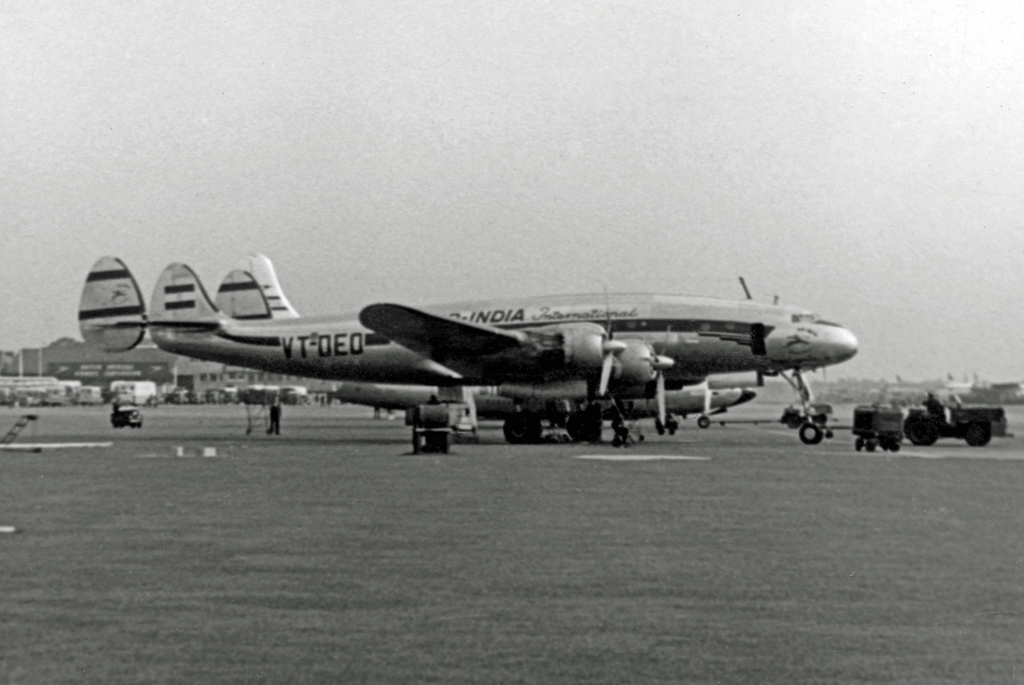
The Kashmir Princess, or Air India Flight 300, was a chartered Lockheed L-749A Constellation Air India flight. On 11 April 1955, it was damaged in midair by a bomb explosion and crashed into the South China Sea while en route from Bombay, India, and Hong Kong to Jakarta, Indonesia. Sixteen of those on board were killed, while three survived. The explosion was an assassination attempt targeting Chinese Premier Zhou Enlai, who missed the flight either due to a medical emergency or, as one historian concluded, because he had prior knowledge. The Chinese government insisted that Hong Kong authorities investigate; they concluded that the Kuomintang were responsible for the bombing.
Flight 300 departed Hong Kong at 04:25 GMT carrying Chinese and Eastern European delegates, mainly journalists, to the Afro-Asian Bandung Conference in Jakarta. At approximately 09:25 GMT the crew heard an explosion; smoke quickly entered the cabin from a fire on the right wing directly behind the No. 3 (or right inboard) engine. Upon hearing the explosion and seeing the fire-warning light for the baggage compartment come on, the captain shut off the No. 3 engine and feathered its propeller, fearing the engine would catch fire. This left three engines running. The crew sent out three distress signals giving their position over the Natuna Islands before the radio went dead.
The captain tried to land the plane on the sea, but the depressurising cabin and the failing circuits made that impossible. Additionally, smoke was seeping into the cockpit. Left with no other option, the crew issued life jackets and opened the emergency doors to ensure a quick escape as the plane plunged into the sea below.
The starboard wing struck water first, tearing the plane into three parts. The aircraft maintenance engineer (ground engineer), navigator and first officer escaped and were later found by the Indonesian Coast Guard. The remaining 16 passengers and crew members, however, drowned at sea.
Investigators believed that the explosion had been caused by a time bomb placed aboard the aircraft by a Kuomintang secret agent who was attempting to assassinate Chinese Premier Zhou Enlai, who had been scheduled to board the plane to attend the conference but had changed his travel plans at the last minute.
The target of the assassination attempt, Zhou Enlai, had planned to fly from Beijing to Hong Kong and then on to Jakarta on Kashmir Princess. An emergency appendectomy delayed his arrival in Hong Kong; he left China three days after the crash and flew to Rangoon to meet with Indian Prime Minister Jawaharlal Nehru and Burmese Prime Minister U Nu before continuing on to Bandung to attend the conference.
Some historians have argued that Zhou may have known about the assassination plot beforehand and that the premier did not undergo an appendectomy at the time. Steve Tsang of Oxford University wrote in the September 1994 edition of The China Quarterly, "Evidence now suggests that Zhou knew of the plot beforehand and secretly changed his travel plans, though he did not stop a decoy delegation of lesser cadres from taking his place."
The day after the crash, China's Foreign Ministry issued a statement that described the bombing as "a murder by the special service organizations of the United States and Chiang Kai-shek", while Hong Kong Governor Sir Alexander Grantham maintained that the plane was not tampered with in Hong Kong. However, on 26 May, an Indonesian board of inquiry later announced that a time bomb with an American-made MK-7 detonator was responsible for the crash, and it was highly probable that the bomb was placed on the plane in Hong Kong.[citation needed]
Hub AI
Kashmir Princess AI simulator
(@Kashmir Princess_simulator)
Kashmir Princess
The Kashmir Princess, or Air India Flight 300, was a chartered Lockheed L-749A Constellation Air India flight. On 11 April 1955, it was damaged in midair by a bomb explosion and crashed into the South China Sea while en route from Bombay, India, and Hong Kong to Jakarta, Indonesia. Sixteen of those on board were killed, while three survived. The explosion was an assassination attempt targeting Chinese Premier Zhou Enlai, who missed the flight either due to a medical emergency or, as one historian concluded, because he had prior knowledge. The Chinese government insisted that Hong Kong authorities investigate; they concluded that the Kuomintang were responsible for the bombing.
Flight 300 departed Hong Kong at 04:25 GMT carrying Chinese and Eastern European delegates, mainly journalists, to the Afro-Asian Bandung Conference in Jakarta. At approximately 09:25 GMT the crew heard an explosion; smoke quickly entered the cabin from a fire on the right wing directly behind the No. 3 (or right inboard) engine. Upon hearing the explosion and seeing the fire-warning light for the baggage compartment come on, the captain shut off the No. 3 engine and feathered its propeller, fearing the engine would catch fire. This left three engines running. The crew sent out three distress signals giving their position over the Natuna Islands before the radio went dead.
The captain tried to land the plane on the sea, but the depressurising cabin and the failing circuits made that impossible. Additionally, smoke was seeping into the cockpit. Left with no other option, the crew issued life jackets and opened the emergency doors to ensure a quick escape as the plane plunged into the sea below.
The starboard wing struck water first, tearing the plane into three parts. The aircraft maintenance engineer (ground engineer), navigator and first officer escaped and were later found by the Indonesian Coast Guard. The remaining 16 passengers and crew members, however, drowned at sea.
Investigators believed that the explosion had been caused by a time bomb placed aboard the aircraft by a Kuomintang secret agent who was attempting to assassinate Chinese Premier Zhou Enlai, who had been scheduled to board the plane to attend the conference but had changed his travel plans at the last minute.
The target of the assassination attempt, Zhou Enlai, had planned to fly from Beijing to Hong Kong and then on to Jakarta on Kashmir Princess. An emergency appendectomy delayed his arrival in Hong Kong; he left China three days after the crash and flew to Rangoon to meet with Indian Prime Minister Jawaharlal Nehru and Burmese Prime Minister U Nu before continuing on to Bandung to attend the conference.
Some historians have argued that Zhou may have known about the assassination plot beforehand and that the premier did not undergo an appendectomy at the time. Steve Tsang of Oxford University wrote in the September 1994 edition of The China Quarterly, "Evidence now suggests that Zhou knew of the plot beforehand and secretly changed his travel plans, though he did not stop a decoy delegation of lesser cadres from taking his place."
The day after the crash, China's Foreign Ministry issued a statement that described the bombing as "a murder by the special service organizations of the United States and Chiang Kai-shek", while Hong Kong Governor Sir Alexander Grantham maintained that the plane was not tampered with in Hong Kong. However, on 26 May, an Indonesian board of inquiry later announced that a time bomb with an American-made MK-7 detonator was responsible for the crash, and it was highly probable that the bomb was placed on the plane in Hong Kong.[citation needed]
Recent media