
Recent from talks
Kazakh language
Knowledge base stats:
Talk channels stats:
Members stats:
Kazakh language
Kazakh is a Turkic language of the Kipchak branch spoken in Central Asia by the Kazakhs. It is closely related to Nogai, Kyrgyz and Karakalpak. It is the official language of Kazakhstan, and has official status in the Altai Republic of Russia. It is also a minority language in the Ili Kazakh Autonomous Prefecture in Xinjiang, China, and in the Bayan-Ölgii Province of western Mongolia. The language is also spoken by many ethnic Kazakhs throughout the former Soviet Union (some 472,000 in Russia according to the 2010 Russian census), Germany, and Turkey.
Like other Turkic languages, Kazakh is an agglutinative language and employs vowel harmony. Kazakh builds words by adding suffixes one after another to the word stem, with each suffix expressing only one unique meaning and following a fixed sequence. Ethnologue recognizes three mutually intelligible dialect groups: Northeastern Kazakh—the most widely spoken variety, which also serves as the basis for the official language—Southern Kazakh, and Western Kazakh. The language shares a degree of mutual intelligibility with the closely related Karakalpak language while its Western dialects maintain limited mutual intelligibility with the Altai languages.
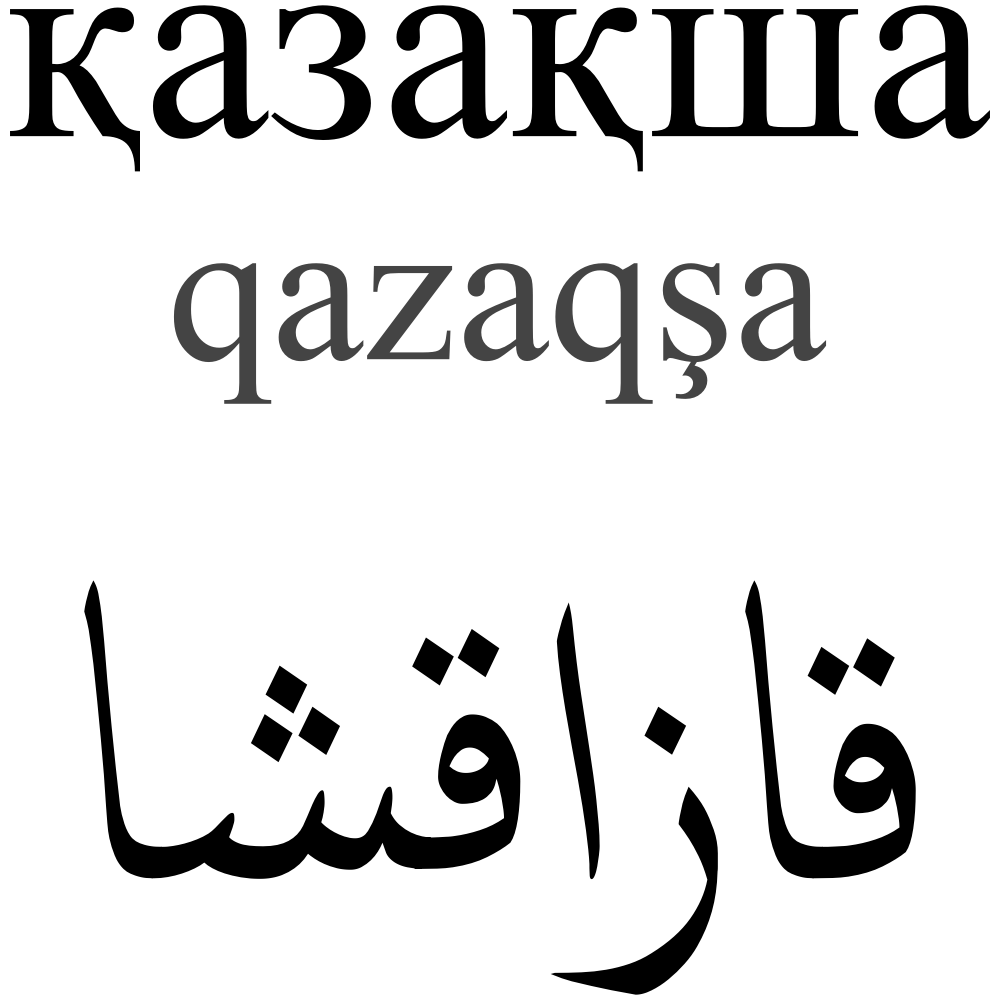
In October 2017, Kazakh president Nursultan Nazarbayev decreed that the writing system would change from using Cyrillic to Latin script by 2025. The proposed Latin alphabet has been revised several times and as of January 2021 is close to the inventory of the Turkish alphabet, though lacking the letters C and Ç and having four additional letters: Ä, Ñ, Q and Ū (though other letters such as Y have different values in the two languages). It is scheduled to be phased in from 2023 to 2031. Over one million Kazakh speakers in Xinjiang use a modified version of the Perso-Arabic script for writing.
Speakers of Kazakh (mainly Kazakhs) are spread over a vast territory from the Tian Shan to the western shore of the Caspian Sea. Kazakh is the official state language of Kazakhstan, with nearly 10 million speakers (based on information from the CIA World Factbook on population and proportion of Kazakh speakers).
In China, nearly two million ethnic Kazakhs and Kazakh speakers reside in the Ili Kazakh Autonomous Prefecture of Xinjiang.
The Kipchak branch of Turkic languages, which Kazakh is borne out of, was mainly solidified during the reign of the Golden Horde. The modern Kazakh language is said to have originated in approximately 1465 AD during the formation of the Kazakh Khanate. Modern Kazakh is likely a descendant of both Chagatay Turkic as spoken by the Timurids and Kipchak Turkic as spoken in the Golden Horde.
Kazakh uses a high volume of loanwords from Persian and Arabic due to the frequent historical interactions between Kazakhs and Iranian ethnic groups to the south. Additionally, Persian was a lingua franca in the Kazakh Khanate, which allowed Kazakhs to mix Persian words into their own spoken and written vernacular. Meanwhile, Arabic was used by Kazakhs in mosques and mausoleums, serving as a language exclusively for religious contexts, similar to how Latin served as a liturgical language in the Western European cultural sphere.
The Kazakhs used the Arabic script to write their language until approximately 1929. In the early 1900s, Kazakh activist Akhmet Baitursynuly reformed the Kazakh-Arabic alphabet, but his work was largely overshadowed by the Soviet presence in Central Asia. At that point, the new Soviet regime forced the Kazakhs to use a Latin script, and then a Cyrillic script in the 1940s. Today, Kazakhs use the Cyrillic and Latin scripts to write their language, although a presidential decree from 2017 ordered the transition from Cyrillic to Latin by 2031.
Hub AI
Kazakh language AI simulator
(@Kazakh language_simulator)
Kazakh language
Kazakh is a Turkic language of the Kipchak branch spoken in Central Asia by the Kazakhs. It is closely related to Nogai, Kyrgyz and Karakalpak. It is the official language of Kazakhstan, and has official status in the Altai Republic of Russia. It is also a minority language in the Ili Kazakh Autonomous Prefecture in Xinjiang, China, and in the Bayan-Ölgii Province of western Mongolia. The language is also spoken by many ethnic Kazakhs throughout the former Soviet Union (some 472,000 in Russia according to the 2010 Russian census), Germany, and Turkey.
Like other Turkic languages, Kazakh is an agglutinative language and employs vowel harmony. Kazakh builds words by adding suffixes one after another to the word stem, with each suffix expressing only one unique meaning and following a fixed sequence. Ethnologue recognizes three mutually intelligible dialect groups: Northeastern Kazakh—the most widely spoken variety, which also serves as the basis for the official language—Southern Kazakh, and Western Kazakh. The language shares a degree of mutual intelligibility with the closely related Karakalpak language while its Western dialects maintain limited mutual intelligibility with the Altai languages.
In October 2017, Kazakh president Nursultan Nazarbayev decreed that the writing system would change from using Cyrillic to Latin script by 2025. The proposed Latin alphabet has been revised several times and as of January 2021 is close to the inventory of the Turkish alphabet, though lacking the letters C and Ç and having four additional letters: Ä, Ñ, Q and Ū (though other letters such as Y have different values in the two languages). It is scheduled to be phased in from 2023 to 2031. Over one million Kazakh speakers in Xinjiang use a modified version of the Perso-Arabic script for writing.
Speakers of Kazakh (mainly Kazakhs) are spread over a vast territory from the Tian Shan to the western shore of the Caspian Sea. Kazakh is the official state language of Kazakhstan, with nearly 10 million speakers (based on information from the CIA World Factbook on population and proportion of Kazakh speakers).
In China, nearly two million ethnic Kazakhs and Kazakh speakers reside in the Ili Kazakh Autonomous Prefecture of Xinjiang.
The Kipchak branch of Turkic languages, which Kazakh is borne out of, was mainly solidified during the reign of the Golden Horde. The modern Kazakh language is said to have originated in approximately 1465 AD during the formation of the Kazakh Khanate. Modern Kazakh is likely a descendant of both Chagatay Turkic as spoken by the Timurids and Kipchak Turkic as spoken in the Golden Horde.
Kazakh uses a high volume of loanwords from Persian and Arabic due to the frequent historical interactions between Kazakhs and Iranian ethnic groups to the south. Additionally, Persian was a lingua franca in the Kazakh Khanate, which allowed Kazakhs to mix Persian words into their own spoken and written vernacular. Meanwhile, Arabic was used by Kazakhs in mosques and mausoleums, serving as a language exclusively for religious contexts, similar to how Latin served as a liturgical language in the Western European cultural sphere.
The Kazakhs used the Arabic script to write their language until approximately 1929. In the early 1900s, Kazakh activist Akhmet Baitursynuly reformed the Kazakh-Arabic alphabet, but his work was largely overshadowed by the Soviet presence in Central Asia. At that point, the new Soviet regime forced the Kazakhs to use a Latin script, and then a Cyrillic script in the 1940s. Today, Kazakhs use the Cyrillic and Latin scripts to write their language, although a presidential decree from 2017 ordered the transition from Cyrillic to Latin by 2031.
Recent media