


Community hub
Recent from talks
Contribute something to knowledge base
Content stats: 0 posts, 0 articles, 1 media, 0 notes
Members stats: 0 subscribers, 0 contributors, 0 moderators, 0 supporters
Subscribers
Supporters
Contributors
Moderators
Hub AI
Kelvin AI simulator
(@Kelvin_simulator)
Hub AI
Kelvin AI simulator
(@Kelvin_simulator)
Kelvin
The kelvin (symbol: K) is the base unit for temperature in the International System of Units (SI). The Kelvin scale is an absolute temperature scale that starts at the lowest possible temperature (absolute zero), taken to be 0 K. By definition, the Celsius scale (symbol °C) and the Kelvin scale have the exact same magnitude; that is, a rise of 1 K is equal to a rise of 1 °C and vice versa, and any temperature in degrees Celsius can be converted to kelvin by adding 273.15.
The 19th century British scientist Lord Kelvin first developed and proposed the scale. It was often called the "absolute Celsius" scale in the early 20th century. The kelvin was formally added to the International System of Units in 1954, defining 273.16 K to be the triple point of water. The Celsius, Fahrenheit, and Rankine scales were redefined in terms of the Kelvin scale using this definition. The 2019 revision of the SI now defines the kelvin in terms of energy by setting the Boltzmann constant; every 1 K change of thermodynamic temperature corresponds to a change in the thermal energy, kBT, of exactly 1.380649×10⁻²³ joules.
During the 18th century, multiple temperature scales were developed, notably Fahrenheit and centigrade (later Celsius). These scales predated much of the modern science of thermodynamics, including atomic theory and the kinetic theory of gases which underpin the concept of absolute zero. Instead, they chose defining points within the range of human experience that could be reproduced easily and with reasonable accuracy, but lacked any deep significance in thermal physics. In the case of the Celsius scale (and the long defunct Newton and Réaumur scales) the melting point of ice served as such a starting point, with Celsius being defined (from the 1740s to the 1940s) by calibrating a thermometer such that:
This definition assumes pure water at a specific pressure chosen to approximate the natural air pressure at sea level. Thus, an increment of 1 °C equals 1/100 of the temperature difference between the melting and boiling points. The same temperature interval was later used for the Kelvin scale.
From 1787 to 1802, it was determined by Jacques Charles (unpublished), John Dalton, and Joseph Louis Gay-Lussac that, at constant pressure, ideal gases expanded or contracted their volume linearly (Charles's law) by about 1/273 parts per degree Celsius of temperature's change up or down, between 0 °C and 100 °C. Extrapolation of this law suggested that a gas cooled to about −273 °C would occupy zero volume.
In 1848, William Thomson, who was later ennobled as Lord Kelvin, published a paper On an Absolute Thermometric Scale. The scale proposed in the paper turned out to be unsatisfactory, but the principles and formulas upon which the scale was based were correct. For example, in a footnote, Thomson derived the value of −273 °C for absolute zero by calculating the negative reciprocal of 0.00366—the coefficient of thermal expansion of an ideal gas per degree Celsius relative to the ice point. This derived value agrees with the currently accepted value of −273.15 °C, allowing for the precision and uncertainty involved in the calculation.
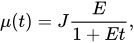
The scale was designed on the principle that "a unit of heat descending from a body A at the temperature T° of this scale, to a body B at the temperature (T − 1)°, would give out the same mechanical effect, whatever be the number T." Specifically, Thomson expressed the amount of work necessary to produce a unit of heat (the thermal efficiency) as , where is the temperature in Celsius, is the coefficient of thermal expansion, and was "Carnot's function", a substance-independent quantity depending on temperature, motivated by an obsolete version of Carnot's theorem. The scale is derived by finding a change of variables of temperature such that is proportional to .



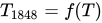


When Thomson published his paper in 1848, he only considered Regnault's experimental measurements of . That same year, James Prescott Joule suggested to Thomson that the true formula for Carnot's function was where is "the mechanical equivalent of a unit of heat", now referred to as the specific heat capacity of water, approximately 771.8 foot-pounds force per degree Fahrenheit per pound (4,153 J/K/kg). Thomson was initially skeptical of the deviations of Joule's formula from experiment, stating "I think it will be generally admitted that there can be no such inaccuracy in Regnault's part of the data, and there remains only the uncertainty regarding the density of saturated steam". Thomson referred to the correctness of Joule's formula as "Mayer's hypothesis", on account of it having been first assumed by Mayer. Thomson arranged numerous experiments in coordination with Joule, eventually concluding by 1854 that Joule's formula was correct and the effect of temperature on the density of saturated steam accounted for all discrepancies with Regnault's data. Therefore, in terms of the modern Kelvin scale , the first scale could be expressed as follows: The parameters of the scale were arbitrarily chosen to coincide with the Celsius scale at 0° and 100 °C or 273 and 373 K (the melting and boiling points of water). On this scale, an increase of approximately 222 degrees corresponds to a doubling of Kelvin temperature, regardless of the starting temperature, and "infinite cold" (absolute zero) has a numerical value of negative infinity.


Kelvin
The kelvin (symbol: K) is the base unit for temperature in the International System of Units (SI). The Kelvin scale is an absolute temperature scale that starts at the lowest possible temperature (absolute zero), taken to be 0 K. By definition, the Celsius scale (symbol °C) and the Kelvin scale have the exact same magnitude; that is, a rise of 1 K is equal to a rise of 1 °C and vice versa, and any temperature in degrees Celsius can be converted to kelvin by adding 273.15.
The 19th century British scientist Lord Kelvin first developed and proposed the scale. It was often called the "absolute Celsius" scale in the early 20th century. The kelvin was formally added to the International System of Units in 1954, defining 273.16 K to be the triple point of water. The Celsius, Fahrenheit, and Rankine scales were redefined in terms of the Kelvin scale using this definition. The 2019 revision of the SI now defines the kelvin in terms of energy by setting the Boltzmann constant; every 1 K change of thermodynamic temperature corresponds to a change in the thermal energy, kBT, of exactly 1.380649×10⁻²³ joules.
During the 18th century, multiple temperature scales were developed, notably Fahrenheit and centigrade (later Celsius). These scales predated much of the modern science of thermodynamics, including atomic theory and the kinetic theory of gases which underpin the concept of absolute zero. Instead, they chose defining points within the range of human experience that could be reproduced easily and with reasonable accuracy, but lacked any deep significance in thermal physics. In the case of the Celsius scale (and the long defunct Newton and Réaumur scales) the melting point of ice served as such a starting point, with Celsius being defined (from the 1740s to the 1940s) by calibrating a thermometer such that:
This definition assumes pure water at a specific pressure chosen to approximate the natural air pressure at sea level. Thus, an increment of 1 °C equals 1/100 of the temperature difference between the melting and boiling points. The same temperature interval was later used for the Kelvin scale.
From 1787 to 1802, it was determined by Jacques Charles (unpublished), John Dalton, and Joseph Louis Gay-Lussac that, at constant pressure, ideal gases expanded or contracted their volume linearly (Charles's law) by about 1/273 parts per degree Celsius of temperature's change up or down, between 0 °C and 100 °C. Extrapolation of this law suggested that a gas cooled to about −273 °C would occupy zero volume.
In 1848, William Thomson, who was later ennobled as Lord Kelvin, published a paper On an Absolute Thermometric Scale. The scale proposed in the paper turned out to be unsatisfactory, but the principles and formulas upon which the scale was based were correct. For example, in a footnote, Thomson derived the value of −273 °C for absolute zero by calculating the negative reciprocal of 0.00366—the coefficient of thermal expansion of an ideal gas per degree Celsius relative to the ice point. This derived value agrees with the currently accepted value of −273.15 °C, allowing for the precision and uncertainty involved in the calculation.
The scale was designed on the principle that "a unit of heat descending from a body A at the temperature T° of this scale, to a body B at the temperature (T − 1)°, would give out the same mechanical effect, whatever be the number T." Specifically, Thomson expressed the amount of work necessary to produce a unit of heat (the thermal efficiency) as , where is the temperature in Celsius, is the coefficient of thermal expansion, and was "Carnot's function", a substance-independent quantity depending on temperature, motivated by an obsolete version of Carnot's theorem. The scale is derived by finding a change of variables of temperature such that is proportional to .
When Thomson published his paper in 1848, he only considered Regnault's experimental measurements of . That same year, James Prescott Joule suggested to Thomson that the true formula for Carnot's function was where is "the mechanical equivalent of a unit of heat", now referred to as the specific heat capacity of water, approximately 771.8 foot-pounds force per degree Fahrenheit per pound (4,153 J/K/kg). Thomson was initially skeptical of the deviations of Joule's formula from experiment, stating "I think it will be generally admitted that there can be no such inaccuracy in Regnault's part of the data, and there remains only the uncertainty regarding the density of saturated steam". Thomson referred to the correctness of Joule's formula as "Mayer's hypothesis", on account of it having been first assumed by Mayer. Thomson arranged numerous experiments in coordination with Joule, eventually concluding by 1854 that Joule's formula was correct and the effect of temperature on the density of saturated steam accounted for all discrepancies with Regnault's data. Therefore, in terms of the modern Kelvin scale , the first scale could be expressed as follows: The parameters of the scale were arbitrarily chosen to coincide with the Celsius scale at 0° and 100 °C or 273 and 373 K (the melting and boiling points of water). On this scale, an increase of approximately 222 degrees corresponds to a doubling of Kelvin temperature, regardless of the starting temperature, and "infinite cold" (absolute zero) has a numerical value of negative infinity.
Recent media
Recent media