



Community hub
Recent from talks
Contribute something
Nothing was collected or created yet.
Scale of temperature
View on Wikipedia

Scale of temperature is a methodology of calibrating the physical quantity temperature in metrology. Empirical scales measure temperature in relation to convenient and stable parameters or reference points, such as the freezing and boiling point of water. Absolute temperature is based on thermodynamic principles: using the lowest possible temperature as the zero point, and selecting a convenient incremental unit.
Celsius, Kelvin, and Fahrenheit are common temperature scales. Other scales used throughout history include Rankine, Rømer, Newton, Delisle, Réaumur, Gas mark, Leiden, and Wedgwood.
Technical definition
[edit]The zeroth law of thermodynamics describes thermal equilibrium between thermodynamic systems in form of an equivalence relation. Accordingly, the set of all thermal systems may be divided into a quotient set of equivalence classes, denoted as , where any element of collects all systems that are in thermal equilibrium with one another.

If the set has cardinality at most (the cardinality of the continuum), then one can construct an injective function into the real numbers by which every thermal system has a parameter – a specific real number – associated with it: the property of temperature. By definition, when two systems are in thermal equilibrium, they belong to the same equivalence class, hence to the same element of , and are assigned the same temperature. Conversely, two systems not in thermal equilibrium belong to different equivalence classes, and since is injective, they are assigned different temperatures.


Temperature depends on the specific choice of , and any suitable – any specific way of assigning numerical values for temperature – establishes a scale of temperature.[1][2][3] In practical terms, a temperature scale is always based on usually a single physical property of a simple thermodynamic system, called a thermometer, that defines a scaling function for mapping the temperature to the measurable thermometric parameter. Such temperature scales that are purely based on measurement are called empirical temperature scales.
The second law of thermodynamics provides a fundamental, natural definition of thermodynamic temperature starting with a null point of absolute zero. A scale for thermodynamic temperature is established similarly to the empirical temperature scales, however, needing only one additional fixing point.
Empirical scales
[edit]Empirical scales are based on the measurement of physical parameters that express the property of interest to be measured through some formal, most commonly a simple linear, functional relationship. For the measurement of temperature, the formal definition of thermal equilibrium in terms of the thermodynamic coordinate spaces of thermodynamic systems, expressed in the zeroth law of thermodynamics, provides the framework to measure temperature.
All temperature scales, including the modern thermodynamic temperature scale used in the International System of Units, are calibrated according to thermal properties of a particular substance or device. Typically, this is established by fixing two well-defined temperature points and defining temperature increments via a linear function of the response of the thermometric device. For example, both the old Celsius scale and Fahrenheit scale were originally based on the linear expansion of a narrow mercury column within a limited range of temperature,[4] each using different reference points and scale increments.
Different empirical scales may not be compatible with each other, except for small regions of temperature overlap. If an alcohol thermometer and a mercury thermometer have the same two fixed points, namely the freezing and boiling point of water, their readings will not agree with each other except at the fixed points, as the linear 1:1 relationship of expansion between any two thermometric substances may not be guaranteed.
Empirical temperature scales are not reflective of the fundamental, microscopic laws of matter. Temperature is a universal attribute of matter, yet empirical scales map a narrow range onto a scale that is known to have a useful functional form for a particular application. Thus, their range is limited. The working material only exists in a form under certain circumstances, beyond which it no longer can serve as a scale. For example, mercury freezes below 234.32 K, so temperatures lower than that cannot be measured in a scale based on mercury. Even ITS-90, which interpolates among different ranges of temperature, has a range of only 0.65 K to approximately 1358 K (−272.5 °C to 1085 °C).
Ideal gas scale
[edit]When pressure approaches zero, all real gas will behave like ideal gas, that is, pV of a mole of gas relying only on temperature. Therefore, we can design a scale with pV as its argument. Of course any bijective function will do, but for convenience's sake a linear function is the best. Therefore, we define it as[5]
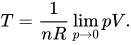
The ideal gas scale is in some sense a "mixed" scale. It relies on the universal properties of gas, a big advance from just a particular substance. But still it is empirical since it puts gas at a special position and thus has limited applicability—at some point no gas can exist. One distinguishing characteristic of ideal gas scale, however, is that it precisely equals thermodynamical scale when it is well defined (see § Equality to ideal gas scale).
International temperature scale of 1990
[edit]ITS-90 is designed to represent the thermodynamic temperature scale (referencing absolute zero) as closely as possible throughout its range. Many different thermometer designs are required to cover the entire range. These include helium vapor pressure thermometers, helium gas thermometers, standard platinum resistance thermometers (known as SPRTs, PRTs or Platinum RTDs) and monochromatic radiation thermometers.
Although the Kelvin and Celsius scales are defined using absolute zero (0 K) and the triple point of water (273.16 K and 0.01 °C), it is impractical to use this definition at temperatures that are very different from the triple point of water. Accordingly, ITS–90 uses numerous defined points, all of which are based on various thermodynamic equilibrium states of fourteen pure chemical elements and one compound (water). Most of the defined points are based on a phase transition; specifically the melting/freezing point of a pure chemical element. However, the deepest cryogenic points are based exclusively on the vapor pressure/temperature relationship of helium and its isotopes whereas the remainder of its cold points (those less than room temperature) are based on triple points. Examples of other defining points are the triple point of hydrogen (−259.3467 °C) and the freezing point of aluminum (660.323 °C).
Thermometers calibrated per ITS–90 use complex mathematical formulas to interpolate between its defined points. ITS–90 specifies rigorous control over variables to ensure reproducibility from lab to lab. For instance, the small effect that atmospheric pressure has upon the various melting points is compensated for (an effect that typically amounts to no more than half a millikelvin across the different altitudes and barometric pressures likely to be encountered). The standard even compensates for the pressure effect due to how deeply the temperature probe is immersed into the sample. ITS–90 also draws a distinction between "freezing" and "melting" points. The distinction depends on whether heat is going into (melting) or out of (freezing) the sample when the measurement is made. Only gallium is measured while melting, all the other metals are measured while the samples are freezing.
There are often small differences between measurements calibrated per ITS–90 and thermodynamic temperature. For instance, precise measurements show that the boiling point of VSMOW water under one standard atmosphere of pressure is actually 373.1339 K (99.9839 °C) when adhering strictly to the two-point definition of thermodynamic temperature. When calibrated to ITS–90, where one must interpolate between the defining points of gallium and indium, the boiling point of VSMOW water is about 10 mK less, about 99.974 °C. The virtue of ITS–90 is that another lab in another part of the world will measure the very same temperature with ease due to the advantages of a comprehensive international calibration standard featuring many conveniently spaced, reproducible, defining points spanning a wide range of temperatures.
OV
[edit]OV is a specialized scale used in Japan to measure female basal body temperature for fertility awareness. The range of 35.5 °C (OV 0) to 38.0 °C (OV 50) is divided into 50 equal parts.[6]
Celsius scale
[edit]Celsius (known until 1948 as centigrade) is a temperature scale that is named after the Swedish astronomer Anders Celsius (1701–1744), who developed a similar temperature scale two years before his death. The degree Celsius (°C) can refer to a specific temperature on the Celsius scale as well as a unit to indicate a temperature interval (a difference between two temperatures).
From 1744 until 1954, 0 °C was defined as the freezing point of water and 100 °C was defined as the boiling point of water, both at a pressure of one standard atmosphere.[citation needed]
Although these defining correlations are commonly taught in schools today, by international agreement, between 1954 and 2019 the unit degree Celsius and the Celsius scale were defined by absolute zero and the triple point of VSMOW (specially prepared water). This definition also precisely related the Celsius scale to the Kelvin scale, which defines the SI base unit of thermodynamic temperature with symbol K. Absolute zero, the lowest temperature possible, is defined as being exactly 0 K and −273.15 °C. Until 19 May 2019, the temperature of the triple point of water was defined as exactly 273.16 K (0.01 °C). This means that a temperature difference of one degree Celsius and that of one kelvin are exactly the same.
On 20 May 2019, the kelvin was redefined so that its value is now determined by the definition of the Boltzmann constant rather than being defined by the triple point of VSMOW. This means that the triple point is now a measured value, not a defined value. The newly defined exact value of the Boltzmann constant was selected so that the measured value of the VSMOW triple point is exactly the same as the older defined value to within the limits of accuracy of contemporary metrology. The degree Celsius remains exactly equal to the kelvin, and 0 K remains exactly −273.15 °C.
Thermodynamic scale
[edit]Thermodynamic scale differs from empirical scales in that it is absolute. It is based on the fundamental laws of thermodynamics or statistical mechanics instead of some arbitrary chosen working material. Besides it covers full range of temperature and has simple relation with microscopic quantities like the average kinetic energy of particles (see equipartition theorem). In experiments ITS-90 is used to approximate thermodynamic scale due to simpler realization.
Definition
[edit]Lord Kelvin devised the thermodynamic scale based on the efficiency of heat engines as shown below:
The efficiency of an engine is the work divided by the heat introduced to the system or

where wcy is the work done per cycle. Thus, the efficiency depends only on qC/qH.
Because of Carnot theorem, any reversible heat engine operating between temperatures T1 and T2 must have the same efficiency, meaning, the efficiency is the function of the temperatures only:
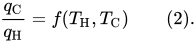
In addition, a reversible heat engine operating between temperatures T1 and T3 must have the same efficiency as one consisting of two cycles, one between T1 and another (intermediate) temperature T2, and the second between T2 and T3. This can only be the case if

Specializing to the case that is a fixed reference temperature: the temperature of the triple point of water. Then for any T2 and T3,


Therefore, if thermodynamic temperature is defined by

then the function f, viewed as a function of thermodynamic temperature, is
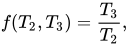
and the reference temperature T1 has the value 273.16. (Of course any reference temperature and any positive numerical value could be used—the choice here corresponds to the Kelvin scale.)
Equality to ideal gas scale
[edit]It follows immediately that

Substituting Equation 3 back into Equation 1 gives a relationship for the efficiency in terms of temperature:

This is identical to the efficiency formula for Carnot cycle, which effectively employs the ideal gas scale. This means that the two scales equal numerically at every point.
Conversion table between different temperature scales
[edit]




See also
[edit]Notes and references
[edit]- ^ H A Buchdahl (1966). "2.Zeroth law". The concepts of classical thermodynamics. Cambridge U.P.1966. ISBN 978-0-521-04359-5.
- ^ Giuseppe Morandi; F Napoli; E Ercolessi (2001). Statistical mechanics: an intermediate course. Singapore; River Edge, N.J. : World Scientific, 2001. pp. 6~7. ISBN 978-981-02-4477-4.
- ^ Walter Greiner; Ludwig Neise; Horst Stöcker. Thermodynamics and statistical mechanics. New York [u.a.] : Springer, 2004. pp. 6~7.
- ^ Carl S. Helrich (2009). Modern Thermodynamics with Statistical Mechanics. Berlin, Heidelberg: Springer Berlin Heidelberg. ISBN 978-3-540-85417-3.
- ^ "Thermometers and the Ideal Gas Temperature Scale".
- ^ Masaru Harada. "基礎体温表|おしえて生理痛". seiritsu.jp (in Japanese). Retrieved 10 July 2024.
婦人体温計は、わずかな体温の変化を読み取れるように、「OV値」を使っています。 これは35.5~38.0℃を50等分した値です。
[Women's thermometers use the "OV value" so that slight changes in body temperature can be read. This is a value that divides the range of 35.5 to 38.0°C into 50 equal parts.]

Scale of temperature
View on GrokipediaBasic Principles
Technical Definition
Temperature in physics is fundamentally a measure of the average energy associated with the random motion of particles in a system, encompassing translational, rotational, vibrational, and other degrees of freedom. This concept arises from the kinetic theory of gases and statistical mechanics, where the thermodynamic temperature is proportional to the average energy per degree of freedom, given by for each quadratic term in the energy (with as the Boltzmann constant).[5]/12%3A_Temperature_and_Kinetic_Theory/12.02%3A_Temperature_and_Temperature_Scales) A temperature scale is a standardized system for assigning ordered numerical values to the thermal equilibrium states of systems, enabling quantitative comparisons of hotness or coldness. These scales are calibrated using reproducible fixed points, such as the triple point of water or phase transitions of pure substances, to define intervals between reference temperatures. The scale provides a way to interpolate and extrapolate temperature measurements beyond the fixed points, ensuring consistency in scientific and practical applications./Book%3A_University_Physics_II_-Thermodynamics_Electricity_and_Magnetism(OpenStax)/01%3A_Temperature_and_Heat/1.02%3A_Thermometers_and_Temperature_Scales)[4] Temperature scales can be classified as interval scales or ratio scales based on their measurement properties. Interval scales, such as the Celsius scale, have equal intervals between values but lack a true absolute zero, meaning ratios of temperatures (e.g., one temperature being "twice as hot" as another) are not physically meaningful. Ratio scales, like the Kelvin scale, include an absolute zero— the lowest possible temperature where thermal motion ceases—allowing meaningful ratios and multiples. This distinction is crucial in thermodynamics, where absolute scales align with the second law and entropy calculations./01%3A_Introduction_to_Statistics/1.02%3A_Levels_of_Measurement)[5] The development of standardized temperature scales emerged in the 18th and 19th centuries to address inconsistencies in early thermometry for advancing thermodynamics and meteorology. Prior to standardization, various arbitrary scales led to errors in scientific experiments and weather observations; for instance, the need for precise calibration became evident during the formulation of the ideal gas law and steam engine efficiency studies in the Industrial Revolution. International agreements, such as those by the International Committee of Weights and Measures, established uniform scales to facilitate global research and engineering.[6][7]Properties of Temperature Scales
A temperature scale must exhibit monotonicity, ensuring that higher numerical values correspond to hotter states of a system, thereby preserving the order of thermal intensities observed in nature. This property arises from the fundamental ordering of hotness, where any empirical scale is defined as a monotonic function that maps the sequence of increasingly hot bodies to increasing numerical values. For instance, in constructing such a scale, a thermometric property (like the volume of a liquid) must vary continuously and monotonically with the degree of hotness to allow reliable comparisons.[8] Linearity and additivity are essential for practical utility, requiring that equal intervals on the scale represent equal increments in temperature differences, enabling arithmetic operations such as addition and subtraction of thermal intervals. This interval scale property, first formalized in the 19th century, ensures that the difference between two temperatures is independent of the reference point, allowing consistent measurement of temperature changes across the scale. Additivity specifically means that the temperature difference between points A and C equals the sum of differences from A to B and B to C, which underpins the calibration of instruments using reproducible reference points.[8] Transitivity in temperature comparisons is guaranteed by the zeroth law of thermodynamics, which states that if two systems are each in thermal equilibrium with a third, they are in thermal equilibrium with each other, implying they share the same temperature. This transitive relation allows the definition of a unique temperature for systems in thermal contact, forming the basis for consistent ordering without cycles or inconsistencies in hotness assessments.[8] Temperature is fundamentally an intensive property, independent of the size or amount of the system, unlike extensive properties such as heat or internal energy that scale with mass. This distinguishes temperature as a measure of the average thermal energy per degree of freedom in a system's molecules, ensuring it remains uniform across subsystems in equilibrium regardless of total volume or particle number.[8] Fixed points play a crucial role in defining and calibrating temperature scales by providing reproducible reference states where phase transitions occur at invariant temperatures, such as the triple point of water at 273.16 K, which serves as the anchor for the Kelvin scale. These points, including freezing or boiling transitions of pure substances under standard conditions, allow the subdivision of the scale into equal intervals with high precision, ensuring international consistency in measurements as outlined in standards like the International Temperature Scale of 1990 (ITS-90).[8]Thermodynamic Temperature
Definition
The zeroth law of thermodynamics establishes the concept of thermal equilibrium, stating that if two systems are each in thermal equilibrium with a third system, then they are in thermal equilibrium with each other.[9] This law defines temperature as the property that determines whether systems are in thermal equilibrium, allowing for the consistent measurement of temperature across different systems.[10] The second law of thermodynamics introduces entropy as a state function related to temperature, where for a reversible process, the change in entropy is given by , with as the reversible heat transfer and as the absolute temperature.[11] This relation positions temperature as the reciprocal of the rate at which entropy changes with heat addition in reversible processes, forming the basis for the thermodynamic temperature scale. Thermodynamic temperature is an absolute scale where values are positive, and absolute zero corresponds to the point where the entropy of a perfect crystal in its ground state is zero, implying no further decrease in entropy upon cooling.[12] In 2019, the kelvin—the unit of this scale—was redefined by fixing the Boltzmann constant at J/K, decoupling it from empirical fixed points such as the triple point of water and linking it directly to fundamental physical constants.[13] This redefinition ensures the scale's universality. Thermodynamic temperature is independent of any particular substance or measurement method, relying solely on thermodynamic principles rather than material properties.[14] The kelvin scale serves as its practical realization in scientific and engineering applications.[15]Kelvin Scale
The Kelvin scale serves as the International System of Units (SI) implementation of thermodynamic temperature, with the kelvin (symbol: K) designated as its base unit. Prior to the 2019 SI revision, the kelvin was defined as the temperature interval equal to 1/273.16 of the thermodynamic temperature at the triple point of water (approximately 0.01 °C).[16] Following the redefinition effective May 20, 2019, the kelvin is now defined by fixing the Boltzmann constant to the exact value J/K, thereby defining one kelvin as the temperature change corresponding to a thermal energy increase of by this fixed amount, where is temperature in kelvins.[16] This redefinition ensures the kelvin's stability by tying it to fundamental physical constants rather than a specific material property.[16] Absolute zero is fixed at 0 K on the Kelvin scale, representing the point of minimum thermal energy where molecular motion theoretically ceases, and the scale inherently prohibits negative temperatures.[3] The triple point of water, previously the defining anchor, now measures approximately 273.16 K with a relative standard uncertainty of about 0.4 × 10^{-6}, serving as a practical calibration reference.[16] In scientific contexts, the Kelvin scale underpins key thermodynamic relations, notably the ideal gas law , where pressure , volume , and amount of substance relate through the gas constant J/(mol·K).[17][18] This usage is prevalent in fields like chemistry and physics for calculations involving heat capacities, reaction equilibria, and statistical mechanics, as the absolute nature of the scale aligns with entropy-based formulations.[17] The Kelvin scale contrasts with the Rankine scale, another absolute temperature system used primarily in Anglo-American engineering; while both start at 0 for absolute zero, the Rankine degree equals 5/9 of a kelvin, such that temperatures in Rankine are 9/5 times those in kelvin (e.g., 300 K = 540 °R).[19][20] High-precision calibration of the Kelvin scale, especially at low temperatures, relies on primary thermometry methods like Johnson noise thermometry, which measures the random thermal fluctuations (noise) in a conductor's voltage or current, proportional to temperature via , achieving uncertainties below 1 mK near 1 K and extending to sub-millikelvin regimes.[21][22] This technique supports realizations across the scale without fixed points, complementing practical scales like ITS-90 for everyday metrology.[16] The Kelvin scale relates to the Celsius scale through a simple offset, with 0 °C defined as 273.15 K.[3]Empirical Temperature Scales
Ideal Gas Scale
The ideal gas temperature scale is an empirical scale that approximates thermodynamic temperature by leveraging the behavior of gases assumed to follow the ideal gas law, particularly Charles's law, which posits that for a fixed amount of gas at constant pressure, the volume is directly proportional to the absolute temperature : .[23] This proportionality allows temperature to be defined as , where is the volume at a reference temperature .[24] In practice, the scale is calibrated using fixed points such as the ice point (0 °C) and steam point (100 °C) of water, with the temperature interval between them set to 100 units, and extrapolated linearly to absolute zero at 0 K based on the observed volume contraction.[25] The fundamental equation underlying this scale derives from the ideal gas law, , where is pressure, is volume, is the amount of substance, is the universal gas constant, and is the temperature in kelvins.[23] Rearranging for temperature yields , providing a direct measure of temperature proportional to the product of pressure and volume for a given amount of gas. To ensure the measurement approaches the true thermodynamic temperature and minimizes deviations from ideality, the limit as pressure approaches zero is taken, as low-pressure conditions suppress intermolecular forces, making the gas behave more ideally: , where is the pressure at the triple point of water (273.16 K).[25][24] Despite its foundational role, the ideal gas scale has limitations when applied to real gases, which deviate from ideal behavior at high pressures or low temperatures due to finite molecular volume and intermolecular attractions. These deviations are accounted for using corrections like the van der Waals equation, , where and are empirical constants representing attractive forces and molecular volume, respectively, highlighting the need for low-density conditions to maintain accuracy.[26] The International Temperature Scale of 1990 (ITS-90) refines this approach with practical interpolation methods beyond pure gas thermometry.[23]International Temperature Scale of 1990
The International Temperature Scale of 1990 (ITS-90) serves as the prevailing international metrological standard for realizing and disseminating temperature measurements in practical applications, closely approximating the thermodynamic temperature scale across the range from 0.65 K to 1357.77 K.[27] Adopted by the International Committee for Weights and Measures (CIPM) in 1989 and implemented effective January 1, 1990, it supersedes the International Practical Temperature Scale of 1968 (IPTS-68) and the Extension of the International Practical Temperature Scale to 1976 (EPT-76/90), enhancing precision, continuity, and reproducibility in temperature calibration.[27] The scale defines International Kelvin Temperatures (T90) and International Celsius Temperatures (t90) using a set of 17 defining fixed points and specified interpolation methods, ensuring high fidelity to absolute thermodynamic values while enabling routine laboratory realizations.[28] ITS-90 establishes its reference framework through 17 carefully selected fixed points, primarily phase transitions that provide stable, reproducible temperature anchors. These include a vapor-pressure formulation for helium isotopes in the range 0.65 K to 5 K (calibrated at higher points), vapor-pressure points of equilibrium hydrogen at approximately 17.035 K and 20.27 K, the triple points of equilibrium hydrogen (13.8033 K), neon (24.5561 K), oxygen (54.3584 K), argon (83.8058 K), mercury (234.3156 K), and water (273.16 K), the melting point of gallium (302.9146 K), and the freezing points of metals such as indium (429.7485 K), tin (505.078 K), zinc (692.677 K), aluminum (933.473 K), silver (1234.93 K), gold (1337.33 K), and copper (1357.77 K).[27] These points are realized using sealed cells containing high-purity substances under controlled conditions, with assigned numerical values that deviate minimally from thermodynamic temperatures—typically by less than 1 mK for most points.[28] Between these fixed points, ITS-90 employs range-specific interpolation procedures to derive temperatures with optimal accuracy and practicality. In the cryogenic range below 5 K, temperatures are interpolated using vapor-pressure equations for helium isotopes, calibrated against the helium-3 triple point and other low-temperature fixed points.[27] From 13.8033 K to 1234.93 K, capsule-standard or long-stem platinum resistance thermometers (PRTs) are used, with deviation functions fitted to data from multiple fixed points in subranges such as 13.8033 K to 273.16 K (using hydrogen, neon, oxygen, argon, mercury, and water triple points) and 273.16 K to 1234.93 K (incorporating gallium, indium, tin, zinc, aluminum, and silver points).[27] Above 1234.93 K, extrapolation relies on the Planck radiation law applied to optical or acoustic pyrometers, referenced to the silver, gold, and copper freezing points, extending the scale to higher temperatures where contact thermometry becomes impractical.[27] The ITS-90 achieves an accuracy of 0.1 mK to a few millikelvins relative to the thermodynamic scale across its range, with realization uncertainties varying by method—for instance, 0.03 mK at the water triple point and up to 25 mK at the copper freezing point—while offering reproducibility better than 0.001 K through standardized procedures.[27] As of 2025, no major revisions to ITS-90 have been adopted by the CIPM, maintaining its status as the baseline standard; however, ongoing research by the Consultative Committee for Thermometry (CCT) explores extensions for sub-0.65 K cryogenics using advanced gas thermometry and for temperatures beyond 1357.77 K via improved radiation-based techniques to address emerging needs in quantum technologies and materials science. Recent updates, such as the 2022 CCT estimates, provide improved values for differences between ITS-90 and thermodynamic temperatures below 335 K.[29][30]Common Conventional Scales
Celsius Scale
The Celsius scale, also known as the centigrade scale, was proposed by Swedish astronomer Anders Celsius in 1742 as a relative temperature scale based on the properties of water. In its original formulation, Celsius assigned 0° to the boiling point of water and 100° to the freezing point at standard atmospheric pressure, dividing the interval into 100 equal degrees. This inversion was reversed in 1743 by French astronomer Jean-Pierre Christin, who proposed the modern configuration with the freezing point at 0° and the boiling point at 100°, facilitating intuitive everyday use.[31] The scale defines 0°C as the ice point—the temperature at which pure water freezes into ice at a pressure of 1 standard atmosphere (101.325 kPa)—and 100°C as the steam point—the temperature at which water boils into steam under the same conditions—with the interval subdivided into 100 degrees of equal size. This empirical definition, established in the International Practical Temperature Scale of 1948 (IPTS-48), provided a practical approximation to thermodynamic temperature until refined in later scales. The Celsius scale relates to the absolute thermodynamic scale via the Kelvin temperature, where the zero point of Celsius corresponds to 273.15 K, though full conversions are detailed elsewhere.[32][3] As the standard metric temperature scale, Celsius is widely applied in meteorology for weather forecasts, in culinary arts for recipe instructions, and in scientific contexts requiring relative measurements rather than absolute values, such as chemistry and biology experiments. The 9th General Conference on Weights and Measures (CGPM) in 1948 formally adopted "degree Celsius" as the official name, replacing "centigrade," and it has since become the legal standard in nearly all countries except the United States for non-scientific uses.[33] For enhanced precision in metrology, the International Temperature Scale of 1990 (ITS-90) introduces variations to the conventional fixed points; notably, it replaces the ice point with the triple point of water at exactly 0.01°C (273.16 K) as a primary reference, while the steam point is approximated through interpolation among multiple fixed points rather than direct measurement, ensuring better alignment with thermodynamic values across a broader range. These adjustments minimize uncertainties in calibration, particularly for industrial and research thermometry, without altering the everyday utility of the 0–100°C water-based interval.[27]Fahrenheit Scale
The Fahrenheit scale was proposed in 1724 by the Polish-German physicist Daniel Gabriel Fahrenheit (1686–1736), who was working as an instrument maker in Amsterdam.[34] To establish his scale, Fahrenheit calibrated his mercury thermometers using three key reference points: 0°F for the lowest reproducible temperature he could achieve with a brine mixture of ice, water, and ammonium chloride (in a 1:1:1 ratio, known as the Amsterdam mixture); 32°F for the freezing point of pure water (an ice-and-water mixture in a 1:1 ratio); and approximately 96°F for average human body temperature, measured under the armpit.[35] This initial setup drew from earlier work, including Fahrenheit's adaptation of the Danish astronomer Ole Rømer's scale from around 1701, which he multiplied by four to create finer divisions while retaining similar reference points.[35] The scale is defined with the ice point (freezing of water at standard atmospheric pressure) at 32°F and the steam point (boiling of water at 1 atm) at 212°F, resulting in 180 degrees between these fixed points—smaller intervals than the 100 degrees on the Celsius scale.[34] Over time, the body temperature reference was adjusted to 98.6°F for greater accuracy, but the core fixed points of 32°F and 212°F, established by Fahrenheit's successors to preserve the degree size, became standard.[35] These points provided a practical relative scale for everyday and scientific measurements in the 18th century, particularly in English-speaking regions where Fahrenheit's thermometers gained popularity through the Royal Society.[34] Today, the Fahrenheit scale remains in use primarily in the United States for weather reporting, household appliances like ovens and refrigerators (e.g., freezers set to 0°F), and some engineering contexts.[36] In the United Kingdom, it appears occasionally alongside Celsius in weather forecasts but is not official.[37] Its non-metric nature poses disadvantages, including conversion errors in international scientific and trade contexts, higher costs for dual-scale manufacturing in the US, and complications in global standardization efforts.[37] The Fahrenheit scale serves as the relative counterpart to the absolute Rankine scale, which uses the same degree size but shifts the zero point by adding an offset of 459.67 to Fahrenheit values to align with absolute zero (-459.67°F = 0°R).[38]Rankine Scale
The Rankine scale is an absolute thermodynamic temperature scale named after the Scottish engineer and physicist William John Macquorn Rankine, who proposed it in 1859 as a counterpart to the Fahrenheit scale, defining 0°R as absolute zero with the same degree interval size as Fahrenheit.[39] This scale anchors temperatures to the absence of molecular motion at its zero point, providing a framework for absolute measurements in imperial units.[19] Key fixed points on the Rankine scale include the ice point, defined as the equilibrium temperature of ice and water at standard atmospheric pressure, at 491.67°R, and the steam point, the boiling temperature of water under the same conditions, at 671.67°R.[40] These reference points align directly with 32°F and 212°F, respectively, facilitating compatibility with Fahrenheit-based systems while extending to absolute values.[41] The scale is primarily applied in engineering fields, particularly in the United States, for thermodynamic calculations involving customary units, such as steam tables used in power generation and nuclear facility analyses.[41] In these contexts, it supports evaluations of energy transfer, cycle efficiency, and property determinations like enthalpy and entropy for steam-water systems.[41] The Rankine temperature relates to the Kelvin scale by the formula , yielding larger numerical values owing to the finer Fahrenheit degree subdivision compared to the Celsius interval underlying Kelvin.[42] Adoption of the Rankine scale remains limited to imperial-unit environments in English-speaking regions, as the International System of Units (SI) prioritizes the Kelvin scale for global standardization in scientific and engineering practice.[42]Conversions Between Scales
Conversion Formulas
Temperature scales are related through linear transformations of the form , where and are constants specific to the pair of scales being converted. This general form arises because temperature scales differ in their zero points and unit sizes, but maintain proportionality for intervals away from the zero. For example, the conversion from Celsius to Kelvin uses and , reflecting that the degree sizes are identical while the zero points differ by the triple point of water offset.[3][43] The standard conversion from Celsius to Kelvin is given by where is the temperature in kelvins and is the temperature in degrees Celsius. This exact relation defines the Kelvin scale relative to the Celsius scale, with the addition of 273.15 ensuring alignment at absolute zero. Conversely, the Kelvin to Celsius conversion is .[3] For Fahrenheit and Celsius, the conversion accounts for both differing unit sizes (1°C = 1.8°F) and zero points. The formula from Fahrenheit to Celsius is and the reverse is These derive from the fixed points: the ice point (freezing of water at 0°C = 32°F) and the steam point (boiling of water at 100°C = 212°F). To derive, note the interval between fixed points is 100°C = 180°F, so the scale factor is . Using the ice point as a reference, solve the linear equation ; substituting 0°C = 32°F yields . Similarly, for the reverse, ; using 32°F = 0°C gives , but the standard form shifts to the subtracted 32 for simplicity.[3][43] The Rankine scale, an absolute counterpart to Fahrenheit, converts from Kelvin via since the degree size matches Fahrenheit (1 K = 1.8°R) and both start at absolute zero. From Fahrenheit, it is where 459.67 is the Fahrenheit equivalent of absolute zero (-459.67°F = 0°R), derived from the Kelvin-Fahrenheit relation at zero: 0 K = -459.67°F, so adding this offset aligns the scales. The reverse conversions follow by rearranging these equations.[42][44] These linear formulas handle negative temperatures without issue, as the transformations preserve the ordering and intervals across scales; for instance, -40°C equals -40°F, a coincidence from the specific coefficients. Absolute zero (0 K = 0°R) remains invariant under absolute scale conversions but shifts to negative values on conventional scales like Celsius (-273.15°C) and Fahrenheit (-459.67°F), emphasizing that conventional scales allow readings below their arbitrary zeros while absolute scales do not. Care must be taken in thermodynamic contexts, where only absolute scales (Kelvin, Rankine) are used to avoid negative values in equations like the ideal gas law.[3][43]Comparison Table
The following table presents equivalent temperatures at selected fixed points and reference values across the Kelvin (K), Celsius (°C), Fahrenheit (°F), and Rankine (°R) scales, based on standard definitions and conversions. These points include absolute zero, the triple point of water, the ice point, approximate human body temperature, the boiling point of water at standard atmospheric pressure, and an example high temperature of 1000 K. Values are exact where defined by the International System of Units (SI) post-2019 redefinition, with the Kelvin scale serving as the SI base unit.[3][45]| Description | Kelvin (K) | Celsius (°C) | Fahrenheit (°F) | Rankine (°R) |
|---|---|---|---|---|
| Absolute zero | 0 | -273.15 | -459.67 | 0 |
| Triple point of water | 273.16 | 0.01 | 32.018 | 491.68 |
| Ice point (freezing of water) | 273.15 | 0 | 32 | 491.67 |
| Human body temperature (approx.) | 310.15 | 37 | 98.6 | 558.27 |
| Boiling point of water (at 1 atm) | 373.15 | 100 | 212 | 671.67 |
| High temperature example | 1000 | 726.85 | 1340.33 | 1800 |