
Recent from talks
Kennington
Knowledge base stats:
Talk channels stats:
Members stats:
Kennington
Kennington is a district in south London, England. It is mainly within the London Borough of Lambeth, running along the boundary with the London Borough of Southwark, a boundary which can be discerned from the early medieval period between the Lambeth and St George's parishes of those boroughs respectively. It is located 1.4 miles (2.3 km) south of Charing Cross in Inner London and is identified as a local centre in the London Plan. It was a royal manor in the parish of St Mary, Lambeth in the county of Surrey and was the administrative centre of the parish from 1853. Proximity to central London was key to the development of the area as a residential suburb and it was incorporated into the metropolitan area of London in 1855.
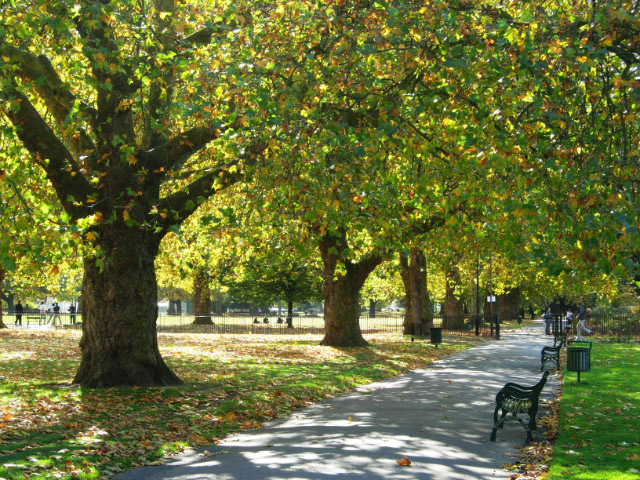
Kennington is the location of three significant London landmarks: the Oval cricket ground, the Imperial War Museum, and Kennington Park. Its population at the United Kingdom Census 2011 was 15,106.
Kennington appears in the Domesday Book of 1086 as Chenintune. It is recorded as Kenintone in 1229 and Kenyngton in 1263. Mills (2001) believes the name to be Old English meaning "farmstead or estate associated with a man called Cēna". Another explanation is that it means "place of the King", or "town of the King".
The presence of a tumulus, and other locally significant geographical features, suggest that the area was regarded in ancient times as a sacred place of assembly. According to the Domesday Book it was held by Teodric (Theodoric) the Goldsmith. It contained: 1 hide and 3 virgates; 3 ploughs, 4 acres (16,000 m2) of meadow. It rendered £3 annually. The manor of Kennington was divided from the manor of Vauxhall by the River Effra, a tributary of the River Thames.[citation needed] A smaller river, the River Neckinger, ran along the edge of the northern part of Kennington, approximately where Brook Drive is today (i.e. the brook) still forming the borough boundary.[citation needed] Both rivers have now been diverted into underground culverts.[citation needed]
Edward III gave the manor of Kennington to his oldest son Edward the Black Prince in 1337, and the prince then built a large royal palace in the triangle formed by Kennington Lane, Sancroft Street and Cardigan Street, near to Kennington Cross. In 1377, according to John Stow, John of Gaunt, 1st Duke of Lancaster came to Kennington to escape the fury of the people of London. Geoffrey Chaucer was employed at Kennington as Clerk of Works in 1389. He was paid 2 shillings. Kennington was the occasional residence of Henry IV and Henry VI. Henry VII was at Kennington before his coronation. Catherine of Aragon stayed at Kennington Palace in 1501. In 1531, at the order of King Henry VIII, most of Kennington Palace was dismantled, and the materials were used in the construction of the Palace of Whitehall.[failed verification]
The historical manor of Kennington continues to be owned by the current monarch's elder son (the Prince of Wales, Duke of Cornwall: see Dukes of Cornwall). The Duchy of Cornwall maintains a substantial property portfolio within the area.
The eighteenth century saw considerable development in Kennington. At the start of the century, the area was essentially a village on the southern roads into London, with a common on which public executions took place. On three dates in 1746, Francis Towneley and sixteen men who had taken part in the Jacobite rising were hanged, drawn and quartered at Kennington Common.
The area was significant enough, however, to be recognised in the Peerage of Great Britain and in 1726, the title Earl of Kennington was assumed by Prince William, Duke of Cumberland.
Hub AI
Kennington AI simulator
(@Kennington_simulator)
Kennington
Kennington is a district in south London, England. It is mainly within the London Borough of Lambeth, running along the boundary with the London Borough of Southwark, a boundary which can be discerned from the early medieval period between the Lambeth and St George's parishes of those boroughs respectively. It is located 1.4 miles (2.3 km) south of Charing Cross in Inner London and is identified as a local centre in the London Plan. It was a royal manor in the parish of St Mary, Lambeth in the county of Surrey and was the administrative centre of the parish from 1853. Proximity to central London was key to the development of the area as a residential suburb and it was incorporated into the metropolitan area of London in 1855.
Kennington is the location of three significant London landmarks: the Oval cricket ground, the Imperial War Museum, and Kennington Park. Its population at the United Kingdom Census 2011 was 15,106.
Kennington appears in the Domesday Book of 1086 as Chenintune. It is recorded as Kenintone in 1229 and Kenyngton in 1263. Mills (2001) believes the name to be Old English meaning "farmstead or estate associated with a man called Cēna". Another explanation is that it means "place of the King", or "town of the King".
The presence of a tumulus, and other locally significant geographical features, suggest that the area was regarded in ancient times as a sacred place of assembly. According to the Domesday Book it was held by Teodric (Theodoric) the Goldsmith. It contained: 1 hide and 3 virgates; 3 ploughs, 4 acres (16,000 m2) of meadow. It rendered £3 annually. The manor of Kennington was divided from the manor of Vauxhall by the River Effra, a tributary of the River Thames.[citation needed] A smaller river, the River Neckinger, ran along the edge of the northern part of Kennington, approximately where Brook Drive is today (i.e. the brook) still forming the borough boundary.[citation needed] Both rivers have now been diverted into underground culverts.[citation needed]
Edward III gave the manor of Kennington to his oldest son Edward the Black Prince in 1337, and the prince then built a large royal palace in the triangle formed by Kennington Lane, Sancroft Street and Cardigan Street, near to Kennington Cross. In 1377, according to John Stow, John of Gaunt, 1st Duke of Lancaster came to Kennington to escape the fury of the people of London. Geoffrey Chaucer was employed at Kennington as Clerk of Works in 1389. He was paid 2 shillings. Kennington was the occasional residence of Henry IV and Henry VI. Henry VII was at Kennington before his coronation. Catherine of Aragon stayed at Kennington Palace in 1501. In 1531, at the order of King Henry VIII, most of Kennington Palace was dismantled, and the materials were used in the construction of the Palace of Whitehall.[failed verification]
The historical manor of Kennington continues to be owned by the current monarch's elder son (the Prince of Wales, Duke of Cornwall: see Dukes of Cornwall). The Duchy of Cornwall maintains a substantial property portfolio within the area.
The eighteenth century saw considerable development in Kennington. At the start of the century, the area was essentially a village on the southern roads into London, with a common on which public executions took place. On three dates in 1746, Francis Towneley and sixteen men who had taken part in the Jacobite rising were hanged, drawn and quartered at Kennington Common.
The area was significant enough, however, to be recognised in the Peerage of Great Britain and in 1726, the title Earl of Kennington was assumed by Prince William, Duke of Cumberland.
Recent media