


Community hub
Recent from talks
Contribute something
Nothing was collected or created yet.
Kevin Curtis
View on Wikipedia
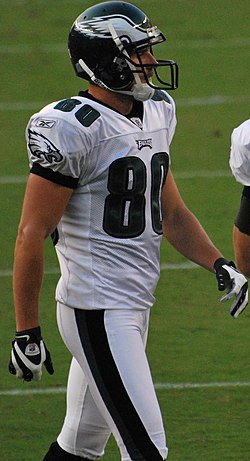
Kevin Devon Curtis (born July 17, 1978) is an American former professional football player who was a wide receiver in the National Football League (NFL). He played college football for the Utah State Aggies and was selected by the St. Louis Rams in the third round of the 2003 NFL draft. He also played for the Philadelphia Eagles, Miami Dolphins, Kansas City Chiefs and Tennessee Titans.
Key Information


Early life
[edit]Curtis attended Bingham High School in South Jordan, Utah and was a letterman in football and basketball. In football, he was an All-Region honoree as both a wide receiver and as a defensive back.
College career
[edit]Curtis began his collegiate career at NJCAA junior college powerhouse Snow College where he earned second-team All-American honors. He then transferred to Utah State.
Curtis started his Utah State career as a walk-on. As a junior, he led the nation in receptions, earning him third-team All-American honors. He also broke many Utah State single-season records along the way including pass receptions (100), receiving yards (1,531), most 10-reception games (6), most 100-yard receiving games (9), and most consecutive 100-yard receiving games (6). He was also named his team's Offensive MVP. His tremendous play as a junior earned him a scholarship for his senior year where he ranked seventh in the nation in receiving yards per game (114.36), and 12th in the country in receptions per game (6.73). Curtis also led the Aggies with 74 receptions (fifth-best season total in school history) for 1,258 yards (fifth-best in a single season) and scored 60 points to lead the team with an average of 117.4 all-purpose yards a game. In only two years at Utah State he ended his career leading in many statistical categories including career receptions (174), career pass reception yards per game (126.8), career pass receptions per game (7.9), and finished second in career receiving yards (2,789). He was teammates with Washington Redskins tight end Chris Cooley.
Professional career
[edit]Pre-draft
[edit]Curtis ran a hand-timed 40-yard dash of 4.21 but a 4.35 at the NFL Combine; at the Combine, he scored a 48 out of a possible 50 points on the Wonderlic intelligence test. This is tied for the highest verified score among active players (Ryan Fitzpatrick and Benjamin Watson also scored 48). The only two players that scored higher on the Wonderlic Test were Pat McInally with a perfect 50 and Mike Mamula with a 49.[1]
| Height | Weight | Arm length | Hand span | 40-yard dash | 10-yard split | 20-yard split | 20-yard shuttle | Three-cone drill | Vertical jump | Broad jump | Wonderlic | |
|---|---|---|---|---|---|---|---|---|---|---|---|---|
| 5 ft 11+1⁄8 in (1.81 m) |
186 lb (84 kg) |
30+3⁄8 in (0.77 m) |
9+3⁄8 in (0.24 m) |
4.35 s | 1.53 s | 2.59 s | 3.99 s | 6.76 s | 36 in (0.91 m) |
10 ft 2 in (3.10 m) |
48 | |
| All values from the NFL Combine[2][3] | ||||||||||||
St. Louis Rams
[edit]Curtis was selected by the St. Louis Rams in the third round (74th overall) of the 2003 NFL draft.[4] Curtis was inactive for the first five games of 2003 after suffering a broken fibula in the final preseason game at Buffalo. In 2004, Curtis played in all but one game, totaling 32 catches for 421 yards and 2 touchdowns. The Rams would finish just 8-8 that year, barely making the playoffs.
In the 2004 playoffs, Curtis and the Rams made history. In their wildcard game against the Seahawks, Curtis had four catches for 107 yards. The Rams would win the game, becoming the first playoff team in NFL history to win a game without having a winning record. In their divisional playoff loss at Atlanta the following week, Curtis caught seven passes for 128 yards and a 57-yard touchdown catch where he beat Falcons' cornerback DeAngelo Hall. Curtis became the 2nd player in NFL history to have two back-to-back 100-yard receiving games in the playoffs before ever recording one in the regular season.
His playoff performance proved to be no fluke, as Curtis had an impressive 2005. On the year, Curtis recorded 60 receptions, 801 yards and six touchdowns, all of which were second on the team. He also had a rushing touchdown in a win against the Saints that year.[5] Curtis would again be the Rams slot receiver in 2006.
Philadelphia Eagles
[edit]
On March 15, 2007, Curtis signed a 6-year, $32 million deal with the Philadelphia Eagles, including $9.5 million in guaranteed money.[6] Curtis spent his whole career behind potential Hall of Famers Isaac Bruce and Torry Holt. Now, free from their shadow, he set career highs in his first year with the Eagles and finished the year with 1,110 yards, 77 receptions and 6 touchdowns. He was the eleventh receiver in Eagles history to reach over 1,000 receiving yards, and just the second to under Andy Reid.
Curtis had his best game on September 23, 2007, in the first half of a 56-21 Eagles win over the Detroit Lions. His nine catches for 205 yards and three touchdowns tied Lee Evans for the most receiving yards during the first half of a game since 1987, when Steve Largent had 224 yards during a replacement game.[7] Curtis finished the day with 11 catches for 221 yards and three touchdowns.[8] He became the first player in NFL history to recover his own team's fumble for a touchdown in back-to-back games when he fell on Reggie Brown's fumble in the 3rd quarter against the Buffalo Bills on December 30, 2007. He recovered a McNabb fumble for a score a week earlier at the New Orleans Saints on December 23, 2007. With his 77 receptions in 2007, became just the 4th wide receiver in Eagles history to record 75-or-more catches in a single season, joining Irving Fryar (88 in 1996, 86 in 1997), Fred Barnett (78 in 1994), and Terrell Owens (77 in 2004).
In 2008, Curtis only played 9 games in the season due to injury. He had surgery on August 21, 2008, to repair a sports hernia and was inactive for the first six games of the season. He was also inactive at Washington on December 21, 2008, with a calf strain. However, he had highlights against Cleveland, Curtis caught 4 receptions for 45 yards and a touchdown. In the season Curtis caught 33 balls for 390 yards, and two touchdowns. His return helped engineer an improbable run to the playoffs for Philadelphia, where the 5-5-1 Eagles would go 9-6-1 (6-3-1 in games Curtis played), and make it to the NFC Championship game. He led the team with 122 receiving yards on four catches in the NFC Championship game at Arizona on January 18, 2009, which tied a franchise postseason record among wide receivers.
In 2009, Curtis played in the Eagles first two games of the season, before requiring arthroscopic surgery on his left knee. He missed twelve games because of it, and did not return until week 15 against the San Francisco 49ers. He was released by the Eagles on March 18, 2010.[9] He later attended workouts for the Giants and Lions but was not offered a contract.
During the 2010 offseason, Curtis underwent treatment for testicular cancer. After a successful surgery in September, Curtis announced he would be returning to the NFL.[10]
Miami Dolphins
[edit]Curtis was signed by the Miami Dolphins on December 13, 2010. He managed just one catch for six yards in the two games he played. On December 28, 2010, he was released by the Dolphins.
Kansas City Chiefs
[edit]On January 5, 2011, Curtis signed with the Kansas City Chiefs prior to their playoff game against the Ravens. Curtis played 30 snaps in the Chiefs' playoff loss, catching one pass for three yards.[11]
Tennessee Titans
[edit]On August 26, 2011, he signed with the Tennessee Titans. He signed in time to play in the preseason finale, where he caught two passes for 20 yards.[12] However, Curtis broke his left hand in the game, and was placed on injured reserve before the season officially started.[13]
NFL career statistics
[edit]| Legend | |
|---|---|
| Bold | Career high |
Regular season
[edit]| Year | Team | Games | Receiving | ||||||
|---|---|---|---|---|---|---|---|---|---|
| GP | GS | Tgt | Rec | Yds | Avg | Lng | TD | ||
| 2003 | STL | 4 | 1 | 5 | 4 | 13 | 3.3 | 8 | 0 |
| 2004 | STL | 15 | 0 | 50 | 32 | 421 | 13.2 | 41 | 2 |
| 2005 | STL | 16 | 9 | 97 | 60 | 801 | 13.4 | 83 | 6 |
| 2006 | STL | 16 | 1 | 57 | 40 | 479 | 12.0 | 42 | 4 |
| 2007 | PHI | 16 | 16 | 135 | 77 | 1,110 | 14.4 | 75 | 6 |
| 2008 | PHI | 9 | 8 | 63 | 33 | 390 | 11.8 | 32 | 2 |
| 2009 | PHI | 3 | 1 | 15 | 6 | 77 | 12.8 | 19 | 0 |
| 2010 | MIA | 2 | 0 | 2 | 1 | 6 | 6.0 | 6 | 0 |
| 81 | 36 | 424 | 253 | 3,297 | 13.0 | 83 | 20 | ||
Playoffs
[edit]| Year | Team | Games | Receiving | ||||||
|---|---|---|---|---|---|---|---|---|---|
| GP | GS | Tgt | Rec | Yds | Avg | Lng | TD | ||
| 2004 | STL | 2 | 2 | 17 | 11 | 235 | 21.4 | 57 | 1 |
| 2008 | PHI | 3 | 3 | 22 | 12 | 211 | 17.6 | 50 | 0 |
| 2010 | MIA | 1 | 0 | 3 | 1 | 3 | 3.0 | 3 | 0 |
| 6 | 5 | 42 | 24 | 449 | 18.7 | 57 | 1 | ||
Personal life
[edit]Curtis is a member of the Church of Jesus Christ of Latter-day Saints also known as the Mormon faith; after high school, he served a two-year Mormon mission in London, England.
On September 23, 2010, Curtis received an orchiectomy due to testicular cancer, at the Huntsman Cancer Institute.[14]
References
[edit]- ^ Robinson, Doug (October 25, 2005). "Kevin Curtis is ... a Surprising, Rising Star". Deseret Morning News. Deseret News. Retrieved October 29, 2007.
- ^ "2003 NFL Draft Scout Kevin Curtis College Football Profile". DraftScout.com. Retrieved May 31, 2023.
- ^ (February 28, 2008).Kevin Curtis & The Wonderlic Test Archived 2008-06-16 at the Wayback Machine Yardbarker.com. Retrieved April 27, 2009.
- ^ "2003 NFL Draft Listing". Pro-Football-Reference.com. Retrieved March 28, 2023.
- ^ "Watch New Orleans Saints vs. St. Louis Rams [10/23/2005] - NFL.com". www.nfl.com.
- ^ "Eagles land former Rams wideout Curtis". espn.com. March 15, 2007. Retrieved March 15, 2007.
- ^ "Curtis has career day in the first half". Philadelphia Daily News. philly.com. September 23, 2007. Retrieved October 29, 2007. [dead link]
- ^ Pennell, Randy (September 23, 2007). "Curtis catches 11 passes for 221 yards in Eagles win". Yahoo Sports. Retrieved October 29, 2007.
- ^ McLane, Jeff (March 18, 2010). "Eagles cut Curtis and Howard". Philly.com. Retrieved March 18, 2010.
- ^ "Veteran WR ready to start playing again - Yardbarker". Archived from the original on April 2, 2015. Retrieved March 11, 2015.
- ^ "Chiefs have right of first refusal on Kevin Curtis". NBC Sports. July 25, 2011. Retrieved May 10, 2025.
- ^ "Watch Tennessee Titans vs. New Orleans Saints [09/01/2011] - NFL.com". www.nfl.com.
- ^ "Titans WR Kevin Curtis breaks bone in left hand - NFL News | FOX Sports on MSN". www.foxsports.com. Archived from the original on March 11, 2015. Retrieved June 6, 2022.
- ^ "Former Bingham USU star Kevin Curtis fighting testicular cancer". Deseret News. October 7, 2010.
External links
[edit]- Philadelphia Eagles bio
 Media related to Kevin Curtis at Wikimedia Commons

Kevin Curtis
View on GrokipediaEarly years
Upbringing and family
Kevin Curtis was born on July 17, 1978, in Murray, Utah.[3] He grew up in South Jordan, Utah, as the middle child among seven siblings in a close-knit family.[1][6] His father, Stuart Curtis, played a key role in fostering a supportive household environment, actively encouraging his children's interests by delivering game tapes to college coaches and discussing career decisions like serving a religious mission.[6] The family emphasized athletics, with siblings including a younger brother, Chris, who later played football at Utah State University, and a sister, Carolee, who attended the same institution.[6] This dynamic created an atmosphere where sports were a central part of daily life and family bonding. Curtis's early exposure to athletics came through family activities and the active sports culture of the South Jordan community, where youth participation in organized games was common.[6] During his elementary and middle school years, he developed an initial interest in football and basketball, influenced by these surroundings and his household's emphasis on physical development, though he was noted as a late physical bloomer, weighing just 110 pounds as a high school sophomore.[6]High school career
Kevin Curtis attended Bingham High School in South Jordan, Utah, participating in both football and basketball programs during his high school years.[6] In football, Curtis earned second-team All-Region honors on defense as a senior while contributing on both sides of the ball.[7] He recorded approximately 10 receptions that season despite a broken hand that limited him to defensive duties for four games.[6] Curtis also lettered in basketball, making the varsity team after being cut twice early in his high school career.[6] Despite his multi-sport involvement, Curtis received no scholarship offers for football upon graduating and unsuccessfully tried out as a walk-on at Brigham Young University.[8] His father provided crucial support during this period by personally delivering game film to college programs.[6]Collegiate career
Junior college at Snow College
Kevin Curtis enrolled at Snow College in Ephraim, Utah, in 1996 as a walk-on wide receiver after graduating from Bingham High School without any major college scholarship offers.[8] During his freshman season, he quickly adapted to the junior college level, recording 30 receptions for 600 yards and 5 touchdowns while contributing to Snow College's high-powered offense in the Western States Football League (WSFL).[9] In his sophomore year of 1997, Curtis significantly elevated his performance, hauling in 55 receptions for 1,100 yards and an impressive 19 touchdowns, which helped anchor the team's passing attack and led to a strong finish in the WSFL standings, including a second-place conference position.[9] His standout play earned him first-team All-WSFL honors, NJCAA All-American recognition, team Most Valuable Player award, and selection as team captain, highlighting his leadership and reliability on the field.[9] Curtis's two seasons at Snow College were pivotal in his development, transforming him from an overlooked walk-on into a nationally recognized talent and preparing him for the rigors of Division I football through rigorous training and competitive experience in a program known for producing professional prospects.[9] Although specific academic details from this period are limited, his time there fostered personal discipline.[10]Utah State University
Kevin Curtis enrolled at Utah State University in 2000 from Snow College, where he had earned second-team All-American honors, joining the Aggies as a walk-on and redshirting his initial season.[1][11] In his junior year of 2001, Curtis exploded onto the scene, recording 100 receptions for 1,531 yards and 10 touchdowns over 11 games, leading the nation with 9.1 receptions per game and ranking third nationally in receiving yards per game at 139.2.[12] These figures set Utah State single-season school records for receptions and receiving yards by a wide receiver, while also establishing marks for double-digit reception games (6) and 100-yard receiving games (9).[1] His performance earned him Associated Press Third-Team All-American honors and a first-team all-independent selection, contributing to an Aggies offense that ranked 13th nationally in passing yards per game (288.0).[1][13] As a senior in 2002, Curtis remained the focal point of Utah State's passing attack, leading the team with 74 receptions for 1,258 yards and 9 touchdowns in 11 games, ranking seventh nationally in receiving yards per game (114.4) and 12th in receptions per game (6.7).[12][1] He again secured first-team all-independent honors and helped anchor an offense that ranked 13th in the nation in total offense.[1][13] Over his two seasons at Utah State, Curtis amassed 174 receptions for 2,789 yards and 19 touchdowns, setting career school records for 100-yard receiving games (16) and receptions per game (7.9).[1] Curtis's on-field dominance, combined with his athletic testing at the NFL Scouting Combine, drew strong interest from NFL scouts. He clocked a 4.42-second 40-yard dash and recorded a 36-inch vertical jump, showcasing the speed, explosiveness, and strength that complemented his proven production as a slot receiver capable of stretching defenses and excelling after the catch.[14]Professional career
2003 NFL Draft
Kevin Curtis was selected by the St. Louis Rams in the third round (74th overall) of the 2003 NFL Draft.[3] His record-setting senior season at Utah State, where he recorded 74 receptions for 1,258 yards and nine touchdowns, elevated him to mid-round prospect status.[12] During the pre-draft process, Curtis impressed at the NFL Scouting Combine with a 4.42-second 40-yard dash, a 36-inch vertical jump, and a 3.99-second 20-yard shuttle, showcasing his athleticism despite his 5-foot-11 frame.[14] In a private workout for NFL scouts, he ran a hand-timed 4.21-second 40-yard dash and completed 20 repetitions of 225 pounds on the bench press, further highlighting his speed and strength.[6] Scouts viewed him as a versatile slot receiver with strong hands, quick route-running, and intelligence, though his size limited him to third-round projections rather than earlier selection.[15] Curtis signed a three-year rookie contract with the Rams on July 22, 2003, worth $1.431 million, including a $521,000 signing bonus.[16][17]St. Louis Rams (2003–2006)
Kevin Curtis joined the St. Louis Rams as a third-round draft pick in 2003 and spent his first four professional seasons with the team, evolving from a limited rookie contributor to a reliable secondary receiver in a veteran-laden offense.[3] In his rookie year of 2003, Curtis saw minimal action, appearing in just four games with four receptions for 13 yards and no touchdowns, primarily as a depth player behind established wideouts Torry Holt and Isaac Bruce.[18] His snaps increased gradually the following season, as he played 15 games in 2004, recording 32 receptions for 421 yards and two touchdowns while contributing on special teams.[19] That postseason, Curtis emerged prominently during the Rams' wild-card run, catching 11 passes for 235 yards and one touchdown across two games, including four receptions for 107 yards against the Seattle Seahawks in the wild-card victory and seven for 128 yards with a 57-yard score versus the Atlanta Falcons in the divisional round loss.[20] Curtis achieved his breakout in 2005, starting nine games and posting career highs with 60 receptions for 801 yards and six touchdowns, solidifying his role as a key target in an offense that featured running back Marshall Faulk's versatile contributions alongside Holt and Bruce. He maintained productivity in 2006 with 40 receptions for 479 yards and four touchdowns over 16 games, though his starting opportunities diminished to one. Over his Rams tenure, spanning 51 games, Curtis amassed 136 receptions for 1,714 yards and 12 receiving touchdowns, often serving as a complementary piece in the Rams' passing attack that emphasized Faulk's dual-threat presence and the deep threats from Holt and Bruce.[3] Curtis's time with the Rams concluded after the 2006 season when he entered unrestricted free agency, seeking a larger role elsewhere.[16]Philadelphia Eagles (2007–2009)
Curtis signed with the Philadelphia Eagles as an unrestricted free agent on March 15, 2007, agreeing to a six-year contract worth up to $32 million, including $9.5 million in guaranteed money.[21][22] This deal came after four seasons with the St. Louis Rams, where he had established himself as a reliable receiver, prompting the Eagles to view him as a key addition to their passing attack led by quarterback Donovan McNabb and complemented by running back Brian Westbrook.[23] In the 2007 regular season, Curtis achieved career highs, recording 77 receptions for 1,110 yards and six touchdowns over 16 games, all as starts, while leading the team in receiving yards.[3] Curtis's tenure with the Eagles declined in the following years due to injuries. In 2008, a sports hernia sidelined him for the first half of the season, limiting him to nine games with 33 receptions for 390 yards and two touchdowns.[24][3] Despite the injury, Curtis contributed in the playoffs as the Eagles made an improbable run to the NFC Championship Game after finishing the regular season 9–6–1, catching 12 passes for 211 yards across three games.[3] The 2009 season brought further challenges from a knee injury that hampered him since training camp, restricting him to three games with six receptions for 77 yards before he underwent surgery in October and was placed on injured reserve.[25][26][3]Miami Dolphins and later teams (2010–2011)
After being released by the Philadelphia Eagles in March 2010, Curtis signed with the Miami Dolphins on December 13, 2010, to bolster their wide receiver depth amid injuries to other players.[27] He appeared in two regular-season games for Miami, recording one reception for six yards on December 19 against the Buffalo Bills, while also rushing once for six yards; his second game on December 26 against the Detroit Lions yielded no receptions.[28] The Dolphins released Curtis on December 28, 2010, shortly after the season's end.[29] Curtis then joined the Kansas City Chiefs on January 5, 2011, as a free agent to provide depth for their playoff roster. He played in the Chiefs' AFC Wild Card playoff game against the Baltimore Ravens on January 9, catching one pass for three yards in a 30–7 loss, marking his final NFL appearance. At age 32 during the 2010 season and 33 in 2011, these limited opportunities reflected Curtis's ongoing challenges with injuries from prior years, including knee issues with the Eagles, as he sought to extend his career.[30] In an effort to revive his professional tenure, Curtis signed with the Tennessee Titans on August 26, 2011, agreeing to a one-year contract.[31] He participated in the Titans' preseason finale on September 1 against the Green Bay Packers, catching two passes for 20 yards.[32] However, during that game, Curtis sustained a broken bone in his left hand, leading to his placement on injured reserve on September 3, 2011, which sidelined him for the entire regular season. The Titans released him following the 2011 season, effectively concluding his nine-year NFL career.[16]Career statistics
Regular season
Kevin Curtis's regular-season NFL career spanned eight seasons from 2003 to 2010, during which he recorded 253 receptions for 3,297 yards and 20 touchdowns across 81 games played.[3] His performance showed a clear progression, starting with minimal output as a rookie before peaking in 2007 with the Philadelphia Eagles, followed by a sharp decline due to injuries that limited his playing time in later years.[3] Curtis's early years with the St. Louis Rams featured steady improvement, culminating in a breakout 2005 season with 60 receptions for 801 yards and six touchdowns, establishing him as a reliable slot receiver.[3] He reached his career high in 2007 after signing with the Eagles, amassing 77 receptions for 1,110 yards and six touchdowns in 16 games, highlighting his role in a dynamic passing offense.[3] Post-2007, hamstring and knee injuries hampered his productivity, resulting in just 40 receptions over his final three seasons with the Eagles and a brief stint with the Miami Dolphins.[3] The following table summarizes Curtis's regular-season receiving statistics by year, including games played (G), receptions (Rec), receiving yards (Yds), yards per reception (Y/R), longest reception (Lng), touchdowns (TD), and fumbles (Fmb).[3]| Year | Team | G | Rec | Yds | Y/R | Lng | TD | Fmb |
|---|---|---|---|---|---|---|---|---|
| 2003 | STL | 4 | 4 | 13 | 3.3 | 8 | 0 | 0 |
| 2004 | STL | 15 | 32 | 421 | 13.2 | 41 | 2 | 1 |
| 2005 | STL | 16 | 60 | 801 | 13.4 | 83 | 6 | 2 |
| 2006 | STL | 16 | 40 | 479 | 12.0 | 42 | 4 | 1 |
| 2007 | PHI | 16 | 77 | 1110 | 14.4 | 75 | 6 | 0 |
| 2008 | PHI | 9 | 33 | 390 | 11.8 | 32 | 2 | 0 |
| 2009 | PHI | 3 | 6 | 77 | 12.8 | 19 | 0 | 0 |
| 2010 | MIA | 2 | 1 | 6 | 6.0 | 6 | 0 | 0 |
| Career | - | 81 | 253 | 3,297 | 13.0 | 83 | 20 | 4 |
Postseason
Kevin Curtis appeared in six NFL postseason games across three teams, recording 24 receptions for 449 yards and one touchdown. His playoff contributions were most notable during his time with the St. Louis Rams in 2004 and the Philadelphia Eagles in 2008, where he provided key receiving production in multiple rounds, though his role diminished in his final appearance with the Kansas City Chiefs in 2010.[3] In the 2004 NFC Wild Card playoff, Curtis helped the Rams secure a 27–20 upset victory over the Seattle Seahawks on January 8, 2005, with four receptions for 107 yards.[33][34] The Rams advanced to the NFC Divisional round, where Curtis had a breakout performance against the Atlanta Falcons on January 15, 2005, catching seven passes for 128 yards and his sole postseason touchdown on a 57-yard strike from Marc Bulger that pulled St. Louis within 14–7 in the first quarter; however, the Rams fell 47–17.[35][36] These efforts highlighted Curtis's emerging role as a reliable deep threat in high-stakes games, amassing 11 receptions for 235 yards and the touchdown over the two contests. Curtis's most extensive playoff run came with the Eagles in the 2008 postseason. In the Wild Card victory over the Minnesota Vikings on January 4, 2009 (26–14), he recorded four receptions for 49 yards, contributing to Philadelphia's balanced aerial attack.[37][38] The Eagles then defeated the New York Giants 23–11 in the Divisional round on January 11, 2009, with Curtis adding four catches for 40 yards, including a 15-yard reception that helped sustain a key drive.[39][40] In the NFC Championship against the Arizona Cardinals on January 18, 2009, Curtis led the team with four receptions for 122 yards, featuring a pivotal 50-yard grab on a third-and-18 in the third quarter that set up a touchdown and a 47-yard catch that fueled a late comeback attempt, though Philadelphia lost 32–25.[41][42] Over these three games, Curtis totaled 12 receptions for 211 yards, demonstrating his value in clutch situations despite no touchdowns. Curtis's final postseason outing was limited, as he caught one pass for three yards in the Chiefs' 30–7 wild-card loss to the Baltimore Ravens on January 9, 2011, playing just 30 snaps in a subdued offensive effort.[43] He did not appear in any further playoff games after 2011.[3]| Year | Team | Round | Opponent | Receptions | Yards | TD |
|---|---|---|---|---|---|---|
| 2004 | Rams | Wild Card | Seahawks | 4 | 107 | 0 |
| 2004 | Rams | Divisional | Falcons | 7 | 128 | 1 |
| 2008 | Eagles | Wild Card | Vikings | 4 | 49 | 0 |
| 2008 | Eagles | Divisional | Giants | 4 | 40 | 0 |
| 2008 | Eagles | Championship | Cardinals | 4 | 122 | 0 |
| 2010 | Chiefs | Wild Card | Ravens | 1 | 3 | 0 |