Hubbry Logo
search
logo
KeyMod
KeyMod
current hub
625284

KeyMod

logo
Community Hub0 Subscribers
Read side by side
from Wikipedia

KeyMod is a universal interface system for firearm accessory components. The concept was first created by VLTOR Weapon Systems of Tucson, Arizona, and released through Noveske Rifleworks of Grants Pass, Oregon, before being published open sourced in the public domain for adoption by the entire firearms accessory industry.[1][2][3] The name "KeyMod" was coined by Eric Kincel (then working for VLTOR Weapon Systems) following the naming trend of other VLTOR accessories with the suffix "Mod" meaning modular, and "Key" being a reference to the key-hole profile of the mounting slots[citation needed].

Key Information

History

[edit]

VLTOR Weapon Systems had previously pursued a design which was the basis for the KeyMod system. While developing the first prototype systems, Eric Kincel of VLTOR Weapon systems was approached by John Noveske of Noveske Rifleworks with a design for a universal accessory attachment system. After a short collaboration, during which Todd Krawczyk of Noveske Rifleworks suggested an improvement to the accessory lock/anti-rotation nut, John Noveske decided to adopt what became the KeyMod system for the NSR series of hand guards and accessories.[4] Kincel's design was developed simultaneously, but without knowledge of the independently developed keyhole slot system by Accuracy International, until after KeyMod's release.[5]

The specifications for the KeyMod system were first published in July 2012. The current revision was released in October 2012.

In 2017, a summary report of testing conducted by Naval Surface Warfare Center Crane Division for United States Special Operations Command (USSOCOM) indicated that, while comparable in endurance and rough handling testing, the M-LOK system greatly outperformed KeyMod in repeatability, drop testing and failure load testing.[6]

Description

[edit]

KeyMod is an open-source design released for use and distribution in the public domain in an effort to standardize universal attachment systems in the firearm accessories market. The KeyMod system is intended to be used as a direct attachment method for firearm accessories such as flashlight mounts, laser modules, sights, scope mounts, vertical grips, rail panels, hand stops, barricade supports, and many others.[7][failed verification]

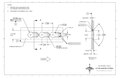
The goal is to eliminate the need for the rail to be fully outfitted with 1913 rails covering the entire handguard. The KeyMod system allows a user to place MIL-STD-1913 rails wherever needed, even in the 45° positions at times. The KeyMod system consists of two parts: the KeyMod slot and the KeyMod nut. The slot is distinctive with a larger diameter through-hole combined with a narrow slot. The slot is chamfered on the backside, while the through hole is sized for clearance of a quick-detach sling swivel (approximately 3/8" diameter).

Zbroyar Z-15 rifle with KeyMod slots on the handguard.

The nut is stepped, and the larger diameter end is chamfered around 270 degrees of its diameter. The angled face created is meant to interface with the chamfer on the backside of the KeyMod slot. The full diameter is left intact to create two flats on the nut which align the nut to the slot, and allow it to be indexed to the accessory as well as to the KeyMod slot. This eliminates the need to align the nuts to the holes prior to accessory installation. In most accessories, the screw is swaged after assembly to ensure that it cannot be backed out of the nut. This prevents loss of small parts (screws, nuts or other small parts used in the assembly of the accessory). The spacing of the holes is critical and is based on MIL-STD-1913 spacing to allow the greatest modularity with existing accessories.

The KeyMod specifications call out a "recoil lug" on the accessories, which is intended to interface with the larger through hole portion and resist slippage of accessories during counter-recoil. The combination of the angled interface of the nut to the KeyMod slot and the recoil lug to the through hole make for a very strong attachment point which will not slip under harsh recoil or counter recoil. It also provides for an excellent return-to-zero when removed and re-installed.

Technical specifications

[edit]

The specifications for the KeyMod system were initially released by VLTOR Weapon Systems as an open-source set of drawings. As such, some manufacturers have added their own variations to the system, such as using the through-hole portion as a sling-swivel attachment point. The critical interface dimensions, however, still follow the specifications. In an effort to ensure interface dimensions are kept consistent and repeatable, Bravo Company MFG released a set of drawings for KeyMod gauges that allow for expedient inspection of the 100° chamfer feature in January 2014.

See also

[edit]
  • Rail Integration System, generic term for a system for attaching accessories to small firearms
  • Weaver rail mount, early system used for scope mounts, still has some popularity in the civilian market
  • Picatinny rail (MIL-STD-1913), improved and standardized version of the Weaver mount. Used both for scope mounts and for accessories (such as extra sling mounts, vertical grips, bipods etc.). Major popularity in the civilian market.
  • NATO Accessory Rail, further development from the MIL-STD-1913
  • UIT rail, older standard used for mounting slings particularly on competition firearms
  • M-LOK, free licensed competing standard to KeyMod
  • Zeiss rail, ringless scope mounting standard

References

[edit]
Revisions and contributorsEdit on WikipediaRead on Wikipedia
from Grokipedia
KeyMod is a lightweight, modular mounting interface system designed for attaching accessories directly to firearm handguards and forends, utilizing a series of keyhole-shaped slots that enable self-centering, tool-free installation and removal without requiring continuous rails.[1] Introduced in 2012 by VLTOR Weapon Systems in collaboration with Noveske Rifleworks, the system was released into the public domain as an open-source standard to encourage widespread industry adoption and innovation in accessory mounting solutions.[2][1] The KeyMod design draws inspiration from keyhole shelving mechanisms, featuring elongated slots with a circular enlargement at one end for inserting T-nuts or locking tabs that secure accessories such as vertical foregrips, lights, bipods, sling mounts, and rail sections.[1] This configuration allows for customizable placement along the handguard, reducing overall weight and bulk compared to the heavier Picatinny rail system (MIL-STD-1913), while remaining backward compatible with Picatinny accessories via modular rail inserts.[2] Key advantages include its slim profile, which minimizes interference with hand placement, and the ability to mount components at precise intervals (typically 20 mm spacing), promoting a streamlined aesthetic and ergonomic efficiency on platforms like AR-15 rifles.[3] Although KeyMod gained initial popularity for its simplicity and cost-effectiveness in civilian and tactical markets during the mid-2010s, it faced challenges in durability testing. In 2016, the U.S. Special Operations Command (USSOCOM) evaluated it against competing systems, finding that KeyMod retained only 33% of attachments during drop tests, compared to 100% for the M-LOK system developed by Magpul Industries.[2][4] This led to M-LOK's selection as the preferred standard for military applications in 2017, contributing to KeyMod's declining dominance.[3] As of 2024, KeyMod remains available and viable for non-critical uses, particularly in lightweight builds where its open design supports broad accessory compatibility, though M-LOK has become the industry benchmark for reliability and versatility.[5][6]

History

Development

KeyMod was developed by VLTOR Weapon Systems in collaboration with Noveske Rifleworks, beginning in late 2011 as part of a project to create lighter-weight modular systems for modern firearms.[7] The initiative stemmed from requests by the United States Marine Corps (USMC) for an enhanced upper receiver group that prioritized reduced weight, improved modularity, and ease of use compared to existing rail systems.[8] Primary designer Eric Kincel, then VLTOR's general manager and lead engineer, worked alongside VLTOR engineer Jeff O'Brien to refine the concept, drawing initial inspiration from keyhole-shaped slot designs commonly used in industrial applications for quick, secure attachments.[9] The core motivation behind KeyMod's creation was to address the limitations of the Picatinny rail system, particularly its excessive weight and lack of flexibility for accessory placement, which hindered lightweight builds and user customization on tactical firearms.[1] Kincel aimed to develop a minimalist interface that allowed direct mounting without additional rail sections, promoting better weight distribution and ventilation while ensuring accessories could re-zero reliably under recoil.[10] This approach built on earlier prototypes tested with Noveske's NSR handguard, focusing on simplicity and universality to encourage broad industry participation.[11] The first specifications for KeyMod were published in July 2012, making the technical data package publicly available to foster adoption.[12] A revised version followed in October 2012, incorporating refinements to the slot and mounting dimensions for greater compatibility.[13] VLTOR released the system as open-source, waiving licensing fees to promote widespread manufacturing and standardization without proprietary restrictions, with the explicit goal of establishing it as an industry parallel to Picatinny rails.[14]

Introduction and Early Adoption

KeyMod, a modular mounting system for firearm accessories, was officially released in 2012 through Noveske Rifleworks, which showcased the NSR handguard incorporating the technology at that year's SHOT Show. Developed by Vltor Weapon Systems under the direction of Eric S. Kincel, the system utilized a keyhole-shaped slot design intended to enable direct attachment of accessories to handguards, complementing rather than replacing traditional Picatinny rails. Vltor published the technical specifications as an open-source data package in July 2012, placing the drawings in the public domain to encourage widespread industry adoption without patent restrictions.[1][15] The open-source nature of KeyMod facilitated rapid prototyping and production by third-party manufacturers, leading to a surge in compatible products from 2013 to 2015. Early adopters included Bravo Company Manufacturing (BCM), which introduced its lightweight KMR handguard series in early 2014, emphasizing modularity for AR-15 platforms. Other notable endorsements came from Geissele Automatics, Midwest Industries, and CMMG, who integrated KeyMod into their handguards and accessories, targeting both civilian enthusiasts and tactical users seeking streamlined rifle configurations. This period saw the proliferation of KeyMod-equipped AR-15 handguards and direct-mount items such as vertical grips, lights, and rail sections, as manufacturers capitalized on the system's versatility.[15][16] KeyMod was promoted for its initial advantages in reducing overall rifle weight—by allowing users to forgo bulky Picatinny rail sections—and enabling faster accessory attachment times through self-centering, tool-free mounting. These features appealed particularly to AR-15 users in civilian and tactical markets, where lighter, more ergonomic setups improved handling and reduced fatigue during extended use. By 2015, the system's growing ecosystem reflected its early momentum as a potential industry standard for modular fore-ends.[15]

Decline and Legacy

KeyMod reached its peak adoption between 2014 and 2016, as manufacturers and enthusiasts embraced its lightweight, open-standard design for modular firearm accessories. However, this period of growth was short-lived, with a notable decline beginning in 2017 following rigorous testing by the U.S. Special Operations Command (USSOCOM) at the Naval Surface Warfare Center (NSWC) Crane. The tests compared KeyMod and M-LOK systems under conditions including drop impacts, cyclic loading, and rough handling; M-LOK demonstrated superior retention, with 100% of accessories remaining attached after drops from 5 feet onto a steel plate (though 67% slid rearward in some configurations), while KeyMod retained only 33% of attachments (67% detached). Additionally, M-LOK showed a 73% improvement in average point-of-aim shift over KeyMod during vibration and load tests. These results, favoring M-LOK for its robustness in military applications, prompted USSOCOM to select M-LOK as the preferred system for special operations applications in 2017, leading the U.S. Army to adopt it in certain programs and influencing broader industry trends, while the Marine Corps incorporated it more gradually in later years.[17][18] Contributing to KeyMod's decline were inherent design limitations, such as its one-directional mounting orientation, which restricted accessory placement flexibility compared to bidirectional alternatives, and inconsistencies in third-party implementations that led to variable retention and compatibility issues, particularly with polymer components. A pivotal industry shift occurred in 2017 when major manufacturers, including Magpul—who had developed M-LOK in 2014 as a direct competitor and prioritized it for their product lines—effectively ceased new KeyMod development in favor of M-LOK to align with military standards and market demand. By the early 2020s, accessory availability had significantly diminished as suppliers reallocated resources; for instance, companies like Aero Precision discontinued KeyMod lines due to declining sales, leaving only clearance stock and aftermarket options. This manufacturer pivot accelerated KeyMod's obsolescence in mainstream production.[19][20][21] Despite its decline, KeyMod's legacy endures in the evolution of modular rail systems, having pioneered an open-source standard that emphasized reduced weight and direct attachment over traditional Picatinny rails, thereby influencing subsequent designs toward greater modularity and lightness in firearms accessories. As of 2025, it remains in use for legacy systems, custom builds in niche communities, and older equipment where retrofitting is impractical, ensuring its continued, albeit limited, presence in the firearms ecosystem.[21][20]

Design and Functionality

System Overview

KeyMod is a modular mounting system designed for attaching firearm accessories, such as lights, grips, and optics, directly to the handguards of rifles, offering a lightweight alternative to traditional full-length rail systems like Picatinny.[17][22] Developed as an open-source standard, it enables users to customize weapons with minimal added weight and bulk, prioritizing a low-profile design for enhanced handling.[17] At its core, the KeyMod system operates through a series of recessed keyhole-shaped slots spaced along the handguard, allowing accessories to secure via locking nuts or bolts without requiring extensive rail infrastructure.[22][6] Accessories are attached by inserting compatible mounting hardware through the larger portion of the slot, sliding it into the narrower section for alignment, and then tightening to lock in place, facilitating quick and direct integration.[17] This mechanism supports efficient modularity, with insertion being tool-free but standard securing typically requiring a tool for tightening, though quick-detach options allow tool-free use, bypassing the need for continuous rails and reducing overall material use for slimmer profiles.[22] Primarily intended for AR-15 platforms, KeyMod's design extends to other rifle configurations, emphasizing minimalism to maintain balance and reduce weight during use.[6] By enabling direct accessory mounting, it promotes a streamlined setup that keeps the firearm's fore-end sleek while accommodating tactical needs.[17]

Key Components and Mechanism

The KeyMod system consists of two primary components: the host rail integrated into the firearm handguard and the accessory mounts. The host rail features a series of circular slots connected to elongated keyhole-shaped openings, designed to provide mounting points along the rail's surface. Accessory mounts incorporate nuts that fit into these slots, enabling direct attachment without intermediate adapters in many cases.[17][3] The attachment mechanism operates through a straightforward insertion and locking process. To secure an accessory, the nuts on the mount are first aligned and inserted into the circular portion of the KeyMod slot. The accessory is then slid forward into the narrower keyhole slot, where the nuts engage the rail's contours to prevent lateral movement. Final securing is achieved by tightening screws or using a quick-detach (QD) lever, which applies pressure to lock the nuts firmly against the rail. This process allows for rapid attachment and removal while distributing recoil forces evenly across the mount.[3][17] KeyMod rails are typically constructed from lightweight materials such as aluminum alloys for durability in high-stress environments or high-strength polymers for reduced weight in tactical applications. The slots are arranged at regular intervals around the handguard, commonly at 0°, 45°, 90°, 135°, 180°, 225°, 270°, and 315° positions relative to the top rail, facilitating versatile accessory alignment without compromising the rail's low-profile design.[14][17] Variations in KeyMod implementation include direct-mount options, where accessories like vertical grips or lights attach straight to the slots via integrated nuts, and rail-section adapters that convert segments of the KeyMod rail into traditional Picatinny sections for legacy compatibility. These adapters use specialized nuts that fit into the slots and allow bolting of Picatinny-compatible rails, bridging older systems with the modular KeyMod framework.[3][17]

Technical Specifications

Slot and Attachment Dimensions

The KeyMod system employs precise slot dimensions to facilitate secure and repeatable accessory mounting on firearm handguards. The circular hole in each slot measures 0.380 inches in diameter, providing clearance for the attachment's primary protrusion, while the adjoining keyhole slot has a width of 0.234 inches and a length of approximately 0.5 inches, allowing the locking tab to slide into place for retention.[3] Center-to-center spacing between adjacent slots is standardized at 0.788 inches, equivalent to 20 mm, ensuring modular consistency across compatible platforms; this spacing incorporates tolerances of ±0.005 inches to maintain manufacturing repeatability and alignment accuracy.[3] Attachment hardware features a matching circular protrusion with a 0.375-inch diameter designed to fit snugly within the slot's hole, complemented by locking tabs up to 0.230 inches wide that engage the keyhole slot for anti-rotation stability. These components include a depth recess of 0.125 inches to enable flush mounting against the rail surface. The dimensional standards are derived from reference CAD drawings released in 2012 by VLTOR Weapon Systems, which established the open specification for KeyMod to promote interoperability among manufacturers.

Compatibility and Standards

KeyMod operates as an open-source mounting system, with VLTOR Weapon Systems releasing its technical data package into the public domain in 2012, imposing no patents, royalties, or licensing fees on manufacturers. This approach, supported by early adopters like Bravo Company Manufacturing (BCM), relies on freely available specifications to promote widespread interoperability and discourage proprietary modifications. The core guidelines are detailed in VLTOR's published technical drawings, which define slot configurations and attachment mechanisms to ensure consistent performance across compliant products.[14][12] For compatibility, accessories must conform to the precise tolerances in these specifications, particularly the dimensions of the keyhole-shaped slots and locking tabs, enabling a universal fit on any standards-compliant KeyMod handguard. This direct-attachment design allows for quick installation without tools, though rail sections or adapters are commonly used to mount Picatinny-compatible optics, lights, or grips. Such adapters, produced by manufacturers including VLTOR and BCM, bridge KeyMod systems with legacy Picatinny accessories while maintaining the low-profile benefits of the platform.[23][24][17] The standards evolved through an initial specification release in July 2012, followed by a revision in October 2012 that refined tolerances to improve indexing accuracy and reduce potential misalignment during attachment. Unlike formalized systems, KeyMod lacks official ANSI or ISO certification, depending instead on industry self-regulation where manufacturers voluntarily adhere to VLTOR's drawings for reliability. However, this open framework has limitations, as varying interpretations by third-party producers can result in inconsistent slot depths or tab fits, leading to occasional attachment failures or reduced repeatability in high-stress applications. Independent testing across multiple brands has highlighted such variances, with average point-of-aim shifts of 4.9 MOA (up to 14.6 MOA) and higher detachment rates in drop tests for non-compliant implementations.[12][17]

Applications and Comparisons

Use in Firearms Accessories

KeyMod has been widely applied in the mounting of various firearms accessories directly onto compatible handguards, particularly on platforms such as the AR-15, SR-25, and similar modular rifles. Vertical foregrips are commonly attached using KeyMod-compatible mounts to enhance shooter control and stability during handling and firing. Weapon lights and lasers are frequently integrated via dedicated KeyMod adapters, allowing for precise positioning along the rail without the need for additional rail sections, which supports tactical illumination and aiming in low-light conditions. Bipods, including Harris-style or swivel models, are secured through KeyMod bipod mounts to provide stable support for prone shooting or benchrest setups.[25][26][27] In practical implementations, KeyMod integrates seamlessly with free-float handguards like the Bravo Company Manufacturing (BCM) KMR series and Geissele Super Modular Rail (SMR) MK variants, enabling direct accessory attachment on AR-15 uppers. These configurations are employed across civilian self-defense builds, law enforcement duty rifles, and competitive shooting setups, where modularity facilitates rapid reconfiguration for specific scenarios. For instance, the BCM KMR Alpha handguard supports lightweight accessory placement on AR-15 and M4 platforms, promoting balanced weight distribution during extended use. Internationally, the Ukrainian Armed Forces have adopted the UAR-15 rifle, which features KeyMod handguards, for special operations units as of the early 2020s.[28][29][30] The system's design promotes firearm customization by enabling sparse accessory mounting, which reduces overall weight compared to traditional full-rail systems and improves ergonomics for users. This modularity allows builders to attach only essential components, achieving lighter rifle configurations suitable for maneuverability in dynamic environments. As of 2025, KeyMod remains prevalent in budget-oriented and legacy AR-15 builds, particularly where compatibility with existing components is prioritized over newer standards.[31][4][32] Maintenance of KeyMod attachments involves straightforward detachment for routine firearm cleaning, as the locking mechanism permits quick removal of accessories without specialized tools. However, after heavy or prolonged use, it is advisable to inspect and verify the tightness of mounts to ensure secure retention and prevent loosening from recoil vibrations. This approach supports reliable performance while facilitating access to the handguard and barrel for thorough cleaning and lubrication.

Comparison with Picatinny and M-LOK

KeyMod offers several advantages over the Picatinny rail system, primarily in weight and attachment efficiency, though it sacrifices some versatility for longer accessories. Unlike Picatinny's continuous full-length rail, which adds significant bulk, KeyMod employs spaced slots that eliminate excess material, resulting in rails up to 40% lighter overall—for instance, a 15-inch KeyMod or equivalent modular rail typically weighs around 11-12 ounces compared to 17 ounces for a Picatinny quad-rail of the same length.[4] This weight reduction, often 4-6 ounces more per full rail section for Picatinny due to its extruded aluminum construction, enhances firearm balance and maneuverability without compromising basic functionality.[31] Additionally, KeyMod attachments secure directly via threaded screws into the slots, enabling quicker installation—often tool-free or with minimal adjustment—versus Picatinny's clamp-based mounting, which requires precise alignment and can take longer for multiple accessories.[33] However, Picatinny remains more versatile for extended accessories like long optics or bipods, as its uniform slots support direct, full-length rail sections without adapters, whereas KeyMod's discrete slots limit seamless integration for such items and may necessitate hybrid rail adapters.[34] In comparison to M-LOK, another modular system, KeyMod shares a lightweight, slot-based design but differs in mounting mechanics and performance reliability. Both prioritize modularity over Picatinny's rigidity, but M-LOK's T-slot configuration allows bidirectional attachment—enabling accessories to lock from multiple angles with perpendicular force resistance—while KeyMod relies on radial key-shaped slots that orient attachments in fixed directions, potentially complicating non-topside placements.[5] Early adoption favored KeyMod for its lower initial manufacturing costs, making it more affordable for civilian and entry-level builds in the mid-2010s.[35] However, by 2025, KeyMod accessories and rails have become scarcer as manufacturers phase out support, driven by M-LOK's broader ecosystem.[21] Performance evaluations highlight KeyMod's strengths in weight savings alongside notable weaknesses in durability under stress, particularly relative to M-LOK. KeyMod excels in reducing overall rail mass by up to 40% compared to Picatinny, aiding in faster handling and reduced fatigue during extended use.[36] Yet, U.S. military tests conducted by the Naval Surface Warfare Center in 2017 revealed KeyMod's underperformance in drop and retention scenarios: in 5-foot drops, only 33% of KeyMod attachments remained secure (with 67% detaching or damaging), versus 100% retention for M-LOK, where accessories either stayed in place or merely slid rearward without failure.[17] Vibration tests simulating M4A1 firing (17 Hz cyclic loads for 10,200 rounds) showed both systems adequate with no loosening, but M-LOK demonstrated superior overall retention, achieving a 215% higher average failure load (over three times that of KeyMod) before accessory detachment at the handguard interface.[17] Furthermore, M-LOK exhibited 73% less point-of-aim shift (1.3 MOA average versus 4.9 MOA for KeyMod), underscoring better stability in dynamic conditions.[17] The market dynamics between 2016 and 2017 accelerated KeyMod's transition to niche status, largely due to M-LOK's rapid adoption by Magpul and U.S. Special Operations Command (USSOCOM). Magpul's development and promotion of M-LOK in 2016, followed by USSOCOM's selection for weapon programs in March 2017, prioritized its proven retention and compatibility, sidelining KeyMod despite its open-source origins.[37] By 2025, this shift has confined KeyMod to legacy systems and specialized lightweight builds, while M-LOK dominates military and commercial applications for its balanced performance.[38]

References

User Avatar
No comments yet.