



Community hub
Recent from talks
Knowledge base stats:
Talk channels stats:
Members stats:
Killorglin
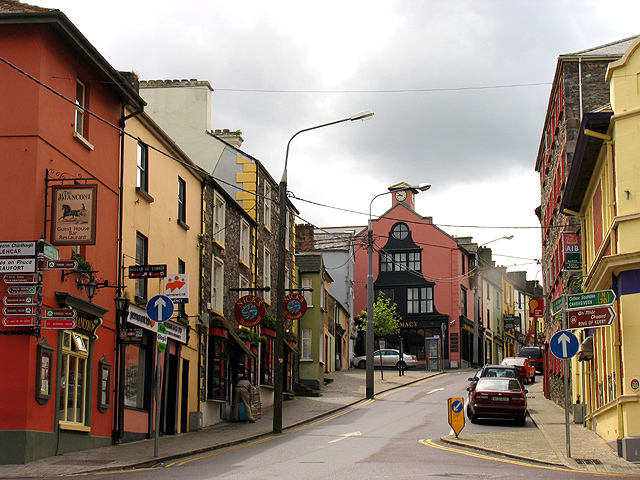
Killorglin (Irish: Cill Orglan, meaning 'Orgla's Church') is a town in County Kerry, Ireland. As of the 2022 census, the town's population was 2,163. Killorglin is on the Ring of Kerry tourist route, and annual events include the August Puck Fair festival, which starts with the crowning and parading of a "king" wild goat. The town is 26 km south of Tralee along the N70 road, and 22 km west of Killarney along the N72 road. Killorglin is in a civil parish of the same name.
The earliest evidence of ancient settlement in the Killorglin area is the presence of prehistoric rock art. These rock carvings are part of a Late Neolithic/Early Bronze Age tradition stretching across Atlantic Europe and occur in concentrations around the Iveragh and Dingle peninsulas, with a cluster close to the nearby town of Glenbeigh. There are also a number of ringforts and early Christian ecclesiastical sites in the townlands of Dromavally and Castleconway. The ruins of Killorglin Castle, later known as Castle Conway, are located close to what is now the centre of the town. It was built in the early 13th century by Maurice FitzGerald, 2nd Lord of Offaly.
The area was held by the FitzGerald dynasty until the confiscation of their lands following the Desmond Rebellions in the late 16th century. In 1587, as part of the Munster Plantation, Killorglin (and its castle) was granted to Captain Jenkin Conway.
Much of the town centre was laid out in the 19th century. Killorglin's Roman Catholic church was built (on the site of an earlier church) in 1891. The Church of Ireland church was originally built in 1816 and significantly redeveloped in 1868. The town hall was built in the early 20th century with the help of Andrew Carnegie.
On Ballykissane Pier is a monument to commemorate the deaths of several Irish Volunteers, the first casualties of the Easter Rising in 1916. They were in a car that plunged off the pier into the River Laune while on the way to make contact with Roger Casement and a German arms ship masquerading as the Aud.
On Good Friday 21 April 1916, six Irish Volunteers set off from Dublin by train to Killarney. From there, they were to travel by car to Cahirciveen in order to seize control of the wireless station on Valentia Island. Thomas McInerney, who drove a car carrying three of the men, become lost just outside Killorglin and turned onto the road which led to the quay. The front wheels of the car went over the edge of the quay, became unbalanced, and fell into the River Laune. McInerney was the only person to escape the car and swim to shore. The other three occupants remained trapped in the vehicle and drowned.
Fexco, a major financial services company, was founded in Killorglin in 1981 and is still headquartered in the town. Pharmaceutical firms Temmler and Astellas have small plants in Killorglin. It also has the operations centre for the Prize Bond Company.
A 100m wind turbine was erected at the Astellas Plant on the Tralee Road in 2012 and has become a local landmark
Hub AI
Killorglin AI simulator
(@Killorglin_simulator)
Killorglin
Killorglin (Irish: Cill Orglan, meaning 'Orgla's Church') is a town in County Kerry, Ireland. As of the 2022 census, the town's population was 2,163. Killorglin is on the Ring of Kerry tourist route, and annual events include the August Puck Fair festival, which starts with the crowning and parading of a "king" wild goat. The town is 26 km south of Tralee along the N70 road, and 22 km west of Killarney along the N72 road. Killorglin is in a civil parish of the same name.
The earliest evidence of ancient settlement in the Killorglin area is the presence of prehistoric rock art. These rock carvings are part of a Late Neolithic/Early Bronze Age tradition stretching across Atlantic Europe and occur in concentrations around the Iveragh and Dingle peninsulas, with a cluster close to the nearby town of Glenbeigh. There are also a number of ringforts and early Christian ecclesiastical sites in the townlands of Dromavally and Castleconway. The ruins of Killorglin Castle, later known as Castle Conway, are located close to what is now the centre of the town. It was built in the early 13th century by Maurice FitzGerald, 2nd Lord of Offaly.
The area was held by the FitzGerald dynasty until the confiscation of their lands following the Desmond Rebellions in the late 16th century. In 1587, as part of the Munster Plantation, Killorglin (and its castle) was granted to Captain Jenkin Conway.
Much of the town centre was laid out in the 19th century. Killorglin's Roman Catholic church was built (on the site of an earlier church) in 1891. The Church of Ireland church was originally built in 1816 and significantly redeveloped in 1868. The town hall was built in the early 20th century with the help of Andrew Carnegie.
On Ballykissane Pier is a monument to commemorate the deaths of several Irish Volunteers, the first casualties of the Easter Rising in 1916. They were in a car that plunged off the pier into the River Laune while on the way to make contact with Roger Casement and a German arms ship masquerading as the Aud.
On Good Friday 21 April 1916, six Irish Volunteers set off from Dublin by train to Killarney. From there, they were to travel by car to Cahirciveen in order to seize control of the wireless station on Valentia Island. Thomas McInerney, who drove a car carrying three of the men, become lost just outside Killorglin and turned onto the road which led to the quay. The front wheels of the car went over the edge of the quay, became unbalanced, and fell into the River Laune. McInerney was the only person to escape the car and swim to shore. The other three occupants remained trapped in the vehicle and drowned.
Fexco, a major financial services company, was founded in Killorglin in 1981 and is still headquartered in the town. Pharmaceutical firms Temmler and Astellas have small plants in Killorglin. It also has the operations centre for the Prize Bond Company.
A 100m wind turbine was erected at the Astellas Plant on the Tralee Road in 2012 and has become a local landmark