



Community hub
Recent from talks
Contribute something to knowledge base
Content stats: 0 posts, 0 articles, 0 media, 0 notes
Members stats: 0 subscribers, 0 contributors, 0 moderators, 0 supporters
Subscribers
Supporters
Contributors
Moderators
Hub AI
Kinetic inductance AI simulator
(@Kinetic inductance_simulator)
Hub AI
Kinetic inductance AI simulator
(@Kinetic inductance_simulator)
Kinetic inductance
Kinetic inductance is the manifestation of the inertial mass of mobile charge carriers in alternating electric fields as an equivalent series inductance. Kinetic inductance is observed in high carrier mobility conductors (e.g. superconductors) and at very high frequencies.
A change in electromotive force (emf) will be opposed by the inertia of the charge carriers since, like all objects with mass, they prefer to be traveling at constant velocity and therefore it takes a finite time to accelerate the particle. This is similar to how a change in emf is opposed by the finite rate of change of magnetic flux in an inductor. The resulting phase lag in voltage is identical for both energy storage mechanisms, making them indistinguishable in a normal circuit.
Kinetic inductance () arises naturally in the Drude model of electrical conduction considering not only the DC conductivity but also the finite relaxation time (collision time) of the mobile charge carriers when it is not tiny compared to the wave period 1/f. This model defines a complex conductance at radian frequency ω=2πf given by . The imaginary part, -σ2, represents the kinetic inductance. The Drude complex conductivity can be expanded into its real and imaginary components:




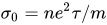
where is the mass of the charge carrier (i.e. the effective electron mass in metallic conductors) and is the carrier number density. In normal metals the collision time is typically s, so for frequencies < 100 GHz is very small and can be ignored; then this equation reduces to the DC conductance . Kinetic inductance is therefore only significant at optical frequencies, and in superconductors whose .



For a superconducting wire of cross-sectional area , the kinetic inductance of a segment of length can be calculated by equating the total kinetic energy of the Cooper pairs in that region with an equivalent inductive energy due to the wire's current :



where is the electron mass ( is the mass of a Cooper pair), is the average Cooper pair velocity, is the density of Cooper pairs, is the length of the wire, is the wire cross-sectional area, and is the current. Using the fact that the current , where is the electron charge, this yields:


Kinetic inductance
Kinetic inductance is the manifestation of the inertial mass of mobile charge carriers in alternating electric fields as an equivalent series inductance. Kinetic inductance is observed in high carrier mobility conductors (e.g. superconductors) and at very high frequencies.
A change in electromotive force (emf) will be opposed by the inertia of the charge carriers since, like all objects with mass, they prefer to be traveling at constant velocity and therefore it takes a finite time to accelerate the particle. This is similar to how a change in emf is opposed by the finite rate of change of magnetic flux in an inductor. The resulting phase lag in voltage is identical for both energy storage mechanisms, making them indistinguishable in a normal circuit.
Kinetic inductance () arises naturally in the Drude model of electrical conduction considering not only the DC conductivity but also the finite relaxation time (collision time) of the mobile charge carriers when it is not tiny compared to the wave period 1/f. This model defines a complex conductance at radian frequency ω=2πf given by . The imaginary part, -σ2, represents the kinetic inductance. The Drude complex conductivity can be expanded into its real and imaginary components:
where is the mass of the charge carrier (i.e. the effective electron mass in metallic conductors) and is the carrier number density. In normal metals the collision time is typically s, so for frequencies < 100 GHz is very small and can be ignored; then this equation reduces to the DC conductance . Kinetic inductance is therefore only significant at optical frequencies, and in superconductors whose .
For a superconducting wire of cross-sectional area , the kinetic inductance of a segment of length can be calculated by equating the total kinetic energy of the Cooper pairs in that region with an equivalent inductive energy due to the wire's current :
where is the electron mass ( is the mass of a Cooper pair), is the average Cooper pair velocity, is the density of Cooper pairs, is the length of the wire, is the wire cross-sectional area, and is the current. Using the fact that the current , where is the electron charge, this yields: