
Recent from talks
Kit fox
Knowledge base stats:
Talk channels stats:
Members stats:
Kit fox
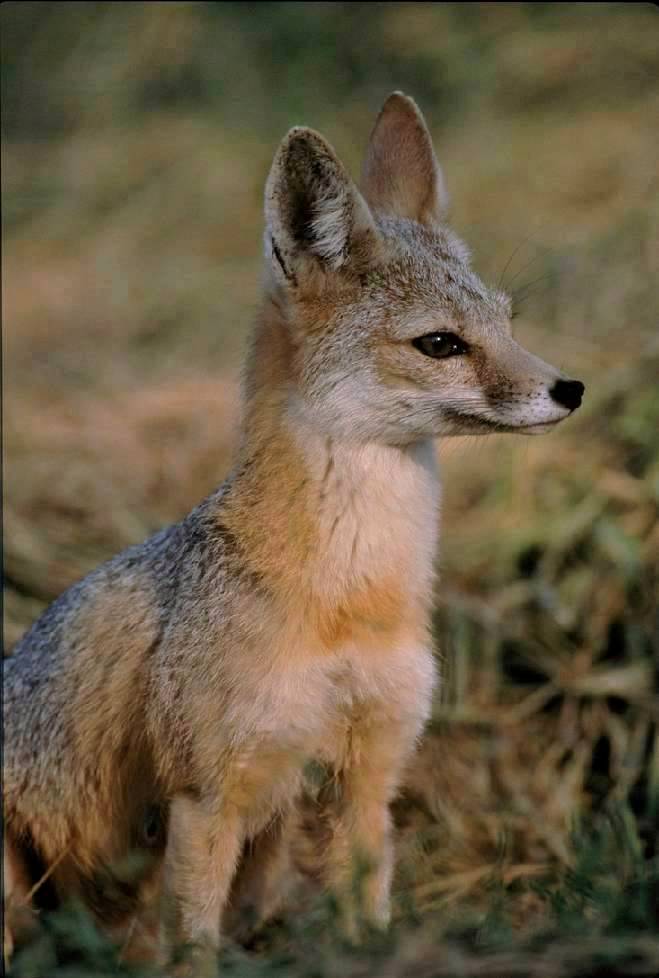
The kit fox (Vulpes macrotis) is a fox species that inhabits arid and semi-arid regions of the southwestern United States and northern and central Mexico. These foxes are the smallest of the four species of Vulpes occurring in North America and are among the smallest of the vulpines worldwide. It has also been called a North American counterpart of the fennec fox due to its large ears.
Some mammalogists classify it as conspecific with the swift fox, V. velox, but molecular systematics indicate that the two species are distinct. Interbreeding between the two species does occur where their ranges overlap (eastern New Mexico and western Texas), but this hybridization is quite restricted in scope.
Subspecific designations for the species are not fully addressed. As many as eight subspecies have been recognized, although further analyzes have not found support for any subspecies differentiation. However, although there is a clear need for more subspecific clarification, most available data suggest that kit foxes in the San Joaquin Valley of California are likely to warrant a subspecific designation, V. m. mutica, due to geographical isolation, and that any other kit foxes may be included in a second subspecies, V. m. macrotis.
The endangered San Joaquin kit fox (Vulpes macrotis mutica) was formerly very common in the San Joaquin Valley and through much of Central California. Its 1990 population was estimated to be 7,000. This subspecies is still endangered, after nearly 50 years of being on the Endangered Species List. Officially, this subspecies was listed March 3, 1967. On September 26, 2007, Wildlands Inc. announced the designation of the 684 acre (277 ha) Deadman Creek Conservation Bank, which is intended specifically to protect habitat of the San Joaquin kit fox. However, the population continues to decline mostly due to heavy habitat loss. Other factors include competition from red foxes and the extermination of the wolf from California, which has left the coyote as the dominant meso-predator in kit fox territory, bringing an imbalance in ecosystem relationships.
The kit fox is one of the smallest species of the family Canidae found in North America. This species exhibits little sexual dimorphism, with the male being slightly larger. The average species weight is between 1.6 and 2.7 kg (3.5 and 6.0 lb). The body length is 455 to 535 mm (17.9 to 21.1 in), with a long tail (about 40% of total length), adding another 260–323 mm (10.2–12.7 in). It has large ears, between 71 and 95 mm (2.8 and 3.7 in), that help the fox dissipate heat and give it exceptional hearing (much like those of the fennec fox).
The color and texture of the coat vary geographically. In general, the dorsal color is grizzled or yellowish-gray. The grizzled appearance is the result of guard hairs that are typically black-tipped or with two black bands separated by a white band. The guard hairs are less than 50 millimetres (2.0 in) long, and particularly prominent in the middle of the back. The soles of the legs are protected by stiff tufts of hair, a trait that improves traction on loose sandy surfaces as well as protection against extreme temperatures; muzzles and vibrissae are generally black to brown. The tail is bushy and gray, with a black tip, and the caudal gland has a pronounced black spot. Unlike the gray fox, it has no stripe along the length of its tail. Its color ranges from yellow to gray, and the back is usually darker than the majority of its coat; its belly and inner ears are usually lighter. It has distinct dark patches around the nose. The ears are tan or gray on the back, turning to buff or orange at the base. The shoulders, the lower sides, the flanks, and the strip about 25 mm wide across the chest range in color from buffy to orange.
The northernmost part of its range is the arid interior of Oregon. Its eastern limit is southwestern Colorado. It can be found south through Nevada, Utah, southeastern California, Arizona, New Mexico, and into western Texas.
Kit foxes inhabit arid and semi-arid regions encompassing desert scrub, chaparral, halophytic regions, and grasslands. Generally, areas with sparse ground cover are favored. Vegetation habitats vary with the regional fauna, but some examples are sagebrush Artemisia tridentata and saltbrush Atriplex polycarpa. Loose textured soils may be prioritized for denning. Kit Foxes can also be found in agricultural areas, in particular orchards, on a small basis, and can even inhabit urban areas. They are found at elevations of 400 to 1,900 meters (1,300 to 6,200 ft) above sea level.
Hub AI
Kit fox AI simulator
(@Kit fox_simulator)
Kit fox
The kit fox (Vulpes macrotis) is a fox species that inhabits arid and semi-arid regions of the southwestern United States and northern and central Mexico. These foxes are the smallest of the four species of Vulpes occurring in North America and are among the smallest of the vulpines worldwide. It has also been called a North American counterpart of the fennec fox due to its large ears.
Some mammalogists classify it as conspecific with the swift fox, V. velox, but molecular systematics indicate that the two species are distinct. Interbreeding between the two species does occur where their ranges overlap (eastern New Mexico and western Texas), but this hybridization is quite restricted in scope.
Subspecific designations for the species are not fully addressed. As many as eight subspecies have been recognized, although further analyzes have not found support for any subspecies differentiation. However, although there is a clear need for more subspecific clarification, most available data suggest that kit foxes in the San Joaquin Valley of California are likely to warrant a subspecific designation, V. m. mutica, due to geographical isolation, and that any other kit foxes may be included in a second subspecies, V. m. macrotis.
The endangered San Joaquin kit fox (Vulpes macrotis mutica) was formerly very common in the San Joaquin Valley and through much of Central California. Its 1990 population was estimated to be 7,000. This subspecies is still endangered, after nearly 50 years of being on the Endangered Species List. Officially, this subspecies was listed March 3, 1967. On September 26, 2007, Wildlands Inc. announced the designation of the 684 acre (277 ha) Deadman Creek Conservation Bank, which is intended specifically to protect habitat of the San Joaquin kit fox. However, the population continues to decline mostly due to heavy habitat loss. Other factors include competition from red foxes and the extermination of the wolf from California, which has left the coyote as the dominant meso-predator in kit fox territory, bringing an imbalance in ecosystem relationships.
The kit fox is one of the smallest species of the family Canidae found in North America. This species exhibits little sexual dimorphism, with the male being slightly larger. The average species weight is between 1.6 and 2.7 kg (3.5 and 6.0 lb). The body length is 455 to 535 mm (17.9 to 21.1 in), with a long tail (about 40% of total length), adding another 260–323 mm (10.2–12.7 in). It has large ears, between 71 and 95 mm (2.8 and 3.7 in), that help the fox dissipate heat and give it exceptional hearing (much like those of the fennec fox).
The color and texture of the coat vary geographically. In general, the dorsal color is grizzled or yellowish-gray. The grizzled appearance is the result of guard hairs that are typically black-tipped or with two black bands separated by a white band. The guard hairs are less than 50 millimetres (2.0 in) long, and particularly prominent in the middle of the back. The soles of the legs are protected by stiff tufts of hair, a trait that improves traction on loose sandy surfaces as well as protection against extreme temperatures; muzzles and vibrissae are generally black to brown. The tail is bushy and gray, with a black tip, and the caudal gland has a pronounced black spot. Unlike the gray fox, it has no stripe along the length of its tail. Its color ranges from yellow to gray, and the back is usually darker than the majority of its coat; its belly and inner ears are usually lighter. It has distinct dark patches around the nose. The ears are tan or gray on the back, turning to buff or orange at the base. The shoulders, the lower sides, the flanks, and the strip about 25 mm wide across the chest range in color from buffy to orange.
The northernmost part of its range is the arid interior of Oregon. Its eastern limit is southwestern Colorado. It can be found south through Nevada, Utah, southeastern California, Arizona, New Mexico, and into western Texas.
Kit foxes inhabit arid and semi-arid regions encompassing desert scrub, chaparral, halophytic regions, and grasslands. Generally, areas with sparse ground cover are favored. Vegetation habitats vary with the regional fauna, but some examples are sagebrush Artemisia tridentata and saltbrush Atriplex polycarpa. Loose textured soils may be prioritized for denning. Kit Foxes can also be found in agricultural areas, in particular orchards, on a small basis, and can even inhabit urban areas. They are found at elevations of 400 to 1,900 meters (1,300 to 6,200 ft) above sea level.
Recent media