
Recent from talks
Jack (playing card)
Knowledge base stats:
Talk channels stats:
Members stats:
Jack (playing card)
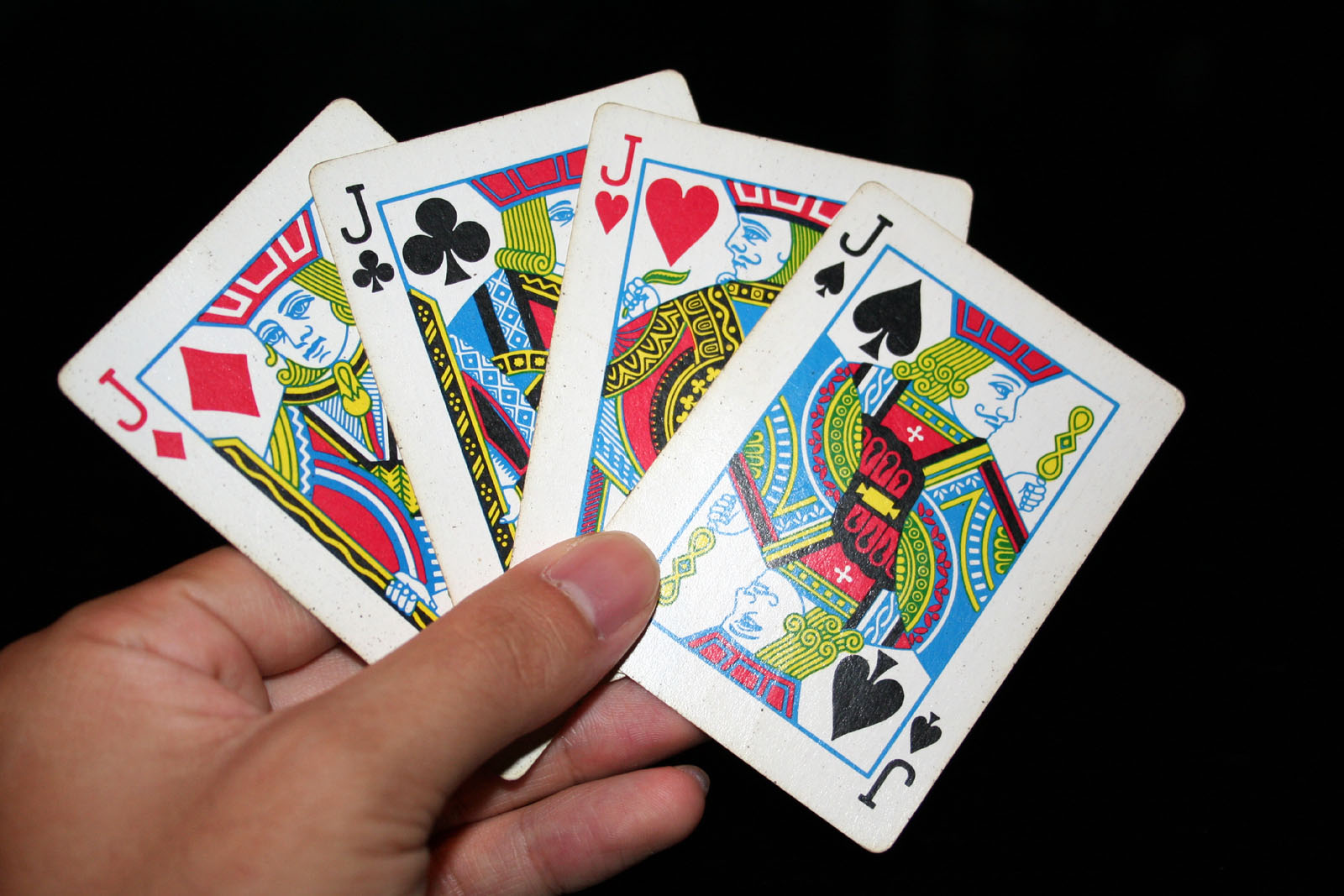
A Jack or Knave, in some games referred to as a Bower, in Tarot card games as a Valet, is a playing card which, in traditional French and English decks, pictures a man in the traditional or historic aristocratic or courtier dress generally associated with Europe of the 16th or 17th century. The usual rank of a jack is between the ten and the queen. The Jack corresponds to the Unter in German and Swiss-suited playing cards.
The earliest predecessor of the knave was the thānī nā'ib (second or under-deputy) in the Mamluk card deck. This was the lowest of the three court cards, and, like all court cards, was depicted via abstract art or calligraphy. When brought over to Italy and Spain, the thānī nā'ib was made into the fante (an infantry soldier) and the sota (a page, which ranks below the knight card) respectively. In France, where the card was called the valet, the queen was inserted between the king and the knight. The knight was subsequently dropped out of non-Tarot decks, leaving the valet directly under the queen. The king-queen-valet format then made its way into England.
As early as the mid-1500s, the card was known in England as the knave, which originally meant 'boy or young man', as its German equivalent, Knabe, still does. In the context of a royal household, it meant a male servant without a specific role or skill; not a cook, gardener, coachman, etc. The French word valet means the same thing.
The word 'Jack' was in common usage in the 16th and 17th centuries to mean any generic man or fellow, as in Jack-of-all-trades (one who is good at many things), Jack-in-the-box (a child's toy), or Jack-in-the-Pulpit (a plant).
The term became more entrenched in card play when, in 1864, American cardmaker Samuel Hart published a deck using "J" instead of "Kn" to designate the lowest-ranking court card. The knave card had been called a jack as part of the terminology of the game All Fours since the 17th century, but this usage was considered common or low class. However, because the card abbreviation for knave was so close to that of the king ("Kn" versus "K"), the two were easily confused. This confusion was even more pronounced after the markings indicating suits and rankings were moved to the corners of the card, a move which enabled players to "fan" a hand of cards without obscuring the individual suits and ranks. The earliest deck known of this type is from 1693, but such positioning did not become widespread until reintroduced by Hart in 1864, together with the knave-to-jack change. Books of card games published in the third quarter of the 19th century still referred to the "knave". Note the exclamation by Estella in Charles Dickens's novel Great Expectations: "He calls the knaves, jacks, this boy!". 'Knave' was the proper term, and it was considered uncouth to call them 'Jacks'. Nevertheless, in a few European countries, the equivalent of the name 'knave' for this card continues to the present. For example, in Denmark, it is the Knægt, symbol B (for Bonde); in Sweden, the knekt, symbol Kn.
The German nickname of Bauer ("farmer" or "peasant"), which is often used for the Jacks, appears in English as the loanword Bower, which is used for the top trumps (usually Jacks) in games of the euchre family, as well as some games of German origin in which the Jacks play a significant role, e.g. Reunion.
In the English pattern, the jack and the other face cards represent no one in particular, in contrast to the historical French practice, in which each court card is said to represent a particular historical or mythological personage. The valets in the Paris pattern have traditionally been associated with such figures as Ogier the Dane (a knight of Charlemagne and legendary hero of the chansons de geste) for the jack of spades; La Hire (French warrior) for the Jack of Hearts; Hector (mythological hero of the Iliad) for the jack of diamonds; and Lancelot or Judas Maccabeus for the jack of clubs.
In some southern Italian decks, there are androgynous knaves that are sometimes referred to as maids. In the Sicilian Tarot deck, the knaves are unambiguously female, and are likewise known as maids. As this deck also includes queens, it is the only traditional set to survive into modern times with two ranks of female face cards. This pack may have been influenced by the obsolete Portuguese deck, which also had female knaves. The modern Mexican pattern also has female knaves.
Hub AI
Jack (playing card) AI simulator
(@Jack (playing card)_simulator)
Jack (playing card)
A Jack or Knave, in some games referred to as a Bower, in Tarot card games as a Valet, is a playing card which, in traditional French and English decks, pictures a man in the traditional or historic aristocratic or courtier dress generally associated with Europe of the 16th or 17th century. The usual rank of a jack is between the ten and the queen. The Jack corresponds to the Unter in German and Swiss-suited playing cards.
The earliest predecessor of the knave was the thānī nā'ib (second or under-deputy) in the Mamluk card deck. This was the lowest of the three court cards, and, like all court cards, was depicted via abstract art or calligraphy. When brought over to Italy and Spain, the thānī nā'ib was made into the fante (an infantry soldier) and the sota (a page, which ranks below the knight card) respectively. In France, where the card was called the valet, the queen was inserted between the king and the knight. The knight was subsequently dropped out of non-Tarot decks, leaving the valet directly under the queen. The king-queen-valet format then made its way into England.
As early as the mid-1500s, the card was known in England as the knave, which originally meant 'boy or young man', as its German equivalent, Knabe, still does. In the context of a royal household, it meant a male servant without a specific role or skill; not a cook, gardener, coachman, etc. The French word valet means the same thing.
The word 'Jack' was in common usage in the 16th and 17th centuries to mean any generic man or fellow, as in Jack-of-all-trades (one who is good at many things), Jack-in-the-box (a child's toy), or Jack-in-the-Pulpit (a plant).
The term became more entrenched in card play when, in 1864, American cardmaker Samuel Hart published a deck using "J" instead of "Kn" to designate the lowest-ranking court card. The knave card had been called a jack as part of the terminology of the game All Fours since the 17th century, but this usage was considered common or low class. However, because the card abbreviation for knave was so close to that of the king ("Kn" versus "K"), the two were easily confused. This confusion was even more pronounced after the markings indicating suits and rankings were moved to the corners of the card, a move which enabled players to "fan" a hand of cards without obscuring the individual suits and ranks. The earliest deck known of this type is from 1693, but such positioning did not become widespread until reintroduced by Hart in 1864, together with the knave-to-jack change. Books of card games published in the third quarter of the 19th century still referred to the "knave". Note the exclamation by Estella in Charles Dickens's novel Great Expectations: "He calls the knaves, jacks, this boy!". 'Knave' was the proper term, and it was considered uncouth to call them 'Jacks'. Nevertheless, in a few European countries, the equivalent of the name 'knave' for this card continues to the present. For example, in Denmark, it is the Knægt, symbol B (for Bonde); in Sweden, the knekt, symbol Kn.
The German nickname of Bauer ("farmer" or "peasant"), which is often used for the Jacks, appears in English as the loanword Bower, which is used for the top trumps (usually Jacks) in games of the euchre family, as well as some games of German origin in which the Jacks play a significant role, e.g. Reunion.
In the English pattern, the jack and the other face cards represent no one in particular, in contrast to the historical French practice, in which each court card is said to represent a particular historical or mythological personage. The valets in the Paris pattern have traditionally been associated with such figures as Ogier the Dane (a knight of Charlemagne and legendary hero of the chansons de geste) for the jack of spades; La Hire (French warrior) for the Jack of Hearts; Hector (mythological hero of the Iliad) for the jack of diamonds; and Lancelot or Judas Maccabeus for the jack of clubs.
In some southern Italian decks, there are androgynous knaves that are sometimes referred to as maids. In the Sicilian Tarot deck, the knaves are unambiguously female, and are likewise known as maids. As this deck also includes queens, it is the only traditional set to survive into modern times with two ranks of female face cards. This pack may have been influenced by the obsolete Portuguese deck, which also had female knaves. The modern Mexican pattern also has female knaves.
Recent media