Hubbry Logo
Chanson de gesteChanson de gesteMain
Open search
Chanson de geste
Community hub
Chanson de geste
logo
8 pages, 0 posts
0 subscribers
Be the first to start a discussion here.
Chanson de geste
Chanson de geste
from Wikipedia

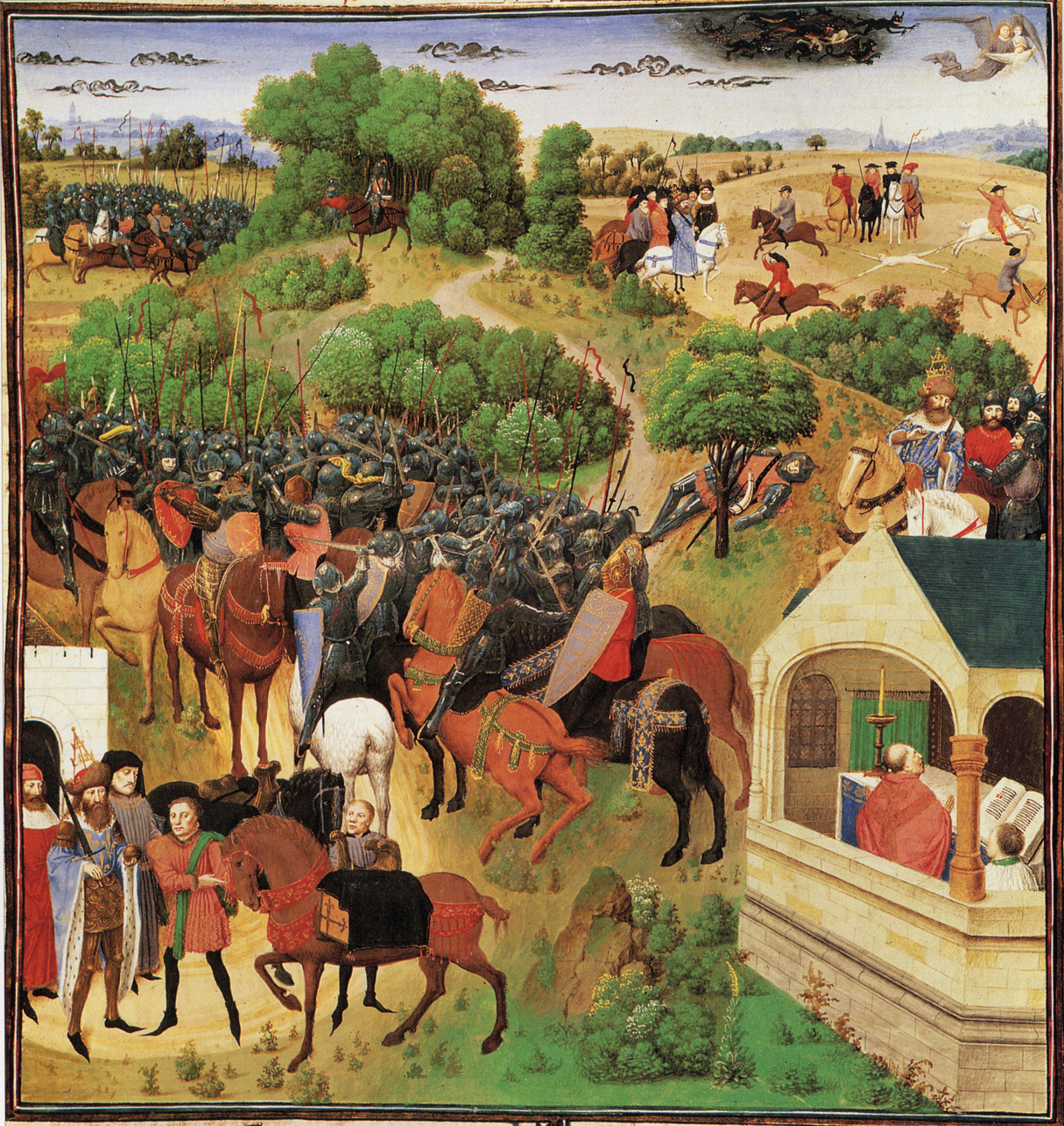
The eight phases of The Song of Roland in one picture.

The chanson de geste (Old French for 'song of heroic deeds',[a] from Latin: gesta 'deeds, actions accomplished'[1]) is a medieval narrative, a type of epic poem that appears at the dawn of French literature.[2] The earliest known poems of this genre date from the late 11th and early 12th centuries, shortly before the emergence of the lyric poetry of the troubadours and trouvères, and the earliest verse romances. They reached their highest point of acceptance in the period 1150–1250.[3]

Composed in verse, these narrative poems of moderate length (averaging 4000 lines[4]) were originally sung, or (later) recited, by minstrels or jongleurs. More than one hundred chansons de geste have survived in approximately three hundred manuscripts[5] that date from the 12th to the 15th century.

Origins

[edit]

Since the 19th century, much critical debate has centered on the origins of the chansons de geste, and particularly on explaining the length of time between the composition of the chansons and the actual historical events which they reference.[6] The historical events the chansons allude to occur in the 8th through 10th centuries, yet the earliest chansons that have survived were probably composed at the end of the 11th century: only three chansons de geste have a composition that incontestably dates from before 1150: the Chanson de Guillaume, The Song of Roland and Gormont et Isembart:[6] the first half of the Chanson de Guillaume may date from as early as the 11th century;[7][8] Gormont et Isembart may date from as early as 1068, according to one expert;[9] and The Song of Roland probably dates from after 1086[10] to c.1100.[6][11]

Three early theories of the origin of chansons de geste believe in the continued existence of epic material (either as lyric poems, epic poems or prose narrations) in these intervening two or three centuries.[12] Critics like Claude Charles Fauriel, François Raynouard and German Romanticists like Jacob Grimm posited the spontaneous creation of lyric poems by the people as a whole at the time of the historic battles, which were later put together to form the epics.[13] This was the basis for the "cantilena" theory of epic origin, which was elaborated by Gaston Paris, although he maintained that single authors, rather than the multitude, were responsible for the songs.[14]

This theory was also supported by Robert Fawtier and by Léon Gautier (although Gautier thought the cantilenae were composed in Germanic languages).[14] At the end of the 19th century, Pio Rajna, seeing similarities between the chansons de geste and old Germanic/Merovingian tales, posited a Germanic origin for the French poems.[14] A different theory, introduced by the medievalist Paul Meyer, suggested the poems were based on old prose narrations of the original events.[12][15]

Another theory (largely discredited today[16]), developed by Joseph Bédier, posited that the early chansons were recent creations, not earlier than the year 1000, developed by singers who, emulating the songs of "saints' lives" sung in front of churches (and collaborating with the church clerics[16]), created epic stories based on the heroes whose shrines and tombs dotted the great pilgrimage routes, as a way of drawing pilgrims to these churches.[17] Critics have also suggested that knowledge by clerics of ancient Latin epics may have played a role in their composition.[15][17]

Subsequent criticism has vacillated between "traditionalists" (chansons created as part of a popular tradition) and "individualists" (chansons created by a unique author),[15] but more recent historical research has done much to fill in gaps in the literary record and complicate the question of origins. Critics have discovered manuscripts, texts and other traces of the legendary heroes, and further explored the continued existence of a Latin literary tradition (cf. the scholarship of Ernst Robert Curtius) in the intervening centuries.[18] The work of Jean Rychner on the art of the minstrels[16] and the work of Parry and Lord on Yugoslavian oral traditional poetry, Homeric verse and oral composition have also been suggested to shed light on the oral composition of the chansons, although this view is not without its critics[19] who maintain the importance of writing not only in the preservation of the texts, but also in their composition, especially for the more sophisticated poems.[19]

Subject matter and structure

[edit]

Composed in Old French and apparently intended for oral performance by jongleurs, the chansons de geste narrate legendary incidents (sometimes based on real events) in the history of France during the 8th, 9th and 10th centuries, the age of Charles Martel, Charlemagne and Louis the Pious, with emphasis on their conflicts with the Moors and Saracens, and also disputes between kings and their vassals.

The traditional subject matter of the chansons de geste became known as the Matter of France. This distinguished them from romances concerned with the Matter of Britain, that is, King Arthur and his knights; and with the so-called Matter of Rome, covering the Trojan War, the conquests of Alexander the Great, the life of Julius Cæsar and some of his Imperial successors, who were given medieval makeovers as exemplars of chivalry.[20]

A key theme of the chansons de geste, which set them off from the romances (which tended to explore the role of the "individual"), is their critique and celebration of community/collectivity (their epic heroes are portrayed as figures in the destiny of the nation and Christianity)[21] and their representation of the complexities of feudal relations and service.

The subject matter of the chansons evolved over time, according to public taste. Alongside the great battles and scenes of historic prowess of the early chansons there began to appear other themes. Realistic elements (money, urban scenes) and elements from the new court culture (female characters, the role of love) began to appear.[3] Other fantasy and adventure elements, derived from the romances, were gradually added:[3] giants, magic, and monsters increasingly appear among the foes along with Muslims. There is also an increasing dose of Eastern adventure, drawing on contemporary experiences in the Crusades; in addition, one series of chansons retells the events of the First Crusade and the first years of the Kingdom of Jerusalem. The conflicts of the 14th century (Hundred Years' War) brought a renewed epic spirit and nationalistic (or propagandistic[22]) fervor to some chansons de geste (such as La Chanson de Hugues Capet).[23]

The poems contain an assortment of character types; the repertoire of valiant hero, brave traitor, shifty or cowardly traitor, Saracen giant, beautiful Saracen princess, and so forth. As the genre matured, fantasy elements were introduced. Some of the characters that were devised by the poets in this genre include the fairy Oberon, who made his literary debut in Huon de Bordeaux; and the magic horse Bayard, who first appears in Renaud de Montauban. Quite soon an element of self-parody appears; even the august Charlemagne was not above gentle mockery in the Pèlerinage de Charlemagne.

The narrative structure of the chanson de geste has been compared to the one in the Nibelungenlied and in creole legends by Henri Wittmann[24] on the basis of common narreme structure as first developed in the work of Eugene Dorfman[25] and Jean-Pierre Tusseau[26]

Versification

[edit]

Early chansons de geste were typically composed in ten-syllable lines grouped in assonanced (meaning that the last stressed vowel is the same in each line throughout the stanza, but the last consonant differs from line to line) stanzas (called laisses). These stanzas are of variable length.

An example from the Chanson de Roland illustrates the technique of the ten-syllable assonanced form. The assonance in this stanza is on e:

Desuz un pin, delez un eglanter
Un faldestoed i unt, fait tout d'or mer:
La siet li reis ki dulce France tient.
Blanche ad la barbe et tut flurit le chef,
Gent ad le cors et le cuntenant fier.
S'est kil demandet, ne l'estoet enseigner.

Translation:

Under a pine tree, by a rosebush,
there is a throne made entirely of gold.
There sits the king who rules sweet France;
his beard is white, with a full head of hair.
He is noble in carriage, and proud of bearing.
If anyone is looking for the King, he doesn't need to be pointed out.

Later chansons were composed in monorhyme stanzas, in which the last syllable of each line rhymes fully throughout the stanza. Later chansons also tended to be composed using alexandrines (twelve-syllable) lines, instead of ten-syllable lines (some early chansons, such as Girart de Vienne, were even adapted into a twelve-syllable version).

The following example of the twelve-syllable rhymed form is from the opening lines of Les Chétifs, a chanson in the Crusade cycle. The rhyme is on ie:

Or s'en fuit Corbarans tos les plains de Surie,
N'enmaine que .ii. rois ens en sa conpaignie.
S'enporte Brohadas, fis Soudan de Persie;
En l'estor l'avoit mort a l'espee forbie
Li bons dus Godefrois a le chiere hardie
Tres devant Anthioce ens en la prairie.

Translation:

So Corbaran escaped across the plains of Syria;
He took only two kings in his company.
He carried away Brohadas, son of the Sultan of Persia,
Who had been killed in the battle by the clean sword
Of the brave-spirited good duke Godfrey
Right in front of Antioch, down in the meadow.

These forms of versification were substantially different than the forms found in the Old French verse romances (romans) which were written in octosyllabic rhymed couplets.

Composition and performance

[edit]

The public of the chansons de geste—the lay (secular) public of the 11th to the 13th centuries—was largely illiterate,[27] except for (at least to the end of the 12th century) members of the great courts and (in the south) smaller noble families.[28] Thus, the chansons were primarily an oral medium.

Opinions vary greatly on whether the early chansons were first written down and then read from manuscripts (although parchment was quite expensive[29]) or memorized for performance,[30] or whether portions were improvised,[29] or whether they were entirely the product of spontaneous oral composition and later written down. Similarly, scholars differ greatly on the social condition and literacy of the poets themselves; were they cultured clerics or illiterate jongleurs working within an oral tradition? As an indication of the role played by orality in the tradition of the chanson de geste, lines and sometimes whole stanzas, especially in the earlier examples, are noticeably formulaic in nature, making it possible both for the poet to construct a poem in performance and for the audience to grasp a new theme with ease.

Scholarly opinions differ on the exact manner of recitation, but it is generally believed that the chansons de geste were originally sung (whereas the medieval romances were probably spoken)[30] by poets, minstrels or jongleurs, who would sometimes accompany themselves, or be accompanied, on the vielle, a mediæval fiddle played with a bow. Several manuscript texts include lines in which the jongleur demands attention, threatens to stop singing, promises to continue the next day, and asks for money or gifts.[29] By the middle of the 13th century, singing had probably given way to recitation.[3]

It has been calculated that a reciter could sing about a thousand verses an hour[31] and probably limited himself to 1000–1300 verses by performance,[27] making it likely that the performance of works extended over several days.[31] Given that many chansons from the late 12th century on extended to over 10,000 verses or more (for example, Aspremont comprises 11,376 verses, while Quatre Fils Aymon comprises 18,489 verses), it is conceivable that few spectators heard the longest works in their entirety.[32]

While poems like The Song of Roland were sometimes heard in public squares and were no doubt warmly received by a broad public,[33] some critics caution that the chansons should probably not be characterized as popular literature[34] and some chansons appear particularly tailored for an audience of aristocratic, privileged or warrior classes.[35]

List of chansons

[edit]

More than one hundred chansons de geste have survived in around three hundred manuscripts[5] that date from the 12th to the 15th century. Several popular chansons were written down more than once in varying forms. The earliest chansons are all (more or less) anonymous; many later ones have named authors.

By the middle of the 12th century, the corpus of works was being expanded principally by "cyclisation", that is to say by the formation of "cycles" of chansons attached to a character or group of characters—with new chansons being added to the ensemble by singing of the earlier or later adventures of the hero, of his youthful exploits ("enfances"), the great deeds of his ancestors or descendants, or his retreat from the world to a convent ("moniage") – or attached to an event (like the Crusades).[36]

About 1215 Bertrand de Bar-sur-Aube, in the introductory lines to his Girart de Vienne, subdivided the Matter of France, the usual subject area of the chansons de geste, into three cycles, which revolved around three main characters (see quotation at Matter of France). There are several other less formal lists of chansons, or of the legends they incorporate. One can be found in the fabliau entitled Des Deux Bordeors Ribauz, a humorous tale of the second half of the 13th century, in which a jongleur lists the stories he knows.[37] Another is included by the Catalan troubadour Guiraut de Cabrera in his humorous ensenhamen Cabra juglar: this is addressed to a juglar (jongleur) and purports to instruct him on the poems he ought to know but does not.[38]

The listing below is arranged according to Bertrand de Bar-sur-Aube's cycles, extended with two additional groupings and with a final list of chansons that fit into no cycle. There are numerous differences of opinion about the categorization of individual chansons.

Geste du roi

[edit]

The chief character is usually Charlemagne or one of his immediate successors. A pervasive theme is the King's role as champion of Christianity. This cycle contains the first of the chansons to be written down, the Chanson de Roland or "The Song of Roland".

Geste de Garin de Monglane

[edit]

The central character is not Garin de Monglane but his supposed great-grandson, Guillaume d'Orange. These chansons deal with knights who were typically younger sons, not heirs, who seek land and glory through combat with the Infidel (in practice, Muslim) enemy.

Geste de Doon de Mayence

[edit]

This cycle concerns traitors and rebels against royal authority. In each case the revolt ends with the defeat of the rebels and their eventual repentance.

Lorraine cycle

[edit]

This local cycle of epics of Lorraine traditional history, in the late form in which it is now known, includes details evidently drawn from Huon de Bordeaux and Ogier le Danois.

Crusade Cycle

[edit]

Not listed by Bertrand de Bar-sur-Aube, this cycle deals with the First Crusade and its immediate aftermath.

  • Chanson d'Antioche, apparently begun by Richard le Pèlerin c. 1100; earliest surviving text by Graindor de Douai c. 1180; expanded version 14th century
  • Les Chétifs telling the adventures (mostly fictional) of the poor crusaders led by Peter the Hermit; the hero is Harpin de Bourges. The episode was eventually incorporated, c. 1180, by Graindor de Douai in his reworking of the Chanson d'Antioche
  • Matabrune tells the story of old Matabrune and of the great-grandfather of Godefroi de Bouillon
  • Le Chevalier au Cigne tells the story of Elias, grandfather of Godefroi de Bouillon. Originally composed around 1192, it was afterwards extended and divided into several branches
  • Les Enfances Godefroi or "Childhood exploits of Godefroi" tells the story of the youth of Godefroi de Bouillon and his three brothers
  • Chanson de Jérusalem
  • La Mort de Godefroi de Bouillon, quite unhistorical, narrates Godefroi's poisoning by the Patriarch of Jerusalem
  • Baudouin de Sebourc (mid-14th century)
  • Bâtard de Bouillon (early 14th century)

Others

[edit]

The chansons de geste reached their apogee in the period 1150–1250.[3] By the middle of the 13th century, public taste in France had begun to abandon these epics, preferring, rather, the romances.[59] As the genre progressed in the middle of the 13th century, only certain traits (like versification, laisse structure, formulaic forms, setting, and other clichés of the genre) remained to set the chansons apart from the romances.[59] The 15th century saw the cycles of chansons (along with other chronicles) converted into large prose compilations (such as the compilation made by David Aubert).[23][60] Yet, the themes of the epics continued to exert an influence through the 16th century.[60]

Legacy and adaptations

[edit]

The chansons de geste created a body of mythology that lived on well after they ceased to be produced in France.

The French chanson gave rise to the Old Spanish tradition of the cantar de gesta.

The chanson de geste was also adapted in southern (Occitan-speaking) France. One of the three surviving manuscripts of the chanson Girart de Roussillon (12th century) is in Occitan,[61] as are two works based on the story of Charlemagne and Roland, Rollan a Saragossa[62] and Ronsasvals (early 12th century).[63] The chanson de geste form was also used in such Occitan texts as Canso d'Antioca (late 12th century), Daurel e Betó (first half of the 13th century), and Song of the Albigensian Crusade (c.1275) (cf Occitan literature).

In medieval Germany, the chansons de geste elicited little interest from the German courtly audience, unlike the romances which were much appreciated. While The Song of Roland was among the first French epics to be translated into German (by Konrad der Pfaffe as the Rolandslied, c.1170), and the German poet Wolfram von Eschenbach based his (incomplete) 13th century epic Willehalm (consisting of seventy-eight manuscripts) on the Aliscans, a work in the cycle of William of Orange (Eschenbach's work had a great success in Germany), these remained isolated examples. Other than a few other works translated from the cycle of Charlemagne in the 13th century, the chansons de geste were not adapted into German, and it is believed that this was because the epic poems lacked what the romances specialized in portraying: scenes of idealized knighthood, love and courtly society.[64]

In the late 13th century, certain French chansons de geste were adapted into the Old Norse Karlamagnús saga.

In Italy, there exist several 14th-century texts in verse or prose which recount the feats of Charlemagne in Spain, including a chanson de geste in Franco-Venetian, the Entrée d'Espagne (c.1320)[65] (notable for transforming the character of Roland into a knight errant, similar to heroes from the Arthurian romances[66]), and a similar Italian epic La Spagna (1350–1360) in ottava rima. Through such works, the "Matter of France" became an important source of material (albeit significantly transformed) in Italian romantic epics. Morgante (c.1483) by Luigi Pulci, Orlando innamorato (1495) by Matteo Maria Boiardo, Orlando furioso (1516) by Ludovico Ariosto, and Jerusalem Delivered (1581) by Torquato Tasso are all indebted to the French narrative material (the Pulci, Boiardo and Ariosto poems are founded on the legends of the paladins of Charlemagne, and particularly, of Roland, translated as "Orlando").

The incidents and plot devices of the Italian epics later became central to works of English literature such as Edmund Spenser's The Faerie Queene; Spenser attempted to adapt the form devised to tell the tale of the triumph of Christianity over Islam to tell instead of the triumph of Protestantism over Roman Catholicism.

The Welsh poet, painter, soldier and engraver David Jones's Modernist poem "In Parenthesis" was described by contemporary critic Herbert Read as having "the heroic ring which we associate with the old chansons de geste".

See also

[edit]

Notes

[edit]

References

[edit]
[edit]
Revisions and contributorsEdit on WikipediaRead on Wikipedia
from Grokipedia
The chanson de geste, meaning "song of heroic deeds" in , is a genre of medieval that narrates the valorous exploits of historical or legendary figures, particularly and his paladins, in the context of feudal warfare and Christian-Muslim conflicts. Emerging in the as the foundational form of , these long narrative poems were typically performed orally by professional reciters known as jongleurs to the accompaniment of stringed instruments, blending historical events with legendary embellishments to celebrate themes of loyalty, honor, and piety. The origins of the chanson de geste trace back to oral traditions inspired by real historical occurrences, such as the ambush at in 778 CE during Charlemagne's campaigns in , which evolved into written compositions by the late 11th century amid the fervor of the early . The oldest extant example, La Chanson de Roland, dates to circa 1100 CE and survives in a 12th-century , exemplifying the genre's focus on heroic sacrifice and betrayal. Structurally, these works are composed in decasyllabic (ten-syllable) lines organized into laisses—irregular stanzas unified by (vowel harmony) in early examples or rhyme in later ones—enabling rhythmic recitation and techniques like laisses similaires for emphasizing key dramatic moments through repetition and variation. Over 100 chansons de geste survive across approximately 300 manuscripts dating from the 12th to 15th centuries, grouped into three main cycles: the Geste du Roi centered on Charlemagne's reign and conflicts with Saracens (e.g., La Chanson de Roland); the Geste de Guillaume d'Orange depicting struggles to defend the realm (e.g., La Chanson de Guillaume); the Geste de Doon de Mayence concerning rebellious barons (e.g., Doon de Mayence); along with other cycles such as the Crusade cycle chronicling holy wars (e.g., La Chanson d'Antioche). These epics not only preserved a sense of French national identity and chivalric ideals during the but also influenced broader European literary traditions, including adaptations in prose romances and national histories.

Origins and Historical Context

Emergence and Dating

The chanson de geste refers to a of medieval epic poems composed in that celebrate heroic deeds and martial exploits, often set against the backdrop of the Carolingian era, and it emerged in the as the earliest major vernacular literary form in . These works originated primarily as oral compositions performed by jongleurs, reflecting the cultural and social values of feudal society in northern . The genre's foundational text is La Chanson de Roland, an anonymous epic dated to circa 1100, which dramatizes the death of the historical figure of , who is portrayed in the poem as Charlemagne's nephew. This poem draws on the real historical event of the ambush at in 778, when Basque forces attacked the Frankish rear guard during Charlemagne's retreat from , though the chanson transforms the incident into a Christian crusade against Saracens. Scholars have also proposed a possible composition shortly after the in 1066, based on accounts that the Norman minstrel Taillefer recited an early version of the Roland story to inspire troops before the engagement. Production of chansons de geste peaked during the 12th and early 13th centuries, a period when over 100 such poems were composed and preserved, predominantly in the northern French dialect known as the langue d'oïl. The genre began to wane by the late 13th century, supplanted by the growing popularity of prose romances and shifting audience preferences toward more courtly and fantastical narratives.

Sources and Influences

The term chanson de geste, meaning "song of heroic deeds," derives from the phrase geste or gestes, which referred to a lineage of heroic exploits or family sagas, and was popularized in modern scholarship during the by the medievalist Gaston Paris to categorize these epic poems. 's usage emphasized their narrative focus on deeds (gesta) of historical or legendary figures, distinguishing them from other medieval . The chansons de geste drew significant historical inspiration from the Carolingian era of the 8th and 9th centuries, particularly pseudo-histories and Latin chronicles depicting 's campaigns against Muslim forces in and . Einhard's (c. 830), a biography of , provided key details on events like the 778 , which formed the basis for epics such as the , transforming brief mentions of figures like into central heroic narratives. Other Latin sources, including chronicles by chroniclers like the Annales Regni Francorum, amplified Carolingian legends of imperial expansion and Christian victory, which were adapted into vernacular tales to evoke a sense of Frankish identity and martial prowess. Possible literary precursors include classical and late antique Latin epics, adapted into the Old French vernacular to suit feudal audiences. Virgil's Aeneid influenced the portrayal of heroic lineages and epic battles, with barbarian adversaries in the Roman poem evolving into the Saracen foes of the chansons, thereby framing Frankish heroes as heirs to a classical imperial tradition. Late antique works, such as Juvencus's Historia Evangelica (c. 330), a versified Gospel narrative, may have contributed to the blend of Christian piety and epic form, though direct transmission remains conjectural amid the broader shift from Latin to vernacular storytelling. The genre developed primarily in northern France, particularly in regions like and , where the dialect of the earliest manuscripts, such as the Oxford version of the Chanson de Roland, reflects local linguistic features. This emergence tied closely to the feudal society of the , emphasizing vassalage and knightly service amid the consolidation of Capetian power, while the Norman conquests of England () and southern Italy facilitated the spread of these epics across Europe. Early dissemination occurred along pilgrimage routes to , where jongleurs performed chansons evoking Charlemagne's legendary journey, using the paths as a backdrop for tales of and the paladins to engage traveling audiences.

Form and Poetics

Versification and Prosody

The versification of the chansons de geste is characterized by the decasyllabic line, consisting of ten s, which forms the rhythmic foundation of early works such as the Chanson de Roland. This ten-syllable structure, derived from popular oral traditions, emphasizes a steady, chant-like cadence suitable for performance by jongleurs. The line typically features a fixed medial after the fourth , dividing it into hemistichs of four and six s, respectively; this "epic caesura" creates balanced rhythmic units that facilitate memorization and delivery in public . Such prosodic features not only enhance the auditory appeal but also underscore key narrative moments through syntactic pauses and semantic emphasis. Rather than employing full rhyme, the poems rely on —a of s—to link lines, promoting a flexible yet cohesive phonetic pattern that echoes the improvisational nature of . This assonantal system binds verses into laisses, irregular stanzas of varying length, often spanning 10 to 60 lines, where the repeated sound unifies the group while allowing for narrative progression through thematic or rhythmic echoes. In , the laisses provided structural breaks, enabling the singer to pause, adjust pace, or engage the , as seen in examples from the Charroi de Nîmes where longer laisses amplify dramatic tension. Over time, particularly from the late twelfth century onward, the form evolved under influences from courtly lyric and romance traditions, with some texts adopting the dodecasyllabic line of twelve syllables for greater expressiveness. By the thirteenth century, a transition from to true became common, often appearing in hybrid forms within individual poems, reflecting broader shifts in medieval French toward more refined metrical precision. This evolution maintained the laissé structure but adapted it to support increasingly complex narratives, bridging epic and lyric modes.

Narrative Structure

The narrative structure of the chansons de geste is characterized by an episodic construction that builds linear narratives through a series of interconnected exploits, often organized into assonanced laisses as fundamental building blocks. These poems typically unfold as a sequence of distinct episodes centered on a single heroic fait (deed or exploit), such as a battle or quest, rather than encompassing a hero's full , which allows for focused dramatic intensity while permitting expansion in or manuscript variants. The structure emphasizes progression through repetition and variation, creating a rhythmic flow suited to oral delivery. Central to this episodic form are the laisses similaires and laisses parallèles, techniques that use groups of stanzas (laisses) to repeat and vary motifs for emphasis and emotional depth. Laisses similaires involve successive stanzas that reprise the same action or theme with slight modifications, such as intensifying a hero's agony or decision-making, as seen in the escalating calls of Roland's olifant in La Chanson de Roland (laisses 133–135), where the repetition heightens urgency and marks the passage of time. Laisses parallèles, by contrast, juxtapose parallel actions across characters or events to underscore contrasts or convergences, like the mirrored viewpoints of Marsilie and Ganelon in laisses 40–42 of the same poem, advancing the plot while reinforcing thematic tensions. These devices slow the at key moments, fostering a sense of inevitability and allowing jongleurs to recompose episodes on the fly. Common motifs provide the episodic scaffolding, including tournament preambles that set up conflicts through ritualistic gatherings, extended battle sequences featuring single combats or mass routs, scenes where feudal deliberations drive the plot, and interventions like prophetic dreams or divine signs that intervene in human affairs. For instance, battle sequences often follow standardized patterns of charge, clash, and retreat, while s depict baronial debates that propel the toward his fait. These elements recur across the corpus to maintain narrative momentum without exhaustive detail. The poems' scope reflects their performative origins, ranging from under 1,000 lines in shorter fragments to over 30,000 in expansive cycles, though most core texts span 2,000 to 20,000 lines to suit recitation over multiple sessions. This variability supports a focus on one or a few central exploits, enabling the integration of formulaic elements for efficiency. Formulaic language, including stock phrases like mult fu dolente (expressing profound grief) and type-scenes such as siege preparations or heroic enumerations, facilitates rapid composition and oral recomposition by providing reusable building blocks that evoke tradition without impeding the story's forward drive. These phrases and scenes, drawn from a shared epic repertoire, appear in hemistichs or full verses across multiple works, ensuring consistency in depicting emotions, actions, and settings.

Cycles and Major Works

Geste du Roi

The Geste du Roi, also known as the royal cycle, forms the foundational grouping within the chansons de geste, focusing on the exploits of as the and his loyal vassals in defending against external threats. This cycle portrays not merely as a historical figure but as an idealized monarch whose reign embodies imperial authority and Christian piety, surrounded by a cadre of elite warriors including his nephew , the steadfast Oliver, and the legendary Twelve Peers, who represent the pinnacle of chivalric devotion. Among the major works in this cycle, La Chanson de Roland stands as the preeminent example, narrating the betrayal and heroic last stand of and the rear guard at the in 778, where they perish defending 's forces from ambush, emphasizing themes of sacrifice and vengeance. Aspremont depicts the youthful 's conquests in against invaders, highlighting his early triumphs and the acquisition of sacred relics, while Pèlerinage de Charlemagne offers a satirical take on the emperor's pilgrimage to , where he engages in boastful contests with the Byzantine ruler Hugo, blending humor with dynastic prestige. These poems, along with others like Otinel and Fierabras, collectively underscore motifs of unwavering imperial loyalty, relentless warfare against Saracens as symbols of otherness, and the continuity of 's lineage through heroic progeny, reinforcing a vision of as the bulwark of . Approximately twenty surviving poems comprise the Geste du Roi, transmitted through manuscripts from the twelfth to fifteenth centuries, though many exist in fragmented or variant forms that reflect oral performance traditions. These works draw on a historical kernel from the eighth century, particularly Charlemagne's Iberian campaigns and the real Roncevaux defeat, but extensively fictionalize them to align with eleventh- and twelfth-century feudal ideals of vassal-homage and royal sovereignty, transforming Carolingian history into a mythic narrative of national identity.

Geste de Garin de Monglane

The Geste de Garin de Monglane, also known as the cycle of Guillaume d'Orange, constitutes one of the three principal cycles of chansons de geste, encompassing approximately 24 poems that trace the exploits of a lineage of southern French barons defending Christian territories against incursions. The central hero is Guillaume d'Orange (William of Orange), a semi-legendary figure modeled on the historical , count of Toulouse and in the late eighth and early ninth centuries, who served as Charlemagne's governor of the and later founded the of Gellone (modern ). Unlike the imperial grandeur of the Geste du Roi, this cycle emphasizes gritty regional autonomy, with Guillaume and his kin portrayed as loyal yet fiercely independent vassals who prioritize local defense over royal politics. Key texts within the cycle include La Chanson de Guillaume, an early twelfth-century Anglo-Norman poem dated to around 1130–1180, which survives in a relatively complete form of about 3,000 lines and recounts Guillaume's nephew Vivien's heroic at the battle of Aliscans against overwhelming forces, only for Guillaume to arrive too late for aid. Another foundational work is Aliscans, a major battle poem from the late twelfth century, focusing on the climactic confrontation at Aliscans where Guillaume, alongside his brothers and nephew, mounts a desperate defense emphasizing themes of familial solidarity and Christian perseverance amid defeat and revenge. The Charroi de Nîmes, composed in the first half of the twelfth century, depicts Guillaume's cunning conquest of the -held city of Nîmes, securing his through and combat after being overlooked by King Louis in land distributions, thus highlighting baronial initiative in territorial recovery. Recurring motifs in the cycle revolve around baronial independence and the Christian reconquest of southern regions like and , where heroes undertake defensive wars to reclaim lands from persistent threats, often without direct royal support. The geographic focus centers on locales such as Orange and Arles, evoking a strong sense of regional identity tied to the historical efforts in the valley and beyond. In contrast to the internal rebellions of the Geste de Doon de Mayence, these narratives underscore loyal yet pragmatic southern barons who embody feudal resilience. The appear as ethnic and religious others, symbolizing invasive forces that test the heroes' faith and martial prowess.

Geste de Doon de Mayence

The Geste de Doon de Mayence, also known as the cycle of the rebellious vassals or the geste du traître, forms the third principal cycle of chansons de geste, distinct from the royalist and defensive themes of other groupings by its focus on internal strife and noble insurrections against Charlemagne's authority. This cycle traces the genealogy of Doon de Mayence, a who seizes the imperial city of through treachery, establishing a lineage of defiant barons whose actions challenge the emperor's dominance and expose fractures in the feudal order. Comprising approximately 15 poems composed primarily between the late 12th and 14th centuries, the works emphasize generational conflicts rooted in perceived tyrannies, portraying the rebels not merely as antagonists but as figures compelled by injustice to defy the crown. Central to the cycle is the protagonist lineage descending from Doon through his son Séguin to later descendants such as Aymon de Dordonne and his four sons—Aymon, Renaut (Renaud), Richart, and Guischart—who embody the rebellious spirit in their outlaw existence. Renaut de stands out as a paradigmatic , leading his brothers in against Charlemagne's forces after a fatal quarrel over a chess game escalates into broader feud. This lineage underscores the cycle's exploration of inherited discord, where noble bloodlines perpetuate resistance against monarchical overreach, often culminating in fragile peaces that reaffirm feudal bonds while critiquing their fragility. Key works include Doon de Mayence, an early 13th-century poem that narrates the ancestor's usurpation of and his wars against loyalists like , highlighting themes of betrayal and territorial ambition. Les Quatre Fils Aymon (alternatively titled Renaut de ), one of the longest and most influential chansons de geste at over 18,000 lines, details the brothers' exploits as fugitives, their construction of the enchanted horse Bayard, and their eventual pilgrimage for absolution. Other significant poems, such as Maugis d'Aigremont and Auberi le Bourguignon, expand the with episodes of sorcery and further revolts, weaving a tapestry of interconnected yet loosely related narratives. Recurring motifs across the cycle include feudal arising from royal favoritism and vassal dispossession, the outlaw heroism of protagonists who thrive in through cunning and prowess, and resolutions through that restore hierarchical equilibrium. Magic and feature prominently, as in Maugis's use of allies and deceptive stratagems to aid his kin, serving to amplify the moral stakes of rebellion. These elements convey on the perils of unchecked royal power, portraying Charlemagne's as a site of that provokes noble uprising, while the poems' moralizing undertones warn against and disloyalty as paths to ruin. The cycle's emphasis on individual agency in defying systemic ties into broader heroic values, celebrating resilience amid feudal tensions.

Other Cycles

The Lorraine cycle, also termed the Geste des Lorrains, centers on intense family feuds and feudal rivalries in eastern France, particularly around Metz and Lorraine, depicting generational conflicts between the noble lineages of Garin and Fromont from the 8th century onward. Its principal work, Garin le Loherain (late 12th century), recounts the bloody wars between Garin, Duke of Lorraine, and his rival Fromont de Lens over control of territories and imperial favor under Charles Martel and Pippin, emphasizing themes of vengeance, loyalty, and the savagery of baronial strife while drawing on semi-legendary Carolingian-era figures. The cycle comprises five poems, beginning with the prequel Hervis de Metz (13th century) that establishes the ancestral backstory, followed by the core diptych of Garin le Loherain and its direct continuation Gerbert de Metz (both late 12th century), and later sequels such as Anseÿs de Mes and La Vengeance Raguidel (13th century), which resolve ongoing feuds through further battles and reconciliations, often involving divine or royal intervention. These texts, preserved in multiple manuscripts, underscore local traditions of eastern French identity and the tensions between regional lords and central authority, distinct from the broader royalist narratives of the Matter of France. The Crusade cycle, originating around 1180–1200, narrates events of the First Crusade (1096–1099) under Godefroi de Bouillon, integrating historical chronicles with epic heroism to celebrate Christian triumphs over Muslim forces. Comprising about 10 interconnected poems, it begins with ancestral legends in Bâtarde de Bouillon and progresses through key battles in La Chanson d'Antioche (c. 1180), Les Chétifs, and La Conquête de Jerusalem (early 13th century), which dramatize the siege of Antioch and capture of the Holy City. Later extensions, like La Chrétienté and Les Enfances de Godefroi, extend the narrative to post-crusade exploits, blending eyewitness accounts from sources such as the Gesta Francorum with fictional embellishments of chivalric valor. This cycle, influenced by contemporary pilgrimage fervor, totals around a dozen works and reflects the era's ideological fusion of warfare and piety. Beyond these, outlier cycles include the Enfances subgenre, youth tales appended to major heroes, such as Les Enfances Ogier (13th century), which details the early trials of Ogier le Danois in a to his rebellious arc, emphasizing formative knightly education and familial bonds. Hybrid compositions like Anseïs de (c. 1190–1220) merge epic motifs with courtly romance, following the adventures of a Saracen princess's son raised as a Christian , thus bridging cultural boundaries in a of conversion and alliance. Collectively, these minor and derivative cycles—numbering fewer than 20 extant texts—emerged predominantly in the , incorporating romance elements like amorous intrigue and exotic settings while preserving the assonanced laisses and heroic ethos of earlier chansons de geste.

Themes and Ideology

Heroic and Feudal Values

The chansons de geste prominently feature the feudal triad of obligations binding vassals to their lords: homage ( and ), ( in battle), and (advice in governance and disputes). This structure is vividly exemplified in La Chanson de Roland, where 's unwavering vassalage to encompasses personal through oaths of service, active combat support against forces, and strategic input during the Roncevaux campaign, underscoring the reciprocal bonds of protection and duty in medieval society. Central to the genre is the heroic of the parfait vassal or perfect , characterized by exceptional bravery, piety, and , often culminating in death amid scenarios of or overwhelming odds. Roland embodies this ideal through his relentless valor in and his ultimate at Roncevaux, refusing aid until too late to preserve his honor and lord's glory, a motif that elevates the as a model of unyielding commitment. Similarly, in the Guillaume cycle, figures like William of Orange demonstrate this by prioritizing feudal duty over personal survival in defensive battles. The narratives reinforce a rigid social hierarchy centered on noble lineage, or geste, portraying barons and knights as the primary defenders of feudal order and territorial integrity against internal and external threats. Lineage determines status and entitlement, with heroes deriving authority from ancestral claims, while disloyalty or cowardice invites severe condemnation and narrative punishment, as seen in depictions of traitorous vassals disrupting the chain of command. This emphasis critiques deviations from hierarchical norms, promoting baronial solidarity as essential to societal stability. Over time, the portrayal of these values evolved from a predominantly focus in the , emphasizing raw heroism and battlefield exploits, to greater moral introspection by century, where knights grapple with the ethical implications of and in more complex interpersonal dynamics. This shift reflects broader societal changes, incorporating didactic elements that probe the tensions between personal honor and collective duty.

Religion, Ethnicity, and Otherness

The chansons de geste are framed within a staunchly , where conflicts are depicted as holy wars (guerre sainte) against pagan adversaries, emphasizing divine intervention to affirm the righteousness of the Christian cause. Battles often feature , such as angelic appearances or aid, alongside the veneration of relics that bolster the ' morale and efficacy in combat; for instance, Turpin rallies troops with religious exhortations, promising and a martyr's in paradise, portraying as favoring the faithful and condemning the . This theological structure underscores the epics' role in promoting a crusading , with victory attributed to God's will rather than mere prowess. Saracens are routinely stereotyped as idolatrous antagonists who worship figures like Mahomet or Apollin as deities, embodying ethnic and religious otherness that sharpens the contrast with Frankish . Despite their portrayal as treacherous and demonic—often linked to infernal forces and moral depravity—they are occasionally granted noble warrior qualities, serving as worthy foils that highlight Christian heroism while reinforcing cultural binaries of superiority. This depiction of Saracens as a collective "other" not only justifies their subjugation but also solidifies the epics' function in bolstering Frankish ethnic cohesion amid perceived existential threats. Motifs of conversion frequently appear, particularly through Saracen princesses who renounce their faith upon falling in love with Christian knights, symbolizing both personal redemption and broader conquest of pagan lands. Exemplified in tales like La Prise d'Orange in the Guillaume cycle, where the princess Orable becomes the Christian Guibourc after aiding the , these narratives frame conversion as a pathway to integration, often tied to and the assimilation of Saracen nobility into Frankish society. Such elements idealize religious triumph without eradicating the ethnic divide entirely. These portrayals reflect historical ties to the and , yet they are markedly anachronistic, as 11th-century poems like the Chanson de Roland project 12th-century crusading zeal onto earlier Carolingian events, such as the 778 campaign against reimagined as a war against Muslims. This temporal displacement served to mythologize contemporary struggles, adapting epic traditions to inspire participation in ongoing holy wars.

Gender and Social Roles

In the chansons de geste, women are predominantly portrayed in passive roles, serving as mothers, wives, or symbols that motivate male heroes or function as rewards in feudal alliances. These figures often embody ideals of and but lack independent agency, reinforcing the genre's focus on masculine heroism and patrilineal inheritance. Rare exceptions highlight maternal ferocity or limited influence, such as Bernier's mother in Raoul de Cambrai, who intervenes to protect her son amid feudal conflicts, or Beatris, who asserts a distinctive voice in advocating for after personal losses. Non-knightly figures occupy marginal positions as social outsiders, serving primarily as foils to the central knightly protagonists and underscoring the hierarchical feudal order. Clerics, for instance, appear as supportive allies or moral authorities, exemplified by Archbishop Turpin in La Chanson de Roland, who wields both spiritual guidance and martial prowess to bolster Christian knighthood. Peasants and lower classes are depicted episodically, often as victims of or symbols of communal suffering, with little narrative depth that might explore their perspectives. Traitors, such as Ganelon in La Chanson de Roland, embody of vassalic oaths and are vilified to affirm as a core knightly virtue, while the emerging receives scant attention, reflecting the epics' rootedness in aristocratic concerns. Feminist scholarship has critiqued these representations for perpetuating patriarchal structures and a "monologic " that excludes women from the ethical and heroic value systems of the genre. Sarah , in her 1995 analysis, argues that gender in the chansons de geste operates as a relational predicate rather than a fixed category, with women's subjugation—through motifs like the exchange of daughters in marriage—serving as shorthand for political and feudal negotiations that marginalize subjectivity. This perspective, revisited in later discussions, highlights how epic narratives naturalize male dominance while occasionally disrupting it through ironic or resistant figures, such as Saracen women who convert but retain traces of agency in conquest stories. further notes that works like La Chanson de Guillaume exemplify this dynamic by subordinating women to homosocial bonds among men. By the 13th century, some chansons de geste show a modest , incorporating slightly more prominent voices influenced by courtly romance traditions, such as in cycles where women negotiate alliances or express with greater emotional depth. This shift subtly challenges the earlier monologic focus, though patriarchal frameworks persist.

Production and Transmission

Authorship and Composition

The authorship of most chansons de geste remains anonymous, with the poets behind these epic poems rarely identified in surviving texts. One partial exception appears in the colophon of the manuscript (Digby 23) of the Chanson de Roland, which states "Ci falt la geste que Turoldus declinet" (Here ends the song that Turold recounts), leading to ongoing scholarly debate about whether Turold was the poet, a , or a performer who adapted the work. Overall, the poems are frequently attributed to jongleurs—professional minstrels who recited them orally—or to clerics, reflecting the literate elite potentially involved in their initial creation. The composition of chansons de geste likely involved a blend of oral and written traditions, with origins possibly in monastic settings where clerics drew on historical annals and legends before adapting the material for secular performance. These works underwent iterative revisions over generations, a process known as mouvance, through which performers and copyists reinvented the narratives during and transcription, leading to variant versions that evolved while preserving core structures. Influenced by Albert Lord's The Singer of Tales (1960), the oral-formulaic theory posits that chansons de geste were recomposed in each performance using repetitive formulas—standard phrases or motifs—to facilitate and , much like in South Slavic epics. However, this application is debated, as the poems' written fixation in manuscripts suggests a literate that may imitate oral style rather than derive purely from live recomposition, with elements like irony and structured irony indicating authorial craft. Unlike courtly romances, which emphasize individual quests, fantasy, and personal desires, chansons de geste prioritize historical or pseudo-historical events, collective feudal obligations, and heroic deeds tied to real figures like , as exemplified in Jehan Bodel's early 13th-century classification of literary matters into the historical French matière of the geste, the Roman, and the fantastical British. This focus on communal history over individual fantasy underscores their role in reinforcing feudal and ideological values.

Manuscripts and Textual Variants

The survival of chansons de geste is attested through approximately one hundred poems preserved across around three hundred manuscripts, dating from the twelfth to the fifteenth centuries. These artifacts are predominantly housed in French institutional collections, such as the in , which holds numerous exemplars including fragments and full texts of epic cycles. A notable exception is the in , which preserves key insular copies like the celebrated Digby 23 manuscript. One of the most significant among these is Digby 23, a composite whose second part contains the earliest known copy of the Chanson de Roland, dating to the second quarter of the twelfth century and written in Anglo-Norman dialect. This manuscript exemplifies the regional linguistic variations evident in the corpus, with other exemplars reflecting dialects such as Picard, as seen in continental French versions that adapted the texts for local audiences. These dialectal differences often signal scribal interventions or regional recompositions, contributing to the genre's textual diversity. The chansons de geste exhibit considerable textual instability, with individual poems frequently surviving in multiple versions that diverge through expansions, omissions, or rearrangements. For instance, the Chanson de Roland exists in four complete Old French manuscripts, including the assonant Oxford version (O) and three rhymed ones: Châteauroux (C), Venice 7 (V7), and a related continental exemplar. Later variants, particularly the rhymed iterations like C and V7, incorporate pious interpolations—such as extended prayers, moral reflections, or amplified Christian motifs—that enhance the religious dimension of the narrative, reflecting evolving clerical influences during transmission. These variations underscore the oral-formulaic roots of the genre, where performers and scribes adapted content to contemporary contexts. Significant losses have diminished the corpus, with many manuscripts destroyed during the amid widespread and dispersal of monastic libraries. Recovery and standardization efforts emerged in the nineteenth century, notably through the pioneering editions of Francisque Michel, who transcribed and published the Oxford Roland in 1837, establishing a benchmark for philological study of the texts. Michel's work, drawing directly from Digby 23, facilitated broader access and comparative analysis of variants, preserving the material legacy of these medieval epics.

Performance and Audience

The chansons de geste were primarily performed orally by professional minstrels known as jongleurs, who declaimed or sang the epics to live audiences, often accompanied by string instruments such as the vielle. These itinerant performers, typically male, traveled across , delivering the poems in a rhythmic, formulaic style that facilitated memorization and improvisation during recitation. Evidence for this mode of delivery appears in self-referential passages within the texts themselves, such as in the mid-thirteenth-century Huon de , where a jongleur is depicted in the midst of performing an epic, adapting the to engage listeners directly. Performances took place in diverse settings, including noble halls after evening meals, bustling public squares and markets, and occasionally courts or even monastic refectories during feast days like or . Jongleurs were sometimes affiliated with confraternities that sponsored recitals, as documented in statutes from (1376–1564), where they entertained monks on major holidays, though such practices were most prevalent from the eleventh to thirteenth centuries. Full recitals of lengthy epics, which could span thousands of lines—such as the approximately 34,000 lines of Lion de —often extended over multiple days, with performers pausing and resuming to suit the occasion, whether a , pilgrimage stop, or urban gathering. Iconographic evidence from medieval manuscripts illustrates jongleurs performing without written aids, emphasizing the and communal experience. The primary audience consisted of laypeople, particularly the and emerging , alongside urban workers and occasionally religious communities, during the height of the genre's popularity in the eleventh to thirteenth centuries. These epics served an educational function, reinforcing feudal values such as , , and hierarchical through heroic narratives that mirrored societal ideals, as noted by thirteenth-century music theorist de Grocheio, who described such performances as vital for preserving civic harmony among the elderly, laborers, and middle classes. Sermons from the period, like one by Daniel of (1272), highlight the moral impact, drawing parallels between epic heroes and saints to instruct listeners emotionally and ethically, with crowds reportedly moved to tears during public recitals on bridges. This reception underscores the chansons' role in shaping and values among non-clerical audiences.

Legacy and Modern Reception

Influence on Later Literature

The Matter of France, central to the chansons de geste, exerted influence on Arthurian romances by introducing epic elements of feudal loyalty, heroic combat, and crusader motifs into the , creating hybrid narratives that blended the two traditions. In works such as the Bataille Loquifer and the Huon de Bordeaux cycle, Arthurian characters like and appear in epic contexts, where romance motifs—such as trials in or the fairy realm of Féerie—enhance the chivalric identity of epic heroes like Rainouart and Huon, transforming the supernatural from a romance device into a testing ground for epic valor. This intermingling is evident in the Istoire d’Ogier le redouté, where Ogier's journey to integrates Arthurian interludes to underscore themes of paternity and redemption, drawing directly from Vulgate Cycle romances while adapting them to the chanson's structure. In medieval extensions beyond , the chansons de geste inspired adaptations in and . The 13th-century Karlamagnús saga, a Norse prose compilation, translates and synthesizes multiple epics, including elements from the Chanson de Roland and the Guillaume cycle, into a cohesive narrative that mirrors the cyclic organization of French geste manuscripts while incorporating Scandinavian heroic ideals. Similarly, Italian cantari—narrative poems in —emerged in the as vernacular adaptations of Carolingian epics, with works like the Cantari di Aspramonte and Cantari di Rinaldo da Monte Albano Italianizing French characters and settings for oral performance. Andrea da Barberino's early 15th-century prose compilation I Reali di Francia further exemplifies this by weaving together chansons such as Aspromonte and Storie nerbonesi into a unified genealogical epic, serving as a bridge to verse traditions. Renaissance adaptations amplified the chansons' legacy through chivalric romances and ballads. Luigi Pulci's Morgante (completed 1478), a burlesque epic precursor to the Orlando cycle, reworks the material from the , infusing French paladin adventures with Italian humor and humanism while echoing the Chanson de Roland's themes of betrayal and heroism. In , the romanceros—traditional ballads—drew extensively from the Roland cycle, as seen in the Romance de Durandarte, which fragments the epic's tragic climax at Roncevaux into poignant vignettes of knightly death and mourning, blending chanson motifs with Iberian oral traditions. The genre's crusader themes permeated national epics of the early modern period, shaping heroic narratives of conquest and faith. Torquato Tasso's Gerusalemme Liberata (1581) incorporates chanson de geste elements like communal Christian warfare against Saracen foes, drawing on Crusade chronicles and epic motifs of divine intervention and siege combat to depict the First Crusade's capture of Jerusalem, thereby elevating medieval French heroic ideals into a Renaissance synthesis of classical and Christian epic. Luís de Camões' Os Lusíadas (1572) similarly evokes crusader motifs from the Matter of France in its portrayal of Vasco da Gama's voyages as a providential extension of medieval holy wars, adapting epic cycles' emphasis on imperial destiny and maritime peril to celebrate Portuguese expansion. By the 14th century, these influences extended to prose historiography, as in Jean Froissart's chronicles, which embed chanson-style heroic battles and feudal oaths into accounts of the Hundred Years' War, transforming epic verse traditions into narrative history.

Scholarship and Critical Approaches

The scholarly study of the chanson de geste began in the with foundational work that emphasized its role in establishing a national literary tradition. Gaston Paris, in his 1865 Histoire poétique de Charlemagne, proposed the influential cycle theory, classifying the epics into three main groupings—the (focused on ), the Matter of William of Orange, and the Matter of Doon de Mayence—based on shared heroic lineages and thematic continuities across poems. This framework highlighted the interconnectedness of the corpus and positioned the chansons as the epic foundation of , often likened to 's works in nationalistic scholarship that celebrated them as the "French Homer" amid post-Revolutionary efforts to forge a cultural identity. Paris's approach, rooted in philological , prioritized textual reconstruction and historical contextualization, influencing generations of editors and historians. The 20th century marked a shift toward oralist and structuralist perspectives, challenging the 19th-century emphasis on written authorship and linear evolution. 's oral-formulaic theory, developed in the through studies of Homeric epics, posited that repetitive formulas facilitated composition-in-performance by traditional singers; this was extended to the chansons de geste by scholars like Jean Rychner in his 1956 La chanson de geste, which analyzed laisses similaires (thematic repetitions) as evidence of jongleur improvisation rather than fixed literary texts. Structuralist analyses further explored these patterns, examining narrative deep structures and binary oppositions (e.g., Christian vs. ) to uncover underlying mythic frameworks, as in 's comparative studies of epic motifs across cycles. These methods moved beyond biographical attributions to emphasize the genre's performative and collective dynamics, integrating linguistic and anthropological insights. From 2000 to 2025, scholarship has increasingly critiqued earlier biases while adopting interdisciplinary lenses to address methodological gaps. Sarah Kay's 1995 The Chansons de Geste in the Age of Romance: Political Fictions interrogated 19th-century nationalist and positivist assumptions, revealing how cycles constructed feudal ideologies amid romance influences; subsequent discussions have updated these critiques to highlight genre hybridity and ideological manipulations. William W. Kibler's contributions, notably in the 2014 edited volume Au carrefour des routes d'Europe: la chanson de geste, traced the genre's evolution through European transmissions, emphasizing adaptations beyond and challenging monolithic views of its decline. Recent work, such as the 2022 PhD thesis Time of the Telling: Affective Temporalities in the Chansons de Geste by Simon Thomas, explores how temporal structures evoke emotional responses to heroism and loss, integrating to reframe the epics' psychological depth. More recent scholarship includes a 2023 DPhil thesis at the , Conceptualising national identity in late twelfth-century chansons de geste, which challenges traditional boundaries in analyzing through the epics. To bridge positivist limitations, scholars have turned to for performance ethnographies and postcolonial readings that reexamine Saracens not as mere antagonists but as sites of cultural negotiation and otherness, as in analyses of conversion motifs that critique orientalist legacies. These approaches occasionally intersect with feminist perspectives on gender roles, though they prioritize broader socio-political reinterpretations.

Adaptations and Digital Resources

In the 20th and 21st centuries, chansons de geste have inspired various media adaptations that reinterpret their heroic themes for modern audiences. A notable example is the 1978 French film La Chanson de Roland, directed by Frank Cassenti, which dramatizes the epic's central battle and themes of and betrayal, starring as . Video games have also incorporated motifs from these epics, such as the Age of Empires II series (including its 2024 Victors and Vanquished DLC campaign featuring ), which blend historical strategy with elements of feudal valor inspired by paladins like . Modern literary adaptations include English translations of lesser-known works like Aiol, a 13th-century chanson de geste, rendered accessible through Sandra C. Malicote and A. Richard Hartman's 2014 edition, which provides the first complete English version alongside the original text. Contemporary translations and editions have broadened access to these texts through bilingual formats and digital enhancements. The Penguin Classics edition of The Song of Roland, translated by Dorothy L. Sayers in 1957 and reissued in subsequent decades, offers a poetic English rendering that captures the epic's rhythmic intensity, making it a staple for English-speaking readers. In German literary traditions, adaptations such as Herpin—a 15th-century prose version of the French Lion de Bourges—have been digitized by the Heidelberg University Library, allowing scholars to explore its expansions on chivalric motifs in a searchable online format. Digital projects have revolutionized the study and dissemination of chansons de geste by creating interactive resources for textual . The of Antioch Project at , an ongoing initiative since the early , provides a TEI-encoded digital edition of the late 12th-century Siège d'Antioche, enabling users to navigate its over 400 rhymed laisses and compare manuscript variants (including with the related Chanson d'Antioche) related to the . Complementing this, the Textual Sources of the Chanson de Geste collection within the Andy Holt Virtual Library aggregates digitized manuscripts of medieval French vernacular texts, including epic cycles, to facilitate on over 800 documents. Quantitative analyses have further advanced understanding, as seen in the 2015 Digital Humanities conference presentation on interactive visual alignment tools, which apply computational methods to collate variants in chansons de geste and related romances, revealing patterns of textual evolution. These adaptations underscore the enduring relevance of chansons de geste in education and cultural heritage. Sites associated with , such as the Roland statue on Bremen's marketplace, received UNESCO World Heritage recognition in as symbols of medieval civic autonomy, drawing tourists and educators to explore the epics' historical roots. In contemporary reinterpretations, feminist perspectives have emerged in graphic novels that reexamine gender dynamics, such as those drawing on the epics' portrayals of female agency amid warrior narratives, promoting discussions in classrooms and heritage programs.

References

Add your contribution
Related Hubs
User Avatar
No comments yet.