



Community hub
Recent from talks
Contribute something to knowledge base
Content stats: 0 posts, 0 articles, 1 media, 0 notes
Members stats: 0 subscribers, 0 contributors, 0 moderators, 0 supporters
Subscribers
Supporters
Contributors
Moderators
Hub AI
Kumbhalgarh AI simulator
(@Kumbhalgarh_simulator)
Hub AI
Kumbhalgarh AI simulator
(@Kumbhalgarh_simulator)
Kumbhalgarh
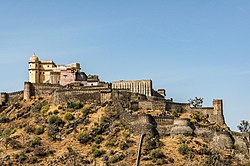
Kumbhalgarh also known as the Great Wall of India, is a fortress located on the western range of the Aravalli Hills in Kumbhalgarh, Rajsamand district, Rajasthan, India. Located approximately 48 km (30 mi) from Rajsamand and 84 km (52 mi) from Udaipur, the fort was constructed in the 15th century by Rana Kumbha. The wall of Kumbhalgarh is one of the longest continuous walls in the world, spanning 36 kilometers. It is also the birthplace of great king and military leader Maharana Pratap of Mewar.
In 2013, at the 37th session of the World Heritage Committee held in Phnom Penh, Cambodia, Kumbhalgarh Fort, along with five other forts of Rajasthan, was declared a UNESCO World Heritage Site under the group Hill Forts of Rajasthan.
The name Kumbhalgarh derives from Rana Kumbha (r. 1433–1468), the Mewar ruler who commissioned the construction of the fort in the 15th century. The suffix "-garh" is a common Indo-Aryan term meaning "fort" (from Sanskrit gṛha or durga), hence "Kumbhalgarh" literally means "Kumbha's Fort". The region around the fort gradually adopted the same name due to the prominence of the structure and its founder.
Rana Lakha won this entire area and plains of Godwar from Chauhan Rajputs of Nadol in late 14th century.
Kumbhalgarh fort was built by Mandan who was the chief architect of the Kingdom of Mewar. Rana Kumbha ordered for the construction of the fort in 1448 AD according to the Kumbhalgarh inscription. The fort served as Rana Kumbha's second most favoured capital. Rana Kumbha's kingdom of Mewar stretched from Ranthambore to Gwalior and included large tracts of what is now Madhya Pradesh and Rajasthan. Out of the 84 forts in his dominion, Rana Kumbha is said to have built 32 of them, of which Kumbhalgarh is the largest and most elaborate.
Ahmad Shah II of Gujarat attacked the fort in 1457, but found the effort futile. There was a local belief then that the Banmata deity in the fort protected it and hence he destroyed the temple. There were further attempts in 1458–59 and 1467 by Mahmud Khalji, but it also proved futile. Akbar's general, Shahbaz Khan, attacked this fort in October 1577 and after the siege of 6 months, he was able to capture the fort in April 1578. But it was recaptured by Maharana Pratap in 1583. In 1818, an armed band of sanyasis formed a garrison to protect the fort, but was convinced[clarification needed] by James Tod and the fort was taken over by the British and later returned to Udaipur State. There were additions made by Maharanas of Mewar, but the original structure built by Maharana Kumbha remains. The residential buildings and temples are well-preserved. The fort is also known to be the birthplace of Maharana Pratap.
The chief architect who built this fort was Mandan, who documented his style of work in his text, Rajvallabh. Built on a hilltop 1,100 m (3,600 ft) above sea level on the Aravalli range, the fort of Kumbhalgarh has perimeter walls that extend 36 km (22 mi), making it among the longest walls in the world. The frontal walls are 4.5 m (15 ft). Kumbhalgarh has seven fortified gateways. There are over 360 temples within the fort, both Jain and Hindu Temples. From the palace top, it is possible to see Kilometres into the Aravalli Range.
Aaret Pol was the first entry gate of the fort. Halla Pol is on the downward slope from the entrance. Just after Halla Pol is Badshahi Bavdi, a stepped tank, built after the invasion of Shahbaz Khan in 1578, the general of Mughal emperor Akbar to provide water to the troops.
Kumbhalgarh
Kumbhalgarh also known as the Great Wall of India, is a fortress located on the western range of the Aravalli Hills in Kumbhalgarh, Rajsamand district, Rajasthan, India. Located approximately 48 km (30 mi) from Rajsamand and 84 km (52 mi) from Udaipur, the fort was constructed in the 15th century by Rana Kumbha. The wall of Kumbhalgarh is one of the longest continuous walls in the world, spanning 36 kilometers. It is also the birthplace of great king and military leader Maharana Pratap of Mewar.
In 2013, at the 37th session of the World Heritage Committee held in Phnom Penh, Cambodia, Kumbhalgarh Fort, along with five other forts of Rajasthan, was declared a UNESCO World Heritage Site under the group Hill Forts of Rajasthan.
The name Kumbhalgarh derives from Rana Kumbha (r. 1433–1468), the Mewar ruler who commissioned the construction of the fort in the 15th century. The suffix "-garh" is a common Indo-Aryan term meaning "fort" (from Sanskrit gṛha or durga), hence "Kumbhalgarh" literally means "Kumbha's Fort". The region around the fort gradually adopted the same name due to the prominence of the structure and its founder.
Rana Lakha won this entire area and plains of Godwar from Chauhan Rajputs of Nadol in late 14th century.
Kumbhalgarh fort was built by Mandan who was the chief architect of the Kingdom of Mewar. Rana Kumbha ordered for the construction of the fort in 1448 AD according to the Kumbhalgarh inscription. The fort served as Rana Kumbha's second most favoured capital. Rana Kumbha's kingdom of Mewar stretched from Ranthambore to Gwalior and included large tracts of what is now Madhya Pradesh and Rajasthan. Out of the 84 forts in his dominion, Rana Kumbha is said to have built 32 of them, of which Kumbhalgarh is the largest and most elaborate.
Ahmad Shah II of Gujarat attacked the fort in 1457, but found the effort futile. There was a local belief then that the Banmata deity in the fort protected it and hence he destroyed the temple. There were further attempts in 1458–59 and 1467 by Mahmud Khalji, but it also proved futile. Akbar's general, Shahbaz Khan, attacked this fort in October 1577 and after the siege of 6 months, he was able to capture the fort in April 1578. But it was recaptured by Maharana Pratap in 1583. In 1818, an armed band of sanyasis formed a garrison to protect the fort, but was convinced[clarification needed] by James Tod and the fort was taken over by the British and later returned to Udaipur State. There were additions made by Maharanas of Mewar, but the original structure built by Maharana Kumbha remains. The residential buildings and temples are well-preserved. The fort is also known to be the birthplace of Maharana Pratap.
The chief architect who built this fort was Mandan, who documented his style of work in his text, Rajvallabh. Built on a hilltop 1,100 m (3,600 ft) above sea level on the Aravalli range, the fort of Kumbhalgarh has perimeter walls that extend 36 km (22 mi), making it among the longest walls in the world. The frontal walls are 4.5 m (15 ft). Kumbhalgarh has seven fortified gateways. There are over 360 temples within the fort, both Jain and Hindu Temples. From the palace top, it is possible to see Kilometres into the Aravalli Range.
Aaret Pol was the first entry gate of the fort. Halla Pol is on the downward slope from the entrance. Just after Halla Pol is Badshahi Bavdi, a stepped tank, built after the invasion of Shahbaz Khan in 1578, the general of Mughal emperor Akbar to provide water to the troops.
Recent media
Recent media