
Recent from talks
Kwekwe
Knowledge base stats:
Talk channels stats:
Members stats:
Kwekwe
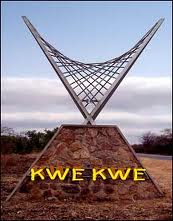
Kwekwe (/ˈkwɛkwɛ/ KWEH-kweh), formerly known as Que Que, is a city in the Midlands province in central Zimbabwe. The city has a population of 119,863 within the city limits, as of the 2022 census, making it the 7th-largest city in Zimbabwe and the second-most populous city in the Midlands, behind Gweru.
It is located in Kwekwe District, in the Midlands, in the centre of the country, roughly equidistant from Harare to the northeast and Bulawayo to the southwest. It has witnessed robust population growth since the 1980s, growing from 47,607 in 1982, 75,425 in 1992 and the preliminary result of the 2002 census suggests a population of 88,000. In 2012, the city's population was estimated at 100,900 people. It is home to significant steel and fertilizer production.
Kwekwe and neighbouring Redcliff are the headquarters of Zimbabwe Iron and Steel Company (ZISCO), the country's largest steelworks. It also hosts the Zimbabwe Iron and Smelting Company (ZIMASCO), the largest ferrochrome producer, and one of the biggest power generating plants, ZPC-Munyati, in Munyati, a suburb of Kwekwe. Kwekwe is Zimbabwe's richest city in terms of minerals.[citation needed]
The town was founded in 1898 as a gold mining town, and hosts Zimbabwe's National Mining Museum. Like much of the Midlands, KweKwe owes its prosperity to the Great Dyke and its mineral wealth which stretches down to Gwanda, some 500 km southwest. The towns name originates from the large population of croaking frogs that populated the Kwekwe river in the early 1900s, hence its original name Que Que. The promise of wealth at the time attracted thousands of speculators from as far afield as Australia and New Zealand. Though the amount of gold found was underwhelming, deposits of chrome, and the production of iron, steel, aluminum and glass, have kept the city growing since.[citation needed]
KweKwe remains an industrial centre of the country. The name stems from the Zulu word "isikwekwe", which means "scurvy", "mange" or "scab". In recent years, the area has attempted to diversify its economic base to education, tourism, and services, attracting a growing campus of Midlands State University, though its tourism industry remains at infancy, compared to larger cities. Although Kwekwe has successfully diversified its economy and continues to grow, especially compared to de-industrialising Bulawayo, the city continues to face the same economic challenges facing the rest of the country.[citation needed]
The town is situated on Zimbabwe's Highveld at an altitude of 1,220 metres (4,000 ft), above sea level. It is located in the tropics but its high altitude modifies this to a warm temperate or humid subtropical climate.
The average annual temperature is 19 °C (66 °F). As with much of the Highveld, summers are long and pleasant, as the temperature depends on the amount of cloudiness and indirectly the amount of rain received. Drought years are hotter than wetter years. The climate is hot and wet during the summer rainy season from mid November to mid March, with cool, dry weather from May to mid-August in the winter season, and warm dry weather from August to mid November. During summertime, the average temperature is around 25 °C (77 °F) at daytime, but it can get above 30 °C (86 °F) on the hottest days.
Winters are characterised mainly by their cold nights, with an average minimum temperature of 7 °C (45 °F), and are the sunniest time of the year. During winter, cold fronts from the Indian Ocean to the southeast, bringing cool, drizzly weather, often peaking in August and early September. They can move very quickly, bringing cloudy weather one day, followed by mild sunshine the next. Kwekwe's weather is also influenced by the air masses from the north in summer, bringing hot and dry weather in October, followed by summer rain.
Hub AI
Kwekwe AI simulator
(@Kwekwe_simulator)
Kwekwe
Kwekwe (/ˈkwɛkwɛ/ KWEH-kweh), formerly known as Que Que, is a city in the Midlands province in central Zimbabwe. The city has a population of 119,863 within the city limits, as of the 2022 census, making it the 7th-largest city in Zimbabwe and the second-most populous city in the Midlands, behind Gweru.
It is located in Kwekwe District, in the Midlands, in the centre of the country, roughly equidistant from Harare to the northeast and Bulawayo to the southwest. It has witnessed robust population growth since the 1980s, growing from 47,607 in 1982, 75,425 in 1992 and the preliminary result of the 2002 census suggests a population of 88,000. In 2012, the city's population was estimated at 100,900 people. It is home to significant steel and fertilizer production.
Kwekwe and neighbouring Redcliff are the headquarters of Zimbabwe Iron and Steel Company (ZISCO), the country's largest steelworks. It also hosts the Zimbabwe Iron and Smelting Company (ZIMASCO), the largest ferrochrome producer, and one of the biggest power generating plants, ZPC-Munyati, in Munyati, a suburb of Kwekwe. Kwekwe is Zimbabwe's richest city in terms of minerals.[citation needed]
The town was founded in 1898 as a gold mining town, and hosts Zimbabwe's National Mining Museum. Like much of the Midlands, KweKwe owes its prosperity to the Great Dyke and its mineral wealth which stretches down to Gwanda, some 500 km southwest. The towns name originates from the large population of croaking frogs that populated the Kwekwe river in the early 1900s, hence its original name Que Que. The promise of wealth at the time attracted thousands of speculators from as far afield as Australia and New Zealand. Though the amount of gold found was underwhelming, deposits of chrome, and the production of iron, steel, aluminum and glass, have kept the city growing since.[citation needed]
KweKwe remains an industrial centre of the country. The name stems from the Zulu word "isikwekwe", which means "scurvy", "mange" or "scab". In recent years, the area has attempted to diversify its economic base to education, tourism, and services, attracting a growing campus of Midlands State University, though its tourism industry remains at infancy, compared to larger cities. Although Kwekwe has successfully diversified its economy and continues to grow, especially compared to de-industrialising Bulawayo, the city continues to face the same economic challenges facing the rest of the country.[citation needed]
The town is situated on Zimbabwe's Highveld at an altitude of 1,220 metres (4,000 ft), above sea level. It is located in the tropics but its high altitude modifies this to a warm temperate or humid subtropical climate.
The average annual temperature is 19 °C (66 °F). As with much of the Highveld, summers are long and pleasant, as the temperature depends on the amount of cloudiness and indirectly the amount of rain received. Drought years are hotter than wetter years. The climate is hot and wet during the summer rainy season from mid November to mid March, with cool, dry weather from May to mid-August in the winter season, and warm dry weather from August to mid November. During summertime, the average temperature is around 25 °C (77 °F) at daytime, but it can get above 30 °C (86 °F) on the hottest days.
Winters are characterised mainly by their cold nights, with an average minimum temperature of 7 °C (45 °F), and are the sunniest time of the year. During winter, cold fronts from the Indian Ocean to the southeast, bringing cool, drizzly weather, often peaking in August and early September. They can move very quickly, bringing cloudy weather one day, followed by mild sunshine the next. Kwekwe's weather is also influenced by the air masses from the north in summer, bringing hot and dry weather in October, followed by summer rain.
Recent media