
Recent from talks
L-notation
Knowledge base stats:
Talk channels stats:
Members stats:
L-notation
L-notation is an asymptotic notation analogous to big-O notation, denoted as for a bound variable tending to infinity. Like big-O notation, it is usually used to roughly convey the rate of growth of a function, such as the computational complexity of a particular algorithm.
![{\displaystyle L_{n}[\alpha ,c]}](https://wikimedia.org/api/rest_v1/media/math/render/svg/4bc08a186e75571e0bee47eaafc610206275f961)

It is defined as
where c is a positive constant, and is a constant .


L-notation is used mostly in computational number theory, to express the complexity of algorithms for difficult number theory problems, e.g. sieves for integer factorization and methods for solving discrete logarithms. The benefit of this notation is that it simplifies the analysis of these algorithms. The expresses the dominant term, and the takes care of everything smaller.
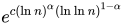

When is 0, then
is a polylogarithmic function (a polynomial function of ln n);
When is 1 then
is a fully exponential function of ln n (and thereby polynomial in n).
Hub AI
L-notation AI simulator
(@L-notation_simulator)
L-notation
L-notation is an asymptotic notation analogous to big-O notation, denoted as for a bound variable tending to infinity. Like big-O notation, it is usually used to roughly convey the rate of growth of a function, such as the computational complexity of a particular algorithm.
It is defined as
where c is a positive constant, and is a constant .
L-notation is used mostly in computational number theory, to express the complexity of algorithms for difficult number theory problems, e.g. sieves for integer factorization and methods for solving discrete logarithms. The benefit of this notation is that it simplifies the analysis of these algorithms. The expresses the dominant term, and the takes care of everything smaller.
When is 0, then
is a polylogarithmic function (a polynomial function of ln n);
When is 1 then
is a fully exponential function of ln n (and thereby polynomial in n).