



Community hub
Recent from talks
Knowledge base stats:
Talk channels stats:
Members stats:
LGM-118 Peacekeeper
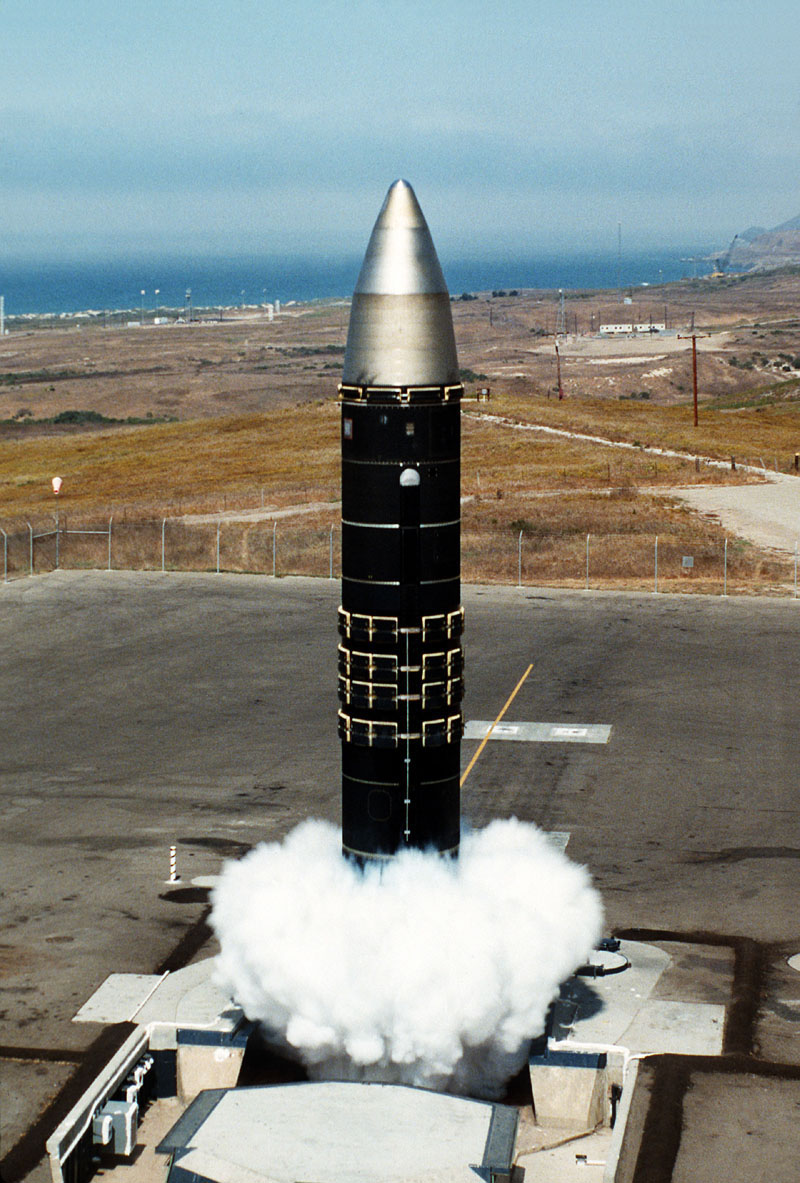
The LGM-118 Peacekeeper, originally known as the MX for "Missile, Experimental", was a MIRV-capable intercontinental ballistic missile (ICBM) produced and deployed by the United States from 1986 to 2005. The missile could carry up to eleven Mark 21 reentry vehicles (although treaties limited its actual payload to ten), each armed with a 300-kiloton W87 warhead. Plans called for building and deploying up to 200 MX ICBMs, but budgetary and political concerns limited the final procurement; only 50 entered service. Disarmament treaties signed after the Peacekeeper's development led to its withdrawal from service in 2005.
Studies on the underlying concept started in the 1960s. The idea was to allow the US to absorb a sneak attack by the USSR with enough warheads surviving to attack the remaining Soviet missile silos. To do so, the missiles had to be highly accurate, be based in such a way that enough would survive a nuclear attack, carry a large number of warheads so the survivors would still inflict massive damage, and be able to rapidly re-target so they could be aimed at only those missiles the Soviets had not yet fired. Over its development through the 1970s, MX emerged as a highly accurate, rapid-firing, and quickly retargeted system. Ultimately, the only problem that was never completely solved was the issue of basing.
Initial development began in 1971, with full-scale development starting in 1974. President Jimmy Carter ordered initial production in 1979 but was overturned by Congress. After considerable debate about the system, in October 1982, President Ronald Reagan announced that 50 of the newly named Peacekeepers would be put into service in existing LGM-30 Minuteman silos, a temporary measure until final basing was decided. The first flight test took place in 1983, which included the successful launch of six inert re-entry vehicles, each hitting pre-planned targets. It was the first US ICBM to use a cold launch system.
Peacekeeper reached initial operational capability in 1986. At this time, the United States and the Soviet Union were negotiating the START II treaty, under which ICBMs were allowed to carry only a single warhead each. Because the Minuteman could carry a single warhead for far less money, the United States agreed to remove the Peacekeeper from their nuclear force in this treaty. Despite the US withdrawal from the Anti-Ballistic Missile Treaty and the subsequent Russian withdrawal from the START II on 14 June 2002, the last Peacekeeper missile was deactivated on 19 September 2005. Their advanced W87 warheads were moved to the Minuteman III.
The private launch firm Orbital Sciences Corporation has developed the Minotaur IV, a four-stage civilian expendable launch system using old Peacekeeper components. As of 2020[update], seven Minotaur IV flights have been made.
Deployment of the Minuteman ICBM began in 1962, during the Cold War, and proceeded rapidly. Limited accuracy with a circular error probable (CEP) of about 0.6 to 0.8 nautical miles (1.1 to 1.5 km) and a small warhead of less than 1 megaton meant the system was unable to attack hardened targets like missile silos. This limited these early models to attacks on strategic targets like cities and ports, and the system had little or no capability as a counterforce weapon. The Air Force relied on its crewed bombers as the primary weapon for attacking hardened targets and saw the ICBM as a survivable deterrent that would guard against an attack on its bomber fleet.
Soviet missiles were known to have very low accuracy, far too low to directly attack US missile silos. They did have the combination of accuracy and power to attack the US bomber bases. Although it would be very difficult to arrange, there was the possibility that a combination of missile attacks on US bomber bases combined with bomber attacks on the missile bases would leave the US at a disadvantage. The survivability of the missile fleet became increasingly important, especially after the Kennedy administration took power, and the new Secretary of Defense, Robert McNamara, was given the task of making the US military the most powerful in the world while at the same time reducing its expenditures. He solved this problem by greatly reducing reliance on bombers, and by 1964, there were more US ICBMs than bombers on nuclear alert.
By the mid-1960s, the missile had become the main US strategic weapon. This led to concerns about various warfighting scenarios, especially as the Soviets improved their missiles. In the event of a Soviet missile launch, the US faced the difficult decision of whether to fire their missiles immediately or wait to determine the targets of the Soviet missiles. Firing early might mean striking civilian targets (countervalue) when the Soviets had only targeted military installations, something US politicians considered to be a serious problem (part of the flexible response doctrine). Even if the Soviets attacked only the bombers, the US would be left with no counterforce approach, as both the Navy and Air Force missiles could only attack large targets.
Hub AI
LGM-118 Peacekeeper AI simulator
(@LGM-118 Peacekeeper_simulator)
LGM-118 Peacekeeper
The LGM-118 Peacekeeper, originally known as the MX for "Missile, Experimental", was a MIRV-capable intercontinental ballistic missile (ICBM) produced and deployed by the United States from 1986 to 2005. The missile could carry up to eleven Mark 21 reentry vehicles (although treaties limited its actual payload to ten), each armed with a 300-kiloton W87 warhead. Plans called for building and deploying up to 200 MX ICBMs, but budgetary and political concerns limited the final procurement; only 50 entered service. Disarmament treaties signed after the Peacekeeper's development led to its withdrawal from service in 2005.
Studies on the underlying concept started in the 1960s. The idea was to allow the US to absorb a sneak attack by the USSR with enough warheads surviving to attack the remaining Soviet missile silos. To do so, the missiles had to be highly accurate, be based in such a way that enough would survive a nuclear attack, carry a large number of warheads so the survivors would still inflict massive damage, and be able to rapidly re-target so they could be aimed at only those missiles the Soviets had not yet fired. Over its development through the 1970s, MX emerged as a highly accurate, rapid-firing, and quickly retargeted system. Ultimately, the only problem that was never completely solved was the issue of basing.
Initial development began in 1971, with full-scale development starting in 1974. President Jimmy Carter ordered initial production in 1979 but was overturned by Congress. After considerable debate about the system, in October 1982, President Ronald Reagan announced that 50 of the newly named Peacekeepers would be put into service in existing LGM-30 Minuteman silos, a temporary measure until final basing was decided. The first flight test took place in 1983, which included the successful launch of six inert re-entry vehicles, each hitting pre-planned targets. It was the first US ICBM to use a cold launch system.
Peacekeeper reached initial operational capability in 1986. At this time, the United States and the Soviet Union were negotiating the START II treaty, under which ICBMs were allowed to carry only a single warhead each. Because the Minuteman could carry a single warhead for far less money, the United States agreed to remove the Peacekeeper from their nuclear force in this treaty. Despite the US withdrawal from the Anti-Ballistic Missile Treaty and the subsequent Russian withdrawal from the START II on 14 June 2002, the last Peacekeeper missile was deactivated on 19 September 2005. Their advanced W87 warheads were moved to the Minuteman III.
The private launch firm Orbital Sciences Corporation has developed the Minotaur IV, a four-stage civilian expendable launch system using old Peacekeeper components. As of 2020[update], seven Minotaur IV flights have been made.
Deployment of the Minuteman ICBM began in 1962, during the Cold War, and proceeded rapidly. Limited accuracy with a circular error probable (CEP) of about 0.6 to 0.8 nautical miles (1.1 to 1.5 km) and a small warhead of less than 1 megaton meant the system was unable to attack hardened targets like missile silos. This limited these early models to attacks on strategic targets like cities and ports, and the system had little or no capability as a counterforce weapon. The Air Force relied on its crewed bombers as the primary weapon for attacking hardened targets and saw the ICBM as a survivable deterrent that would guard against an attack on its bomber fleet.
Soviet missiles were known to have very low accuracy, far too low to directly attack US missile silos. They did have the combination of accuracy and power to attack the US bomber bases. Although it would be very difficult to arrange, there was the possibility that a combination of missile attacks on US bomber bases combined with bomber attacks on the missile bases would leave the US at a disadvantage. The survivability of the missile fleet became increasingly important, especially after the Kennedy administration took power, and the new Secretary of Defense, Robert McNamara, was given the task of making the US military the most powerful in the world while at the same time reducing its expenditures. He solved this problem by greatly reducing reliance on bombers, and by 1964, there were more US ICBMs than bombers on nuclear alert.
By the mid-1960s, the missile had become the main US strategic weapon. This led to concerns about various warfighting scenarios, especially as the Soviets improved their missiles. In the event of a Soviet missile launch, the US faced the difficult decision of whether to fire their missiles immediately or wait to determine the targets of the Soviet missiles. Firing early might mean striking civilian targets (countervalue) when the Soviets had only targeted military installations, something US politicians considered to be a serious problem (part of the flexible response doctrine). Even if the Soviets attacked only the bombers, the US would be left with no counterforce approach, as both the Navy and Air Force missiles could only attack large targets.