
Recent from talks
LTT 1445
Knowledge base stats:
Talk channels stats:
Members stats:
LTT 1445
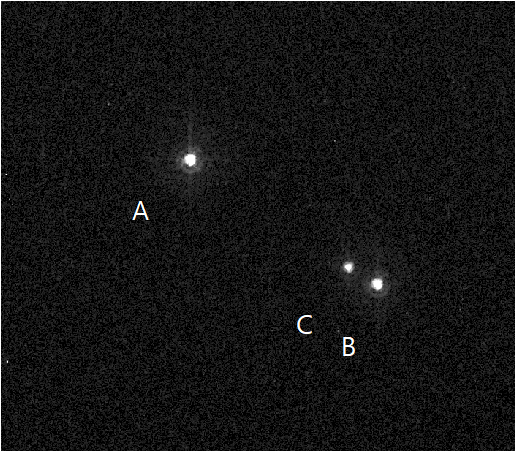
LTT 1445 is a triple M-dwarf system 22.4 light-years (6.9 parsecs) distant in the constellation Eridanus. The primary LTT 1445 A hosts two exoplanets—one discovered in 2019 that transits the star every 5.36 days, and another found in 2021 that transits the star every 3.12 days, close to a 12:7 resonance. As of October 2022 it is the second closest transiting exoplanet system discovered, with the closest being HD 219134 bc.
All three stars in the system are M-dwarfs, with masses between 0.16 M☉ and 0.26 M☉. LTT 1445 A and LTT 1445 BC are separated by about 34 astronomical units and orbit each other with a period of about 250 years. The BC pair orbit each other about every 36 years in an eccentric orbit (e= ~0.5). The alignment of the three stars and the edge-on orbit of the BC pair suggests co-planarity of the system. The existence of transiting planets suggests that the entire system is co-planar, with orbits in one plane.
The TESS light curve showed stellar flares and rotational modulation due to starspots, likely on either the B or C component. Observations with Chandra showed that component C is the dominat X-ray source, with some contributions by component B. Flares are detected for component A in ultraviolet with Hubble and in x-rays with Chandra. Hubble observations also revealed an ultraviolet flare for component C, which was invisible at optical wavelengths.
LTT 1445 Ab is an exoplanet located approximately 22 light years away from Earth. Astrophysicists of the Harvard Center for Astrophysics discovered it in June 2019 with data from the Transiting Exoplanet Survey Satellite. The team obtained follow-up observations, including HARPS radial velocity measurements to constrain the mass of the planet.
LTT 1445 Ab takes 5 days to orbit its star.
In July 2021, the mass of the planet was measured as 2.87±0.25 Earth masses, confirming an Earth-like composition. LTT 1445 Ab likely has a rocky composition, and because it orbits close to the M-dwarf, it has an equilibrium temperature of 431±23 K (158 °C; 316 °F).
In 2022, a planetary transmission spectrum showed no evidence for an atmosphere, although an atmosphere with high altitude hazes cannot be ruled out yet. In 2025 a transmission spectrum with Hubble was published. The spectrum is consistent with a flat line. Only the infrared shows potential features consistent with hydrogen cyanide. Some retrievals weakly favour an atmosphere, but these could be stellar contamination.
A thermal emission spectrum of LTT 1445 Ab was detected with JWST MIRI low resultion spectroscopy (LRS). The observation observed the planet during the secondary eclipse at the 5-12 μm range. During a secondary eclipse the planet disappears behind the star. This allowed the scientists to determine the dayside brightness temperature of 525 ± 15 K (252 °C; 485 °F). This measurement is consistent with a dark rocky surface. The observations disfavour a very thick CO2 atmosphere, but it is uncertain if a moderately thin atmosphere is possible (atmospheres like those on Mars, Titan or Earth).
Hub AI
LTT 1445 AI simulator
(@LTT 1445_simulator)
LTT 1445
LTT 1445 is a triple M-dwarf system 22.4 light-years (6.9 parsecs) distant in the constellation Eridanus. The primary LTT 1445 A hosts two exoplanets—one discovered in 2019 that transits the star every 5.36 days, and another found in 2021 that transits the star every 3.12 days, close to a 12:7 resonance. As of October 2022 it is the second closest transiting exoplanet system discovered, with the closest being HD 219134 bc.
All three stars in the system are M-dwarfs, with masses between 0.16 M☉ and 0.26 M☉. LTT 1445 A and LTT 1445 BC are separated by about 34 astronomical units and orbit each other with a period of about 250 years. The BC pair orbit each other about every 36 years in an eccentric orbit (e= ~0.5). The alignment of the three stars and the edge-on orbit of the BC pair suggests co-planarity of the system. The existence of transiting planets suggests that the entire system is co-planar, with orbits in one plane.
The TESS light curve showed stellar flares and rotational modulation due to starspots, likely on either the B or C component. Observations with Chandra showed that component C is the dominat X-ray source, with some contributions by component B. Flares are detected for component A in ultraviolet with Hubble and in x-rays with Chandra. Hubble observations also revealed an ultraviolet flare for component C, which was invisible at optical wavelengths.
LTT 1445 Ab is an exoplanet located approximately 22 light years away from Earth. Astrophysicists of the Harvard Center for Astrophysics discovered it in June 2019 with data from the Transiting Exoplanet Survey Satellite. The team obtained follow-up observations, including HARPS radial velocity measurements to constrain the mass of the planet.
LTT 1445 Ab takes 5 days to orbit its star.
In July 2021, the mass of the planet was measured as 2.87±0.25 Earth masses, confirming an Earth-like composition. LTT 1445 Ab likely has a rocky composition, and because it orbits close to the M-dwarf, it has an equilibrium temperature of 431±23 K (158 °C; 316 °F).
In 2022, a planetary transmission spectrum showed no evidence for an atmosphere, although an atmosphere with high altitude hazes cannot be ruled out yet. In 2025 a transmission spectrum with Hubble was published. The spectrum is consistent with a flat line. Only the infrared shows potential features consistent with hydrogen cyanide. Some retrievals weakly favour an atmosphere, but these could be stellar contamination.
A thermal emission spectrum of LTT 1445 Ab was detected with JWST MIRI low resultion spectroscopy (LRS). The observation observed the planet during the secondary eclipse at the 5-12 μm range. During a secondary eclipse the planet disappears behind the star. This allowed the scientists to determine the dayside brightness temperature of 525 ± 15 K (252 °C; 485 °F). This measurement is consistent with a dark rocky surface. The observations disfavour a very thick CO2 atmosphere, but it is uncertain if a moderately thin atmosphere is possible (atmospheres like those on Mars, Titan or Earth).
Recent media