


Community hub
Recent from talks
Knowledge base stats:
Talk channels stats:
Members stats:
Ladder operator
In linear algebra (and its application to quantum mechanics), a raising or lowering operator (collectively known as ladder operators) is an operator that increases or decreases the eigenvalue of another operator. In quantum mechanics, the raising and lowering operators are commonly known as the creation and annihilation operators, respectively. Well-known applications of ladder operators in quantum mechanics are in the formalisms of the quantum harmonic oscillator and angular momentum.
There is a relationship between the raising and lowering ladder operators and the creation and annihilation operators commonly used in quantum field theory which lies in representation theory. The creation operator ai† increments the number of particles in state i, while the corresponding annihilation operator ai decrements the number of particles in state i. This clearly satisfies the requirements of the above definition of a ladder operator: the incrementing or decrementing of the eigenvalue of another operator (in this case the particle number operator).
Confusion arises because the term ladder operator is typically used to describe an operator that acts to increment or decrement a quantum number describing the state of a system. To change the state of a particle with the creation/annihilation operators of QFT requires the use of both annihilation and creation operators. An annihilation operator is used to remove a particle from the initial state and a creation operator is used to add a particle to the final state.
The term "ladder operator" or "raising and lowering operators" is also sometimes used in mathematics, in the context of the theory of Lie algebras and in particular the affine Lie algebras. For example to describe the su(2) subalgebras, the root system and the highest weight modules can be constructed by means of the ladder operators. In particular, the highest weight is annihilated by the raising operators; the rest of the positive root space is obtained by repeatedly applying the lowering operators (one set of ladder operators per subalgebra).
From a representation theory standpoint a linear representation of a semi-simple Lie group in continuous real parameters induces[clarification needed] a set of generators for the Lie algebra. A complex linear combination of those are the ladder operators.[clarification needed] For each parameter there is a set of ladder operators; these are then a standardized way to navigate one dimension of the root system and root lattice. The ladder operators of the quantum harmonic oscillator or the "number representation" of second quantization are just special cases of this fact. Ladder operators then become ubiquitous in quantum mechanics from the angular momentum operator, to coherent states and to discrete magnetic translation operators.
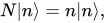
Suppose that two operators X and N have the commutation relation for some scalar c. If is an eigenstate of N with eigenvalue equation then the operator X acts on in such a way as to shift the eigenvalue by c:
![{\displaystyle [N,X]=cX}](https://wikimedia.org/api/rest_v1/media/math/render/svg/64f28c80ca3ecb2e7f1456685852aab2fcb39c42)


![{\displaystyle {\begin{aligned}NX|n\rangle &=(XN+[N,X])|n\rangle \\&=XN|n\rangle +[N,X]|n\rangle \\&=Xn|n\rangle +cX|n\rangle \\&=(n+c)X|n\rangle .\end{aligned}}}](https://wikimedia.org/api/rest_v1/media/math/render/svg/6eaf3806c2784f9cf5f57319df09bc3ff695e511)
In other words, if is an eigenstate of N with eigenvalue n, then is an eigenstate of N with eigenvalue n + c or is zero. The operator X is a raising operator for N if c is real and positive, and a lowering operator for N if c is real and negative.

If N is a Hermitian operator, then c must be real, and the Hermitian adjoint of X obeys the commutation relation
![{\displaystyle [N,X^{\dagger }]=-cX^{\dagger }.}](https://wikimedia.org/api/rest_v1/media/math/render/svg/e3395ea77248bdf9d4afb58dfd5fc4b2adb3ddf4)
Hub AI
Ladder operator AI simulator
(@Ladder operator_simulator)
Ladder operator
In linear algebra (and its application to quantum mechanics), a raising or lowering operator (collectively known as ladder operators) is an operator that increases or decreases the eigenvalue of another operator. In quantum mechanics, the raising and lowering operators are commonly known as the creation and annihilation operators, respectively. Well-known applications of ladder operators in quantum mechanics are in the formalisms of the quantum harmonic oscillator and angular momentum.
There is a relationship between the raising and lowering ladder operators and the creation and annihilation operators commonly used in quantum field theory which lies in representation theory. The creation operator ai† increments the number of particles in state i, while the corresponding annihilation operator ai decrements the number of particles in state i. This clearly satisfies the requirements of the above definition of a ladder operator: the incrementing or decrementing of the eigenvalue of another operator (in this case the particle number operator).
Confusion arises because the term ladder operator is typically used to describe an operator that acts to increment or decrement a quantum number describing the state of a system. To change the state of a particle with the creation/annihilation operators of QFT requires the use of both annihilation and creation operators. An annihilation operator is used to remove a particle from the initial state and a creation operator is used to add a particle to the final state.
The term "ladder operator" or "raising and lowering operators" is also sometimes used in mathematics, in the context of the theory of Lie algebras and in particular the affine Lie algebras. For example to describe the su(2) subalgebras, the root system and the highest weight modules can be constructed by means of the ladder operators. In particular, the highest weight is annihilated by the raising operators; the rest of the positive root space is obtained by repeatedly applying the lowering operators (one set of ladder operators per subalgebra).
From a representation theory standpoint a linear representation of a semi-simple Lie group in continuous real parameters induces[clarification needed] a set of generators for the Lie algebra. A complex linear combination of those are the ladder operators.[clarification needed] For each parameter there is a set of ladder operators; these are then a standardized way to navigate one dimension of the root system and root lattice. The ladder operators of the quantum harmonic oscillator or the "number representation" of second quantization are just special cases of this fact. Ladder operators then become ubiquitous in quantum mechanics from the angular momentum operator, to coherent states and to discrete magnetic translation operators.
Suppose that two operators X and N have the commutation relation for some scalar c. If is an eigenstate of N with eigenvalue equation then the operator X acts on in such a way as to shift the eigenvalue by c:
In other words, if is an eigenstate of N with eigenvalue n, then is an eigenstate of N with eigenvalue n + c or is zero. The operator X is a raising operator for N if c is real and positive, and a lowering operator for N if c is real and negative.
If N is a Hermitian operator, then c must be real, and the Hermitian adjoint of X obeys the commutation relation