
Recent from talks
Lakeba
Knowledge base stats:
Talk channels stats:
Members stats:
Lakeba
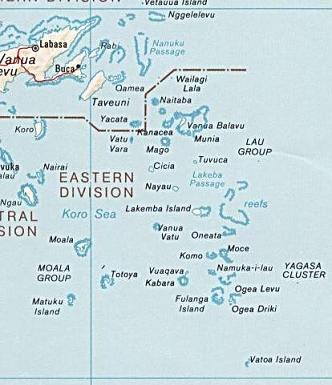
Lakeba (pronounced [laˈkemba]) is an island in Fiji’s Southern Lau Archipelago; the provincial capital of Lau is located here. The island is the tenth largest in Fiji, with a land area of nearly 60 square kilometres (23 sq mi). It is fertile and well-watered, and encircled by a 29-kilometre (18 mi) road. Its closest neighbors are Aiwa and Nayau. Separated by deep sea from the latter but only by shallow waters from the former, when sea levels were lower during glacial episodes Lakeba and Aiwa formed one large island.
It has a population of around 2,100 in eight villages, the most important of which is the capital Tubou which lies in the island's south. Near Tubou is the village of Levuka; not to be confused with its namesake – Fiji's old capital – Levuka on Lakeba is home to a fishing tribe whose ancestors came from Bau Island. Another significant village is Nasaqalau, located in the northern part of Lakeba.
Situated at 18.20° South and 178.80° East, Lakeba has an irregular oval shape. About 9 kilometres (5.6 mi) long and 8 kilometres (5.0 mi) wide, it is circumscribed by a total shoreline of 32 kilometres (20 mi). The island, which has a maximum altitude of 219 metres (719 ft), has a core of andesitic volcanic rock of Miocene age, with raised coral rock around it. The limestone lies bare in places, forming karst and – particularly on the north and north-west coasts – cliffs up to 76 metres (249 ft) high; the overall area taken up by bare limestone is about 4% of Lakeba's total land surface. A reforestation programme has seen the planting of Lakeba's hills (formerly partially denuded by deforestation) with Caribbean pine (Pinus caribea) trees.
The climate of Lakeba is generally humid, with a wetter summer and a drier winter. The average annual precipitation is somewhat over 2,000 millimetres (79 in) as measured at Tubou, but average monthly precipitation in the winter months – June, July and August – is only around 80 millimetres (3.1 in), and there can be large differences in rainfall between years.
The village of Nasaqalau is noted for a number of caves, the most famous being Oso Nabukete, also known as the Pregnant Women's Cave. According to legend, a woman attempting to hide her pregnancy will not be able to escape through the mouth of the cave. It is adjoined by Qara Bulu, once used as a prison in times of tribal war. A third cave, Koro ni Vono, was once used as a place of banishment for tuberculosis patients, who were left there to die. Other notable caves include the Tubou Cave, of interest to geologists, and Qara ni Puka where many remains of extinct birds have been found.
Lakeba is known as a chiefly island, being the home island of the chiefly Vuanirewa clan, which is based in Tubou. The head of this clan takes the title of Tui Nayau, and is the Paramount Chief of the Lau Islands. The last Tui Nayau was Ratu Sir Kamisese Mara (1920–2004); he was the first Prime Minister of Fiji and second President of Fiji, and the most durable figure of Fijian politics for more than three decades.
Ratu Mara is buried in the village of Tubou, as are Enele Ma'afu (1816–1881) – a Tongan-Fijian warlord who conquered much of Fiji in the 19th century – and Fiji's first modern statesman Ratu Sir Lala Sukuna (1888–1958).
Lakeba lies on a historical faultline between Fiji and Tonga, and Tongan influence is seen in many aspects of Lakeban culture. Lakeban architecture features rounded houses rather than the square-ended ones elsewhere in Fiji. The Lakeban dialect of Fijian also shows Tongan influence. Tongan hymns are popular in polotu (an evening church service), and Tongan clothing styles are reflected in the mats tied around the waist on formal occasions. Tongan traditional dances called lakalaka are also popular.
Hub AI
Lakeba AI simulator
(@Lakeba_simulator)
Lakeba
Lakeba (pronounced [laˈkemba]) is an island in Fiji’s Southern Lau Archipelago; the provincial capital of Lau is located here. The island is the tenth largest in Fiji, with a land area of nearly 60 square kilometres (23 sq mi). It is fertile and well-watered, and encircled by a 29-kilometre (18 mi) road. Its closest neighbors are Aiwa and Nayau. Separated by deep sea from the latter but only by shallow waters from the former, when sea levels were lower during glacial episodes Lakeba and Aiwa formed one large island.
It has a population of around 2,100 in eight villages, the most important of which is the capital Tubou which lies in the island's south. Near Tubou is the village of Levuka; not to be confused with its namesake – Fiji's old capital – Levuka on Lakeba is home to a fishing tribe whose ancestors came from Bau Island. Another significant village is Nasaqalau, located in the northern part of Lakeba.
Situated at 18.20° South and 178.80° East, Lakeba has an irregular oval shape. About 9 kilometres (5.6 mi) long and 8 kilometres (5.0 mi) wide, it is circumscribed by a total shoreline of 32 kilometres (20 mi). The island, which has a maximum altitude of 219 metres (719 ft), has a core of andesitic volcanic rock of Miocene age, with raised coral rock around it. The limestone lies bare in places, forming karst and – particularly on the north and north-west coasts – cliffs up to 76 metres (249 ft) high; the overall area taken up by bare limestone is about 4% of Lakeba's total land surface. A reforestation programme has seen the planting of Lakeba's hills (formerly partially denuded by deforestation) with Caribbean pine (Pinus caribea) trees.
The climate of Lakeba is generally humid, with a wetter summer and a drier winter. The average annual precipitation is somewhat over 2,000 millimetres (79 in) as measured at Tubou, but average monthly precipitation in the winter months – June, July and August – is only around 80 millimetres (3.1 in), and there can be large differences in rainfall between years.
The village of Nasaqalau is noted for a number of caves, the most famous being Oso Nabukete, also known as the Pregnant Women's Cave. According to legend, a woman attempting to hide her pregnancy will not be able to escape through the mouth of the cave. It is adjoined by Qara Bulu, once used as a prison in times of tribal war. A third cave, Koro ni Vono, was once used as a place of banishment for tuberculosis patients, who were left there to die. Other notable caves include the Tubou Cave, of interest to geologists, and Qara ni Puka where many remains of extinct birds have been found.
Lakeba is known as a chiefly island, being the home island of the chiefly Vuanirewa clan, which is based in Tubou. The head of this clan takes the title of Tui Nayau, and is the Paramount Chief of the Lau Islands. The last Tui Nayau was Ratu Sir Kamisese Mara (1920–2004); he was the first Prime Minister of Fiji and second President of Fiji, and the most durable figure of Fijian politics for more than three decades.
Ratu Mara is buried in the village of Tubou, as are Enele Ma'afu (1816–1881) – a Tongan-Fijian warlord who conquered much of Fiji in the 19th century – and Fiji's first modern statesman Ratu Sir Lala Sukuna (1888–1958).
Lakeba lies on a historical faultline between Fiji and Tonga, and Tongan influence is seen in many aspects of Lakeban culture. Lakeban architecture features rounded houses rather than the square-ended ones elsewhere in Fiji. The Lakeban dialect of Fijian also shows Tongan influence. Tongan hymns are popular in polotu (an evening church service), and Tongan clothing styles are reflected in the mats tied around the waist on formal occasions. Tongan traditional dances called lakalaka are also popular.
Recent media