


Community hub
Recent from talks
Knowledge base stats:
Talk channels stats:
Members stats:
Large extra dimensions
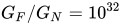
In particle physics and string theory (M-theory), the Arkani-Hamed, Dimopoulos, Dvali model (ADD), also known as the model with large extra dimensions (LED), is a model framework that attempts to solve the hierarchy problem (Why is the force of gravity so weak compared to the electromagnetic force and the other fundamental forces?). The model tries to explain this problem by postulating that our universe, with its four dimensions (three spatial ones plus time), exists on a membrane in a higher dimensional space. It is then suggested that the other forces of nature (the electromagnetic force, strong interaction, and weak interaction) operate within this membrane and its four dimensions, while the hypothetical gravity-bearing particle, the graviton, can propagate across the extra dimensions. This would explain why gravity is very weak compared to the other fundamental forces.[clarification needed] The size of the dimensions in ADD is around the order of the TeV scale, which results in it being experimentally probeable by current colliders, unlike many exotic extra dimensional hypotheses that have the relevant size around the Planck scale.
The model was proposed by Nima Arkani-Hamed, Savas Dimopoulos, and Gia Dvali in 1998.
One way to test the theory is performed by colliding together two protons in the Large Hadron Collider so that they interact and produce particles. If a graviton were to be formed in the collision, it could propagate into the extra dimensions, resulting in an imbalance of transverse momentum. No experiments from the Large Hadron Collider have been decisive thus far. However, the operation range of the LHC (13 TeV collision energy) covers only a small part of the predicted range in which evidence for LED would be recorded (a few TeV to 1016 TeV). This suggests that the theory might be more thoroughly tested with more advanced technology.
Traditionally, in theoretical physics, the Planck scale is the highest energy scale and all dimensionful parameters are measured in terms of the Planck scale. There is a great hierarchy between the weak scale and the Planck scale, and explaining the ratio of strength of weak force and gravity is the focus of much of beyond-Standard-Model physics. In models of large extra dimensions, the fundamental scale is much lower than the Planck. This occurs because the power law of gravity changes. For example, when there are two extra dimensions of size , the power law of gravity is for objects with and for objects with . If we want the Planck scale to be equal to the next accelerator energy (1 TeV), we should take to be approximately 1 mm. For larger numbers of dimensions, fixing the Planck scale at 1 TeV, the size of the extra-dimensions become smaller and as small as 1 femtometer for six extra dimensions.


By reducing the fundamental scale to the weak scale, the fundamental theory of quantum gravity, such as string theory, might be accessible at colliders such as the Tevatron or the LHC. There has been recent[when?] progress in generating large volumes in the context of string theory. Having the fundamental scale accessible allows the production of black holes at the LHC, though there are constraints on the viability of this possibility at the energies at the LHC. There are other signatures of large extra dimensions at high energy colliders.
Many of the mechanisms that were used to explain the problems in the Standard Model used very high energies. In the years after the publication of ADD, much of the work of the beyond the Standard Model physics community went to explore how these problems could be solved with a low scale of quantum gravity. Almost immediately, there was an alternative explanation to the see-saw mechanism for the neutrino mass. Using extra dimensions as a new source of small numbers allowed for new mechanisms for understanding the masses and mixings of the neutrinos.
Another problem with having a low scale of quantum gravity was the existence of possibly TeV-suppressed proton decay, flavor violating, and CP violating operators. These would be disastrous phenomenologically. Physicists quickly realized that there were novel mechanisms for getting small numbers necessary for explaining these very rare processes.
In the traditional view, the enormous gap in energy between the mass scales of ordinary particles and the Planck mass is reflected in the fact that virtual processes involving black holes or gravity are strongly suppressed. The suppression of these terms is the principle of renormalizability – in order to see an interaction at low energy, it must have the property that its coupling only changes logarithmically as a function of the Planck scale. Nonrenormalizable interactions are weak only to the extent that the Planck scale is large.
Hub AI
Large extra dimensions AI simulator
(@Large extra dimensions_simulator)
Large extra dimensions
In particle physics and string theory (M-theory), the Arkani-Hamed, Dimopoulos, Dvali model (ADD), also known as the model with large extra dimensions (LED), is a model framework that attempts to solve the hierarchy problem (Why is the force of gravity so weak compared to the electromagnetic force and the other fundamental forces?). The model tries to explain this problem by postulating that our universe, with its four dimensions (three spatial ones plus time), exists on a membrane in a higher dimensional space. It is then suggested that the other forces of nature (the electromagnetic force, strong interaction, and weak interaction) operate within this membrane and its four dimensions, while the hypothetical gravity-bearing particle, the graviton, can propagate across the extra dimensions. This would explain why gravity is very weak compared to the other fundamental forces.[clarification needed] The size of the dimensions in ADD is around the order of the TeV scale, which results in it being experimentally probeable by current colliders, unlike many exotic extra dimensional hypotheses that have the relevant size around the Planck scale.
The model was proposed by Nima Arkani-Hamed, Savas Dimopoulos, and Gia Dvali in 1998.
One way to test the theory is performed by colliding together two protons in the Large Hadron Collider so that they interact and produce particles. If a graviton were to be formed in the collision, it could propagate into the extra dimensions, resulting in an imbalance of transverse momentum. No experiments from the Large Hadron Collider have been decisive thus far. However, the operation range of the LHC (13 TeV collision energy) covers only a small part of the predicted range in which evidence for LED would be recorded (a few TeV to 1016 TeV). This suggests that the theory might be more thoroughly tested with more advanced technology.
Traditionally, in theoretical physics, the Planck scale is the highest energy scale and all dimensionful parameters are measured in terms of the Planck scale. There is a great hierarchy between the weak scale and the Planck scale, and explaining the ratio of strength of weak force and gravity is the focus of much of beyond-Standard-Model physics. In models of large extra dimensions, the fundamental scale is much lower than the Planck. This occurs because the power law of gravity changes. For example, when there are two extra dimensions of size , the power law of gravity is for objects with and for objects with . If we want the Planck scale to be equal to the next accelerator energy (1 TeV), we should take to be approximately 1 mm. For larger numbers of dimensions, fixing the Planck scale at 1 TeV, the size of the extra-dimensions become smaller and as small as 1 femtometer for six extra dimensions.
By reducing the fundamental scale to the weak scale, the fundamental theory of quantum gravity, such as string theory, might be accessible at colliders such as the Tevatron or the LHC. There has been recent[when?] progress in generating large volumes in the context of string theory. Having the fundamental scale accessible allows the production of black holes at the LHC, though there are constraints on the viability of this possibility at the energies at the LHC. There are other signatures of large extra dimensions at high energy colliders.
Many of the mechanisms that were used to explain the problems in the Standard Model used very high energies. In the years after the publication of ADD, much of the work of the beyond the Standard Model physics community went to explore how these problems could be solved with a low scale of quantum gravity. Almost immediately, there was an alternative explanation to the see-saw mechanism for the neutrino mass. Using extra dimensions as a new source of small numbers allowed for new mechanisms for understanding the masses and mixings of the neutrinos.
Another problem with having a low scale of quantum gravity was the existence of possibly TeV-suppressed proton decay, flavor violating, and CP violating operators. These would be disastrous phenomenologically. Physicists quickly realized that there were novel mechanisms for getting small numbers necessary for explaining these very rare processes.
In the traditional view, the enormous gap in energy between the mass scales of ordinary particles and the Planck mass is reflected in the fact that virtual processes involving black holes or gravity are strongly suppressed. The suppression of these terms is the principle of renormalizability – in order to see an interaction at low energy, it must have the property that its coupling only changes logarithmically as a function of the Planck scale. Nonrenormalizable interactions are weak only to the extent that the Planck scale is large.