Hubbry Logo
TevatronTevatronMain
Open search
Tevatron
Community hub
Tevatron
logo
8 pages, 0 posts
0 subscribers
Be the first to start a discussion here.
Tevatron
Tevatron
from Wikipedia

Tevatron
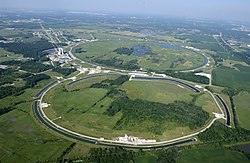
The Tevatron (background) and Main Injector rings
General properties
Accelerator typeSynchrotron
Beam typeProton, antiproton
Target typeCollider
Beam properties
Maximum energy1 TeV
Maximum luminosity4×1032/(cm2⋅s)
Physical properties
Circumference6.28 km (3.90 mi)
LocationBatavia, Illinois
InstitutionFermilab
Dates of operation1983–2011

The Tevatron was a circular particle accelerator (active until 2011) in the United States, at the Fermi National Accelerator Laboratory (called Fermilab), east of Batavia, Illinois, and was the highest energy particle collider until the Large Hadron Collider (LHC) of the European Organization for Nuclear Research (CERN) was built near Geneva, Switzerland. The Tevatron was a synchrotron that accelerated protons and antiprotons in a 6.28 km (3.90 mi) circumference ring to energies of up to 1 TeV, hence its name.[1][2] The Tevatron was completed in 1983 at a cost of $120 million and significant upgrade investments were made during its active years of 1983–2011.

The main achievement of the Tevatron was the discovery in 1995 of the top quark—the last fundamental fermion predicted by the Standard Model of particle physics. On July 2, 2012, scientists of the CDF and collider experiment teams at Fermilab announced the findings from the analysis of around 500 trillion collisions produced from the Tevatron collider since 2001, and found that the existence of the suspected Higgs boson was highly likely with a confidence of 99.8%,[3] later improved to over 99.9%.[4]

The Tevatron ceased operations on 30 September 2011, due to budget cuts[5] and because of the completion of the LHC, which began operations in early 2010 and is far more powerful (planned energies were two 7 TeV beams at the LHC compared to 1 TeV at the Tevatron). The main ring of the Tevatron will probably be reused in future experiments, and its components may be transferred to other particle accelerators.[6]

History

[edit]

December 1, 1968, saw the breaking of ground for the linear accelerator (linac). The construction of the Main Accelerator Enclosure began on October 3, 1969, when the first shovel of earth was turned by Robert R. Wilson, NAL's director. This would become the 6.3 km circumference Fermilab's Main Ring.[1]

The linac first 200 MeV beam started on December 1, 1970. The booster first 8 GeV beam was produced on May 20, 1971. On June 30, 1971, a proton beam was guided for the first time through the entire National Accelerator Laboratory accelerator system including the Main Ring. The beam was accelerated to only 7 GeV. Back then, the Booster Accelerator took 200 MeV protons from the Linac and "boosted" their energy to 8 billion electron volts. They were then injected into the Main Accelerator.[1]

On the same year before the completion of the Main Ring, Wilson testified to the Joint Committee on Atomic Energy on March 9, 1971, that it was feasible to achieve a higher energy by using superconducting magnets. He also suggested that it could be done by using the same tunnel as the main ring and the new magnets would be installed in the same locations to be operated in parallel to the existing magnets of the Main Ring. That was the starting point of the Tevatron project.[7] The Tevatron was in research and development phase between 1973 and 1979 while the acceleration at the Main Ring continued to be enhanced.[8]

A series of milestones saw acceleration rise to 20 GeV on January 22, 1972, to 53 GeV on February 4 and to 100 GeV on February 11. On March 1, 1972, the then NAL accelerator system accelerated for the first time a beam of protons to its design energy of 200 GeV. By the end of 1973, NAL's accelerator system operated routinely at 300 GeV.[1]

On 14 May 1976 Fermilab took its protons all the way to 500 GeV. This achievement provided the opportunity to introduce a new energy scale, the teraelectronvolt (TeV), equal to 1000 GeV. On 17 June of that year, the European Super Proton Synchrotron accelerator (SPS) had achieved an initial circulating proton beam (with no accelerating radio-frequency power) of only 400 GeV.[9]

The conventional magnet Main Ring was shut down in 1981 for installation of superconducting magnets underneath it. The Main Ring continued to serve as an injector for the Tevatron until the Main Injector was completed west of the Main Ring in 2000.[7] The 'Energy Doubler', as it was known then, produced its first accelerated beam—512 GeV—on July 3, 1983.[10]

Its initial energy of 800 GeV was achieved on February 16, 1984. On October 21, 1986, acceleration at the Tevatron was pushed to 900 GeV, providing a first proton–antiproton collision at 1.8 TeV on November 30, 1986.[11]

The Main Injector, which replaced the Main Ring,[12] was the most substantial addition, built over six years from 1993 at a cost of $290 million.[13] Tevatron collider Run II begun on March 1, 2001, after successful completion of that facility upgrade. From then, the beam had been capable of delivering an energy of 980 GeV.[12]

On July 16, 2004, the Tevatron achieved a new peak luminosity, breaking the record previously held by the old European Intersecting Storage Rings (ISR) at CERN. That very Fermilab record was doubled on September 9, 2006, then a bit more than tripled on March 17, 2008, and ultimately multiplied by a factor of 4 over the previous 2004 record on April 16, 2010 (up to 4×1032 cm−2 s−1).[11]

The Tevatron ceased operations on 30 September 2011. By the end of 2011, the Large Hadron Collider (LHC) at CERN had achieved a luminosity almost ten times higher than Tevatron's (at 3.65×1033 cm−2 s−1) and a beam energy of 3.5 TeV each (doing so since March 18, 2010), already ~3.6 times the capabilities of the Tevatron (at 0.98 TeV).

Mechanics

[edit]

The acceleration occurred in a number of stages. The first stage was the 750 keV Cockcroft–Walton pre-accelerator, which ionized hydrogen gas and accelerated the negative ions created using a positive voltage. The ions then passed into the 150 meter long linear accelerator (linac) which used oscillating electrical fields to accelerate the ions to 400 MeV. The ions then passed through a carbon foil, to remove the electrons, and the charged protons then moved into the Booster.[14]

The Booster was a small circular synchrotron, around which the protons passed up to 20,000 times to attain an energy of around 8 GeV. From the Booster the particles were fed into the Main Injector, which had been completed in 1999 to perform a number of tasks. It could accelerate protons up to 150 GeV; produce 120 GeV protons for antiproton creation; increase antiproton energy to 150 GeV; and inject protons or antiprotons into the Tevatron. The antiprotons were created by the Antiproton Source. 120 GeV protons were collided with a nickel target producing a range of particles including antiprotons which could be collected and stored in the accumulator ring. The ring could then pass the antiprotons to the Main Injector.

The Tevatron could accelerate the particles from the Main Injector up to 980 GeV. The protons and antiprotons were accelerated in opposite directions, crossing paths in the CDF and detectors to collide at 1.96 TeV. To hold the particles on track the Tevatron used 774 niobium–titanium superconducting dipole magnets cooled in liquid helium producing the field strength of 4.2 tesla. The field ramped over about 20 seconds as the particles accelerated. Another 240 NbTi quadrupole magnets were used to focus the beam.[2]

The initial design luminosity of the Tevatron was 1030 cm−2 s−1, however, following upgrades, the accelerator had been able to deliver luminosities up to 4×1032 cm−2 s−1.[15]

On September 27, 1993, the cryogenic cooling system of the Tevatron Accelerator was named an International Historic Landmark by the American Society of Mechanical Engineers. The system, which provided cryogenic liquid helium to the Tevatron's superconducting magnets, was the largest low-temperature system in existence upon its completion in 1978. It kept the coils of the magnets, which bent and focused the particle beam, in a superconducting state, so that they consumed only ⅓ of the power they would have required at normal temperatures.[8]

Discoveries

[edit]

The Tevatron confirmed the existence of several subatomic particles that were predicted by theoretical particle physics, or gave suggestions to their existence. In 1995, the CDF experiment and DØ experiment collaborations announced the discovery of the top quark, and by 2007 they measured its mass (172 GeV) to a precision of nearly 1%. In 2006, the CDF collaboration reported the first measurement of Bs oscillations, and observation of two types of sigma baryons.[16] In 2007, the DØ and CDF collaborations reported direct observation of the "Cascade B" (Ξ
b
) Xi baryon.[17]

In September 2008, the DØ collaboration reported detection of the Ω
b
, a "double strange" Omega baryon with the measured mass significantly higher than the quark model prediction.[18][19] In May 2009 the CDF collaboration made public their results on search for Ω
b
based on analysis of data sample roughly four times larger than the one used by DØ experiment.[20] The mass measurements from the CDF experiment were 6054.4±6.8 MeV/c2 and in excellent agreement with Standard Model predictions, and no signal has been observed at the previously reported value from the DØ experiment. The two inconsistent results from DØ and CDF differ by 111±18 MeV/c2 or by 6.2 standard deviations. Due to excellent agreement between the mass measured by CDF and the theoretical expectation, it is a strong indication that the particle discovered by CDF is indeed the Ω
b
. It is anticipated that new data from LHC experiments will clarify the situation in the near future.

On July 2, 2012, two days before a scheduled announcement at the Large Hadron Collider (LHC), scientists at the Tevatron collider from the CDF and DØ collaborations announced their findings from the analysis of around 500 trillion collisions produced since 2001: They found that the existence of the Higgs boson was likely with a mass in the region of 115 to 135 GeV.[21][22] The statistical significance of the observed signs was 2.9 sigma, which meant that there is only a 1-in-550 chance that a signal of that magnitude would have occurred if no particle in fact existed with those properties. The final analysis of data from the Tevatron did however not settle the question of whether the Higgs particle exists.[3][23] Only when the scientists from the Large Hadron Collider announced the more precise LHC results on July 4, 2012, with a mass of 125.3 ± 0.4 GeV (CMS)[24] or 126 ± 0.4 GeV (ATLAS)[25] respectively, was there strong evidence through consistent measurements by the LHC and the Tevatron for the existence of a Higgs particle at that mass range.

Disruptions due to earthquakes

[edit]

Even from thousands of miles away, earthquakes caused strong enough movements in the magnets to negatively affect the quality of particle beams and even disrupt them. Therefore, tiltmeters were installed on Tevatron's magnets to monitor minute movements and to help identify the cause of problems quickly. The first known earthquake to disrupt the beam was the 2002 Denali earthquake, with another collider shutdown caused by a moderate local quake on June 28, 2004.[26] Since then, the minute seismic vibrations emanating from over 20 earthquakes were detected at the Tevatron without a shutdown including the 2004 Indian Ocean earthquake, the 2005 Nias–Simeulue earthquake, New Zealand's 2007 Gisborne earthquake, the 2010 Haiti earthquake and the 2010 Chile earthquake.[27]

See also

[edit]

References

[edit]

Further reading

[edit]
[edit]
Revisions and contributorsEdit on WikipediaRead on Wikipedia
from Grokipedia
The Tevatron was a groundbreaking and located at the Fermi National Accelerator Laboratory (Fermilab) in , that operated from 1983 until its shutdown on September 30, 2011. As the world's highest-energy proton-antiproton for much of its lifespan, it accelerated protons and antiprotons to energies of up to 1 TeV (tera-electronvolt) each, enabling head-on collisions with a center-of-mass energy of nearly 2 TeV—the highest on at the time. Housed in a 4-mile (6.3 km) circumference underground tunnel, the Tevatron utilized over 1,000 superconducting magnets cooled to -450°F (-268°C) with to guide and focus the beams, which circled the ring approximately 47,000 times per second at 99.999954% the . The Tevatron's design originated in the early 1970s as the "Energy Doubler," a superconducting upgrade to 's existing Main Ring accelerator, with authorized by the U.S. Department of Energy in 1978 and first proton beam operations beginning in 1983. Protons were injected from a chain of pre-accelerators, including the Linac (reaching 400 MeV), Booster (up to 8 GeV), and Main Injector (up to 150 GeV), before entering the Tevatron for final acceleration; antiprotons were produced by colliding protons with a target and cooled for storage. Collisions occurred at two major detectors—CDF (Collider Detector at Fermilab) and DØ—each weighing about 5,000 tons and designed to capture rare particle interactions. The accelerator's innovative use of marked the first large-scale application of this technology in high-energy physics, powering the magnets with over 4,000 amps of current. Throughout its 28-year run, the Tevatron drove pivotal advances in , most notably the 1995 discovery of the top —the heaviest known and a cornerstone of the —by the CDF and DØ collaborations after analyzing proton-antiproton collision data. It also confirmed the existence of five new baryons, including the bottom omega baryon, and provided key measurements of particle properties that refined our understanding of fundamental forces. Beyond discoveries, the Tevatron supplied beams for fixed-target experiments and test areas, fostering innovations in detector technology, accelerator engineering, and that influenced global research facilities. The Tevatron's decommissioning in 2011 stemmed from the (LHC) at achieving higher energies starting in 2008, combined with U.S. funding priorities shifting toward and experiments at . Post-shutdown, ongoing data analysis by CDF and DØ teams continues to yield insights, such as evidence for the in 2012, while repurposed components like the Main Injector for new projects, ensuring the Tevatron's legacy endures in modern .

History and Development

Conception and Construction

The Tevatron originated as the Energy Doubler project, proposed by Robert R. Wilson, Fermilab's founding director, in the early 1970s to upgrade the laboratory's accelerator capabilities using superconducting magnet technology. This initiative aimed to double the energy of the existing Main Ring synchrotron from 200 GeV to approximately 1 TeV, enabling higher-energy fixed-target experiments. The formal design effort began in September 1972, building on Wilson's earlier discussions of superconductivity applications dating back to 1967 shortly after the National Accelerator Laboratory (NAL, later Fermilab) was established. The site for NAL in , was selected in 1966 by the Atomic Energy Commission (AEC) due to its geological stability, minimal seismic activity, low population density, and proximity to for logistical support. occurred on December 1, 1968, for the initial linear accelerator (linac), with excavation of the 6.28 km circumference tunnel commencing in 1969 to house the Main Ring . President authorized funding for NAL's construction in 1967 at approximately $250 million, which was completed under budget by 1972. Key construction milestones included the first circulation of protons in the Main Ring on June 30, 1971, initially at 7 GeV and reaching full 200 GeV by 1972. The Tevatron's superconducting components were authorized for construction by the Department of Energy in 1979 at a cost of $120 million, with production ramping up in the late . The first string of superconducting s was cooled to in 1981, and the Main Ring tunnel was adapted to accommodate the new ring beneath the existing one without major disassembly. The project achieved first proton beam circulation in the Tevatron on July 3, 1983, at 512 GeV, marking the completion of the core structure by that year. Engineering challenges centered on excavating the underground tunnel through stable dolomite while ensuring precise alignment for beam stability, a process that required innovative techniques and reinforcement to handle the 4-6 meter depth. Integration with the pre-existing linac (injecting protons at 200 MeV) and 8 GeV booster demanded careful synchronization of beam transfer lines, addressing and alignment issues in the shared infrastructure. The initial design targeted 1 TeV proton beams for fixed-target operations, but by 1978, plans shifted to proton-antiproton collisions to attain an effective center-of-mass energy of up to 2 TeV, leveraging stochastic cooling advancements from . This transition necessitated additional facilities like the Antiproton Source, with the first beam stored in the Tevatron on October 13, 1985. Superconducting magnets, essential for achieving the energy goals, were briefly referenced in early but developed extensively during .

Upgrades and Operational Phases

The Tevatron achieved its first accelerated beam of protons at 512 GeV on July 3, 1983. Collider operations during Run I began in 1985 with initial proton-antiproton collisions recorded by the CDF detector, followed by data collection from both CDF and DØ detectors through 1996, accumulating approximately 120 pb⁻¹ of integrated at a center-of-mass energy of 1.8 TeV. A major upgrade, the Main Injector, was completed in May 1999 at a cost of approximately $299 million, replacing the older Main Ring and enabling higher beam intensities for improved performance. This facility increased proton delivery to the antiproton production target from roughly 6 × 10¹² particles per pulse in Run I to up to 4 × 10¹³ particles per pulse in Run II through techniques like slip-stacking, which combined multiple Booster batches in the Main Injector to boost intensity by a factor of about 1.8 while mitigating beam loading effects. Run II commenced on March 1, 2001, with proton and antiproton beams accelerated to 980 GeV each, yielding a center-of-mass energy of 1.96 TeV for collisions at the CDF and DØ interaction points. Peak instantaneous luminosity rose from around 10³¹ cm⁻² s⁻¹ during Run I to 4 × 10³² cm⁻² s⁻¹ in Run II, driven by enhancements in antiproton stacking and cooling efficiency via upgraded stochastic cooling systems in the Debuncher and Accumulator, alongside slip-stacking for protons. These improvements supported 36-bunch operations and extended store times, with weekly integrated luminosity often exceeding 200 pb⁻¹ by the mid-2000s. Operations encountered minor disruptions from seismic events, including a June 2002 earthquake in Indiana that caused a sudden proton beam loss of less than 1% in the Tevatron, necessitating recalibration of beam position monitors. A local magnitude-4.0 quake near Ottawa, Illinois, on June 28, 2004, similarly affected beam stability, prompting temporary shutdowns and alignment adjustments to restore optimal orbit conditions. By the end of Run II in September 2011, the Tevatron had delivered over 11 fb⁻¹ of integrated luminosity to each experiment.

Design and Technology

Accelerator Complex

The Tevatron accelerator complex at comprised a sophisticated chain of injectors and storage rings designed to produce and accelerate beams of protons and antiprotons for high-energy collisions. The process began with a Cockcroft-Walton pre-accelerator, which generated H⁻ ions at 750 keV using two 750 kV systems operating at 15 Hz, producing a source output of 50-60 mA. These ions were then injected into the linear accelerator (linac), a 500-foot-long structure that boosted them to 400 MeV using 201 MHz RF in the low-energy section and 805 MHz in the high-energy section, achieving a nominal beam current of 34 mA; upon exiting the linac, the H⁻ ions were stripped to protons. The protons next entered the Booster , a 474 m circumference ring that ramped the energy from 400 MeV to 8 GeV over approximately 20,000 turns at 15 Hz, utilizing an 84-harmonic RF system with 85-90% efficiency and delivering 4.5-5.0 × 10¹² protons per pulse. From the Booster, protons were directed to the Main Injector, a 3,319.4 m completed in 1999 that served as the central hub of the complex, accelerating beams from 8 GeV to 150 GeV through slip-stacking techniques to enhance intensity; it delivered batches of up to 8 × 10¹² protons at 120 GeV for production while also preparing beams for injection into the Tevatron. were generated by colliding these 120 GeV proton batches with an fixed target in the Antiproton Source, producing that were then momentum-stacked and cooled in the Debuncher ring (reducing emittance to 3 π mm-mrad) and Accumulator ring using stochastic cooling; this process achieved an accumulation rate of 2.5 × 10¹¹ per hour, with stacks exceeding 300 × 10¹⁰ in the Accumulator and up to 600 × 10¹⁰ in the adjacent Recycler ring for further storage and cooling. The cooled , transferred via the Main Injector, were injected into the Tevatron in batches to build up the colliding beams. The Tevatron itself was an oval ring with a of 6.28 km, buried approximately 7.6 m (25 feet) underground beneath an earthen , featuring 36 lattice periods in a FODO configuration for beam focusing and stability. Protons were accelerated clockwise to 980 GeV, while s traveled counterclockwise to the same energy, colliding head-on at two interaction points equipped with detectors. During Run II operations, the beams consisted of 36 proton bunches and 36 bunches, spaced at 396 ns intervals to match the collider's RF harmonic, enabling luminosities up to 4.3 × 10³² cm⁻² s⁻¹; the beams circulated in a vacuum pipe, guided by over 1,000 superconducting magnets that maintained the required bending and focusing fields.

Superconducting Magnets and Components

The Tevatron's superconducting magnet system represented a advancement in accelerator technology, enabling the first large-scale application of to achieve TeV-scale particle energies in a circular . The system consisted of 774 magnets, each 6.4 meters long, designed to bend the proton and antiproton beams with a nominal strength of 4.2 tesla during collider operations at 980 GeV per beam. Complementing these were 216 magnets for beam focusing, featuring gradients of up to 70 T/m in standard units and 140 T/m in low-beta insertions. The magnets employed niobium-titanium (NbTi) alloy superconducting coils, a material chosen for its high critical temperature and at low temperatures. These coils were cooled to 4.5 using a distributed cryogenic system that circulated saturated , marking the world's largest low-temperature setup at the time of commissioning. The system included a central helium liquefier capable of producing over 4,500 liters per hour of and 24 satellite refrigerators, with a total refrigeration capacity of 23.2 kW at 5 plus 1,000 liters per hour of additional liquefaction for power leads. inventory reached up to 83,300 liters, supported by gas storage of 1,700 cubic meters, ensuring stable operation across the 6.3 km ring. The magnets operated in series, with each coil carrying approximately 1 kA of without resistive losses, minimizing power dissipation compared to conventional electromagnets. The strength required to confine the beams followed from the balance, expressed by the rigidity equation: Bρ=p0.2998qB \rho = \frac{p}{0.2998 q} where BB is the (in tesla), ρ\rho is the bend radius (in meters), pp is the beam momentum (in GeV/c), and qq is the particle charge (in units of the ); approximately, for q=1q = 1, B[T]p[GeV/c]0.3ρ[km]B [\mathrm{T}] \approx \frac{p [\mathrm{GeV/c}]}{0.3 \rho [\mathrm{km}]}. For the Tevatron's design, with p980p \approx 980 GeV/c and an effective ring radius ρ1\rho \approx 1 km, the baseline field was around 3.3 T, but the superconducting dipoles achieved up to 4.4 T to support 1 TeV operations in fixed-target mode and provide operational margins. Supporting the core dipole and quadrupole arrays were auxiliary components essential for precise beam control and stability. Corrector magnets, including multipole elements, adjusted distortions and compensated for field imperfections such as persistent currents in the superconductor. Beam position monitors, distributed around the ring, provided real-time feedback on beam trajectories with sub-millimeter resolution. The vacuum system maintained conditions in the beam pipe at approximately 101010^{-10} , achieved through ion pumps and distributed pumping along the cold surfaces, to reduce beam-gas scattering and ensure long beam lifetimes.

Operation and Experiments

Collider Physics Program

The Tevatron's collider physics program focused on high-energy proton-antiproton collisions to probe fundamental questions in , with primary objectives including the search for the , precise measurements of parameters such as electroweak couplings and quark mixing, and explorations of , notably and other extensions predicting new particles or forces. These goals leveraged the collider's unique capabilities to produce and study heavy particles like the top , which requires high center-of-mass energies for efficient and decay analysis. A key advantage of the Tevatron was its center-of-mass collision energy of 1.96 TeV during Run II, significantly higher than the 209 GeV maximum achieved at the LEP electron-positron , enabling detailed studies of properties and rare processes inaccessible at lower energies. This energy scale allowed for the production of pairs at rates sufficient for precision measurements, while also providing sensitivity to Higgs bosons in the mass range of 100-200 GeV through associated production channels. The program amassed substantial datasets over its operational phases, with Run I delivering approximately 180 pb⁻¹ of integrated to the experiments at 1.8 TeV, and Run II accumulating over 10 fb⁻¹ at 1.96 TeV by shutdown, far exceeding initial projections and enabling statistically robust analyses. Peak luminosities reached up to 4 × 10^{32} cm^{-2} s^{-1}, corresponding to a bunch crossing rate of about 2.5 MHz with up to ~10 inelastic interactions per crossing, yielding total interaction rates of ~25 MHz, from which trigger systems selected interesting events at rates up to 100 Hz for recording and offline processing. Data analysis relied on sophisticated techniques tailored to the complexities of collisions, including event reconstruction to identify particle tracks, vertices, and energy deposits from collision debris; simulations such as for modeling signal and background processes, including parton showers and ; and statistical methods to quantify significance, employing p-values, likelihood ratios, and confidence intervals to distinguish new physics signals from backgrounds. These frameworks were iteratively refined using control samples and systematic uncertainty evaluations to achieve high-fidelity results. The program was executed through two major international collaborations: the Collider Detector at Fermilab (CDF) and the DØ experiment, which together involved thousands of physicists from over 60 institutions across more than 15 countries, fostering global expertise in accelerator-based high-energy physics. The CDF collaboration comprised around 600 scientists, while DØ included about 500, enabling diverse contributions from detector operation to theoretical modeling.

Detector Systems

The Collider Detector at Fermilab (CDF) featured a cylindrical design centered around a 1.4 T solenoidal , enabling precise tracking and measurement of charged particles from proton-antiproton collisions. Its core subsystems included the Silicon VerteX detector (SVX) for high-resolution vertex reconstruction near the interaction point, the Central Outer Tracker (COT) consisting of a large drift chamber for broader tracking, segmented electromagnetic and hadronic calorimeters for deposition measurements across nearly full azimuthal coverage, and multi-layer muon chambers for identifying penetrating s. For Run II, beginning in 2001, the SVX was upgraded to the SVX II silicon system, which incorporated radiation-hardened sensors and improved readout electronics to handle higher luminosities and enhance b-tagging capabilities for heavy-flavor physics. These components collectively allowed CDF to capture and reconstruct collision events with robust hermeticity, focusing on signatures like jets, leptons, and missing transverse . The DØ detector employed a solenoidal 2 T surrounding its inner tracking region, providing a compact and efficient layout for particle identification. Key subsystems comprised a central tracker combining scintillating fibers and strips for trajectories, a unique liquid / sampling offering fine for electromagnetic and hadronic showers, and an extensive muon spectrometer with drift tubes and scintillation counters for muon detection and analysis. The calorimeter's design, with accordion-shaped absorbers, ensured uniform response and compensation for hadronic interactions. Run II upgrades, completed by 2001, introduced a new vertex tracker integrated with the for better impact parameter resolution, along with enhanced forward muon detection using mini-drift tubes and improved shielding to extend coverage and reduce backgrounds at luminosities up to 10^{32} cm^{-2} s^{-1}. Both detectors provided comprehensive pseudorapidity coverage up to |η| < 4, enabling detection of particles across a wide angular range while maintaining azimuthal symmetry for event reconstruction. Advanced multi-level trigger systems were essential for managing the high collision rates, selecting events of interest by reducing the initial ~2.5 MHz bunch crossing rate to approximately 100 Hz for recording, through hardware-based Level 1 decisions on and triggers followed by software-processed Level 2 and Level 3 filters. Performance metrics highlighted their precision: transverse momentum resolution reached σ(p_T)/p_T ≈ 0.1% p_T (GeV) in the central tracking regions, crucial for distinguishing close-mass particles, while energy resolution in the DØ liquid achieved ≈ 15%/√E (GeV), supporting accurate identification. Event data from collisions underwent offline processing on dedicated computing farms at , utilizing parallel architectures for reconstruction, , and to handle the massive throughput. The total recorded and simulated data volume for each experiment exceeded 9 PB, stored primarily on tape archives with disk caching for rapid access, facilitating long-term studies of rare processes.

Scientific Achievements

Key Discoveries

The Tevatron's most celebrated achievement was the discovery of the top quark, the heaviest known , announced on March 2, 1995, by the CDF and DØ collaborations after analyzing data from proton-antiproton collisions at s=1.8\sqrt{s} = 1.8
Add your contribution
Related Hubs
User Avatar
No comments yet.