



Community hub
Recent from talks
Contribute something
Nothing was collected or created yet.
Large extra dimensions
View on WikipediaIn particle physics and string theory (M-theory), the Arkani-Hamed, Dimopoulos, Dvali model (ADD), also known as the model with large extra dimensions (LED), is a model framework that attempts to solve the hierarchy problem (Why is the force of gravity so weak compared to the electromagnetic force and the other fundamental forces?). The model tries to explain this problem by postulating that our universe, with its four dimensions (three spatial ones plus time), exists on a membrane in a higher dimensional space. It is then suggested that the other forces of nature (the electromagnetic force, strong interaction, and weak interaction) operate within this membrane and its four dimensions, while the hypothetical gravity-bearing particle, the graviton, can propagate across the extra dimensions. This would explain why gravity is very weak compared to the other fundamental forces.[clarification needed][1] The size of the dimensions in ADD is around the order of the TeV scale, which results in it being experimentally probeable by current colliders, unlike many exotic extra dimensional hypotheses that have the relevant size around the Planck scale.[2]
The model was proposed by Nima Arkani-Hamed, Savas Dimopoulos, and Gia Dvali in 1998.[3][4]
One way to test the theory is performed by colliding together two protons in the Large Hadron Collider so that they interact and produce particles. If a graviton were to be formed in the collision, it could propagate into the extra dimensions, resulting in an imbalance of transverse momentum. No experiments from the Large Hadron Collider have been decisive thus far.[5][6][7][8][9][10] However, the operation range of the LHC (13 TeV collision energy) covers only a small part of the predicted range in which evidence for LED would be recorded (a few TeV to 1016 TeV).[11] This suggests that the theory might be more thoroughly tested with more advanced technology.
Proponents' views
[edit]Traditionally, in theoretical physics, the Planck scale is the highest energy scale and all dimensionful parameters are measured in terms of the Planck scale. There is a great hierarchy between the weak scale and the Planck scale, and explaining the ratio of strength of weak force and gravity is the focus of much of beyond-Standard-Model physics. In models of large extra dimensions, the fundamental scale is much lower than the Planck. This occurs because the power law of gravity changes. For example, when there are two extra dimensions of size , the power law of gravity is for objects with and for objects with . If we want the Planck scale to be equal to the next accelerator energy (1 TeV), we should take to be approximately 1 mm. For larger numbers of dimensions, fixing the Planck scale at 1 TeV, the size of the extra-dimensions become smaller and as small as 1 femtometer for six extra dimensions.
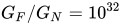


By reducing the fundamental scale to the weak scale, the fundamental theory of quantum gravity, such as string theory, might be accessible at colliders such as the Tevatron or the LHC.[12] There has been recent[when?] progress in generating large volumes in the context of string theory.[13] Having the fundamental scale accessible allows the production of black holes at the LHC,[10][14][15] though there are constraints on the viability of this possibility at the energies at the LHC.[16] There are other signatures of large extra dimensions at high energy colliders.[17][18][19][20][21]
Many of the mechanisms that were used to explain the problems in the Standard Model used very high energies. In the years after the publication of ADD, much of the work of the beyond the Standard Model physics community went to explore how these problems could be solved with a low scale of quantum gravity. Almost immediately, there was an alternative explanation to the see-saw mechanism for the neutrino mass.[22][23] Using extra dimensions as a new source of small numbers allowed for new mechanisms for understanding the masses and mixings of the neutrinos.[24][25]
Another problem with having a low scale of quantum gravity was the existence of possibly TeV-suppressed proton decay, flavor violating, and CP violating operators. These would be disastrous phenomenologically. Physicists quickly realized that there were novel mechanisms for getting small numbers necessary for explaining these very rare processes.[26][27][28][29][30]
Opponents' views
[edit]In the traditional view, the enormous gap in energy between the mass scales of ordinary particles and the Planck mass is reflected in the fact that virtual processes involving black holes or gravity are strongly suppressed. The suppression of these terms is the principle of renormalizability – in order to see an interaction at low energy, it must have the property that its coupling only changes logarithmically as a function of the Planck scale. Nonrenormalizable interactions are weak only to the extent that the Planck scale is large.
Virtual gravitational processes do not conserve anything except gauge charges, because black holes decay into anything with the same charge. Therefore, it is difficult to suppress interactions at the gravitational scale. One way to do it is by postulating new gauge symmetries. A different way to suppress these interactions in the context of extra-dimensional models is the "split fermion scenario" proposed by Arkani-Hamed and Schmaltz in their paper "Hierarchies without Symmetries from Extra Dimensions".[31] In this scenario, the wavefunctions of particles that are bound to the brane have a finite width significantly smaller than the extra-dimension, but the center (e.g. of a Gaussian wave packet) can be dislocated along the direction of the extra dimension in what is known as a "fat brane". Integrating out the additional dimension(s) to obtain the effective coupling of higher-dimensional operators on the brane, the result is suppressed with the exponential of the square of the distance between the centers of the wave functions, a factor that generates a suppression by many orders of magnitude already by a dislocation of only a few times the typical width of the wave function.
In electromagnetism, the electron magnetic moment is described by perturbative processes derived in the QED Lagrangian:

which is calculated and measured to one part in a trillion. But it is also possible to include a Pauli term in the Lagrangian:
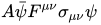
and the magnetic moment would change by . The reason the magnetic moment is correctly calculated without this term is because the coefficient has the dimension of inverse mass. The mass scale is at most the Planck mass, so would only be seen at the 20th decimal place with the usual Planck scale.

Since the electron magnetic moment is measured so accurately, and since the scale where it is measured is at the electron mass, a term of this kind would be visible even if the Planck scale were only about 109 electron masses, which is 1000 TeV. This is much higher than the proposed Planck scale in the ADD model.
QED is not the full theory, and the Standard Model does not have many possible Pauli terms. A good rule of thumb is that a Pauli term is like a mass term – in order to generate it, the Higgs must enter. But in the ADD model, the Higgs vacuum expectation value is comparable to the Planck scale, so the Higgs field can contribute to any power without any suppression. One coupling which generates a Pauli term is the same as the electron mass term, except with an extra where is the U(1) gauge field. This is dimension-six, and it contains one power of the Higgs expectation value, and is suppressed by two powers of the Planck mass. This should start contributing to the electron magnetic moment at the sixth decimal place. A similar term should contribute to the muon magnetic moment at the third or fourth decimal place.


The neutrinos are only massless because the dimension-five operator does not appear. But neutrinos have a mass scale of approximately eV, which is 14 orders of magnitude smaller than the scale of the Higgs expectation value of 1 TeV. This means that the term is suppressed by a mass such that


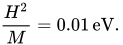
Substituting TeV gives eV GeV. So this is where the neutrino masses suggest new physics; at close to the traditional Grand Unification Theory (GUT) scale, a few orders of magnitude less than the traditional Planck scale. The same term in a large extra dimension model would give a mass to the neutrino in the MeV-GeV range, comparable to the mass of the other particles.


In this view, models with large extra dimensions miscalculate the neutrino masses by inappropriately assuming that the mass is due to interactions with a hypothetical right-handed partner. The only reason to introduce a right-handed partner is to produce neutrino masses in a renormalizable GUT. If the Planck scale is small so that renormalizability is no longer an issue, there are many neutrino mass terms which do not require extra particles.
For example, at dimension-six, there is a Higgs-free term which couples the lepton doublets to the quark doublets, , which is a coupling to the strong interaction quark condensate. Even with a relatively low energy pion scale, this type of interaction could conceivably give a mass to the neutrino of size , which is only a factor of 107 less than the pion condensate itself at 200 MeV. This would be some 10 eV of mass, about a thousand times bigger than what is measured.


This term also allows for lepton number violating pion decays, and for proton decay. In fact, in all operators with dimension greater than four, there are CP, baryon, and lepton-number violations. The only way to suppress them is to deal with them term by term, which nobody has done.[citation needed]
The popularity, or at least prominence, of these models may have been enhanced because they allow the possibility of black hole production at the LHC, which has attracted significant attention.
Empirical tests
[edit]Analyses of results from the Large Hadron Collider severely constrain theories with large extra dimensions.[5][6][7][8][9][10]
In 2012, the Fermi/LAT collaboration published limits on the ADD model of Large Extra Dimensions from astrophysical observations of neutron stars. If the unification scale is at a TeV, then for , the results presented here imply that the compactification topology is more complicated than a torus, i.e., all large extra dimensions (LED) having the same size. For flat LED of the same size, the lower limits on the unification scale results are consistent with n ≥ 4.[32] The details of the analysis is as follows: A sample of 6 gamma-ray faint NS sources not reported in the first Fermi gamma-ray source catalog that are good candidates are selected for this analysis, based on age, surface magnetic field, distance, and galactic latitude. Based on 11 months of data from Fermi-LAT, 95% CL upper limits on the size of extra dimensions from each source are obtained, as well as 95% CL lower limits on the (n+4)-dimensional Planck scale . In addition, the limits from all of the analyzed NSs have been combined statistically using two likelihood-based methods. The results indicate more stringent limits on LED than quoted previously from individual neutron star sources in gamma-rays. In addition, the results are more stringent than current collider limits, from the LHC, for .[33]


See also
[edit]References
[edit]- ^ For a pedagogical introduction, see Shifman, M. (2010). "Large Extra Dimensions: Becoming Acquainted with an Alternative Paradigm". International Journal of Modern Physics A. 25 (2n03): 199–225. arXiv:0907.3074. Bibcode:2010IJMPA..25..199S. CiteSeerX 10.1.1.314.3579. doi:10.1142/S0217751X10048548. S2CID 15019013.
- ^ Hossenfelder, Sabine (2012-12-21). "Backreaction: Large Extra Dimensions – Not Dead Yet". Backreaction. Retrieved 2019-04-03.
- ^ N. Arkani-Hamed; S. Dimopoulos; G. Dvali (1998). "The Hierarchy problem and new dimensions at a millimeter". Physics Letters. B429 (3–4): 263–272. arXiv:hep-ph/9803315. Bibcode:1998PhLB..429..263A. doi:10.1016/S0370-2693(98)00466-3. S2CID 15903444.
- ^ N. Arkani-Hamed; S. Dimopoulos; G. Dvali (1999). "Phenomenology, astrophysics and cosmology of theories with submillimeter dimensions and TeV scale quantum gravity". Physical Review. D59 (8) 086004. arXiv:hep-ph/9807344. Bibcode:1999PhRvD..59h6004A. CiteSeerX 10.1.1.345.9889. doi:10.1103/PhysRevD.59.086004. S2CID 18385871.
- ^ a b CMS Collaboration (2011). "Search for Microscopic Black Hole Signatures at the Large Hadron Collider". Physics Letters B. 697 (5): 434–453. arXiv:1012.3375. Bibcode:2011PhLB..697..434C. doi:10.1016/j.physletb.2011.02.032. S2CID 118488193.
- ^ a b CMS Collaboration (2012). "Search for microscopic black holes in pp collisions at √s = 7 TeV". Journal of High Energy Physics. 2012 (4): 61. arXiv:1202.6396. Bibcode:2012JHEP...04..061C. doi:10.1007/JHEP04(2012)061. S2CID 119117436.
- ^ a b ATLAS Collaboration (2013). "Search for microscopic black holes in a like-sign dimuon final state using large track multiplicity with the ATLAS detector". Physical Review D. 88 (7) 072001. arXiv:1308.4075. Bibcode:2013PhRvD..88g2001A. doi:10.1103/PhysRevD.88.072001. S2CID 119088864.
- ^ a b ATLAS Collaboration (2014). "Search for Quantum Black-Hole Production in High-Invariant-Mass Lepton+Jet Final States Using Proton–Proton Collisions at √s = 8 TeV and the ATLAS Detector". Physical Review Letters. 112 (9) 091804. arXiv:1311.2006. Bibcode:2014PhRvL.112i1804A. doi:10.1103/PhysRevLett.112.091804. PMID 24655244. S2CID 204934578.
- ^ a b ATLAS Collaboration (2014). "Search for microscopic black holes and string balls in final states with leptons and jets with the ATLAS detector at √s = 8 TeV". Journal of High Energy Physics. 2014 (8): 103. arXiv:1405.4254. Bibcode:2014JHEP...08..103A. doi:10.1007/JHEP08(2014)103. S2CID 119279313.
- ^ a b c ATLAS Collaboration (2016). "Search for strong gravity in multijet final states produced in pp collisions at √s = 13 TeV using the ATLAS detector at the LHC". Journal of High Energy Physics. 2016 (3): 26. arXiv:1512.02586. Bibcode:2016JHEP...03..026A. doi:10.1007/JHEP03(2016)026. S2CID 119200293.
- ^ "Reality check at the LHC". Physics World. 18 January 2011. Retrieved 2016-05-11.
- ^ I. Antoniadis; N. Arkani-Hamed; S. Dimopoulos; G. Dvali (1998). "New dimensions at a millimeter to a Fermi and superstrings at a TeV". Physics Letters. B436 (3–4): 257–263. arXiv:hep-ph/9804398. Bibcode:1998PhLB..436..257A. doi:10.1016/S0370-2693(98)00860-0. S2CID 10847839.
- ^ O. DeWolfe; A. Giryavets; S. Kachru; W. Taylor (2005). "Type IIA moduli stabilization". Journal of High Energy Physics. 0507 (7): 066. arXiv:hep-th/0505160. Bibcode:2005JHEP...07..066D. doi:10.1088/1126-6708/2005/07/066. S2CID 119518469.
- ^ S. Dimopoulos; G. Landsberg (2001). "Black holes at the LHC". Physical Review Letters. 87 (16) 161602. arXiv:hep-ph/0106295. Bibcode:2001PhRvL..87p1602D. doi:10.1103/PhysRevLett.87.161602. PMID 11690198. S2CID 119375071.
- ^ S. Giddings; S. Thomas (2002). "High-energy colliders as black hole factories: The End of short distance physics". Physical Review. D65 (5) 056010. arXiv:hep-ph/0106219. Bibcode:2002PhRvD..65e6010G. doi:10.1103/PhysRevD.65.056010. S2CID 1203487.
- ^ G. Giudice; R. Rattazzi; J. Wells (2002). "Transplanckian collisions at the LHC and beyond". Nuclear Physics. B630 (1): 293–325. arXiv:hep-ph/0112161. Bibcode:2002NuPhB.630..293G. doi:10.1016/S0550-3213(02)00142-6. S2CID 14499279.
- ^ D. Bourilkov (1999). "Analysis of Bhabha scattering at LEP2 and limits on low scale gravity models". Journal of High Energy Physics. 9908 (8): 006. arXiv:hep-ph/9907380. Bibcode:1999JHEP...08..006B. doi:10.1088/1126-6708/1999/08/006. S2CID 7032004.
- ^ K. Cheung; G. Landsberg (2000). "Drell-Yan and diphoton production at hadron colliders and low scale gravity models". Physical Review. D62 (7) 076003. arXiv:hep-ph/9909218. Bibcode:2000PhRvD..62g6003C. doi:10.1103/PhysRevD.62.076003. S2CID 16891404.
- ^ T. Rizzo (1999). "Using scalars to probe theories of low scale quantum gravity". Physical Review. D60 (7) 075001. arXiv:hep-ph/9903475. Bibcode:1999PhRvD..60g5001R. CiteSeerX 10.1.1.389.2079. doi:10.1103/PhysRevD.60.075001. S2CID 8405902.
- ^ G. Shiu; R. Shrock; S. Tye (1999). "Collider signatures from the brane world". Physics Letters. B458 (2–3): 274–282. arXiv:hep-ph/9904262. Bibcode:1999PhLB..458..274S. CiteSeerX 10.1.1.344.7811. doi:10.1016/S0370-2693(99)00609-7. S2CID 1819932.
- ^ C. Balazs; H-J. He; W. Repko; C. Yaun; D. Dicus (1999). "Collider tests of compact space dimensions using weak gauge bosons". Physical Review Letters. 83 (11): 2112–2115. arXiv:hep-ph/9904220. Bibcode:1999PhRvL..83.2112B. doi:10.1103/PhysRevLett.83.2112. S2CID 119095037.
- ^ N. Arkani-Hamed; S. Dimopoulos; G. Dvali; J. March-Russell (2002). "Neutrino masses from large extra dimensions". Physical Review. D65 (2) 024032. arXiv:hep-ph/9811448. Bibcode:2001PhRvD..65b4032A. doi:10.1103/PhysRevD.65.024032. S2CID 14524428.
- ^ G. Dvali; A. Yu. Smirnov (1999). "Probing large extra dimensions with neutrinos". Nuclear Physics. B563 (1–2): 63–81. arXiv:hep-ph/9904211. Bibcode:1999NuPhB.563...63D. doi:10.1016/S0550-3213(99)00574-X. S2CID 7709470.
- ^ Y. Grossman; M. Neubert (2000). "Neutrino masses and mixings in nonfactorizable geometry". Physics Letters. B474 (3–4): 361–371. arXiv:hep-ph/9912408. Bibcode:2000PhLB..474..361G. doi:10.1016/S0370-2693(00)00054-X. S2CID 298185.
- ^ N. Arkani-Hamed; L. Hall; H. Murayama; D. Smith; N. Weiner (2000). "Neutrino masses at v3/2". arXiv:hep-ph/0007001.
- ^ N. Arkani-Hamed; M. Schmaltz (2000). "Hierarchies without symmetries from extra dimensions". Physical Review (Submitted manuscript). D61 (3) 033005. arXiv:hep-ph/9903417. Bibcode:2000PhRvD..61c3005A. doi:10.1103/PhysRevD.61.033005. S2CID 18030407.
- ^ N. Arkani-Hamed; Y. Grossman; M. Schmaltz (2000). "Split fermions in extra dimensions and exponentially small cross-sections at future colliders". Physical Review (Submitted manuscript). D61 (11) 115004. arXiv:hep-ph/9909411. Bibcode:2000PhRvD..61k5004A. doi:10.1103/PhysRevD.61.115004. S2CID 18048661.
- ^ D. E. Kaplan; T. Tait (2001). "New tools for fermion masses from extra dimensions". Journal of High Energy Physics. 0111 (11): 051. arXiv:hep-ph/0110126. Bibcode:2001JHEP...11..051K. doi:10.1088/1126-6708/2001/11/051. S2CID 14050574.
- ^ G. Branco; A. de Gouvea; M. Rebelo (2001). "Split fermions in extra dimensions and CP violation". Physics Letters. B506 (1–2): 115–122. arXiv:hep-ph/0012289. Bibcode:2001PhLB..506..115B. doi:10.1016/S0370-2693(01)00389-6. S2CID 16447036.
- ^ N. Arkani-Hamed; L. Hall; D. R. Smith; N. Weiner (2000). "Flavor at the TeV scale with extra dimensions". Physical Review D. 61 (11) 116003. arXiv:hep-ph/9909326. Bibcode:2000PhRvD..61k6003A. doi:10.1103/PhysRevD.61.116003. S2CID 18171461.
- ^ N. Arkani-Hamed; M. Schmaltz (2000). "Hierarchies without Symmetries from Extra Dimensions". Physical Review (Submitted manuscript). D61 (3) 033005. arXiv:hep-ph/9903417. Bibcode:2000PhRvD..61c3005A. doi:10.1103/PhysRevD.61.033005. S2CID 18030407.
- ^ M. Ajello; et al. (2012). "Limits on Large Extra Dimensions Based on Observations of Neutron Stars with the Fermi-LAT". Journal of Cosmology and Astroparticle Physics. 2012 (2): 012. arXiv:1201.2460. Bibcode:2012JCAP...02..012F. doi:10.1088/1475-7516/2012/02/012. S2CID 27227775.
- ^ Further details of the analysis are found in: Bijan Berenji (2012). "Search for Large Extra Dimensions Based on Observations of Neutron Stars with the Fermi-LAT".
Further reading
[edit]- S. Hossenfelder, Extra Dimensions, (2006).
- Kaustubh Agashe and Alex Pomarol Agashe, Kaustubh; Pomarol, Alex (2010). "Focus on Extra Space Dimensions". New Journal of Physics. 12 (7) 075010. doi:10.1088/1367-2630/12/7/075010.
Large extra dimensions
View on GrokipediaIntroduction
Concept and Definition
Large extra dimensions (LED) constitute a theoretical framework in high-energy physics proposing the existence of additional spatial dimensions beyond the three observed in everyday experience, which are macroscopic in scale—ranging from subatomic distances to potentially millimeter sizes—rather than being tightly curled up.[2] In this paradigm, introduced by Arkani-Hamed, Dimopoulos, and Dvali, the Standard Model (SM) particles and forces are confined to a (3+1)-dimensional hypersurface called a brane, embedded within a higher-dimensional bulk spacetime, while gravity propagates freely throughout the bulk, diluting its effective strength in our brane-localized perception.[1] This setup aims to address the hierarchy problem—the vast disparity between the electroweak scale (~246 GeV) and the Planck scale (~10^{19} GeV)—by allowing the fundamental gravitational scale to be lowered to around the TeV range through the geometry of extra dimensions.[1] Unlike the small extra dimensions typical in string theory, where the additional six or seven dimensions are compactified at the Planck length of approximately meters, making them inaccessible to current experiments, LED models feature flat, loosely compactified or even uncompactified dimensions large enough to influence physics at observable scales.[2] LED also differ from warped extra dimension scenarios, such as the Randall-Sundrum model, which employ a single curved fifth dimension with anti-de Sitter geometry to generate the hierarchy via an exponential warp factor that suppresses gravitational interactions on the brane without requiring large flat volumes.[3] In LED, the extra dimensions remain flat, ensuring that only gravity leaks into the bulk, preserving the localization of SM gauge interactions on the brane.[1] The central parameter governing LED phenomenology is the radius of the extra dimensions, which compactifies them into a topology like a torus or sphere, with the inverse scale defining the threshold for new physics effects such as Kaluza-Klein excitations of gravitons.[2] For two extra dimensions, can extend up to about 0.1 mm, placing near 10^{-3} eV, while for six dimensions, it shrinks to around 10^{-12} cm (~3 \times 10^{-14} m), yielding MeV—potentially detectable through a dense tower of Kaluza-Klein modes in high-energy collisions or, for lower δ, in precision gravity tests.[1]Motivation from the Hierarchy Problem
The hierarchy problem in particle physics arises from the enormous disparity between the electroweak scale, set by the Higgs vacuum expectation value of approximately 246 GeV, and the Planck scale of about GeV, which governs quantum gravity. In the Standard Model, radiative corrections to the Higgs mass from virtual loops involving top quarks, electroweak gauge bosons, and other particles would naturally generate contributions of order the cutoff scale—presumed to be the Planck scale—pushing the physical Higgs mass far beyond observed values unless the bare Higgs mass parameter is exquisitely fine-tuned to cancel these effects with a precision of roughly 1 part in . This unnatural sensitivity to high-scale physics motivates extensions beyond the Standard Model that stabilize the electroweak scale without such tuning. Large extra dimensions (LED) address this hierarchy by proposing a geometric mechanism that lowers the fundamental scale of quantum gravity, denoted , to around the TeV range, making the electroweak and gravity scales naturally comparable without invoking fine-tuning or additional symmetries. In this framework, gravity propagates through the full higher-dimensional bulk, while Standard Model fields are confined to a lower-dimensional brane, leading to an effective dilution of gravitational strength in our observable four-dimensional spacetime due to the large volume of the extra dimensions. This reduces the apparent Planck scale from a fundamental parameter to an emergent one, arising from the product of the higher-dimensional Planck mass and the extra-dimensional volume, thus eliminating the need for the extreme cancellations required in the Standard Model. Unlike supersymmetry, which stabilizes the Higgs mass through pairwise cancellations between bosonic and fermionic loops but introduces superpartners that can mediate rapid proton decay in grand unified theories or induce flavor-violating processes exceeding experimental limits, LED achieves naturalness through this spatial geometry alone, avoiding such phenomenological challenges. The analogy often used is that of gravity "leaking" into the extra dimensions, akin to a force spreading over a larger effective area, which weakens its coupling in four dimensions without altering the underlying dynamics at short distances.Historical Background
Early Theories of Extra Dimensions
The concept of extra dimensions in theoretical physics originated in the early 20th century with efforts to unify fundamental forces. In 1921, Theodor Kaluza proposed extending general relativity to five dimensions, where the fifth dimension is spatial and the theory's equations naturally incorporate both gravity and electromagnetism as geometric effects.[4] This framework, known as Kaluza's theory, treats the electromagnetic field as arising from the off-diagonal components of the five-dimensional metric tensor.[5] In 1926, Oskar Klein advanced this idea by providing a quantum mechanical interpretation and mechanism to explain the absence of observable effects from the extra dimension. Klein suggested that the fifth dimension is compactified into a small circle of radius on the order of the Planck length, approximately cm, rendering it undetectable at macroscopic scales. In this compactification, particles propagating around the extra dimension acquire quantized momentum modes, termed Kaluza-Klein (KK) modes, which manifest as a tower of charged particles with masses inversely proportional to the compactification radius, effectively reproducing the spectrum of electromagnetic interactions in four dimensions.[6] The idea of extra dimensions gained renewed prominence in the 1980s through string theory, which requires a higher-dimensional spacetime for mathematical consistency. Superstring theories demand exactly 10 spacetime dimensions to ensure anomaly cancellation, where quantum inconsistencies in gauge and gravitational sectors are resolved only in this dimensionality. The additional six dimensions beyond the observed four are compactified on tiny scales, typically Calabi-Yau manifolds with radii around the string scale of cm, to reproduce the effective four-dimensional physics observed in nature. An early exploration of larger extra dimensions within string theory appeared in 1988, when Ignatios Antoniadis and collaborators investigated mechanisms for supersymmetry breaking. In their work on orbifold compactifications, they considered scenarios where one or more extra dimensions could have sizes up to the TeV scale to mediate supersymmetry breaking while preserving string theory's consistency, though the scales remained small compared to macroscopic distances.[7] However, these early models with small extra dimensions faced significant challenges related to the hierarchy problem, the vast disparity between the electroweak scale (~246 GeV) and the Planck scale (~10^{19} GeV). Compactification at Planckian scales implied unification of forces at extremely high energies, which did not alleviate the need for fine-tuning in the Higgs sector and instead amplified the sensitivity of low-energy parameters to ultraviolet physics without introducing stabilizing mechanisms.The ADD Model
The ADD model was proposed in 1998 by Nima Arkani-Hamed, Savas Dimopoulos, and Gia Dvali as a solution to the hierarchy problem, positing that the apparent weakness of gravity arises from its propagation into large extra dimensions rather than relying on supersymmetry or technicolor.[1] In their framework, the universe consists of a (4 + n)-dimensional spacetime, with n ≥ 2 flat extra dimensions compactified on a torus of radius R, while Standard Model fields are confined to a 3-brane embedded in this bulk.[8] This setup lowers the fundamental quantum gravity scale M_* to the TeV range (approximately 1–100 TeV), enabling unification of gravity with gauge interactions at energies accessible to particle accelerators.[2] A central feature of the model is the relation between the observed 4D Planck scale M_Pl (∼10^{19} GeV) and the higher-dimensional scale, given by M_Pl^2 ≈ M_^{n+2} R^n, which implies R ∼ 1/M_ for the effective size of the extra dimensions when M_* is near the weak scale.[1] The key innovation lies in making these extra dimensions sufficiently large to suppress quantum gravity effects at low energies while remaining consistent with existing gravitational tests, yet small enough to yield novel predictions; for instance, with n=2, R ∼ 0.5 mm, and for n=6, R ∼ 0.1 MeV^{-1} (∼ 2 \times 10^{-14} m).[2] This scale allows gravitons to propagate freely in the bulk, diluting gravity's strength in 4D while opening possibilities for observable deviations, such as modifications to the inverse-square law or production of Kaluza-Klein gravitons.[8] Building on earlier ideas of compact extra dimensions in string theory, the ADD proposal marked a pivotal shift by advocating dimensions large enough for direct experimental probing, transforming them from a theoretical curiosity into a testable paradigm.[2] It inspired subsequent developments, such as the Randall-Sundrum warped extra dimension model in 1999, which addressed similar hierarchy issues through geometry rather than volume dilution. Upon publication, the model gained rapid adoption throughout the late 1990s and 2000s as a compelling alternative to supersymmetry for resolving the hierarchy problem, inspiring extensive theoretical extensions and shaping search strategies at facilities like the Large Hadron Collider, where signatures such as missing energy from graviton emission became standard benchmarks.[2] Its influence is evident in over 5,000 citations of the original paper, underscoring its role in revitalizing extra-dimensional physics.Theoretical Framework
Brane-World Scenarios
In brane-world scenarios central to large extra dimensions, the observable universe is represented as a (p+1)-dimensional brane, specifically a 3+1-dimensional hypersurface for p=3, embedded within a higher-dimensional bulk spacetime of total dimension D=4+d, where d is the number of extra spatial dimensions.[1] This setup confines the Standard Model (SM) fields—such as gauge bosons and fermions—to the brane through localization mechanisms, including orbifolding, which applies parity boundary conditions (e.g., via S^1/Z_2 orbifolds) to restrict field propagation perpendicular to the brane while allowing zero modes along it. The ADD model serves as the primary instantiation of this paradigm, integrating brane localization with flat extra dimensions to address gravitational weakness.[1] Unlike the SM fields, gravity propagates freely in the full bulk, with gravitons able to explore all extra dimensions.[1] At low energies, where the wavelength of gravitational disturbances exceeds the extra dimension size R, this bulk propagation yields an effective four-dimensional gravity, manifesting as the observed Newtonian 1/r potential and recovering general relativity on scales much larger than R.[1] The effective Planck scale M_Pl relates to the fundamental (4+d)-dimensional scale M_* via M_Pl^2 ≈ M_*^{2+d} V_d, where V_d is the extra-dimensional volume, diluting the gravitational coupling in higher dimensions.[1] These scenarios emphasize flat extra dimensions, characterized by the Minkowski metricwhere is the four-dimensional Minkowski metric and (m=1,...,d) are the extra coordinates.[1] This flat geometry contrasts with warped brane-world models, such as those proposed by Randall and Sundrum, which incorporate exponential curvature in the extra dimension to localize gravity near the brane without relying on large flat volumes.[3] The theory remains stable and consistent as a low-energy effective description below the cutoff scale M_*, with the ADD formulation free of ghosts or tachyons due to the positive-definite metric and appropriate boundary conditions in the compactified bulk. This ensures perturbative unitarity and the absence of instabilities in the graviton sector, validating the model's use for phenomenological predictions.[2]