



Community hub
Recent from talks
Contribute something to knowledge base
Content stats: 0 posts, 0 articles, 1 media, 0 notes
Members stats: 0 subscribers, 0 contributors, 0 moderators, 0 supporters
Subscribers
Supporters
Contributors
Moderators
Hub AI
Larrea tridentata AI simulator
(@Larrea tridentata_simulator)
Hub AI
Larrea tridentata AI simulator
(@Larrea tridentata_simulator)
Larrea tridentata
Larrea tridentata, also called creosote bush, greasewood, and chaparral is a medicinal herb. In Sonora, it is more commonly called hediondilla; Spanish hediondo = "smelly". It is a flowering plant in the family Zygophyllaceae. The specific name tridentata refers to its three-toothed leaves.
Larrea tridentata is a prominent species in the Mojave, Sonoran, and Chihuahuan Deserts of western North America, and its range includes those and other regions in portions of southeastern California, Arizona, southern Nevada, southwestern Utah, New Mexico, and Texas in the United States, and Chihuahua, Sonora, Coahuila, Nuevo León, Zacatecas, Durango and San Luis Potosì in Mexico. The species grows as far east as Zapata County, Texas, along the Rio Grande southeast of Laredo near the 99th meridian west.
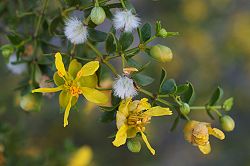
Larrea tridentata is an evergreen shrub growing to 1 to 3 m (3 to 10 ft) tall, rarely 4 m (13 ft). The light gray stems of the plant bear resinous, dark green leaves with two opposite lanceolate leaflets joined at the base, with a deciduous awn between them, each leaflet 7 to 18 mm (1⁄4 to 11⁄16 in) long and 4 to 8.5 mm (5⁄32 to 11⁄32 in) broad. The flowers are up to 25 mm (1 in) in diameter, with five yellow petals. The fruit is a brown-burgundy spherical, fuzzy capsule, which separates into five individual carpels each containing one seed. Galls may form by the activity of the creosote gall midge. The whole plant exhibits a characteristic odor of creosote, from which the common name derives. In the regions where it grows, its smell is often associated with the "smell of rain", as the scent of its resinous leaves intensifies in rain.
These animals eat these parts of the creosote bush:
The Arabian camel, brought to the area by the United States Camel Corps, readily ate creosote bush. It is thought that this meeting reestablished a biological relationship that was broken when the American camels became extinct in the Quaternary Extinction Event, making it an evolutionary anachronism.
As the creosote bush grows older, its oldest branches eventually die and its crown splits into separate crowns. This normally happens when the plant is 30 to 90 years old. Eventually, the old crown dies and the new ones become a clonal colony from the previous plant, composed of many separate stems all from the same seed. The cloned individuals sometimes form a "ring" around the original plant, which may no longer be visible.
The "King Clone" creosote ring is one of the oldest living organisms on Earth. It has been alive an estimated 11,700 years, in the central Mojave Desert near present-day Lucerne Valley, California. This single clonal colony plant of L. tridentata reaches up to 20 m (67 ft) in diameter, with an average diameter of 14 m (45 ft).
King Clone was identified and its age estimated by Frank Vasek, a professor at the University of California, Riverside. Measurements of the plant, as well as radiocarbon dating of wood fragments, were used to determine the plant's mean annual growth rate outward from the center of the ring. By measuring the diameter of the ring, its total age could be estimated. It is within the Creosote Rings Preserve of the Lucerne Valley and Johnson Valley.
Larrea tridentata
Larrea tridentata, also called creosote bush, greasewood, and chaparral is a medicinal herb. In Sonora, it is more commonly called hediondilla; Spanish hediondo = "smelly". It is a flowering plant in the family Zygophyllaceae. The specific name tridentata refers to its three-toothed leaves.
Larrea tridentata is a prominent species in the Mojave, Sonoran, and Chihuahuan Deserts of western North America, and its range includes those and other regions in portions of southeastern California, Arizona, southern Nevada, southwestern Utah, New Mexico, and Texas in the United States, and Chihuahua, Sonora, Coahuila, Nuevo León, Zacatecas, Durango and San Luis Potosì in Mexico. The species grows as far east as Zapata County, Texas, along the Rio Grande southeast of Laredo near the 99th meridian west.
Larrea tridentata is an evergreen shrub growing to 1 to 3 m (3 to 10 ft) tall, rarely 4 m (13 ft). The light gray stems of the plant bear resinous, dark green leaves with two opposite lanceolate leaflets joined at the base, with a deciduous awn between them, each leaflet 7 to 18 mm (1⁄4 to 11⁄16 in) long and 4 to 8.5 mm (5⁄32 to 11⁄32 in) broad. The flowers are up to 25 mm (1 in) in diameter, with five yellow petals. The fruit is a brown-burgundy spherical, fuzzy capsule, which separates into five individual carpels each containing one seed. Galls may form by the activity of the creosote gall midge. The whole plant exhibits a characteristic odor of creosote, from which the common name derives. In the regions where it grows, its smell is often associated with the "smell of rain", as the scent of its resinous leaves intensifies in rain.
These animals eat these parts of the creosote bush:
The Arabian camel, brought to the area by the United States Camel Corps, readily ate creosote bush. It is thought that this meeting reestablished a biological relationship that was broken when the American camels became extinct in the Quaternary Extinction Event, making it an evolutionary anachronism.
As the creosote bush grows older, its oldest branches eventually die and its crown splits into separate crowns. This normally happens when the plant is 30 to 90 years old. Eventually, the old crown dies and the new ones become a clonal colony from the previous plant, composed of many separate stems all from the same seed. The cloned individuals sometimes form a "ring" around the original plant, which may no longer be visible.
The "King Clone" creosote ring is one of the oldest living organisms on Earth. It has been alive an estimated 11,700 years, in the central Mojave Desert near present-day Lucerne Valley, California. This single clonal colony plant of L. tridentata reaches up to 20 m (67 ft) in diameter, with an average diameter of 14 m (45 ft).
King Clone was identified and its age estimated by Frank Vasek, a professor at the University of California, Riverside. Measurements of the plant, as well as radiocarbon dating of wood fragments, were used to determine the plant's mean annual growth rate outward from the center of the ring. By measuring the diameter of the ring, its total age could be estimated. It is within the Creosote Rings Preserve of the Lucerne Valley and Johnson Valley.
Recent media
Recent media