



Community hub
Recent from talks
Knowledge base stats:
Talk channels stats:
Members stats:
Camelops
Camelops is an extinct genus of camel that lived in North and Central America from the middle Pliocene (from around 4-3.2 million years ago) to the end of the Pleistocene (around 13-12,000 years ago). It is more closely related to living camels than to lamines (llamas, alpacas, vicuñas, and guanacos), making it a true camel of the Camelini tribe. Its name is derived from the Ancient Greek κάμηλος (cámēlos, "camel") and ὄψ (óps, "face"), i.e. "camel-face". Camelops lived across Western North America, ranging from the Pacific Coast to the Great Plains, southwards to Honduras and northwards to Alaska. Camelops became extinct as part of the end-Pleistocene extinction event, along with most large mammals across the Americas. The extinctions followed the arrival of humans to the Americas, and evidence has been found indicating that humans butchered Camelops, suggesting that hunting may have been a factor in its extinction.
Camelops was first named by Joseph Leidy in 1854, based on a partial maxilla (upper jawbone), that was found in a gravel drift somewhere in the Kansas Territory, with Leidy naming the type species Camelops kansanus in the same publication based on the maxilla. Later authors have judged that while the jawbone undoubtedly represents Camelops, it is too fragmentary to be diagnostic to species, making C. kansanus a nomen dubium. Later in 1874, Leidy named the species Camelops hesternus, based on teeth found in a gravel deposit in Arroyo Las Positas in Livermore Valley, Alameda County in the southern Bay Area of California. Several other species, including Camelops sulcatus named by Edward Drinker Cope in 1893 based on a partial left mandible, found at Rock Creek, Texas, as well as Camelops huerfanensis, named by Francis Whittemore Cragin in 1892 based on remains found along the Huerfano River in Colorado (as well as its claimed subspecies Camelops huerfanensis dallasi named by Richard Swann Lull in 1921 for remains collected along the Trinity River in northeast Texas), Camelops aransas named by Oliver Perry Hay in 1926 for remains including a partial right mandible found on a bank of the Aransas River in southeast Texas, and Camelops traviswhitei named by Mooser and Dalquist in 1975 from remains found in Aguascalientes in central Mexico, are now regarded as junior synonyms of C. hesternus.
Another species, C. minidokiae, named by Hay in 1927 for jaw and teeth remains found in a gravel bed near Minidoka, Idaho, has been suggested to also be potentially valid, given its apparently smaller size than C. hesternus, though other authors have suggested that it is another synonym for C. hesternus. This species is primarily recorded during the Irvingtonian (Early-Middle Pleistocene), though some remains of the species have been reported from the Rancholabrean (late Middle-Late Pleistocene).
Some scientific publications have used the informal names "western camel" and "yesterday's camel" for Camelops.
The family Camelidae, which contains the living camels, as well as lamines (the tribe Lamini, which includes the llama, guanaco, alpaca and vicuña), first emerged in North America during the Eocene, around 46-42 million years ago, reaching its apex of diversity during the Miocene epoch (23-5.3 million years ago). The two modern tribes of Camelidae, Camelini and Lamini, are suggested to have diverged during this period, around 17.5-16 million years ago. Living camels are thought to descend from Paracamelus, which crossed the Bering Land Bridge into Eurasia from North America during the Late Miocene, around 6 million years ago. Although historically often assigned to Lamini, ancient DNA obtained from Camelops indicates that it is a member of Camelini more closely related to living camels than to lamines, making it a true camel, with an estimated divergence from living camels around 11-10 million years ago.
Phylogenetic relationships of Camelops compared to living and recently extinct camels, after Yuan et al. (2024).
The oldest fossils of Camelops are known from southern North America, dating to around 4-3.2 million years ago during the Pliocene epoch. During the Pliocene and Early Pleistocene epochs (Blancan-Irvingtonian) other camels, such as Gigantocamelus, Blancocamelus, Titanotylopus and cf. Paracamelus were also present in North America, but by the Late Pleistocene (Rancholabrean), Camelops represented the last remaining camel in the Americas.
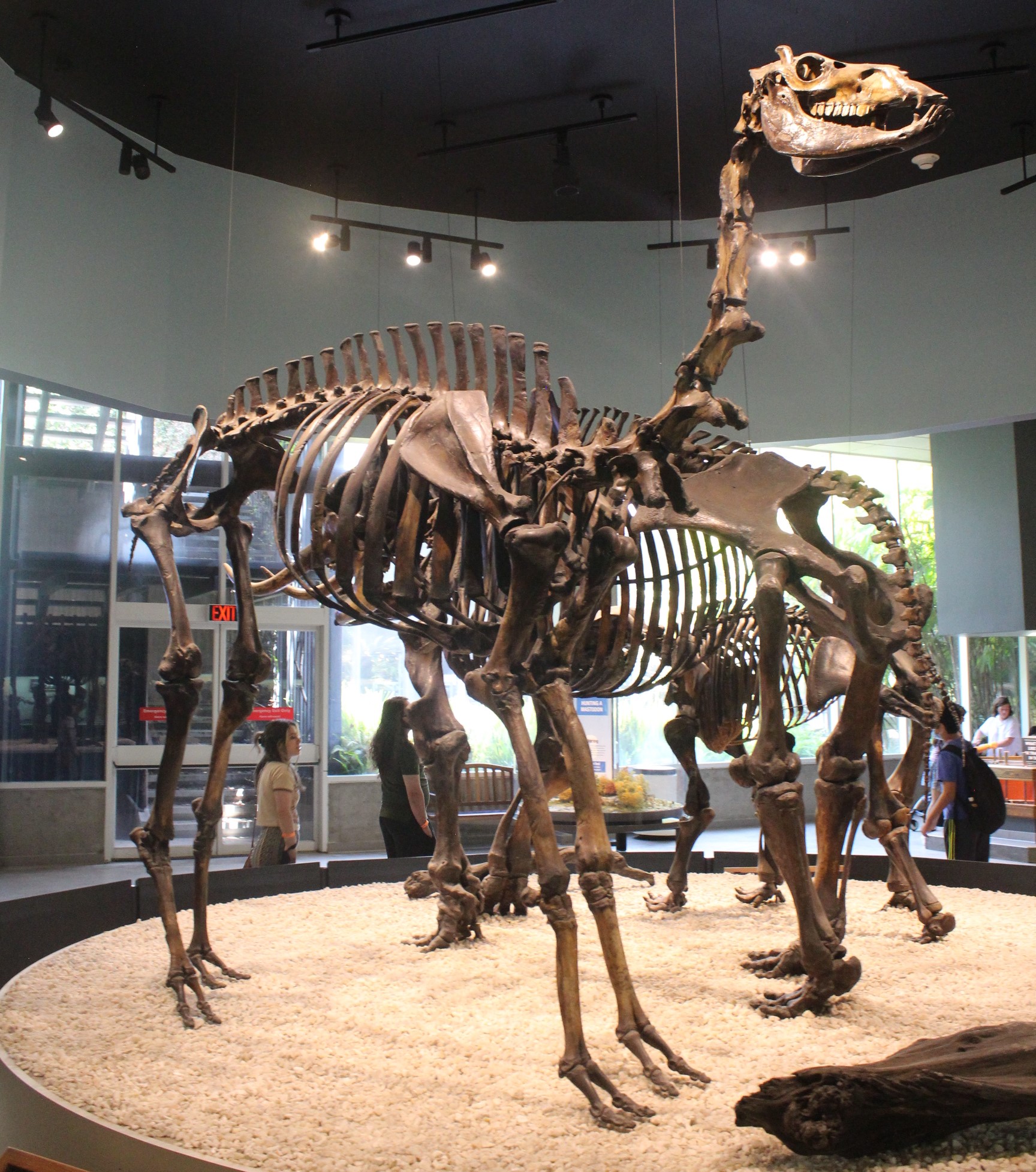
Camelops hesternus was a large camel with a bodyform similar to a living dromedary, reaching a shoulder height of 2.3 m (7 ft 7 in) with body mass estimates ranging from 437 kilograms (963 lb) to 826 kilograms (1,821 lb), to around 1,000 kilograms (2,200 lb), though the size of the species was variable, with individuals known from the far north of the species range in Alaska and Yukon being considerably smaller than those from elsewhere. Whether Camelops had humps or not like living camels is uncertain. The skull has 1 incisor, 1 canine, 2 premolars and 3 molars in each half of the upper jaw, and 3 incisors, 1 canine, 1 premolar and 3 molars in each half of the lower jaw. The upper first premolar and both upper and lower second premolars are absent, with the lower first premolar usually absent and only occasionally present. The molar and premolar teeth are very high-crowned (hypsodont), with the molars being slender relative to their length, with the canines, upper third premolar and lower fourth premolar being reduced in size. The premaxilla bone is robust, with the rostrum of the skull being elongate, with the facial region of the skull not exhibiting considerable shortening. The nasal bones are strongly arched. The brain is relatively large, estimated at 990 grams (2.18 lb). The mandible is relatively deep. The limbs are relatively elongate (around 20% longer than those of living dromedaries) but robust. The metapodial bones are robust and relatively short.
Hub AI
Camelops AI simulator
(@Camelops_simulator)
Camelops
Camelops is an extinct genus of camel that lived in North and Central America from the middle Pliocene (from around 4-3.2 million years ago) to the end of the Pleistocene (around 13-12,000 years ago). It is more closely related to living camels than to lamines (llamas, alpacas, vicuñas, and guanacos), making it a true camel of the Camelini tribe. Its name is derived from the Ancient Greek κάμηλος (cámēlos, "camel") and ὄψ (óps, "face"), i.e. "camel-face". Camelops lived across Western North America, ranging from the Pacific Coast to the Great Plains, southwards to Honduras and northwards to Alaska. Camelops became extinct as part of the end-Pleistocene extinction event, along with most large mammals across the Americas. The extinctions followed the arrival of humans to the Americas, and evidence has been found indicating that humans butchered Camelops, suggesting that hunting may have been a factor in its extinction.
Camelops was first named by Joseph Leidy in 1854, based on a partial maxilla (upper jawbone), that was found in a gravel drift somewhere in the Kansas Territory, with Leidy naming the type species Camelops kansanus in the same publication based on the maxilla. Later authors have judged that while the jawbone undoubtedly represents Camelops, it is too fragmentary to be diagnostic to species, making C. kansanus a nomen dubium. Later in 1874, Leidy named the species Camelops hesternus, based on teeth found in a gravel deposit in Arroyo Las Positas in Livermore Valley, Alameda County in the southern Bay Area of California. Several other species, including Camelops sulcatus named by Edward Drinker Cope in 1893 based on a partial left mandible, found at Rock Creek, Texas, as well as Camelops huerfanensis, named by Francis Whittemore Cragin in 1892 based on remains found along the Huerfano River in Colorado (as well as its claimed subspecies Camelops huerfanensis dallasi named by Richard Swann Lull in 1921 for remains collected along the Trinity River in northeast Texas), Camelops aransas named by Oliver Perry Hay in 1926 for remains including a partial right mandible found on a bank of the Aransas River in southeast Texas, and Camelops traviswhitei named by Mooser and Dalquist in 1975 from remains found in Aguascalientes in central Mexico, are now regarded as junior synonyms of C. hesternus.
Another species, C. minidokiae, named by Hay in 1927 for jaw and teeth remains found in a gravel bed near Minidoka, Idaho, has been suggested to also be potentially valid, given its apparently smaller size than C. hesternus, though other authors have suggested that it is another synonym for C. hesternus. This species is primarily recorded during the Irvingtonian (Early-Middle Pleistocene), though some remains of the species have been reported from the Rancholabrean (late Middle-Late Pleistocene).
Some scientific publications have used the informal names "western camel" and "yesterday's camel" for Camelops.
The family Camelidae, which contains the living camels, as well as lamines (the tribe Lamini, which includes the llama, guanaco, alpaca and vicuña), first emerged in North America during the Eocene, around 46-42 million years ago, reaching its apex of diversity during the Miocene epoch (23-5.3 million years ago). The two modern tribes of Camelidae, Camelini and Lamini, are suggested to have diverged during this period, around 17.5-16 million years ago. Living camels are thought to descend from Paracamelus, which crossed the Bering Land Bridge into Eurasia from North America during the Late Miocene, around 6 million years ago. Although historically often assigned to Lamini, ancient DNA obtained from Camelops indicates that it is a member of Camelini more closely related to living camels than to lamines, making it a true camel, with an estimated divergence from living camels around 11-10 million years ago.
Phylogenetic relationships of Camelops compared to living and recently extinct camels, after Yuan et al. (2024).
The oldest fossils of Camelops are known from southern North America, dating to around 4-3.2 million years ago during the Pliocene epoch. During the Pliocene and Early Pleistocene epochs (Blancan-Irvingtonian) other camels, such as Gigantocamelus, Blancocamelus, Titanotylopus and cf. Paracamelus were also present in North America, but by the Late Pleistocene (Rancholabrean), Camelops represented the last remaining camel in the Americas.
Camelops hesternus was a large camel with a bodyform similar to a living dromedary, reaching a shoulder height of 2.3 m (7 ft 7 in) with body mass estimates ranging from 437 kilograms (963 lb) to 826 kilograms (1,821 lb), to around 1,000 kilograms (2,200 lb), though the size of the species was variable, with individuals known from the far north of the species range in Alaska and Yukon being considerably smaller than those from elsewhere. Whether Camelops had humps or not like living camels is uncertain. The skull has 1 incisor, 1 canine, 2 premolars and 3 molars in each half of the upper jaw, and 3 incisors, 1 canine, 1 premolar and 3 molars in each half of the lower jaw. The upper first premolar and both upper and lower second premolars are absent, with the lower first premolar usually absent and only occasionally present. The molar and premolar teeth are very high-crowned (hypsodont), with the molars being slender relative to their length, with the canines, upper third premolar and lower fourth premolar being reduced in size. The premaxilla bone is robust, with the rostrum of the skull being elongate, with the facial region of the skull not exhibiting considerable shortening. The nasal bones are strongly arched. The brain is relatively large, estimated at 990 grams (2.18 lb). The mandible is relatively deep. The limbs are relatively elongate (around 20% longer than those of living dromedaries) but robust. The metapodial bones are robust and relatively short.