




Community hub
Recent from talks
Contribute something to knowledge base
Content stats: 0 posts, 0 articles, 1 media, 0 notes
Members stats: 0 subscribers, 0 contributors, 0 moderators, 0 supporters
Subscribers
Supporters
Contributors
Moderators
Larsen Ice Shelf
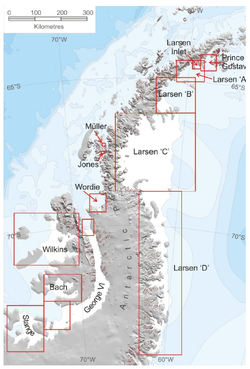
The Larsen Ice Shelf is a long ice shelf in the northwest part of the Weddell Sea, extending along the east coast of the Antarctic Peninsula from Cape Longing to Smith Peninsula. It is named after Captain Carl Anton Larsen, the master of the Norwegian whaling vessel Jason, who sailed along the ice front as far as 68°10' South during December 1893. In finer detail, the Larsen Ice Shelf is a series of shelves that occupy (or occupied) distinct embayments along the coast. From north to south, the segments are called Larsen A (the smallest), Larsen B, and Larsen C (the largest) by researchers who work in the area. Further south, Larsen D and the much smaller Larsen E, F and G are also named.
The breakup of the ice shelf since the mid-1990s has been widely reported, with the collapse of Larsen B in 2002 being particularly dramatic. A large section of the Larsen C shelf broke away in July 2017 to form an iceberg known as A-68.
The ice shelf originally covered an area of 85,000 square kilometres (33,000 sq mi), but following the disintegration in the north and the calving of iceberg A-68, it now covers an area of 67,000 square kilometres (26,000 sq mi).
The collapse of Larsen B has revealed a thriving chemotrophic ecosystem 800 m (half a mile) below the sea. The discovery was accidental. U.S. Antarctic Program scientists were in the north-western Weddell Sea investigating the sediment record in a deep glacial trough of roughly 1,000,000 square kilometres (390,000 sq mi) (twice the size of Texas or France). Methane and hydrogen sulfide associated with cold seeps is suspected as the source of the chemical energy powering the ecosystem. The area had been protected by the overlying ice shelf from debris and sediment which was seen to be building up on the white microbial mats after the breakup of the ice shelf. Clams were observed clustered about the vents.
The former Larsen A region, which was the farthest north and was just outside the Antarctic Circle, had previously broken up in the middle of the present interglacial and reformed only about 4,000 years ago. The former Larsen B, by contrast, had been stable for at least 10,000 years. The ice of the shelf is renewed on a much shorter time-scale and the oldest ice on the current shelf dates from only two hundred years ago. The speed of Crane Glacier increased threefold after the collapse of the Larsen B, likely due to the removal of a buttressing effect of the ice shelf. Data collected in 2007 by an international team of investigators through satellite-based radar measurements suggests that the overall ice-sheet mass balance in Antarctica is increasingly negative.
The Larsen disintegration events were unusual by past standards. Typically, ice shelves lose mass by iceberg calving and by melting at their upper and lower surfaces. The disintegration events were linked by The Independent newspaper in 2005 to ongoing climate warming in the Antarctic Peninsula, about 0.5˚C (0.9˚F) per decade since the late 1940s. According to a paper published in Journal of Climate in 2006, the peninsula at Faraday station warmed by 2.94˚C (5.3˚F) from 1951 to 2004, much faster than Antarctica as a whole and faster than the global trend; anthropogenic global warming causes this localized warming through a strengthening of the winds circling the Antarctic.
The Larsen A ice shelf disintegrated in January 1995. It was an ice shelf near the Prince Gustav Ice Shelf, extending from Cape Longing to Robertson Island, and merged with Larsen B at Seal Nunataks. It was relatively stable and around 4000 km^2 from 1961, until around the 1980s, when large calving resulted in eventual collapse. The disintegration is considered by many scientists to be closely related to climate change. The break-up pattern in the Larsen A, in which 2,000 square kilometers disintegrated into small icebergs, was at that time an unprecedented observation.
From 31 January 2002 to March 2002 the Larsen B sector partially collapsed and parts broke up, 3,250 km2 (1,250 sq mi) of ice 220 m (720 ft) thick, an area comparable to the US state of Rhode Island. In 2015, a study concluded that the remaining Larsen B ice-shelf would disintegrate by 2020, based on observations of faster flow and rapid thinning of glaciers in the area.
Larsen Ice Shelf
The Larsen Ice Shelf is a long ice shelf in the northwest part of the Weddell Sea, extending along the east coast of the Antarctic Peninsula from Cape Longing to Smith Peninsula. It is named after Captain Carl Anton Larsen, the master of the Norwegian whaling vessel Jason, who sailed along the ice front as far as 68°10' South during December 1893. In finer detail, the Larsen Ice Shelf is a series of shelves that occupy (or occupied) distinct embayments along the coast. From north to south, the segments are called Larsen A (the smallest), Larsen B, and Larsen C (the largest) by researchers who work in the area. Further south, Larsen D and the much smaller Larsen E, F and G are also named.
The breakup of the ice shelf since the mid-1990s has been widely reported, with the collapse of Larsen B in 2002 being particularly dramatic. A large section of the Larsen C shelf broke away in July 2017 to form an iceberg known as A-68.
The ice shelf originally covered an area of 85,000 square kilometres (33,000 sq mi), but following the disintegration in the north and the calving of iceberg A-68, it now covers an area of 67,000 square kilometres (26,000 sq mi).
The collapse of Larsen B has revealed a thriving chemotrophic ecosystem 800 m (half a mile) below the sea. The discovery was accidental. U.S. Antarctic Program scientists were in the north-western Weddell Sea investigating the sediment record in a deep glacial trough of roughly 1,000,000 square kilometres (390,000 sq mi) (twice the size of Texas or France). Methane and hydrogen sulfide associated with cold seeps is suspected as the source of the chemical energy powering the ecosystem. The area had been protected by the overlying ice shelf from debris and sediment which was seen to be building up on the white microbial mats after the breakup of the ice shelf. Clams were observed clustered about the vents.
The former Larsen A region, which was the farthest north and was just outside the Antarctic Circle, had previously broken up in the middle of the present interglacial and reformed only about 4,000 years ago. The former Larsen B, by contrast, had been stable for at least 10,000 years. The ice of the shelf is renewed on a much shorter time-scale and the oldest ice on the current shelf dates from only two hundred years ago. The speed of Crane Glacier increased threefold after the collapse of the Larsen B, likely due to the removal of a buttressing effect of the ice shelf. Data collected in 2007 by an international team of investigators through satellite-based radar measurements suggests that the overall ice-sheet mass balance in Antarctica is increasingly negative.
The Larsen disintegration events were unusual by past standards. Typically, ice shelves lose mass by iceberg calving and by melting at their upper and lower surfaces. The disintegration events were linked by The Independent newspaper in 2005 to ongoing climate warming in the Antarctic Peninsula, about 0.5˚C (0.9˚F) per decade since the late 1940s. According to a paper published in Journal of Climate in 2006, the peninsula at Faraday station warmed by 2.94˚C (5.3˚F) from 1951 to 2004, much faster than Antarctica as a whole and faster than the global trend; anthropogenic global warming causes this localized warming through a strengthening of the winds circling the Antarctic.
The Larsen A ice shelf disintegrated in January 1995. It was an ice shelf near the Prince Gustav Ice Shelf, extending from Cape Longing to Robertson Island, and merged with Larsen B at Seal Nunataks. It was relatively stable and around 4000 km^2 from 1961, until around the 1980s, when large calving resulted in eventual collapse. The disintegration is considered by many scientists to be closely related to climate change. The break-up pattern in the Larsen A, in which 2,000 square kilometers disintegrated into small icebergs, was at that time an unprecedented observation.
From 31 January 2002 to March 2002 the Larsen B sector partially collapsed and parts broke up, 3,250 km2 (1,250 sq mi) of ice 220 m (720 ft) thick, an area comparable to the US state of Rhode Island. In 2015, a study concluded that the remaining Larsen B ice-shelf would disintegrate by 2020, based on observations of faster flow and rapid thinning of glaciers in the area.
Recent media
Recent media