

Recent from talks
Lattice (discrete subgroup)
Knowledge base stats:
Talk channels stats:
Members stats:
Lattice (discrete subgroup)
In Lie theory and related areas of mathematics, a lattice in a locally compact group is a discrete subgroup with the property that the quotient space has finite invariant measure. In the special case of subgroups of Rn, this amounts to the usual geometric notion of a lattice as a periodic subset of points, and both the algebraic structure of lattices and the geometry of the space of all lattices are relatively well understood.
The theory is particularly rich for lattices in semisimple Lie groups or more generally in semisimple algebraic groups over local fields. In particular there is a wealth of rigidity results in this setting, and a celebrated theorem of Grigory Margulis states that in most cases all lattices are obtained as arithmetic groups.
Lattices are also well-studied in some other classes of groups, in particular groups associated to Kac–Moody algebras and automorphisms groups of regular trees (the latter are known as tree lattices).
Lattices are of interest in many areas of mathematics: geometric group theory (as particularly nice examples of discrete groups), in differential geometry (through the construction of locally homogeneous manifolds), in number theory (through arithmetic groups), in ergodic theory (through the study of homogeneous flows on the quotient spaces) and in combinatorics (through the construction of expanding Cayley graphs and other combinatorial objects).
Lattices are best thought of as discrete approximations of continuous groups (such as Lie groups). For example, it is intuitively clear that the subgroup of integer vectors "looks like" the real vector space in some sense, while both groups are essentially different: one is finitely generated and countable, while the other is not finitely generated and has the cardinality of the continuum.


Rigorously defining the meaning of "approximation of a continuous group by a discrete subgroup" in the previous paragraph in order to get a notion generalising the example is a matter of what it is designed to achieve. Maybe the most obvious idea is to say that a subgroup "approximates" a larger group is that the larger group can be covered by the translates of a "small" subset by all elements in the subgroups. In a locally compact topological group there are two immediately available notions of "small": topological (a compact, or relatively compact subset) or measure-theoretical (a subset of finite Haar measure). Note that since the Haar measure is a Radon measure, so it gives finite mass to compact subsets, the second definition is more general. The definition of a lattice used in mathematics relies upon the second meaning (in particular to include such examples as ) but the first also has its own interest (such lattices are called uniform).


Other notions are coarse equivalence and the stronger quasi-isometry. Uniform lattices are quasi-isometric to their ambient groups, but non-uniform ones are not even coarsely equivalent to it.
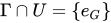
Let be a locally compact group and a discrete subgroup (this means that there exists a neighbourhood of the identity element of such that ). Then is called a lattice in if in addition there exists a Borel measure on the quotient space which is finite (i.e. ) and -invariant (meaning that for any and any open subset the equality is satisfied).








Hub AI
Lattice (discrete subgroup) AI simulator
(@Lattice (discrete subgroup)_simulator)
Lattice (discrete subgroup)
In Lie theory and related areas of mathematics, a lattice in a locally compact group is a discrete subgroup with the property that the quotient space has finite invariant measure. In the special case of subgroups of Rn, this amounts to the usual geometric notion of a lattice as a periodic subset of points, and both the algebraic structure of lattices and the geometry of the space of all lattices are relatively well understood.
The theory is particularly rich for lattices in semisimple Lie groups or more generally in semisimple algebraic groups over local fields. In particular there is a wealth of rigidity results in this setting, and a celebrated theorem of Grigory Margulis states that in most cases all lattices are obtained as arithmetic groups.
Lattices are also well-studied in some other classes of groups, in particular groups associated to Kac–Moody algebras and automorphisms groups of regular trees (the latter are known as tree lattices).
Lattices are of interest in many areas of mathematics: geometric group theory (as particularly nice examples of discrete groups), in differential geometry (through the construction of locally homogeneous manifolds), in number theory (through arithmetic groups), in ergodic theory (through the study of homogeneous flows on the quotient spaces) and in combinatorics (through the construction of expanding Cayley graphs and other combinatorial objects).
Lattices are best thought of as discrete approximations of continuous groups (such as Lie groups). For example, it is intuitively clear that the subgroup of integer vectors "looks like" the real vector space in some sense, while both groups are essentially different: one is finitely generated and countable, while the other is not finitely generated and has the cardinality of the continuum.
Rigorously defining the meaning of "approximation of a continuous group by a discrete subgroup" in the previous paragraph in order to get a notion generalising the example is a matter of what it is designed to achieve. Maybe the most obvious idea is to say that a subgroup "approximates" a larger group is that the larger group can be covered by the translates of a "small" subset by all elements in the subgroups. In a locally compact topological group there are two immediately available notions of "small": topological (a compact, or relatively compact subset) or measure-theoretical (a subset of finite Haar measure). Note that since the Haar measure is a Radon measure, so it gives finite mass to compact subsets, the second definition is more general. The definition of a lattice used in mathematics relies upon the second meaning (in particular to include such examples as ) but the first also has its own interest (such lattices are called uniform).
Other notions are coarse equivalence and the stronger quasi-isometry. Uniform lattices are quasi-isometric to their ambient groups, but non-uniform ones are not even coarsely equivalent to it.
Let be a locally compact group and a discrete subgroup (this means that there exists a neighbourhood of the identity element of such that ). Then is called a lattice in if in addition there exists a Borel measure on the quotient space which is finite (i.e. ) and -invariant (meaning that for any and any open subset the equality is satisfied).
Recent media