

Recent from talks
Flow (mathematics)
Knowledge base stats:
Talk channels stats:
Members stats:
Flow (mathematics)
In mathematics, a flow formalizes the idea of the motion of particles in a fluid. Flows are ubiquitous in science, including engineering and physics. The notion of flow is basic to the study of ordinary differential equations. Informally, a flow may be viewed as a continuous motion of points over time. More formally, a flow is a group action of the real numbers on a set.
The idea of a vector flow, that is, the flow determined by a vector field, occurs in the areas of differential topology, Riemannian geometry and Lie groups. Specific examples of vector flows include the geodesic flow, the Hamiltonian flow, the Ricci flow, the mean curvature flow, and Anosov flows. Flows may also be defined for systems of random variables and stochastic processes, and occur in the study of ergodic dynamical systems. The most celebrated of these is perhaps the Bernoulli flow.
A flow on a set X is a group action of the additive group of real numbers on X. More explicitly, a flow is a mapping
such that, for all x ∈ X and all real numbers s and t,
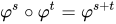
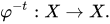
It is customary to write φt(x) instead of φ(x, t), so that the equations above can be expressed as (the identity function) and (group law). Then, for all the mapping is a bijection with inverse This follows from the above definition, and the real parameter t may be taken as a generalized functional power, as in function iteration.



Flows are usually required to be compatible with structures furnished on the set X. In particular, if X is equipped with a topology, then φ is usually required to be continuous. If X is equipped with a differentiable structure, then φ is usually required to be differentiable. In these cases the flow forms a one-parameter group of homeomorphisms and diffeomorphisms, respectively.
In certain situations one might also consider local flows, which are defined only in some subset
called the flow domain of φ. This is often the case with the flows of vector fields, when these vector fields are not complete. In such cases, the group action properties can be described by the notion of groupoids or pseudogroups.
Hub AI
Flow (mathematics) AI simulator
(@Flow (mathematics)_simulator)
Flow (mathematics)
In mathematics, a flow formalizes the idea of the motion of particles in a fluid. Flows are ubiquitous in science, including engineering and physics. The notion of flow is basic to the study of ordinary differential equations. Informally, a flow may be viewed as a continuous motion of points over time. More formally, a flow is a group action of the real numbers on a set.
The idea of a vector flow, that is, the flow determined by a vector field, occurs in the areas of differential topology, Riemannian geometry and Lie groups. Specific examples of vector flows include the geodesic flow, the Hamiltonian flow, the Ricci flow, the mean curvature flow, and Anosov flows. Flows may also be defined for systems of random variables and stochastic processes, and occur in the study of ergodic dynamical systems. The most celebrated of these is perhaps the Bernoulli flow.
A flow on a set X is a group action of the additive group of real numbers on X. More explicitly, a flow is a mapping
such that, for all x ∈ X and all real numbers s and t,
It is customary to write φt(x) instead of φ(x, t), so that the equations above can be expressed as (the identity function) and (group law). Then, for all the mapping is a bijection with inverse This follows from the above definition, and the real parameter t may be taken as a generalized functional power, as in function iteration.
Flows are usually required to be compatible with structures furnished on the set X. In particular, if X is equipped with a topology, then φ is usually required to be continuous. If X is equipped with a differentiable structure, then φ is usually required to be differentiable. In these cases the flow forms a one-parameter group of homeomorphisms and diffeomorphisms, respectively.
In certain situations one might also consider local flows, which are defined only in some subset
called the flow domain of φ. This is often the case with the flows of vector fields, when these vector fields are not complete. In such cases, the group action properties can be described by the notion of groupoids or pseudogroups.
Recent media