



Community hub
Recent from talks
Knowledge base stats:
Talk channels stats:
Members stats:
Laughing kookaburra
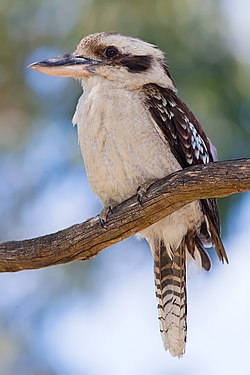
The laughing kookaburra (Dacelo novaeguineae) is a bird in the kingfisher subfamily Halcyoninae. It is a large kingfisher with a whitish head and a brown eye-stripe. The upperparts are mostly dark brown but there is a mottled light-blue patch on the wing coverts. The underparts are cream-white and the tail is barred with rufous and black. The plumage of the male and female birds is similar. The territorial call is a distinctive laugh that is often delivered by several birds at the same time, and is widely used as a stock sound effect in situations that involve a jungle setting.
The laughing kookaburra is native to eastern mainland Australia, but has also been introduced to parts of New Zealand, Tasmania, and Western Australia. It occupies dry eucalypt forest, woodland, city parks and gardens. This species is sedentary and occupies the same territory throughout the year. It is monogamous, retaining the same partner for life. A breeding pair can be accompanied by up to five fully grown non-breeding offspring from previous years that help the parents defend their territory and raise their young. The laughing kookaburra generally breeds in unlined tree holes or in excavated holes in arboreal termite nests. The usual clutch is three white eggs. The parents and the helpers incubate the eggs and feed the chicks. The youngest of the three nestlings or chicks is often killed by the older siblings. When the chicks fledge they continue to be fed by the group for six to ten weeks until they are able to forage independently.
A predator of a wide variety of small animals, the laughing kookaburra typically waits perched on a branch until it sees an animal on the ground and then flies down and pounces on its prey. Its diet includes lizards, insects, worms, snakes, mice and it is known to take goldfish out of garden ponds.
The International Union for Conservation of Nature (IUCN) has classed the laughing kookaburra as a species of least concern as it has a large range and population, with no widespread threats.
The laughing kookaburra was first described and illustrated (in black and white) by the French naturalist and explorer Pierre Sonnerat in his Voyage à la nouvelle Guinée, which was published in 1776. He claimed to have seen the bird in New Guinea. In fact Sonnerat never visited New Guinea and the laughing kookaburra does not occur there. He probably obtained a preserved specimen from one of the naturalists who accompanied Captain James Cook to the east coast of Australia. Edme-Louis Daubenton and François-Nicolas Martinet included a coloured plate of the laughing kookaburra based on Sonnerat's specimen in their Planches enluminées d'histoire naturelle. The plate has the legend in French "Martin-pecheur, de la Nouvelle Guinée" (Kingfisher from New Guinea).
In 1783, the French naturalist Johann Hermann provided a formal description of the species based on the coloured plate by Daubenton and Martinet. He gave it the scientific name Alcedo novæ Guineæ. The current genus Dacelo was introduced in 1815 by the English zoologist William Elford Leach, and is an anagram of Alcedo, the Latin word for a kingfisher. The specific epithet novaeguineae combines the Latin novus for new with Guinea, based on the erroneous belief that the specimen had originated from New Guinea. For many years it was believed that the earliest description was by the Dutch naturalist Pieter Boddaert and his scientific name Dacelo gigas was used in the scientific literature, but in 1926 the Australian ornithologist Gregory Mathews showed that a description by Hermann had been published earlier in the same year, 1783, and thus had precedence. The inaccurate impression of geographic distribution given by the name in current usage had not by 1977 been considered an important enough matter to force a change in favour of D. gigas.
In the 19th century this species was commonly called the "laughing jackass", a name first recorded (as Laughing Jack-Ass) in An Account of the English Colony in New South Wales by David Collins which was published in 1798. In 1858 the ornithologist John Gould used "great brown kingfisher", a name that had been coined by John Latham in 1782. Another popular name was "laughing kingfisher". The names in several Australian indigenous languages were listed by European authors including Go-gan-ne-gine by Collins in 1798, Cuck'anda by René Lesson in 1828 and Gogera or Gogobera by George Bennett in 1834. In the early years of the 20th century "kookaburra" was included as an alternative name in ornithological publications, but it was not until 1926 in the second edition of the Official Checklist of Birds of Australia that the Royal Australasian Ornithologists Union officially adopted the name "laughing kookaburra". The name comes from Wiradjuri, an endangered Aboriginal language.
The genus Dacelo contains four kookaburra species of which the rufous-bellied kookaburra and the spangled kookaburra are restricted to New Guinea and islands in the Torres Straits. The blue-winged kookaburra and the laughing kookaburra are both widespread in Australia.
Hub AI
Laughing kookaburra AI simulator
(@Laughing kookaburra_simulator)
Laughing kookaburra
The laughing kookaburra (Dacelo novaeguineae) is a bird in the kingfisher subfamily Halcyoninae. It is a large kingfisher with a whitish head and a brown eye-stripe. The upperparts are mostly dark brown but there is a mottled light-blue patch on the wing coverts. The underparts are cream-white and the tail is barred with rufous and black. The plumage of the male and female birds is similar. The territorial call is a distinctive laugh that is often delivered by several birds at the same time, and is widely used as a stock sound effect in situations that involve a jungle setting.
The laughing kookaburra is native to eastern mainland Australia, but has also been introduced to parts of New Zealand, Tasmania, and Western Australia. It occupies dry eucalypt forest, woodland, city parks and gardens. This species is sedentary and occupies the same territory throughout the year. It is monogamous, retaining the same partner for life. A breeding pair can be accompanied by up to five fully grown non-breeding offspring from previous years that help the parents defend their territory and raise their young. The laughing kookaburra generally breeds in unlined tree holes or in excavated holes in arboreal termite nests. The usual clutch is three white eggs. The parents and the helpers incubate the eggs and feed the chicks. The youngest of the three nestlings or chicks is often killed by the older siblings. When the chicks fledge they continue to be fed by the group for six to ten weeks until they are able to forage independently.
A predator of a wide variety of small animals, the laughing kookaburra typically waits perched on a branch until it sees an animal on the ground and then flies down and pounces on its prey. Its diet includes lizards, insects, worms, snakes, mice and it is known to take goldfish out of garden ponds.
The International Union for Conservation of Nature (IUCN) has classed the laughing kookaburra as a species of least concern as it has a large range and population, with no widespread threats.
The laughing kookaburra was first described and illustrated (in black and white) by the French naturalist and explorer Pierre Sonnerat in his Voyage à la nouvelle Guinée, which was published in 1776. He claimed to have seen the bird in New Guinea. In fact Sonnerat never visited New Guinea and the laughing kookaburra does not occur there. He probably obtained a preserved specimen from one of the naturalists who accompanied Captain James Cook to the east coast of Australia. Edme-Louis Daubenton and François-Nicolas Martinet included a coloured plate of the laughing kookaburra based on Sonnerat's specimen in their Planches enluminées d'histoire naturelle. The plate has the legend in French "Martin-pecheur, de la Nouvelle Guinée" (Kingfisher from New Guinea).
In 1783, the French naturalist Johann Hermann provided a formal description of the species based on the coloured plate by Daubenton and Martinet. He gave it the scientific name Alcedo novæ Guineæ. The current genus Dacelo was introduced in 1815 by the English zoologist William Elford Leach, and is an anagram of Alcedo, the Latin word for a kingfisher. The specific epithet novaeguineae combines the Latin novus for new with Guinea, based on the erroneous belief that the specimen had originated from New Guinea. For many years it was believed that the earliest description was by the Dutch naturalist Pieter Boddaert and his scientific name Dacelo gigas was used in the scientific literature, but in 1926 the Australian ornithologist Gregory Mathews showed that a description by Hermann had been published earlier in the same year, 1783, and thus had precedence. The inaccurate impression of geographic distribution given by the name in current usage had not by 1977 been considered an important enough matter to force a change in favour of D. gigas.
In the 19th century this species was commonly called the "laughing jackass", a name first recorded (as Laughing Jack-Ass) in An Account of the English Colony in New South Wales by David Collins which was published in 1798. In 1858 the ornithologist John Gould used "great brown kingfisher", a name that had been coined by John Latham in 1782. Another popular name was "laughing kingfisher". The names in several Australian indigenous languages were listed by European authors including Go-gan-ne-gine by Collins in 1798, Cuck'anda by René Lesson in 1828 and Gogera or Gogobera by George Bennett in 1834. In the early years of the 20th century "kookaburra" was included as an alternative name in ornithological publications, but it was not until 1926 in the second edition of the Official Checklist of Birds of Australia that the Royal Australasian Ornithologists Union officially adopted the name "laughing kookaburra". The name comes from Wiradjuri, an endangered Aboriginal language.
The genus Dacelo contains four kookaburra species of which the rufous-bellied kookaburra and the spangled kookaburra are restricted to New Guinea and islands in the Torres Straits. The blue-winged kookaburra and the laughing kookaburra are both widespread in Australia.