



Community hub
Recent from talks
Contribute something to knowledge base
Content stats: 0 posts, 0 articles, 1 media, 0 notes
Members stats: 0 subscribers, 0 contributors, 0 moderators, 0 supporters
Subscribers
Supporters
Contributors
Moderators
Hub AI
Lava Creek Tuff AI simulator
(@Lava Creek Tuff_simulator)
Hub AI
Lava Creek Tuff AI simulator
(@Lava Creek Tuff_simulator)
Lava Creek Tuff
The Lava Creek Tuff is a voluminous sheet of ash-flow tuff located in Wyoming, Montana and Idaho, United States. It was created during the Lava Creek eruption around 630,000 years ago, which led to the formation of the Yellowstone Caldera. This eruption is considered the climactic event of Yellowstone's third volcanic cycle. The Lava Creek Tuff covers an area of more than 7,500 km2 (2,900 sq mi) centered around the caldera and has an estimated magma volume of 1,000 km3 (240 cu mi).
The fallout from the eruption blanketed much of North America, depositing as one of the most widespread air-fall pyroclastic layers, formerly known as the Pearlette type O ash bed in the United States and Wascana Creek ash in Canada.
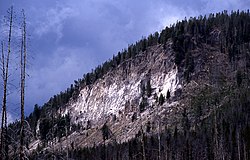
The thick tuff formation resulting from this eruption is well-exposed at various locations within Yellowstone National Park, including Tuff Cliff along the Gibbon River, Virginia Cascade, and along U.S. Highway 20.
Lava Creek Tuff ranges in color from light gray to pale red in some locales. Rock texture of the tuff ranges from fine-grained to aphanitic and is densely welded. The maximum thickness of the tuff layer is approximately 180–200 m (590–660 ft).
Ash flows of the Lava Creek Tuff are divided among six members, informally named unit 1, unit 2, member A, and member B from bottom to top, with units 3 and 4 having unspecified stratigraphic positions. The emplacement of the Lava Creek Tuff was not instantaneous and continuous, but rather, there were multiple pauses, and the members were erupted at different times.
To date the timings of their eruptions, two common methods of radiometric dating are employed: 40Ar/39Ar on sanidine and U–Pb on zircon. The interpretation of the two techniques differs in that zircon crystallization occurs early and progressively during magma evolution; therefore, U–Pb ages must predate the instantaneous age of volcanic eruption as recorded by sanidine.
Two samples from ignimbrite visually closely similar to unit 1 or 2, the oldest ignimbrite units of the Lava Creek Tuff, have 40Ar/39Ar ages of 634.5±6.8 kyr and 630.9±4.1 kyr. 40Ar/39Ar dating experiments on sanidine from member B have yielded eruption ages of 627.0±1.7 kyr, 631.3±4.3 kyr, and 630.9±2.7.
U–Pb dating for zircon crystals from both the member A and B yields an age of 626.5±5.8 kyr, which is indistinguishable from the 40Ar/39Ar date of sanidine. Another team reported U–Pb ages of 626.0±2.6 kyr and 629.2±4.3 kyr for zircon from member A and member B, respectively.
Lava Creek Tuff
The Lava Creek Tuff is a voluminous sheet of ash-flow tuff located in Wyoming, Montana and Idaho, United States. It was created during the Lava Creek eruption around 630,000 years ago, which led to the formation of the Yellowstone Caldera. This eruption is considered the climactic event of Yellowstone's third volcanic cycle. The Lava Creek Tuff covers an area of more than 7,500 km2 (2,900 sq mi) centered around the caldera and has an estimated magma volume of 1,000 km3 (240 cu mi).
The fallout from the eruption blanketed much of North America, depositing as one of the most widespread air-fall pyroclastic layers, formerly known as the Pearlette type O ash bed in the United States and Wascana Creek ash in Canada.
The thick tuff formation resulting from this eruption is well-exposed at various locations within Yellowstone National Park, including Tuff Cliff along the Gibbon River, Virginia Cascade, and along U.S. Highway 20.
Lava Creek Tuff ranges in color from light gray to pale red in some locales. Rock texture of the tuff ranges from fine-grained to aphanitic and is densely welded. The maximum thickness of the tuff layer is approximately 180–200 m (590–660 ft).
Ash flows of the Lava Creek Tuff are divided among six members, informally named unit 1, unit 2, member A, and member B from bottom to top, with units 3 and 4 having unspecified stratigraphic positions. The emplacement of the Lava Creek Tuff was not instantaneous and continuous, but rather, there were multiple pauses, and the members were erupted at different times.
To date the timings of their eruptions, two common methods of radiometric dating are employed: 40Ar/39Ar on sanidine and U–Pb on zircon. The interpretation of the two techniques differs in that zircon crystallization occurs early and progressively during magma evolution; therefore, U–Pb ages must predate the instantaneous age of volcanic eruption as recorded by sanidine.
Two samples from ignimbrite visually closely similar to unit 1 or 2, the oldest ignimbrite units of the Lava Creek Tuff, have 40Ar/39Ar ages of 634.5±6.8 kyr and 630.9±4.1 kyr. 40Ar/39Ar dating experiments on sanidine from member B have yielded eruption ages of 627.0±1.7 kyr, 631.3±4.3 kyr, and 630.9±2.7.
U–Pb dating for zircon crystals from both the member A and B yields an age of 626.5±5.8 kyr, which is indistinguishable from the 40Ar/39Ar date of sanidine. Another team reported U–Pb ages of 626.0±2.6 kyr and 629.2±4.3 kyr for zircon from member A and member B, respectively.
Recent media
Recent media