Recent from talks
Nothing was collected or created yet.
U-bolt
View on WikipediaThis article needs additional citations for verification. (January 2025) |

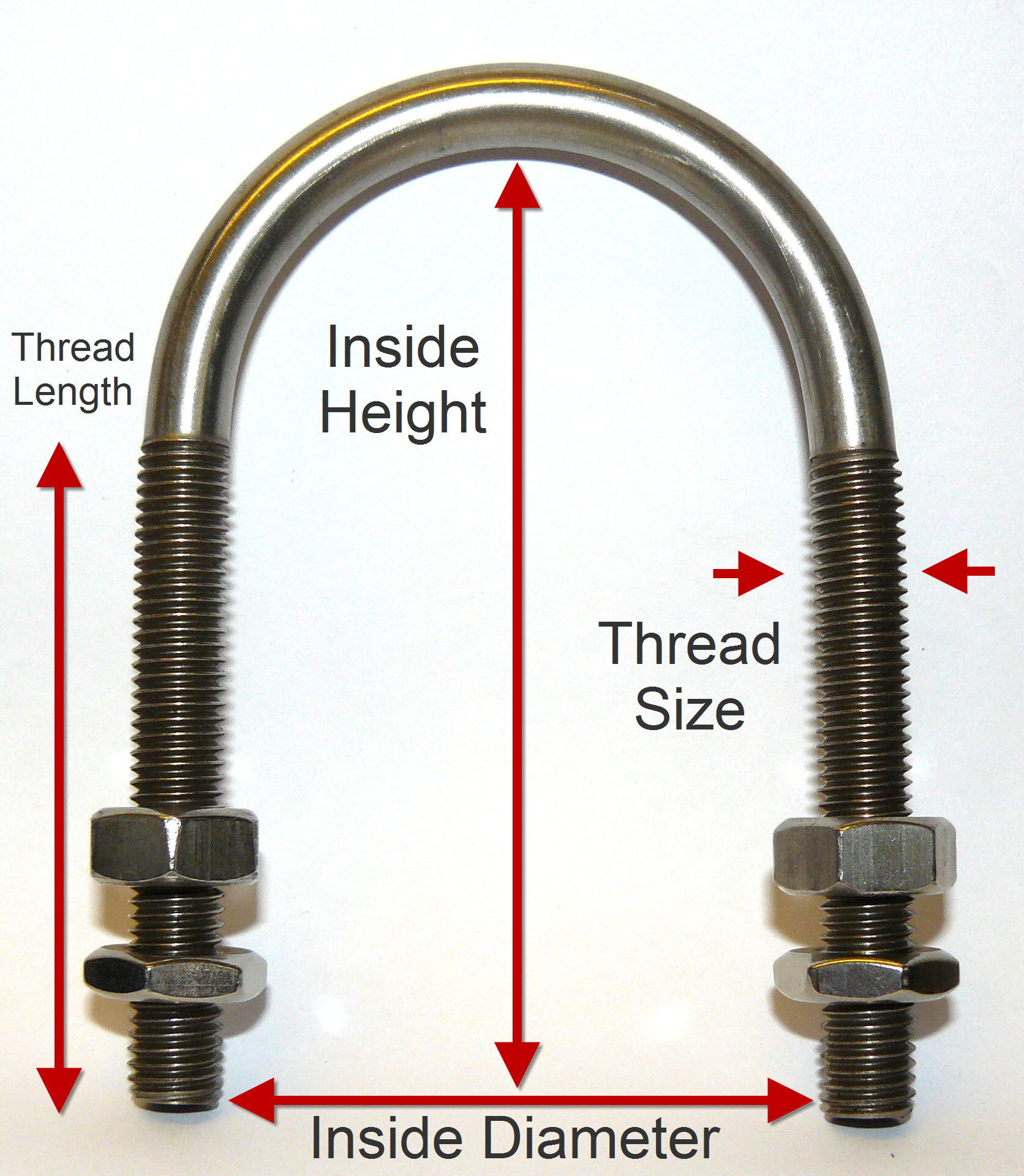
A U-bolt is a bolt in the shape of the letter U with screw threads on both ends.
U-bolts have primarily been used to support pipework. Because of this, U-bolt sizes are given in pipe measurements. A U-bolt is described by the size of pipe it is supporting. For example, a 40 Nominal Bore U-bolt would be asked for by pipe work engineers, and only they would know what that meant. In reality, the 40 nominal bore part bears little resemblance to the size and dimensions of the U-bolt.
As U-bolts are now being used by a much wider audience to clamp any kind of tubing / round bar, then a more convenient measurement system needs to be used.
U-bolts are used to hold rebar cages[1] and overhead road signs.[2] Research has been done into the use of novel U-bolts to improve the interface shear resistance of steel-concrete composite beams.[3]
Four elements uniquely define any U-bolt:
- Material type (for example: bright zinc-plated mild steel)
- Thread dimensions (for example: M12 * 50 mm)
- Inside diameter (for example: 50 mm - the distance between the legs)
- Inside height (for example: 120 mm)
See also
[edit]References
[edit]- ^ Vahedi, Masood; Ebrahimian, Hamed; Itani, Ahmad M. (2023-01-01). "Experimental Investigation of U-Bolt Connectors for Application in Rebar Cages". Journal of Structural Engineering. 149 (1): 04022216. doi:10.1061/JSENDH.STENG-11381.
- ^ Liu, Zhengyu; Phares, Brent M. (2020-07-01). "Determination of U-bolt connection load capacities in overhead sign support structures". Journal of Constructional Steel Research. 170 106096. doi:10.1016/j.jcsr.2020.106096. ISSN 0143-974X.
- ^ Gao, Shan; Bai, Qi; Guo, Lanhui; Kang, Shao-Bo (2023-07-01). "Interface shear resistance of steel-concrete composite beams using U-bolt shear connectors". Engineering Structures. 286 116126. doi:10.1016/j.engstruct.2023.116126. ISSN 0141-0296.
U-bolt
View on GrokipediaDesign and Structure
Physical Characteristics
A U-bolt is a single-piece fastener characterized by its distinctive U-shaped configuration, consisting of two parallel threaded arms extending from a curved base, which allows it to encircle and secure cylindrical objects such as pipes or axles. This design enables the bolt to function as a clamp when nuts are tightened on the threaded ends, providing a reliable means of attachment in mechanical assemblies. The overall form is typically produced from round stock or wire, ensuring uniformity in the parallel legs and the semicircular bend.[3][5] Key dimensions of a U-bolt include the inside diameter (ID) of the U-shaped bend, which determines the fit around the object being clamped; the inside leg length, or height between the bend and the thread starting point; the thread diameter; and the thread length for nut engagement. Thread specifications commonly follow Unified National Coarse (UNC) or Unified National Fine (UNF) standards in imperial units, such as 5/8-11 UNC, or metric equivalents like M6 to M20 with corresponding pitch. Tolerances, such as ±0.030 inches for the centerline width in cold-formed medium-tensile U-bolts, ensure precise manufacturing for compatibility.[6][2][5] The functional design emphasizes load-bearing capacity, with the bend radius playing a critical role in preventing stress concentrations that could lead to failure; the minimum radius is recommended as at least 0.5 times the rod diameter for low-tensile materials or 0.69 times for high-tensile ones, with larger radii preferred to minimize necking and deformation. U-bolts are engineered to handle primary load types including tension from clamping forces, shear across the secured assembly, and resistance to vibration through tight fastening that maintains position under dynamic conditions. Typical torque values for secure installation are lower than for straight bolts due to bend-induced stresses, with examples including a maximum of 170 ft-lbf for a 5/8-inch SAE thread U-bolt (Grade 8).[3][5][7][8]Types and Variations
U-bolts are available in various configurations to accommodate different fastening needs, primarily distinguished by the shape of their bend and ends. The standard round U-bolt features a semi-circular bend designed for securing cylindrical objects such as pipes, allowing for even distribution of clamping force around the circumference.[9] In contrast, square U-bolts have a square bend with angular sides, making them suitable for attaching to square or rectangular fittings like beams or structural members, where a snug fit prevents slippage.[9] These shape differences enable targeted adaptations, with round versions prioritizing smooth contact on curved surfaces and square ones providing stability on flat or angular profiles.[10] Beyond basic round and square forms, U-bolts can include semi-round variations with a slight arch for transitional fits between cylindrical and square profiles. Standard U-bolts follow predefined dimensions for common uses, while custom types permit bespoke adjustments, including plate-end designs where integrated or accompanying flat plates distribute load more evenly across surfaces, enhancing stability in high-stress assemblies like suspension systems.[11] This customization ensures precise fit for non-standard applications, building on the core U-shape for optimal performance.[9] For environments prone to degradation, corrosion-resistant variations incorporate protective coatings or alternative compositions to extend service life, such as galvanized finishes or stainless steel constructions tailored for exposure to moisture, chemicals, or saltwater.[12]Materials and Properties
Common Materials
U-bolts are most commonly constructed from carbon steel, with ASTM A307 Grade A or B serving as the standard specification for general-purpose applications.[13] This low-carbon steel provides sufficient tensile strength, typically around 60 ksi minimum, and is cost-effective for securing pipes, structural elements, and equipment in non-corrosive environments.[14] Manufacturers often produce U-bolts to this specification in diameters ranging from 1/4 inch to 4 inches, ensuring compatibility with standard threading and bending processes.[15] For applications demanding enhanced corrosion resistance, such as marine, chemical, or outdoor settings, stainless steel grades 304 and 316 are prevalent.[16] Grade 304 stainless steel, an austenitic alloy with approximately 18% chromium and 8% nickel, offers good resistance to oxidation and mild corrosive agents, making it suitable for general industrial use.[17] Grade 316, which includes 2-3% molybdenum in addition to higher nickel content, provides superior protection against pitting, crevice corrosion, and chloride exposure, ideal for harsh conditions like saltwater environments.[18] High-strength alloy steels, particularly chrome-molybdenum types meeting ASTM A193 Grade B7, are used for U-bolts subjected to extreme loads, high temperatures, or pressure.[19] This heat-treated alloy achieves a minimum tensile strength of 125 ksi and yield strength of 105 ksi, enabling reliable performance in heavy-duty scenarios such as oil and gas pipelines or structural reinforcements.[20] To improve longevity and protect against environmental degradation, U-bolts frequently incorporate non-metallic coatings like zinc plating or hot-dip galvanization, often applied over carbon or alloy steel bases.[21] Zinc plating deposits a thin, electrodeposited layer (typically 0.0002 to 0.0005 inches thick) for moderate atmospheric corrosion resistance, resulting in a bright, uniform finish.[22] Hot-dip galvanization, by contrast, immerses the U-bolt in molten zinc to form a thicker coating (averaging 0.002 inches or more), providing sacrificial protection and extended service life in wet or industrial atmospheres.[23]Selection Criteria
Selecting the appropriate U-bolt involves evaluating environmental factors to ensure durability in specific conditions. For outdoor or wet applications, corrosion resistance is paramount, with materials like stainless steel (e.g., 304 or 316 grades) providing superior protection against oxidation and moisture compared to plain carbon steel, which requires coatings such as zinc plating or galvanizing. Temperature tolerance is another key consideration; for instance, alloy steels like ASTM A193 B7 can withstand continuous service up to 750–800°F without significant loss of strength, making them suitable for high-heat environments, whereas standard carbon steels are limited to around 400–500°F.[24] Load requirements dictate the choice of U-bolt grade based on tensile strength and fatigue resistance. Medium-carbon steel U-bolts in SAE Grade 5 offer a minimum tensile strength of 120,000 psi, suitable for moderate to heavy static loads in applications like structural supports. For dynamic loads involving vibration or shock, such as in automotive suspensions, higher grades like SAE Grade 8 (with 150,000 psi tensile strength) or materials with enhanced fatigue properties are preferred to prevent premature failure under cyclic stresses.[25][26] Material compatibility with the clamped object is essential to mitigate galvanic corrosion, which occurs when dissimilar metals are in contact in the presence of an electrolyte. Selecting U-bolts from the same or compatible material families—such as pairing carbon steel with zinc-coated components or using stainless steel for aluminum piping—helps avoid accelerated degradation; for example, stainless steel fasteners with aluminum can lead to severe corrosion unless isolated with non-conductive washers.[27][28] Balancing cost and performance is critical, particularly in non-critical applications where over-specifying can inflate expenses unnecessarily. Low-carbon steel (e.g., SAE Grade 2) provides adequate strength for light-duty uses like pipe clamps at a lower cost, while higher-performance alloys like stainless or alloy steels justify their premium in corrosive or high-load scenarios; guidelines recommend specifying the minimum grade that meets safety factors (typically 4:1 for static loads) to optimize value without compromising reliability.[26][24]Manufacturing Process
Production Methods
U-bolts are primarily produced through forming processes that shape raw metal stock into the characteristic U configuration, followed by threading and finishing steps to meet load-bearing requirements.[29] These methods vary based on size, material, and production volume, with modern practices favoring efficient, high-strength techniques such as cold forming over older hot forging approaches.[30] Cold forming is the predominant method for most U-bolts, involving the bending of steel wire or rod at room temperature without prior heating.[30] The wire, typically cold-drawn for uniform diameter and improved tensile strength, is fed into automated bending machines that use dies to form the U-shape, ensuring a minimum bend radius of about 0.5 to 0.7 times the wire diameter to prevent cracking.[30] This technique enhances material strength through work hardening and supports rapid production rates.[31] Hot forging may be used for very large or custom U-bolts requiring specific ductility, where steel rod or bar stock—often carbon steel—is heated to approximately 2000°F to make it malleable.[29] The heated material is then placed into forging dies and shaped under high pressure into the U-form, allowing for precise control of the bend radius and leg lengths in lower-volume production.[31] This process aligns well with materials like carbon steel, which exhibit good forgeability at elevated temperatures, though it has largely been replaced by cold forming in modern practice.[29][30] Threading follows the forming stage, where the ends of the U-bolt legs are machined to create uniform threads, typically using thread-rolling dies that displace rather than cut the metal for superior strength and fatigue resistance.[30] Common thread standards include UNC/UNF for imperial sizes or metric equivalents, with rolling ensuring threads begin at a safe distance from the bend to avoid stress concentrations.[30] Lathes may be used for precision in custom or low-volume runs, but rolling is preferred for its efficiency and finish quality.[31] Post-processing enhances the mechanical properties and durability of the U-bolt through heat treatment and surface finishing. Heat treatment typically involves quenching, where the formed U-bolt is reheated to 850–900°C and rapidly cooled in oil or water to achieve hardness, followed by tempering at 200–650°C to relieve stresses and improve toughness without excessive brittleness.[31] Surface finishing, such as phosphating, applies a phosphate coating to provide corrosion resistance and lubricity, particularly for carbon steel U-bolts in harsh environments.[29]Quality Control Measures
Quality control measures for U-bolts are essential to verify that these fasteners meet dimensional, mechanical, and structural integrity requirements, ensuring reliability in demanding applications such as piping supports and automotive suspensions. These protocols are implemented post-manufacturing to detect defects that could compromise performance, drawing from established practices in fastener production.[32] Dimensional inspection involves precise measurements to confirm the accuracy of key features, including thread pitch, shank diameter, and the bend radius of the U-shape. Tools such as vernier calipers are used to measure the external diameter of the threaded legs, while thread pitch gauges verify the uniformity and spacing of threads to prevent assembly issues or load distribution failures. Specialized gauges assess bend accuracy, ensuring the U-bolt's curvature aligns with design specifications for proper fit around pipes or components, thereby avoiding stress concentrations during use.[33][34] Mechanical testing evaluates the U-bolt's load-bearing capabilities and material hardness to guarantee strength under tension and resistance to deformation. Tensile strength testing subjects samples to axial pulls until failure, measuring ultimate tensile strength to confirm the fastener can handle specified loads without fracturing. Proof load testing applies a controlled tensile force—often up to 120% of the rated working load—to verify the U-bolt withstands the stress without permanent deformation, establishing a safety margin for operational reliability. Hardness checks, typically using the Rockwell scale (e.g., HRC or HRB), assess surface and core hardness to ensure uniform material properties and resistance to wear or galling.[35][36][37] Non-destructive testing (NDT) methods are employed to identify surface and internal defects without compromising the U-bolt's integrity, particularly important for high-volume production. Dye penetrant testing applies a visible or fluorescent liquid to the surface, which seeps into cracks or porosity; excess is removed, and a developer draws out the penetrant for inspection under light, revealing fine surface-breaking flaws like hairline cracks in threads or bends. Ultrasonic testing uses high-frequency sound waves to detect internal discontinuities, such as voids or inclusions in the shank or fillet areas, by analyzing echo patterns from a transducer, enabling early identification of flaws that could lead to fatigue failure.[38][39] Certification processes ensure traceability and compliance for U-bolts used in safety-critical applications, involving batch-specific documentation and physical markings. Each production lot is assigned unique identifiers, such as heat numbers or lot codes, etched or stamped on the U-bolt for full traceability back to raw materials and manufacturing records, allowing for root-cause analysis in case of failures. Mill test reports and inspection certificates accompany certified batches, detailing test results from dimensional, mechanical, and NDT evaluations to verify adherence to quality benchmarks.[40][41]Applications
Structural and Piping Support
U-bolts play a critical role in clamping pipes to supports within plumbing and heating, ventilation, and air conditioning (HVAC) systems, where they secure piping against vibrations and unintended movements caused by operational stresses or environmental factors.[42] By encircling the pipe and fastening to a structural base, such as a beam or bracket, these fasteners maintain alignment and prevent loosening that could lead to system failures or noise generation.[3] In industrial settings, round U-bolts are particularly suited for this purpose due to their compatibility with cylindrical pipes, ensuring a snug fit without excessive localized stress.[42] Beyond piping, U-bolts secure structural elements including I-beams, conduits, and frameworks in buildings and bridges, providing reliable attachment points for overhead or vertical components.[3] These applications leverage the U-bolt's threaded ends and saddle components to anchor heavy loads to concrete or steel structures, enhancing overall stability in construction environments.[42] For instance, in bridge infrastructure, U-bolts fasten conduits and support members to girders, resisting dynamic loads from traffic or wind.[3] A key advantage of U-bolts lies in their ability to distribute loads evenly across the clamped surface, applying uniform pressure that minimizes pipe deformation and extends service life, especially in high-stakes oil and gas pipelines.[43] In these systems, the design transfers gravitational and frictional forces through tension and compression, preventing slippage.[43] Saddle-integrated U-bolts further enhance this by spreading clamping forces.[3] In seismic zones, U-bolts facilitate flexible mounting arrangements for piping and supports, allowing controlled movement during earthquakes to absorb energy and protect infrastructure integrity.[44] Case studies from nuclear facilities demonstrate that U-bolt assemblies in pipe supports achieve strength ratios of 2.8 to 4.2 times the design allowable load under static seismic simulations, with ductility enabling deformation without catastrophic failure.[44] Such configurations, often combined with base plates and frames, have been proposed for brownfield oil and gas projects to maintain stability amid vibrational demands.[43]Automotive and Transportation
In automotive and transportation applications, U-bolts play a critical role in securing leaf springs to axles in trucks and trailers, ensuring stable suspension under varying road conditions. These fasteners clamp the leaf spring assembly to the axle, preventing slippage and maintaining alignment during operation, which is essential for load distribution and ride stability. In heavy-duty setups, such as those with 10,000 lb axle capacities, U-bolts are engineered to withstand dynamic loads from road vibrations and impacts, often using Grade 8 steel for enhanced yield strength exceeding 130,000 psi.[45][46] U-bolts are also widely employed for mounting exhaust systems and drive shafts in vehicles, where they secure pipes and shafts to the chassis to minimize vibration-induced noise and component wear. By providing a firm hold around exhaust tubing, these bolts reduce rattling and heat-related expansion issues, contributing to quieter operation and prolonged system longevity. Similarly, in drive shaft assemblies, U-bolts stabilize connections at U-joints and supports, absorbing torsional forces and preventing misalignment that could accelerate wear on bearings and seals.[47][48] For off-road vehicles, heavy-duty variants of U-bolts are specifically designed to enhance shock absorption in rugged terrains, featuring thicker rods and reinforced bends to endure extreme flexing of leaf springs. These specialized U-bolts, often paired with upgraded plates, allow for greater articulation in suspension systems, distributing impact forces from rocks and jumps while preserving axle integrity. Manufacturers recommend Grade 8 or higher for such applications to handle the intensified dynamic stresses without deformation.[49][45]Installation and Usage
Installation Procedures
Installation of U-bolts requires careful preparation to ensure a secure and even fit around the target object, such as a pipe, axle, or structural member. Begin by measuring the inside diameter (ID) of the U-bolt, which is the distance between the inner edges of its legs at the curve, to match the diameter of the object it will encircle; this prevents slippage or distortion under load.[50][51] Select nuts and washers compatible with the U-bolt's thread size and material grade, such as grade 5 or 8 lock nuts paired with flat or hardened washers to distribute clamping force evenly and resist vibration-induced loosening.[52][45] For specific applications, round-bend U-bolts may require slight adjustments in positioning to accommodate curved surfaces. The installation process involves positioning the U-bolt around the target object, ensuring the legs are parallel and the curve seats firmly without gaps. Thread the selected nuts onto both legs, starting with washers if used, and hand-tighten them evenly to draw the U-bolt into place. Essential tools include a calibrated torque wrench for precise tightening and, in precision applications like piping, alignment jigs to maintain even spacing and prevent misalignment.[45][53] Tighten the nuts in a cross or diagonal pattern—alternating between opposite sides—to ensure uniform pressure distribution and avoid distortion of the clamped components. Apply torque gradually in stages: first to one-third of the target value, then two-thirds, and finally the full specification, which typically ranges from 50-100 ft-lbs for common 1/2-inch to 5/8-inch U-bolts depending on size, grade, and application.[45][54][53] Safety considerations are paramount during installation; always use new U-bolts and hardware to avoid compromised strength from thread damage, and avoid over-tightening, which can strip threads, crack the bolt, or deform the target object, leading to failure under load.[45][54] Lubricate threads with anti-seize compound if recommended by the manufacturer to reduce friction and ensure accurate torque application without galling.[45]Maintenance and Troubleshooting
Routine maintenance for U-bolts requires periodic inspections to detect early signs of wear and ensure secure fastening. Inspections should occur every 6-12 months, or more frequently in high-vibration or harsh environments, focusing on looseness, corrosion, and deformation through visual examination and torque verification.[55] Technicians should use a torque wrench to check nut tightness against manufacturer specifications, re-torquing to the specified torque if found loose, while examining the bolt body for cracks, pitting, or bending that could compromise structural integrity.[56] Common issues with U-bolts in service include fatigue cracking due to cyclic vibration and loading, which manifests as fine fissures at stress concentration points like the bend or threads.[57] Loosening from dynamic forces or corrosion in humid or saline conditions can also lead to reduced clamping force and potential slippage. Solutions involve immediate re-torquing to the recommended levels—often referencing initial installation torque values—for minor looseness, or full replacement for cracked or severely corroded units to prevent failure.[58][59] Repair methods emphasize minimizing damage to clamped components during intervention. For non-destructive removal, especially when bolts are seized due to corrosion, cutting tools like a reciprocating saw or hacksaw can be used to sever the U-bolt at the bend, allowing safe extraction without harming pipes or structures.[60] Post-removal, new U-bolts must be installed with proper alignment and torque to restore function. Preventive measures help extend U-bolt lifespan, particularly in high-humidity settings where threaded areas are prone to seizing. Applying a high-quality lubricant or anti-seize compound to threads during installation and periodic reapplication reduces friction and corrosion risk, while selecting galvanized or stainless steel variants provides inherent protection.[61][56] Regular cleaning with a wire brush to remove debris further aids in maintaining performance across applications.Standards and Specifications
Industry Standards
U-bolts used in structural applications, particularly for anchoring to concrete foundations, are governed by ASTM F1554, which specifies requirements for straight, bent, headed, and headless anchor bolts made from carbon, medium carbon boron, alloy, or high-strength low-alloy steel, with grades 36, 55, and 105 based on minimum yield strengths of 36 ksi, 55 ksi, and 105 ksi, respectively.[62] This standard ensures the bolts meet performance criteria for tensile strength, yield strength, elongation, and reduction of area through defined mechanical testing protocols.[63] For high-pressure piping systems, ASTM A193 applies to U-bolts fabricated from alloy and stainless steels, emphasizing grades like B7 for high-temperature service, with mandatory heat treatment and chemical composition controls to achieve minimum tensile strengths up to 125 ksi. Compliance with ASTM A193 involves rigorous testing for hardness, tensile properties, and impact resistance to certify suitability for pressure vessels and flanges.[64] In the automotive sector, SAE J429 establishes mechanical and material requirements for inch-series steel fasteners, including U-bolts up to 1-1/2 inches in diameter, across grades 1 through 8, specifying proof loads, tensile strengths (e.g., 120 ksi for Grade 5), and grade markings such as three radial lines for Grade 5 to indicate compliance. This standard mandates testing for proof load and wedge tensile strength to verify fastener integrity in vehicle suspension and related assemblies.[25] For metric U-bolts, ISO 898-1 defines mechanical properties of carbon and alloy steel bolts, screws, and studs with coarse and fine threads, covering property classes from 4.6 to 12.9, with minimum tensile strengths ranging from 400 MPa to 1200 MPa and proof load stresses accordingly. The standard requires verification through tensile, proof load, and hardness tests conducted at ambient temperatures to ensure reliability in international applications.[65] Overall compliance for U-bolts under these standards involves mandatory marking protocols, such as grade stamps (e.g., "B7" for ASTM A193 or property class numbers like "8.8" for ISO 898-1) and manufacturer identification on bolt ends or heads, alongside color coding where stamping is impractical, to facilitate traceability and certification.[64] Testing protocols include non-destructive examinations like visual inspection and magnetic particle testing, plus destructive tests for mechanical properties, ensuring all U-bolts bear certification marks confirming adherence to the respective standard's quality assurance requirements.[63]Sizing and Compatibility
U-bolts are sized primarily by the rod diameter, which refers to the nominal diameter of the threaded rod material, such as 1/2 inch or 5/8 inch, determining the overall strength and fit.[6] Thread length specifies the portion of each leg that is threaded for nut engagement, typically ranging from 2 to 4 inches depending on the application, while the bend radius for square-bend U-bolts is generally at least twice the rod diameter to ensure structural integrity without cracking.[6][66] Inside dimensions, including width (to match the object diameter) and height (overall leg length), further define the bend configuration for round-bend types, where the radius is derived from the centerline of the inside width.[6] Threading on U-bolts follows Unified National standards, with coarse threads (UNC) suited for general-purpose applications due to their larger pitch for easier assembly and higher resistance to thread damage in less precise environments.[67] In contrast, fine threads (UNF) feature a smaller pitch, providing greater vibration resistance and tensile strength by increasing the number of engaged threads, making them preferable for dynamic uses like automotive suspensions.[67][68] Compatibility ensures proper fit to pipes or axles, often referenced via charts matching nominal pipe size (NPS) to U-bolt inside width, which approximates the pipe's outside diameter (OD) with a slight clearance.[69] For example, a 2-inch NPS pipe (OD 2.375 inches) typically pairs with a U-bolt having an inside width of 2.4375 inches and rod diameter of 3/8 inch.[69] Axle compatibility follows similar principles, selecting inside width to snugly encircle the axle diameter, such as 3 inches for a 2.75-inch axle, with rod diameters scaled to load requirements.[6] The following table illustrates representative compatibility for common pipe sizes:| NPS Pipe Size | Pipe OD (inches) | Rod Diameter (inches) | Inside Width (inches) | Thread Length (inches) |
|---|---|---|---|---|
| 1/2 | 0.840 | 1/4 | 0.875 | 2.5 |
| 1 | 1.315 | 1/4 | 1.375 | 2.5 |
| 2 | 2.375 | 3/8 | 2.4375 | 2.5 |
| 4 | 4.500 | 1/2 | 4.5625 | 3 |
| 6 | 6.625 | 5/8 | 6.750 | 3.75 |
