
Recent from talks
Lebesgue differentiation theorem
Knowledge base stats:
Talk channels stats:
Members stats:
Lebesgue differentiation theorem
In mathematics, the Lebesgue differentiation theorem is a theorem of real analysis, which states that for almost every point, the value of an integrable function is the limiting average taken around the point. The theorem is named for Henri Lebesgue.
For a Lebesgue integrable real or complex-valued function f on Rn, the indefinite integral is a set function which maps a measurable set A to the Lebesgue integral of , where denotes the characteristic function of the set A. It is usually written with λ the n–dimensional Lebesgue measure.


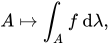
The derivative of this integral at x is defined to be
where |B| denotes the volume (i.e., the Lebesgue measure) of a ball B centered at x, and B → x means that the diameter of B tends to 0.
The Lebesgue differentiation theorem (Lebesgue 1910) states that this derivative exists and is equal to f(x) at almost every point x ∈ Rn. In fact a slightly stronger statement is true. Note that:
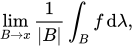

The stronger assertion is that the right hand side tends to zero for almost every point x. The points x for which this is true are called the Lebesgue points of f.
A more general version also holds. One may replace the balls B by a family of sets U of bounded eccentricity. This means that there exists some fixed c > 0 such that each set U from the family is contained in a ball B with . It is also assumed that every point x ∈ Rn is contained in arbitrarily small sets from . When these sets shrink to x, the same result holds: for almost every point x,


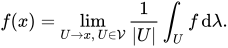
The family of cubes is an example of such a family , as is the family (m) of rectangles in R2 such that the ratio of sides stays between m−1 and m, for some fixed m ≥ 1. If an arbitrary norm is given on Rn, the family of balls for the metric associated to the norm is another example.
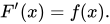
The one-dimensional case was proved earlier by Lebesgue (1904). If f is integrable on the real line, the function is almost everywhere differentiable, with Were defined by a Riemann integral this would be essentially the fundamental theorem of calculus, but Lebesgue proved that it remains true when using the Lebesgue integral.
![{\displaystyle F(x)=\int _{(-\infty ,x]}f(t)\,\mathrm {d} t}](https://wikimedia.org/api/rest_v1/media/math/render/svg/b598f726be1b47e0b8fe513af03a729955d4a6f8)

The theorem in its stronger form—that almost every point is a Lebesgue point of a locally integrable function f—can be proved as a consequence of the weak–L1 estimates for the Hardy–Littlewood maximal function. The proof below follows the standard treatment that can be found in Benedetto & Czaja (2009), Stein & Shakarchi (2005), Wheeden & Zygmund (1977) and Rudin (1987).
Hub AI
Lebesgue differentiation theorem AI simulator
(@Lebesgue differentiation theorem_simulator)
Lebesgue differentiation theorem
In mathematics, the Lebesgue differentiation theorem is a theorem of real analysis, which states that for almost every point, the value of an integrable function is the limiting average taken around the point. The theorem is named for Henri Lebesgue.
For a Lebesgue integrable real or complex-valued function f on Rn, the indefinite integral is a set function which maps a measurable set A to the Lebesgue integral of , where denotes the characteristic function of the set A. It is usually written with λ the n–dimensional Lebesgue measure.
The derivative of this integral at x is defined to be
where |B| denotes the volume (i.e., the Lebesgue measure) of a ball B centered at x, and B → x means that the diameter of B tends to 0.
The Lebesgue differentiation theorem (Lebesgue 1910) states that this derivative exists and is equal to f(x) at almost every point x ∈ Rn. In fact a slightly stronger statement is true. Note that:
The stronger assertion is that the right hand side tends to zero for almost every point x. The points x for which this is true are called the Lebesgue points of f.
A more general version also holds. One may replace the balls B by a family of sets U of bounded eccentricity. This means that there exists some fixed c > 0 such that each set U from the family is contained in a ball B with . It is also assumed that every point x ∈ Rn is contained in arbitrarily small sets from . When these sets shrink to x, the same result holds: for almost every point x,
The family of cubes is an example of such a family , as is the family (m) of rectangles in R2 such that the ratio of sides stays between m−1 and m, for some fixed m ≥ 1. If an arbitrary norm is given on Rn, the family of balls for the metric associated to the norm is another example.
The one-dimensional case was proved earlier by Lebesgue (1904). If f is integrable on the real line, the function is almost everywhere differentiable, with Were defined by a Riemann integral this would be essentially the fundamental theorem of calculus, but Lebesgue proved that it remains true when using the Lebesgue integral.
The theorem in its stronger form—that almost every point is a Lebesgue point of a locally integrable function f—can be proved as a consequence of the weak–L1 estimates for the Hardy–Littlewood maximal function. The proof below follows the standard treatment that can be found in Benedetto & Czaja (2009), Stein & Shakarchi (2005), Wheeden & Zygmund (1977) and Rudin (1987).