Hubbry Logo
Set functionSet functionMain
Open search
Set function
Community hub
Set function
logo
7 pages, 0 posts
0 subscribers
Be the first to start a discussion here.
Set function
Set function
from Wikipedia

In mathematics, especially measure theory, a set function is a function whose domain is a family of subsets of some given set and that (usually) takes its values in the extended real number line which consists of the real numbers and

A set function generally aims to measure subsets in some way. Measures are typical examples of "measuring" set functions. Therefore, the term "set function" is often used for avoiding confusion between the mathematical meaning of "measure" and its common language meaning.

Definitions

[edit]

If is a family of sets over (meaning that where denotes the powerset) then a set function on is a function with domain and codomain or, sometimes, the codomain is instead some vector space, as with vector measures, complex measures, and projection-valued measures. The domain of a set function may have any number properties; the commonly encountered properties and categories of families are listed in the table below.

In general, it is typically assumed that is always well-defined for all or equivalently, that does not take on both and as values. This article will henceforth assume this; although alternatively, all definitions below could instead be qualified by statements such as "whenever the sum/series is defined". This is sometimes done with subtraction, such as with the following result, which holds whenever is finitely additive:
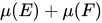
Set difference formula: is defined with satisfying and

Null sets

A set is called a null set (with respect to ) or simply null if Whenever is not identically equal to either or then it is typically also assumed that:

  • null empty set: if

Variation and mass

The total variation of a set is where denotes the absolute value (or more generally, it denotes the norm or seminorm if is vector-valued in a (semi)normed space). Assuming that then is called the total variation of and is called the mass of


A set function is called finite if for every the value is finite (which by definition means that and ; an infinite value is one that is equal to or ). Every finite set function must have a finite mass.

Common properties of set functions

[edit]

A set function on is said to be[1]

  • non-negative if it is valued in
  • finitely additive if for all pairwise disjoint finite sequences such that
    • If is closed under binary unions then is finitely additive if and only if for all disjoint pairs
    • If is finitely additive and if then taking shows that which is only possible if or where in the latter case, for every (so only the case is useful).
  • countably additive or σ-additive[2] if in addition to being finitely additive, for all pairwise disjoint sequences in such that all of the following hold:
      • The series on the left hand side is defined in the usual way as the limit
      • As a consequence, if is any permutation/bijection then this is because and applying this condition (a) twice guarantees that both and hold. By definition, a convergent series with this property is said to be unconditionally convergent. Stated in plain English, this means that rearranging/relabeling the sets to the new order does not affect the sum of their measures. This is desirable since just as the union does not depend on the order of these sets, the same should be true of the sums and
    1. if is not infinite then this series must also converge absolutely, which by definition means that must be finite. This is automatically true if is non-negative (or even just valued in the extended real numbers).
      • As with any convergent series of real numbers, by the Riemann series theorem, the series converges absolutely if and only if its sum does not depend on the order of its terms (a property known as unconditional convergence). Since unconditional convergence is guaranteed by (a) above, this condition is automatically true if is valued in
    2. if is infinite then it is also required that the value of at least one of the series be finite (so that the sum of their values is well-defined). This is automatically true if is non-negative.
  • a pre-measure if it is non-negative, countably additive (including finitely additive), and has a null empty set.
  • a measure if it is a pre-measure whose domain is a σ-algebra. That is to say, a measure is a non-negative countably additive set function on a σ-algebra that has a null empty set.
  • a probability measure if it is a measure that has a mass of
  • an outer measure if it is non-negative, countably subadditive, has a null empty set, and has the power set as its domain.
  • a signed measure if it is countably additive, has a null empty set, and does not take on both and as values.
  • complete if every subset of every null set is null; explicitly, this means: whenever and is any subset of then and
    • Unlike many other properties, completeness places requirements on the set (and not just on 's values).
  • 𝜎-finite if there exists a sequence in such that is finite for every index and also
  • decomposable if there exists a subfamily of pairwise disjoint sets such that is finite for every and also (where ).
    • Every 𝜎-finite set function is decomposable although not conversely. For example, the counting measure on (whose domain is ) is decomposable but not 𝜎-finite.
  • a vector measure if it is a countably additive set function valued in a topological vector space (such as a normed space) whose domain is a σ-algebra.
    • If is valued in a normed space then it is countably additive if and only if for any pairwise disjoint sequence in If is finitely additive and valued in a Banach space then it is countably additive if and only if for any pairwise disjoint sequence in
  • a complex measure if it is a countably additive complex-valued set function whose domain is a σ-algebra.
    • By definition, a complex measure never takes as a value and so has a null empty set.
  • a random measure if it is a measure-valued random element.

Arbitrary sums

As described in this article's section on generalized series, for any family of real numbers indexed by an arbitrary indexing set it is possible to define their sum as the limit of the net of finite partial sums where the domain is directed by Whenever this net converges then its limit is denoted by the symbols while if this net instead diverges to then this may be indicated by writing Any sum over the empty set is defined to be zero; that is, if then by definition.

For example, if for every then And it can be shown that If then the generalized series converges in if and only if converges unconditionally (or equivalently, converges absolutely) in the usual sense. If a generalized series converges in then both and also converge to elements of and the set is necessarily countable (that is, either finite or countably infinite); this remains true if is replaced with any normed space.[proof 1] It follows that in order for a generalized series to converge in or it is necessary that all but at most countably many will be equal to which means that is a sum of at most countably many non-zero terms. Said differently, if is uncountable then the generalized series does not converge.

In summary, due to the nature of the real numbers and its topology, every generalized series of real numbers (indexed by an arbitrary set) that converges can be reduced to an ordinary absolutely convergent series of countably many real numbers. So in the context of measure theory, there is little benefit gained by considering uncountably many sets and generalized series. In particular, this is why the definition of "countably additive" is rarely extended from countably many sets in (and the usual countable series ) to arbitrarily many sets (and the generalized series ).

Inner measures, outer measures, and other properties

[edit]

A set function is said to be/satisfies[1]

  • monotone if whenever satisfy
  • modular if it satisfies the following condition, known as modularity: for all such that
  • submodular if for all such that
  • finitely subadditive if for all finite sequences that satisfy
  • countably subadditive or σ-subadditive if for all sequences in that satisfy
    • If is closed under finite unions then this condition holds if and only if for all If is non-negative then the absolute values may be removed.
    • If is a measure then this condition holds if and only if for all in [3] If is a probability measure then this inequality is Boole's inequality.
    • If is countably subadditive and with then is finitely subadditive.
  • superadditive if whenever are disjoint with
  • continuous from above if for all non-increasing sequences of sets in such that with and all finite.
    • Lebesgue measure is continuous from above but it would not be if the assumption that all are eventually finite was omitted from the definition, as this example shows: For every integer let be the open interval so that where
  • continuous from below if for all non-decreasing sequences of sets in such that
  • infinity is approached from below if whenever satisfies then for every real there exists some such that and
  • an outer measure if is non-negative, countably subadditive, has a null empty set, and has the power set as its domain.
  • an inner measure if is non-negative, superadditive, continuous from above, has a null empty set, has the power set as its domain, and is approached from below.
  • atomic if every measurable set of positive measure contains an atom.

If a binary operation is defined, then a set function is said to be

  • translation invariant if for all and such that
[edit]

If is a topology on then a set function is said to be:

  • a Borel measure if it is a measure defined on the σ-algebra of all Borel sets, which is the smallest σ-algebra containing all open subsets (that is, containing ).
  • a Baire measure if it is a measure defined on the σ-algebra of all Baire sets.
  • locally finite if for every point there exists some neighborhood of this point such that is finite.
    • If is a finitely additive, monotone, and locally finite then is necessarily finite for every compact measurable subset
  • -additive if whenever is directed with respect to and satisfies
    • is directed with respect to if and only if it is not empty and for all there exists some such that and
  • inner regular or tight if for every
  • outer regular if for every
  • regular if it is both inner regular and outer regular.
  • a Borel regular measure if it is a Borel measure that is also regular.
  • a Radon measure if it is a regular and locally finite measure.
  • strictly positive if every non-empty open subset has (strictly) positive measure.
  • a valuation if it is non-negative, monotone, modular, has a null empty set, and has domain

Relationships between set functions

[edit]

If and are two set functions over then:

  • is said to be absolutely continuous with respect to or dominated by , written if for every set that belongs to the domain of both and if then
  • and are singular, written if there exist disjoint sets and in the domains of and such that for all in the domain of and for all in the domain of

Examples

[edit]

Examples of set functions include:

  • The function assigning densities to sufficiently well-behaved subsets is a set function.
  • A probability measure assigns a probability to each set in a σ-algebra. Specifically, the probability of the empty set is zero and the probability of the sample space is with other sets given probabilities between and
  • A possibility measure assigns a number between zero and one to each set in the powerset of some given set. See possibility theory.
  • A random set is a set-valued random variable. See the article random compact set.

The Jordan measure on is a set function defined on the set of all Jordan measurable subsets of it sends a Jordan measurable set to its Jordan measure.

Lebesgue measure

[edit]

The Lebesgue measure on is a set function that assigns a non-negative real number to every set of real numbers that belongs to the Lebesgue -algebra.[5]

Its definition begins with the set of all intervals of real numbers, which is a semialgebra on The function that assigns to every interval its is a finitely additive set function (explicitly, if has endpoints then ). This set function can be extended to the Lebesgue outer measure on which is the translation-invariant set function that sends a subset to the infimum Lebesgue outer measure is not countably additive (and so is not a measure) although its restriction to the 𝜎-algebra of all subsets that satisfy the Carathéodory criterion: is a measure that called Lebesgue measure. Vitali sets are examples of non-measurable sets of real numbers.

Infinite-dimensional space

[edit]

As detailed in the article on infinite-dimensional Lebesgue measure, the only locally finite and translation-invariant Borel measure on an infinite-dimensional separable normed space is the trivial measure. However, it is possible to define Gaussian measures on infinite-dimensional topological vector spaces. The structure theorem for Gaussian measures shows that the abstract Wiener space construction is essentially the only way to obtain a strictly positive Gaussian measure on a separable Banach space.

Finitely additive translation-invariant set functions

[edit]

The only translation-invariant measure on with domain that is finite on every compact subset of is the trivial set function that is identically equal to (that is, it sends every to )[6] However, if countable additivity is weakened to finite additivity then a non-trivial set function with these properties does exist and moreover, some are even valued in In fact, such non-trivial set functions will exist even if is replaced by any other abelian group [7]

Theorem[8]If is any abelian group then there exists a finitely additive and translation-invariant[note 1] set function of mass

Extending set functions

[edit]

Extending from semialgebras to algebras

[edit]

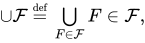
Suppose that is a set function on a semialgebra over and let which is the algebra on generated by The archetypal example of a semialgebra that is not also an algebra is the family on where for all [9] Importantly, the two non-strict inequalities in cannot be replaced with strict inequalities since semialgebras must contain the whole underlying set that is, is a requirement of semialgebras (as is ).

If is finitely additive then it has a unique extension to a set function on defined by sending (where indicates that these are pairwise disjoint) to:[9] This extension will also be finitely additive: for any pairwise disjoint [9]

If in addition is extended real-valued and monotone (which, in particular, will be the case if is non-negative) then will be monotone and finitely subadditive: for any such that [9]

Extending from rings to σ-algebras

[edit]

If is a pre-measure on a ring of sets (such as an algebra of sets) over then has an extension to a measure on the σ-algebra generated by If is σ-finite then this extension is unique.

To define this extension, first extend to an outer measure on by and then restrict it to the set of -measurable sets (that is, Carathéodory-measurable sets), which is the set of all such that It is a -algebra and is sigma-additive on it, by Caratheodory lemma.

Restricting outer measures

[edit]

If is an outer measure on a set where (by definition) the domain is necessarily the power set of then a subset is called –measurable or Carathéodory-measurable if it satisfies the following Carathéodory's criterion: where is the complement of

The family of all –measurable subsets is a σ-algebra and the restriction of the outer measure to this family is a measure.

See also

[edit]

Notes

[edit]

References

[edit]

Further reading

[edit]
Revisions and contributorsEdit on WikipediaRead on Wikipedia
from Grokipedia
A set function is a mathematical function whose domain consists of a collection of sets, typically subsets of a given , and which assigns to each such set an element from a , often the extended real numbers [,][-\infty, \infty]. In the context of , set functions frequently map to non-negative extended reals [0,][0, \infty] and exhibit properties such as monotonicity (if ABA \subseteq B, then μ(A)μ(B)\mu(A) \leq \mu(B)) and (μ(AB)μ(A)+μ(B)\mu(A \cup B) \leq \mu(A) + \mu(B)). Set functions form the foundation of measure theory, where a measure is defined as a countably additive set function μ\mu on a σ\sigma-algebra of sets, satisfying μ()=0\mu(\emptyset) = 0 and μ(n=1An)=n=1μ(An)\mu\left(\bigcup_{n=1}^\infty A_n\right) = \sum_{n=1}^\infty \mu(A_n) for disjoint sets AnA_n. This additivity property distinguishes measures from more general set functions, enabling the rigorous definition of integrals and probabilities. Notable examples include the Lebesgue measure on Rn\mathbb{R}^n, which assigns volumes to measurable sets and extends the notion of length, area, and volume; the Dirac measure δx\delta_x, defined by δx(A)=1\delta_x(A) = 1 if xAx \in A and 0 otherwise, concentrating mass at a point; and the counting measure, which counts the cardinality of finite sets and assigns infinity to infinite ones. Beyond measure theory, set functions appear in probability as probability measures, which are measures normalized so that μ(X)=1\mu(X) = 1 for the entire space XX, and in , where they model quantities like the inclusion-exclusion principle for unions of sets. Properties such as continuity from below or above—where μ(An)=limμ(An)\mu\left(\bigcup A_n\right) = \lim \mu(A_n) for increasing or decreasing sequences of sets—further characterize useful set functions in integration and approximation theorems. These concepts underpin advanced topics like outer measures, for constructing measures from premeasures, and applications in and stochastic processes.

Definitions and Basic Concepts

Formal Definition

In , a set function is a function μ\mu whose domain is a collection of subsets of a given set XX, typically the power set P(X)\mathcal{P}(X), and whose is the extended s R=R{,+}\overline{\mathbb{R}} = \mathbb{R} \cup \{ -\infty, +\infty \}, thereby assigning a real number or to each such . Formally, μ:P(X)R\mu: \mathcal{P}(X) \to \overline{\mathbb{R}}, though the domain is often restricted to a subcollection like an or σ\sigma- of subsets to facilitate specific properties. The standard notation is μ(A)\mu(A) for any AXA \subseteq X. The concept of set functions arose in the early 20th century as part of the foundational developments in measure theory, pioneered by mathematicians such as and . Lebesgue introduced key ideas in his 1902 work on integration and the measure of sets, while Carathéodory provided a rigorous axiomatic framework in 1914 that generalized measure constructions. A simple example of a 0-1 valued set function is the δx\delta_x at a fixed point xXx \in X, defined by δx(A)={1if xA,0if xA,\delta_x(A) = \begin{cases} 1 & \text{if } x \in A, \\ 0 & \text{if } x \notin A, \end{cases} for any AXA \subseteq X, which serves as the of the singleton {x}\{x\} in this context.

Elementary Properties

One fundamental property often imposed on set functions μ: 2^X → ℝ is the normalization at the , where μ(∅) = 0. This condition ensures that the empty subset carries no inherent value or measure, serving as a foundational in definitions of capacities and fuzzy measures. Although not universally required for arbitrary set functions, it is a standard assumption that facilitates consistency in applications such as and integration. The value assigned to the full set X, denoted μ(X), typically represents the total capacity or extent of the universe under consideration. In normalized settings, such as probabilistic or fuzzy measure contexts, μ(X) is set to 1 to reflect completeness, while in more general frameworks it may take any non-negative real value or , indicating the overall scale. Non-negativity is another prevalent elementary , requiring μ(A) ≥ 0 for all A ⊆ X. This ensures that set functions model positive quantities like sizes or beliefs without allowing negative assignments, and it is explicitly part of definitions for capacities and fuzzy measures. Set functions are also distinguished by their range: finite-valued ones satisfy μ(A) < ∞ for every A ⊆ X, common in bounded domains, whereas infinite-valued functions permit μ(A) = ∞, as seen in extended real-valued measures for unbounded spaces. In contexts involving monotonic set functions, a basic inequality holds: for any subsets A, B ⊆ X, μ(A ∪ B) ≥ \max(μ(A), μ(B)). This derives from the increasing nature of such functions and provides a minimal bound on unions without assuming additivity.

Classifications and Types

Additive and Subadditive Functions

A set function μ:A[0,)\mu: \mathcal{A} \to [0, \infty) defined on a collection A\mathcal{A} of subsets of a set XX is finitely additive if μ()=0\mu(\emptyset) = 0 and, for any finite collection of pairwise disjoint sets {A1,,An}A\{A_1, \dots, A_n\} \subseteq \mathcal{A} such that k=1nAkA\bigcup_{k=1}^n A_k \in \mathcal{A}, μ(k=1nAk)=k=1nμ(Ak)\mu\left(\bigcup_{k=1}^n A_k\right) = \sum_{k=1}^n \mu(A_k). In particular, for two disjoint sets A,BAA, B \in \mathcal{A}, finite additivity yields μ(AB)=μ(A)+μ(B)\mu(A \cup B) = \mu(A) + \mu(B). Countable additivity, or σ\sigma-additivity, extends this property to infinite collections: μ\mu is σ\sigma-additive if μ()=0\mu(\emptyset) = 0 and, for any countable collection of pairwise {An}n=1A\{A_n\}_{n=1}^\infty \subseteq \mathcal{A} such that n=1AnA\bigcup_{n=1}^\infty A_n \in \mathcal{A}, μ(n=1An)=n=1μ(An)\mu\left(\bigcup_{n=1}^\infty A_n\right) = \sum_{n=1}^\infty \mu(A_n). Every σ\sigma-additive set function is finitely additive, as one can take all but finitely many AnA_n to be empty. However, the converse does not hold; there exist finitely additive set functions that fail to be σ\sigma-additive. For instance, a Banach limit provides an example of a finitely additive on the power set of the natural numbers that extends the notion of asymptotic but is not σ\sigma-additive, as it assigns positive measure to certain unbounded sets whose countable disjoint union would violate countable additivity. A set function μ\mu is subadditive if, for any finite or countable collection {Ai}iIA\{A_i\}_{i \in I} \subseteq \mathcal{A} (with II finite or countable) such that iIAiA\bigcup_{i \in I} A_i \in \mathcal{A}, μ(iIAi)iIμ(Ai)\mu\left(\bigcup_{i \in I} A_i\right) \leq \sum_{i \in I} \mu(A_i). In particular, for two sets A,BAA, B \in \mathcal{A}, subadditivity implies μ(AB)μ(A)+μ(B)\mu(A \cup B) \leq \mu(A) + \mu(B). The Lebesgue outer measure exemplifies a σ\sigma-subadditive set function. A set function μ\mu is superadditive if, for any finite or countable collection of pairwise {Ai}iIA\{A_i\}_{i \in I} \subseteq \mathcal{A} (with II finite or countable) such that iIAiA\bigcup_{i \in I} A_i \in \mathcal{A}, μ(iIAi)iIμ(Ai)\mu\left(\bigcup_{i \in I} A_i\right) \geq \sum_{i \in I} \mu(A_i). For two A,BAA, B \in \mathcal{A}, this reduces to μ(AB)μ(A)+μ(B)\mu(A \cup B) \geq \mu(A) + \mu(B). Subadditivity implies bounds involving overlaps when combined with non-negativity. Specifically, for any A,BAA, B \in \mathcal{A}, μ(AB)+μ(AB)μ(A)+μ(B).\mu(A \cup B) + \mu(A \cap B) \leq \mu(A) + \mu(B). To sketch the proof, partition A=(AB)(AB)A = (A \cap B) \cup (A \setminus B) and B=(AB)(BA)B = (A \cap B) \cup (B \setminus A). By subadditivity (applied to two sets), μ(A)μ(AB)+μ(AB),μ(B)μ(AB)+μ(BA).\mu(A) \leq \mu(A \cap B) + \mu(A \setminus B), \quad \mu(B) \leq \mu(A \cap B) + \mu(B \setminus A). Adding these yields μ(A)+μ(B)2μ(AB)+μ(AB)+μ(BA)\mu(A) + \mu(B) \geq 2\mu(A \cap B) + \mu(A \setminus B) + \mu(B \setminus A). Now apply subadditivity to the three pairwise disjoint sets ABA \setminus B, BAB \setminus A, and ABA \cap B, whose union is ABA \cup B: μ(AB)μ(AB)+μ(BA)+μ(AB).\mu(A \cup B) \leq \mu(A \setminus B) + \mu(B \setminus A) + \mu(A \cap B). Adding μ(AB)\mu(A \cap B) to both sides gives μ(AB)+μ(AB)μ(AB)+μ(BA)+2μ(AB)μ(A)+μ(B)\mu(A \cup B) + \mu(A \cap B) \leq \mu(A \setminus B) + \mu(B \setminus A) + 2\mu(A \cap B) \leq \mu(A) + \mu(B), as required. This inequality highlights how subadditivity controls the "overlap penalty" in unions, bounding the joint measure by the individual measures.

Measures and Capacities

In measure theory, a measure is defined as a non-negative set function μ:A[0,]\mu: \mathcal{A} \to [0, \infty] defined on a σ\sigma-algebra A\mathcal{A} over a set XX, satisfying σ\sigma-additivity: for any countable collection of pairwise disjoint sets {An}n=1A\{A_n\}_{n=1}^\infty \subseteq \mathcal{A} with union in A\mathcal{A}, μ(n=1An)=n=1μ(An)\mu\left(\bigcup_{n=1}^\infty A_n\right) = \sum_{n=1}^\infty \mu(A_n), and normalized by μ()=0\mu(\emptyset) = 0. This extends finite additivity to countable unions, ensuring consistency in handling infinite decompositions on the domain restricted to a σ\sigma-algebra. Signed measures generalize positive measures by allowing negative values, defined as set functions ν:A[,)\nu: \mathcal{A} \to [-\infty, \infty) on a σ\sigma-algebra A\mathcal{A} that are countably additive and satisfy ν()=0\nu(\emptyset) = 0, with the additional condition that ν\nu does not take both ++\infty and -\infty. The total variation of a signed measure ν\nu on a set AAA \in \mathcal{A} is given by ν(A)=sup{i=1nν(Ei):{Ei}i=1nA disjoint, i=1nEiA}|\nu|(A) = \sup \left\{ \sum_{i=1}^n |\nu(E_i)| : \{E_i\}_{i=1}^n \subseteq \mathcal{A} \text{ disjoint, } \bigcup_{i=1}^n E_i \subseteq A \right\}, where the supremum is over all finite partitions; this yields a positive finite measure ν|\nu| that bounds the oscillation of ν\nu. By the Jordan decomposition theorem, any signed measure decomposes uniquely into ν=ν+ν\nu = \nu^+ - \nu^-, where ν+\nu^+ and ν\nu^- are positive measures with disjoint supports, and ν=ν++ν|\nu| = \nu^+ + \nu^-. Capacities represent a broader class of monotone set functions γ:2X[0,1]\gamma: 2^X \to [0,1] on the power set of XX, satisfying γ()=0\gamma(\emptyset) = 0, γ(X)=1\gamma(X) = 1, and monotonicity: if ABXA \subseteq B \subseteq X, then γ(A)γ(B)\gamma(A) \leq \gamma(B). Outer capacities approximate sets from above using open covers, while inner capacities approximate from below using closed subsets; these are foundational in non-additive integration, such as the Choquet integral. Choquet capacities, introduced as a specific type, are monotone functions that may also satisfy alternating properties—for sets A,BXA, B \subseteq X, γ(AB)+γ(AB)γ(A)+γ(B)\gamma(A \cup B) + \gamma(A \cap B) \leq \gamma(A) + \gamma(B)—enabling the representation of non-linear expectations in decision theory and potential theory. In topological spaces, measures often exhibit regularity properties that align their values with the topology. A measure μ\mu on the Borel σ\sigma-algebra is outer regular if for every Borel set AA, μ(A)=inf{μ(U):U open,AU}\mu(A) = \inf \{ \mu(U) : U \text{ open}, A \subseteq U \}. Inner regularity requires μ(A)=sup{μ(K):K compact,KA}\mu(A) = \sup \{ \mu(K) : K \text{ compact}, K \subseteq A \}, and full regularity combines both; these ensure measures are determined by their values on compact or open sets, facilitating approximation in locally compact Hausdorff spaces. Completeness further characterizes measures: a measure space (X,A,μ)(X, \mathcal{A}, \mu) is complete if every subset of a null set (i.e., set of μ\mu-measure zero) is measurable and has measure zero, often achieved by extending the σ\sigma-algebra to include all such subsets.

Advanced Properties

Monotonicity and Continuity Conditions

Monotonicity is a fundamental property of many set functions, particularly those that are non-negative. A set function μ:A[0,]\mu: \mathcal{A} \to [0, \infty], where A\mathcal{A} is a collection of subsets of a set XX containing the , is said to be monotone if for all A,BAA, B \in \mathcal{A} with ABA \subseteq B, it holds that μ(A)μ(B)\mu(A) \leq \mu(B). This property ensures that the function respects the partial order of set inclusion, making it suitable for applications in optimization and where larger sets should not receive smaller values. Beyond monotonicity, continuity conditions provide finer control over the behavior of set functions under limits of sequences of sets. Continuity from below requires that for any increasing sequence of sets {An}n=1A\{A_n\}_{n=1}^\infty \subseteq \mathcal{A} with AnAn+1A_n \subseteq A_{n+1} for all nn and n=1An=AA\bigcup_{n=1}^\infty A_n = A \in \mathcal{A}, the limit satisfies limnμ(An)=μ(A)\lim_{n \to \infty} \mu(A_n) = \mu(A). Similarly, continuity from above stipulates that for any decreasing sequence {An}n=1A\{A_n\}_{n=1}^\infty \subseteq \mathcal{A} with AnAn+1A_n \supseteq A_{n+1} for all nn, n=1An=AA\bigcap_{n=1}^\infty A_n = A \in \mathcal{A}, and μ(A1)<\mu(A_1) < \infty, it holds that limnμ(An)=μ(A)\lim_{n \to \infty} \mu(A_n) = \mu(A). These conditions generalize the intuitive notion that measures should behave continuously with respect to nested unions and intersections, though they apply to general monotone set functions without requiring additivity. A key relationship exists between σ\sigma-additivity and continuity from below. Suppose μ\mu is σ\sigma-additive, meaning that for any countable collection of pairwise {Bn}n=1A\{B_n\}_{n=1}^\infty \subseteq \mathcal{A} with n=1BnA\bigcup_{n=1}^\infty B_n \in \mathcal{A}, μ(n=1Bn)=n=1μ(Bn)\mu\left(\bigcup_{n=1}^\infty B_n\right) = \sum_{n=1}^\infty \mu(B_n). To show continuity from below, consider an increasing AnAA_n \uparrow A. Define disjoint sets B1=A1B_1 = A_1 and Bn=AnAn1B_n = A_n \setminus A_{n-1} for n2n \geq 2. Then A=n=1BnA = \bigcup_{n=1}^\infty B_n, so by σ\sigma-additivity, μ(A)=n=1μ(Bn).\mu(A) = \sum_{n=1}^\infty \mu(B_n). The partial sums are k=1nμ(Bk)=μ(An)\sum_{k=1}^n \mu(B_k) = \mu(A_n) by finite additivity (which follows from σ\sigma-additivity), and since the terms μ(Bn)0\mu(B_n) \geq 0, the for series yields limnμ(An)=n=1μ(Bn)=μ(A)\lim_{n \to \infty} \mu(A_n) = \sum_{n=1}^\infty \mu(B_n) = \mu(A). Not all monotone set functions satisfy these continuity conditions, leading to discontinuities at certain limits. For instance, consider the set function μ\mu on the power set of N\mathbb{N} defined by μ(A)=0\mu(A) = 0 if AA is finite and μ(A)=1\mu(A) = 1 if AA is infinite. This μ\mu is monotone, as finite subsets of infinite sets have measure 0 while infinite subsets have measure 1, and finite subsets of finite sets preserve 0. However, it fails continuity from below: the increasing sequence An={1,2,,n}A_n = \{1, 2, \dots, n\} satisfies μ(An)=0\mu(A_n) = 0 for all nn, but nAn=N\bigcup_n A_n = \mathbb{N} has μ(N)=1limnμ(An)\mu(\mathbb{N}) = 1 \neq \lim_n \mu(A_n). Similarly, Dirac-like set functions, such as the point mass δp(A)=1\delta_p(A) = 1 if pAp \in A and 0 otherwise for a fixed point pp, exhibit jumps precisely at sets containing or excluding pp, though they satisfy continuity under the standard sequence conditions when σ\sigma-additive.

Inner and Outer Approximations

In measure theory, outer measures provide a way to approximate the size of arbitrary sets from above using coverings from a predefined equipped with a set function. Given a set function μ defined on a collection of sets 𝒞 (often an or ), the μ* induced by μ on the power set of the ambient space X is defined as μ(A)=inf{i=1μ(Ei):Ai=1Ei,EiC}\mu^*(A) = \inf \left\{ \sum_{i=1}^\infty \mu(E_i) : A \subseteq \bigcup_{i=1}^\infty E_i, \, E_i \in \mathcal{C} \right\} for any subset A ⊆ X, where the infimum is taken over all countable covers of A by sets from 𝒞, and the sum is understood to be infinite if no such cover exists with finite total measure. This construction extends μ to all subsets while preserving an upper bound on "size." Outer measures satisfy monotonicity, meaning if A ⊆ B then μ*(A) ≤ μ*(B), and subadditivity, so μ*(∪{i=1}^∞ A_i) ≤ ∑{i=1}^∞ μ*(A_i) for any countable collection of sets {A_i}. These properties ensure that outer measures are non-negative, with μ*(∅) = 0, and finitely subadditive as well. Dually, inner measures approximate sets from below using contained subsets from a suitable family, often closed or compact sets in a topological context. The inner measure μ_* induced by μ is given by μ(A)=sup{μ(K):KA,K compact (or closed)}\mu_*(A) = \sup \left\{ \mu(K) : K \subseteq A, \, K \text{ compact (or closed)} \right\} for A ⊆ X, where the supremum is over all compact (or closed) subsets K of A on which μ is defined. Inner measures are superadditive: if A and B are disjoint, then μ_(A ∪ B) ≥ μ_(A) + μ_(B), and they satisfy μ_(A) ≤ μ_(B) if A ⊆ B, along with μ_(X) = μ(X) if μ is defined on the whole space. This duality allows inner measures to capture a lower bound on the "size" of A, complementing the outer approximation. A key tool for identifying measurable sets within this framework is the Carathéodory criterion, which characterizes sets that behave additively with respect to the . A set E ⊆ X is Carathéodory measurable if for all test sets T ⊆ X, μ(T)=μ(TE)+μ(TEc).\mu^*(T) = \mu^*(T \cap E) + \mu^*(T \cap E^c). This condition ensures that E splits any test set T into measurable pieces without altering the total . The collection of Carathéodory measurable sets forms a on which the restriction of μ* is a complete measure. For a set A, if the inner measure μ_(A) equals the outer measure μ(A), then A is measurable in the sense that it coincides with the measure on the generated by the approximations, ensuring uniqueness in the extension process. This agreement provides a regularity condition that aligns the , facilitating the construction of measures on larger σ-algebras.

Relationships and Equivalences

Connections to Measures

In measure theory, general set functions such as provide a framework for identifying measurable sets via : a EE of the ambient XX is measurable if for every set AXA \subseteq X, m(A)=m(AE)+m(AE)m^*(A) = m^*(A \cap E) + m^*(A \setminus E), where mm^* is the . For such measurable sets, the inner measure m(E)m_*(E), defined as sup{m(F)F measurable,FE}\sup \{ m(F) \mid F \text{ measurable}, F \subseteq E \} or equivalently (when applicable) as m(A)m(AE)m(A) - m^*(A \setminus E) for a measurable cover AEA \supseteq E, equals the outer measure m(E)m^*(E). This ensures that measurable sets capture a precise notion of "size" without ambiguity between approximation from below and above. The collection Σ\Sigma of all such measurable sets forms a σ\sigma-algebra, and restricting the outer measure to Σ\Sigma yields a countably additive measure μ:Σ[0,]\mu: \Sigma \to [0, \infty], thereby defining a measure space (X,Σ,μ)(X, \Sigma, \mu). This construction, known as the Carathéodory extension, transforms a general subadditive set function (like an ) into a complete measure on the σ\sigma-algebra of measurable sets, bridging arbitrary set functions to the rigorous structure required for integration and analysis. Within measure spaces, two measures μ\mu and ν\nu on the same σ\sigma-algebra are equivalent if they share the same null sets, meaning μ(E)=0\mu(E) = 0 if and only if ν(E)=0\nu(E) = 0 for all measurable EE, allowing them to agree almost everywhere with respect to each other. This equivalence relation preserves the essential properties of the measures while ignoring differences on sets of measure zero, facilitating comparisons in probability and analysis. A key connection arises through : if μν\mu \ll \nu (i.e., ν(E)=0\nu(E) = 0 implies μ(E)=0\mu(E) = 0), the Radon-Nikodym theorem guarantees the existence of a f0f \geq 0, called the Radon-Nikodym derivative dμdν\frac{d\mu}{d\nu}, such that for every measurable set EE, μ(E)=Edμdνdν.\mu(E) = \int_E \frac{d\mu}{d\nu} \, d\nu. This derivative represents μ\mu as an with respect to ν\nu, enabling the decomposition of measures and the study of densities in set function contexts. Furthermore, the extends to integrals defined over measure spaces derived from set functions, where if a of measurable functions fnf_n converges to ff and fng|f_n| \leq g with gg , then fndμfdμ\int f_n \, d\mu \to \int f \, d\mu. This result justifies limit interchanges in approximations by simple functions supported on measurable sets, linking set functions to robust calculus. In topological spaces, set functions often manifest as Borel measures, which are defined on the Borel generated by the open sets of the . The Borel consists of the smallest containing all open sets, ensuring that Borel measures assign values to sets derived from the topological structure while maintaining σ-additivity and non-negativity. This integration allows set functions to respect the topological properties, such as openness and closedness, facilitating the study of continuity and approximation in spaces like metric or Hausdorff topologies. A key topological property of such measures is regularity, which quantifies how well measurable sets can be approximated by open or compact subsets. A μ is outer regular if for every E, μ(E) equals the infimum of μ(U) over all open sets U containing E, allowing approximation from above by opens. Similarly, μ is inner regular if μ(E) = sup {μ(K) : K compact, K ⊆ E}, providing approximation from below by compact sets. In locally compact Hausdorff spaces, many s, such as those finite on compacts, exhibit both inner and outer regularity, enhancing their utility in integration and convergence theorems. Algebraically, set functions link to group structures through invariance under group actions, particularly in locally compact groups where Haar measures serve as canonical examples. A left Haar measure on a locally compact Hausdorff group G is a non-zero regular Borel measure μ that is left-invariant, meaning μ(xE) = μ(E) for all x in G and Borel sets E, with finite measure on compact sets. This invariance preserves the algebraic symmetry of the group, enabling the definition of integrals over group elements and applications in representation theory. Right Haar measures are defined analogously, and in compact or abelian groups, left and right versions coincide up to scalar multiples. In non-Hausdorff topological s, regularity of measures requires careful consideration, as the lack of separation axioms can complicate and continuity. While inner regularity is typically defined using compact subsets, some formulations adapt to compact closed sets to ensure well-behaved approximations, though standard literature often retains compact sets for consistency. Additional conditions, such as the space being completely regular or the measure being tight, may be imposed to guarantee continuity properties like inner regularity on open sets.

Examples

Lebesgue Measure

The serves as a fundamental example of a set function on the Rn\mathbb{R}^n, providing a rigorous of , area, and to arbitrary measurable subsets. Its construction begins with the definition of the μ\mu^*, which assigns to any subset ARnA \subseteq \mathbb{R}^n the infimum of the sums of volumes of countable coverings by open s: μ(A)=inf{kv(Rk):AkRk,Rk open rectangles},\mu^*(A) = \inf \left\{ \sum_k v(R_k) : A \subseteq \bigcup_k R_k, \, R_k \text{ open rectangles} \right\}, where v(R)v(R) denotes the of the RR. This outer measure is then restricted to the σ\sigma- of Lebesgue measurable sets via the Carathéodory criterion, yielding the complete Lebesgue measure λ\lambda on Rn\mathbb{R}^n. For a half-open [a1,b1)××[an,bn)[a_1, b_1) \times \cdots \times [a_n, b_n) in Rn\mathbb{R}^n, the measure is given by λ([a1,b1)××[an,bn))=i=1n(biai),\lambda([a_1, b_1) \times \cdots \times [a_n, b_n)) = \prod_{i=1}^n (b_i - a_i), which extends additively to finite disjoint unions of such s and further via the Carathéodory extension to the full σ\sigma-. The exhibits key properties that make it a prototypical measure-theoretic set function. It is translation-invariant, meaning λ(A+t)=λ(A)\lambda(A + t) = \lambda(A) for any measurable ARnA \subseteq \mathbb{R}^n and tRnt \in \mathbb{R}^n. Additionally, it is σ\sigma-finite, as Rn\mathbb{R}^n can be covered by countably many sets of finite measure, such as balls of radius 1. On the Lebesgue σ\sigma-algebra, which includes all Borel sets and their completions with , the measure is complete: any subset of a null set is also measurable with measure zero. In infinite-dimensional settings, such as separable Hilbert spaces, no direct analog of the exists due to the absence of a locally finite, translation-invariant measure on the entire space. Instead, Gaussian measures provide a natural extension, defined via cylindrical approximations and characterized by their mean and covariance operator; these measures are quasi-invariant under translations but not translation-invariant, assigning positive measure to neighborhoods while having full support. The standard on Rn\mathbb{R}^n is unique up to null sets among all σ\sigma-finite, translation-invariant measures on the Borel σ\sigma-algebra, as established by its role as the on the additive group Rn\mathbb{R}^n, normalized such that λ([0,1)n)=1\lambda([0,1)^n) = 1.

Dirac Measure

The Dirac measure δx\delta_x, for a fixed point xx in a XX, is a basic example of a set function defined by δx(A)=1\delta_x(A) = 1 if xAx \in A and 00 otherwise, for subsets AXA \subseteq X. It is a probability measure on the power set or Borel σ\sigma-algebra, concentrating all mass at xx. This set function is finitely additive (and σ\sigma-additive) and serves as a Dirac delta distribution in integration, with key properties including translation-invariance in the sense that δx+y(A)=δx(Ay)\delta_{x+y}(A) = \delta_x(A - y). It is widely used in probability to model point masses and in physics for impulses.

Counting Measure

The counting measure on a set XX assigns to each AXA \subseteq X the A|A| if AA is finite, and \infty otherwise. It is a set function on the power set, σ\sigma-additive, and monotone, but not σ\sigma-finite unless XX is countable. On uncountable sets like R\mathbb{R}, it extends the notion of "size" beyond finite measures, appearing in and as the on discrete groups.

Invariant Set Functions

Invariant set functions, particularly those that are translation-invariant, maintain their value under shifts by elements of an underlying group. A set function μ\mu defined on subsets of a group GG is translation-invariant if μ(A+x)=μ(A)\mu(A + x) = \mu(A) for all measurable sets AGA \subseteq G and all xGx \in G, where A+x={a+xaA}A + x = \{a + x \mid a \in A\}. This property is central in finitely additive cases, where μ\mu satisfies additivity over disjoint finite unions but not necessarily countable ones, allowing extensions beyond standard measures. A prominent example is the Banach measure on R\mathbb{R}, which is a finitely additive, translation-invariant set function extending the from the Lebesgue σ\sigma-algebra to the power set of R\mathbb{R}, normalized such that μ([0,1])=1\mu([0,1]) = 1. Originally constructed by in 1923 using group-theoretic methods, modern proofs employ the Hahn-Banach theorem; this measure agrees with on measurable sets but is not σ\sigma-additive, enabling it to assign measures to non-measurable sets while preserving invariance under translations. For additive invariant functions on Rn\mathbb{R}^n, setting μ([0,1)n)=1\mu([0,1)^n) = 1 ensures consistency with volume properties, though such extensions are not unique. In the context of locally compact groups, Haar measure provides a canonical example of an invariant set function that is σ\sigma-additive. A left Haar measure μ\mu on a GG satisfies μ(gA)=μ(A)\mu(gA) = \mu(A) for all compactly supported measurable sets AA and gGg \in G, and is unique up to positive scalar multiples; right Haar measures satisfy the analogous right-invariance. The existence of such measures follows from the applied to positive linear functionals on the space of continuous compactly supported functions Cc(G)C_c(G), yielding a regular Borel measure that is invariant.

Extensions and Constructions

From Semirings to Algebras

A semiring of sets is a non-empty collection P\mathcal{P} of subsets of a set XX that is closed under finite intersections, meaning that if E,FPE, F \in \mathcal{P}, then EFPE \cap F \in \mathcal{P}, and such that for any E,FPE, F \in \mathcal{P} with EFE \subseteq F, the difference FEF \setminus E can be expressed as a finite disjoint union of sets from P\mathcal{P}. This structure provides a foundational class for defining set functions, often starting with finitely additive functions on P\mathcal{P}. Semirings are particularly useful in measure theory because they allow systematic extensions while preserving key properties like monotonicity. To extend a set function μ:P[0,]\mu: \mathcal{P} \to [0, \infty] defined on a P\mathcal{P} to the A\mathcal{A} generated by P\mathcal{P}, one defines μ\mu on A\mathcal{A} using finite s of elements from P\mathcal{P}. Specifically, every set AAA \in \mathcal{A} can be written as a finite A=i=1nRiA = \bigsqcup_{i=1}^n R_i where each RiPR_i \in \mathcal{P}, and then μ(A)=i=1nμ(Ri)\mu(A) = \sum_{i=1}^n \mu(R_i). This definition ensures that if μ\mu is finitely additive and monotone on P\mathcal{P}, then the extended μ\mu inherits these properties on A\mathcal{A}, maintaining finite additivity for in the algebra and monotonicity for nested sets. The extension is unique provided that the whole XX can be covered by a finite of sets from P\mathcal{P}, ensuring that the A\mathcal{A} includes XX and that no alternative representations affect the values of μ\mu. This finite covering condition guarantees that the measure remains well-defined and consistent across equivalent decompositions in A\mathcal{A}.

Carathéodory Extension

The Carathéodory extension theorem provides a method to extend a countably additive set function, or pre-measure, defined on a ring of subsets to a complete measure on the σ-algebra it generates. Consider a set XX and a ring R\mathcal{R} of subsets of XX, equipped with a pre-measure μ:R[0,]\mu: \mathcal{R} \to [0, \infty] that is countably additive, meaning μ(n=1En)=n=1μ(En)\mu\left(\bigcup_{n=1}^\infty E_n\right) = \sum_{n=1}^\infty \mu(E_n) for any countable collection of pairwise disjoint sets EnRE_n \in \mathcal{R} whose union lies in R\mathcal{R}. This setup allows construction of an outer measure on the power set P(X)\mathcal{P}(X), which serves as the foundation for the extension. The μ\mu^* is defined for any AXA \subset X by μ(A)=inf{n=1μ(En):EnR,An=1En},\mu^*(A) = \inf\left\{ \sum_{n=1}^\infty \mu(E_n) : E_n \in \mathcal{R}, \, A \subset \bigcup_{n=1}^\infty E_n \right\}, with the convention that the infimum over the empty collection is \infty. This μ\mu^* inherits properties such as monotonicity and countable from μ\mu, and it extends μ\mu in the sense that μ(E)=μ(E)\mu^*(E) = \mu(E) for all ERE \in \mathcal{R}. A EXE \subset X is Carathéodory measurable if it satisfies the splitting condition: for every AXA \subset X, μ(A)=μ(AE)+μ(AEc),\mu^*(A) = \mu^*(A \cap E) + \mu^*(A \cap E^c), where Ec=XEE^c = X \setminus E. The collection M\mathcal{M} of all Carathéodory measurable sets forms a containing R\mathcal{R}, and the restriction μM\mu|_{\mathcal{M}} is a complete measure that extends μ\mu, meaning μ(E)=μ(E)\mu(E) = \mu^*(E) for ERE \in \mathcal{R} and μ\mu is countably additive on M\mathcal{M}. This extension theorem, originally formulated by , guarantees that M\mathcal{M} includes the generated by R\mathcal{R}. If μ\mu is σ-finite, meaning XX can be covered by countably many sets of finite μ\mu-measure, then the extension is unique: any other measure on the σ-algebra generated by R\mathcal{R} that agrees with μ\mu on R\mathcal{R} must coincide with μM\mu|_{\mathcal{M}}. Without σ-finiteness, uniqueness may fail, as multiple extensions can exist. The proof begins by verifying that M\mathcal{M} is a σ-algebra, showing closure under complements (directly from the splitting condition) and countable unions (using subadditivity and the splitting property iteratively). Countable additivity of μM\mu|_{\mathcal{M}} follows from the outer measure's subadditivity and the measurability condition, which prevents "overlaps" in approximations. Completeness arises because σ-additivity of the original μ\mu on R\mathcal{R} ensures that null sets (sets with μ=0\mu^* = 0) and their subsets are measurable, with measure zero, making the extension complete.

Outer Measure Restrictions

In measure theory, the restriction of an outer measure refers to the process of limiting its domain to the σ-algebra of Carathéodory-measurable sets, thereby yielding a complete measure. An outer measure μ* on a set X is a function from the power set P(X) to [0, ∞] satisfying μ*(∅) = 0, monotonicity (if A ⊆ B, then μ*(A) ≤ μ*(B)), and countable subadditivity (μ*(∪{n=1}^∞ A_n) ≤ ∑{n=1}^∞ μ*(A_n) for any countable collection {A_n} ⊆ P(X)). Unlike a full measure, an outer measure may not be countably additive on all subsets, but its restriction addresses this limitation. A A ⊆ X is μ*-measurable (or Carathéodory-measurable) if, for every Y ⊆ X, μ*(Y) = μ*(Y ∩ A) + μ*(Y \ A). This condition, known as , ensures that A "splits" any test set Y additively with respect to the . Carathéodory's theorem states that the collection M of all μ*-measurable sets forms a on X, and the restriction μ*|_M : M → [0, ∞], defined by μ(A) = μ*(A) for A ∈ M, is a measure—meaning it is countably additive on disjoint unions of sets in M. Moreover, this measure is complete: any of a (A ∈ M with μ(A) = 0) is also in M with measure zero. The σ-algebra M is closed under complements (if A ∈ M, then X \ A ∈ M) and countable unions (if {A_n} ⊆ M, then ∪{n=1}^∞ A_n ∈ M), which follows from the splitting property applied iteratively. For disjoint measurable sets {A_n} ∈ M, countable additivity holds: μ(∪{n=1}^∞ A_n) = ∑_{n=1}^∞ μ(A_n), restoring the desired property absent in the full . This restriction is unique in the sense that any measure extending a premeasure on a ring will coincide with this construction on the generated σ-algebra, as guaranteed by the extension theorem. In practice, this framework underlies the construction of , where the derived from interval lengths restricts to the standard Lebesgue measure on the Borel completed with null sets. The approach, introduced by in 1914, generalizes length to higher dimensions and arbitrary spaces, providing a foundational tool for integration and probability.

References

Add your contribution
Related Hubs
User Avatar
No comments yet.