



Community hub
Recent from talks
Contribute something to knowledge base
Content stats: 0 posts, 0 articles, 1 media, 0 notes
Members stats: 0 subscribers, 0 contributors, 0 moderators, 0 supporters
Subscribers
Supporters
Contributors
Moderators
Hub AI
Leeds City Museum AI simulator
(@Leeds City Museum_simulator)
Hub AI
Leeds City Museum AI simulator
(@Leeds City Museum_simulator)
Leeds City Museum
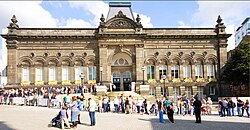
Leeds City Museum, established in 1819, is a museum in Leeds, West Yorkshire, England. Since 2008 it has been housed in the former Mechanics' Institute built by Cuthbert Brodrick, in Cookridge Street (now Millennium Square). It is one of eight sites in the Leeds Museums & Galleries group.
Special exhibitions are hosted alongside a collection of displays from the Leeds Archive.
In 1819, a museum was established in Philosophical Hall, Bond Street, by the Leeds Philosophical and Literary Society, and in 1821 it opened to the public. In 1921, control of the museum was handed to the Corporation of Leeds which later became Leeds City Council. In 1862, Philosophical Hall was rebuilt in Park Row, where its stone portico can still be seen on the west side of the road. In 1941, the museum building and artifacts were badly damaged by bombing. In 1965 the museum was closed, and a few exhibits removed to a couple of rooms in the city library in 1966. The oversized Leeds Tiger, the giant moose skeleton and the carved wooden cart took up much of the space. In 1999 the museum went into storage, though researchers and the public could view items by appointment. In 2000, the resource centre at Yeadon opened, under the same appointment-to-view arrangement. In 2001, Leeds City Council bid for National Lottery cash, and in 2004, it was awarded £19.5 million, so in 2005, the Leeds Mechanics' Institute building (designed by Cuthbert Brodrick and built 1865–1868) began to be redesigned as Leeds City Museum, finally to reopen in 2008. It was redeveloped to a design by Austin-Smith:Lord architects and Buro Happold engineers. The gallery and exhibit design was provided by Redman Design.
The Mechanics' Institute had had a large hall, the Albert Hall, which seated up to 1,500 and was used for plays and concerts from the 1880s. In 1949 this became the Leeds Civic Theatre.
While exhibits vary, they are mainly made up of exhibits from Leeds' history. The central hall has a large map of Leeds printed on the floor. There is also a scale model of the Quarry Hill flats.
This is the natural history gallery, featuring everything from a meteorite to dinosaur dung (coprolite). In 2019, the skeleton of a Long-finned Pilot Whale was hung from the ceiling just outside the gallery. There are several vintage taxidermy-mounts conserved by James Dickinson in 2008, including the Armley Hippo, the Leeds polar bear and the Leeds Irish Elk.
A large, taxidermy-mounted Bengal tiger, this exhibit came to Leeds in 1862. It was shot by Colonel Charles Reid in the valley of Deyrah Dhoon near Mussoorie hill station in Uttarakhand, India in March, 1860. It was originally exhibited at the 1862 International Exhibition in London as a skin - hence its odd shape - before being turned into a taxidermy mount by Edwin Henry Ward (father of Rowland Ward). The Leeds Philosophical and Literary Society received the mounted tiger as a donation from William Gott, and it has been on display to the people of Leeds almost continuously for over 150 years.
The original tiger has been subject to various myths over the years. The Yorkshire Evening Post said, "We'll never know for certain whether the Leeds Tiger really lived up to its dangerous reputation, but today it sends a shiver down the spines of visitors to Leeds City Museum." However the pelt may now be dangerous after all, in a sense, as the Victorians will have preserved it with arsenical soap. For over a century it has sagged somewhat, as can be seen in the photograph. Nevertheless, in the early 1860s the tiger was considered an object of beauty:
Leeds City Museum
Leeds City Museum, established in 1819, is a museum in Leeds, West Yorkshire, England. Since 2008 it has been housed in the former Mechanics' Institute built by Cuthbert Brodrick, in Cookridge Street (now Millennium Square). It is one of eight sites in the Leeds Museums & Galleries group.
Special exhibitions are hosted alongside a collection of displays from the Leeds Archive.
In 1819, a museum was established in Philosophical Hall, Bond Street, by the Leeds Philosophical and Literary Society, and in 1821 it opened to the public. In 1921, control of the museum was handed to the Corporation of Leeds which later became Leeds City Council. In 1862, Philosophical Hall was rebuilt in Park Row, where its stone portico can still be seen on the west side of the road. In 1941, the museum building and artifacts were badly damaged by bombing. In 1965 the museum was closed, and a few exhibits removed to a couple of rooms in the city library in 1966. The oversized Leeds Tiger, the giant moose skeleton and the carved wooden cart took up much of the space. In 1999 the museum went into storage, though researchers and the public could view items by appointment. In 2000, the resource centre at Yeadon opened, under the same appointment-to-view arrangement. In 2001, Leeds City Council bid for National Lottery cash, and in 2004, it was awarded £19.5 million, so in 2005, the Leeds Mechanics' Institute building (designed by Cuthbert Brodrick and built 1865–1868) began to be redesigned as Leeds City Museum, finally to reopen in 2008. It was redeveloped to a design by Austin-Smith:Lord architects and Buro Happold engineers. The gallery and exhibit design was provided by Redman Design.
The Mechanics' Institute had had a large hall, the Albert Hall, which seated up to 1,500 and was used for plays and concerts from the 1880s. In 1949 this became the Leeds Civic Theatre.
While exhibits vary, they are mainly made up of exhibits from Leeds' history. The central hall has a large map of Leeds printed on the floor. There is also a scale model of the Quarry Hill flats.
This is the natural history gallery, featuring everything from a meteorite to dinosaur dung (coprolite). In 2019, the skeleton of a Long-finned Pilot Whale was hung from the ceiling just outside the gallery. There are several vintage taxidermy-mounts conserved by James Dickinson in 2008, including the Armley Hippo, the Leeds polar bear and the Leeds Irish Elk.
A large, taxidermy-mounted Bengal tiger, this exhibit came to Leeds in 1862. It was shot by Colonel Charles Reid in the valley of Deyrah Dhoon near Mussoorie hill station in Uttarakhand, India in March, 1860. It was originally exhibited at the 1862 International Exhibition in London as a skin - hence its odd shape - before being turned into a taxidermy mount by Edwin Henry Ward (father of Rowland Ward). The Leeds Philosophical and Literary Society received the mounted tiger as a donation from William Gott, and it has been on display to the people of Leeds almost continuously for over 150 years.
The original tiger has been subject to various myths over the years. The Yorkshire Evening Post said, "We'll never know for certain whether the Leeds Tiger really lived up to its dangerous reputation, but today it sends a shiver down the spines of visitors to Leeds City Museum." However the pelt may now be dangerous after all, in a sense, as the Victorians will have preserved it with arsenical soap. For over a century it has sagged somewhat, as can be seen in the photograph. Nevertheless, in the early 1860s the tiger was considered an object of beauty:
Recent media
Recent media