


Community hub
Recent from talks
Contribute something to knowledge base
Content stats: 0 posts, 0 articles, 1 media, 0 notes
Members stats: 0 subscribers, 0 contributors, 0 moderators, 0 supporters
Subscribers
Supporters
Contributors
Moderators
Hub AI
Lelantine War AI simulator
(@Lelantine War_simulator)
Hub AI
Lelantine War AI simulator
(@Lelantine War_simulator)
Lelantine War
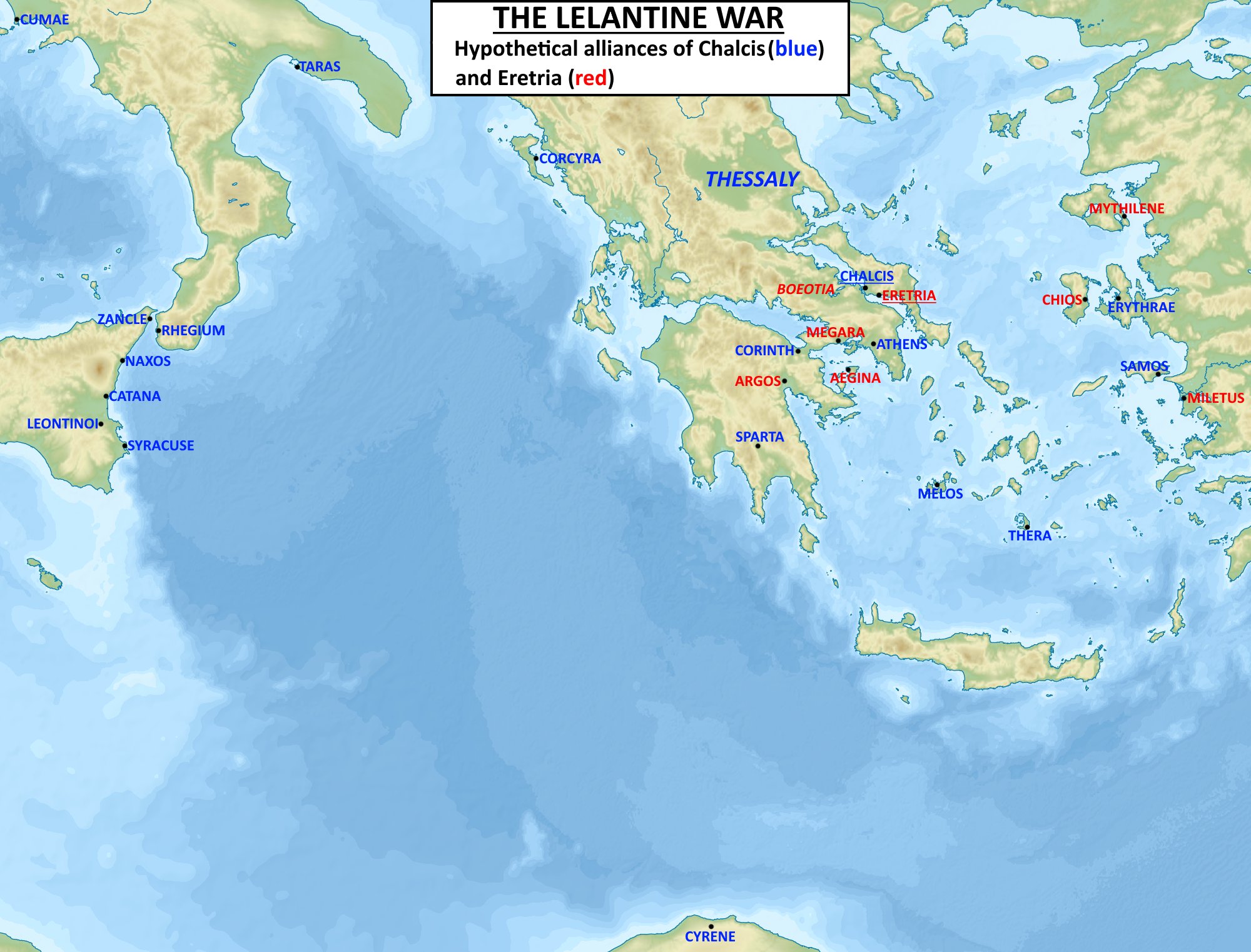
The Lelantine War was a military conflict between the two ancient Greek city states Chalcis and Eretria in Euboea which took place in the early Archaic period, between c. 710 and 650 BC. The reason for war was, according to tradition, the struggle for the fertile Lelantine Plain on the island of Euboea. Due to the economic importance of the two participating poleis, the conflict spread considerably, with multiple further city states joining either side, resulting in much of Greece being at war. The historian Thucydides describes the Lelantine War as exceptional, the only war in Greece between the mythical Trojan War and the Persian Wars of the early 5th century BC in which allied cities rather than single ones were involved.
Ancient authors normally refer to the War between Chalcidians and Eretrians (ancient Greek: πόλεμος Χαλκιδέων καὶ Ἐρετριῶν pólemos Chalkidéon kaì Eretriōn).
The war between Chalcis and Eretria was the one in which most cities belonging to the rest of Greece were divided up into alliances with one side or the other.
— Thucydides (I. 15, 3)
The length of the war, as well as the cities involved, and even the historicity of the Lelantine War remain debated among modern historians.
There is no direct information in ancient sources to date this war. Indirect evidence in Thucydides points towards a date ca 700 BC, that situates it halfway between history and legend. At the very same time, the site of Lefkandi was being incrementally deserted, perhaps as a consequence of the turmoil. The foundation stories of the joint Euboean colony at Ischia suggest that at the mid-8th century Chalcis and Eretria were cooperating. Furthermore, Theognis can be read to imply there was a conflict between Eretria and Chalcis in the middle of the 6th century BC. While a few historians have suggested this as the date of the Lelantine War, it is more probable that Theognis refers to a second, smaller and even less known Lelantine War: "we are certainly not dealing with a 'Hundred Years Lelantine War'", remarks Robin Lane Fox.
Since the conflict took place at an early point in Greek history, before historiography had developed, there are no contemporaneous written sources on the events. The few later sources and the much more copious archaeological evidence allow for a sketchy picture of the Lelantine War. However, as a result of the ambiguity of the surviving written sources, date and extent of the war are disputed among Classical scholarship. Some authors have even suggested that the war may be entirely mythical or even fictional.
No detailed record of the Lelantine War was produced by a contemporary author (such as Thucydides for the Peloponnesian War), as Greek historiography only developed 200 years later, starting with the works of Herodotus. The Greek literary tradition as a whole started only in the late 8th century BC, with Homer. Therefore, the only contemporary sources about the Lelantine War are references in the early poets Hesiod and Archilochos. The first references in historical works are from the 5th century, two centuries after the events, and remain vague and brief.
Lelantine War
The Lelantine War was a military conflict between the two ancient Greek city states Chalcis and Eretria in Euboea which took place in the early Archaic period, between c. 710 and 650 BC. The reason for war was, according to tradition, the struggle for the fertile Lelantine Plain on the island of Euboea. Due to the economic importance of the two participating poleis, the conflict spread considerably, with multiple further city states joining either side, resulting in much of Greece being at war. The historian Thucydides describes the Lelantine War as exceptional, the only war in Greece between the mythical Trojan War and the Persian Wars of the early 5th century BC in which allied cities rather than single ones were involved.
Ancient authors normally refer to the War between Chalcidians and Eretrians (ancient Greek: πόλεμος Χαλκιδέων καὶ Ἐρετριῶν pólemos Chalkidéon kaì Eretriōn).
The war between Chalcis and Eretria was the one in which most cities belonging to the rest of Greece were divided up into alliances with one side or the other.
— Thucydides (I. 15, 3)
The length of the war, as well as the cities involved, and even the historicity of the Lelantine War remain debated among modern historians.
There is no direct information in ancient sources to date this war. Indirect evidence in Thucydides points towards a date ca 700 BC, that situates it halfway between history and legend. At the very same time, the site of Lefkandi was being incrementally deserted, perhaps as a consequence of the turmoil. The foundation stories of the joint Euboean colony at Ischia suggest that at the mid-8th century Chalcis and Eretria were cooperating. Furthermore, Theognis can be read to imply there was a conflict between Eretria and Chalcis in the middle of the 6th century BC. While a few historians have suggested this as the date of the Lelantine War, it is more probable that Theognis refers to a second, smaller and even less known Lelantine War: "we are certainly not dealing with a 'Hundred Years Lelantine War'", remarks Robin Lane Fox.
Since the conflict took place at an early point in Greek history, before historiography had developed, there are no contemporaneous written sources on the events. The few later sources and the much more copious archaeological evidence allow for a sketchy picture of the Lelantine War. However, as a result of the ambiguity of the surviving written sources, date and extent of the war are disputed among Classical scholarship. Some authors have even suggested that the war may be entirely mythical or even fictional.
No detailed record of the Lelantine War was produced by a contemporary author (such as Thucydides for the Peloponnesian War), as Greek historiography only developed 200 years later, starting with the works of Herodotus. The Greek literary tradition as a whole started only in the late 8th century BC, with Homer. Therefore, the only contemporary sources about the Lelantine War are references in the early poets Hesiod and Archilochos. The first references in historical works are from the 5th century, two centuries after the events, and remain vague and brief.
Recent media
Recent media