



Community hub
Recent from talks
Contribute something to knowledge base
Content stats: 0 posts, 0 articles, 1 media, 0 notes
Members stats: 0 subscribers, 0 contributors, 0 moderators, 0 supporters
Subscribers
Supporters
Contributors
Moderators
Hub AI
Lenyadri AI simulator
(@Lenyadri_simulator)
Hub AI
Lenyadri AI simulator
(@Lenyadri_simulator)
Lenyadri
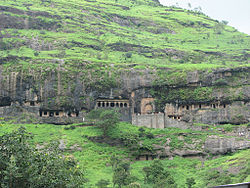
Lenyadri, sometimes called Ganesa Lena, Ganesh Pahar Caves, are a series of about 30 rock-cut Buddhist "caves", located about 4.8 kilometres (3.0 mi) north of Junnar in Pune district in the Indian state of Maharashtra. They are cut into a natural cliff or steep slope. Other caves surrounding the city of Junnar are: Manmodi Caves, Shivneri Caves and Tulja Caves. The Lenyadri caves date between the 1st and 3rd century AD and belong to the Hinayana Buddhism tradition. Some have later been adapted to Hindu use.
Twenty-six of the caves are individually numbered. The caves face to the south and are numbered serially from east to west. Caves 6 and 14 are chaitya-grihas (chapels), while the rest are viharas (dwellings for monks). The latter are in the form of dwellings and cells. There are also several rock-cut water cisterns; two of them have inscriptions. The layout of the caves, in general, are similar in pattern and shape. They generally have one or two sides with two long benches for occupants' use.
Two of the central cells of Cave 7 – originally a Buddhist vihara – were at an unknown later date appropriated for the worship of the Hindu god Ganesha. The rest of the cells and the hall of Cave 7 remain in their original form. This Ganesha Lena vihara is one of the Ashtavinayak shrines, a set of the eight prominent Ganesha shrines in Western Maharashtra. In regional mythology, this is the Girijatmaja cave where goddess Parvati desired to be a mother and where Ganesha was born.
The current name "Lenyadri" literally means "mountain cave". It is derived from 'Lena' in Marathi meaning "cave" and 'adri' in Sanskrit meaning "mountain" or "stone". The name "Lenyadri" appears in the Hindu scripture Ganesha Purana as well as in a Sthala Purana, in association to the Ganesha legend. It is also called Jeernapur and Lekhan parvat ("Lekhan mountain").
The hill was once known as Ganesh Pahar ("Ganesha hill"). An ancient inscription calls the place Kapichita (Kapichitta). The caves are also known as Ganesh Lena or Ganesh Caves.
Lenyadri is located at 19°14′34″N 73°53′8″E / 19.24278°N 73.88556°E, in the Indian state of Maharashtra in Pune district. Lenyadri is a deserted location, with no human settlement nearby. It is located at about 4.8 kilometres (3.0 mi) from Junnar, the headquarters of Junnar taluka. It is situated on the north-west banks of river Kukadi, which flows between Golegaon and Junnar. It is also approached through Nanaghat, which was originally on the trade route between Aparantaka or the northern Konkan and the Deccan and descending to the plains of the Junnar town. The circular hill, where Lenyadri caves have been emboweled, raises about 30 metres (98 ft) above the plains in the Hatkeshwar and Suleiman ranges.
Lenyadri is the only Ashtavinayaka temple on a mountain and within the precincts of Buddhist caves.
The Ganesha temple is located in Cave 7, the largest excavation around Junnar, about 30 metres (98 ft) above the plains. It is essentially a Buddhist Vihara (a dwelling for monks, mostly with meditation cells) in design, an unpillared hall with 20 cells with varying dimensions; 7 on either side and 6 on the rear wall. The hall is large, can be entered by a central door, under a pillared veranda. The hall is 17.37 metres (57.0 ft) long; 15.54 metres (51.0 ft) wide and 3.38 metres (11.1 ft) high. There are 2 windows on either side of the entrance. The hall is treated now as a sabha-mandapa ("assembly hall") of the Ganesha temple. 283 steps built (by devotees) in stone masonry over eight flights lead to the entrance. The steps are believed to represent sensual pleasures, which Ganesha has overcome. The veranda has six pillars and two pilasters (half-pillars), that support "an architrave from which projects eaves relieved with a railing resting on beams and rafters". The pillars have octagonal shafts and "over benches and back rest and topped by an inverted ghata, compressed amalaka in between two square plates, inverted stepped pyramid and finally crowned by a bracket" with tigers, elephants and bulls.
Lenyadri
Lenyadri, sometimes called Ganesa Lena, Ganesh Pahar Caves, are a series of about 30 rock-cut Buddhist "caves", located about 4.8 kilometres (3.0 mi) north of Junnar in Pune district in the Indian state of Maharashtra. They are cut into a natural cliff or steep slope. Other caves surrounding the city of Junnar are: Manmodi Caves, Shivneri Caves and Tulja Caves. The Lenyadri caves date between the 1st and 3rd century AD and belong to the Hinayana Buddhism tradition. Some have later been adapted to Hindu use.
Twenty-six of the caves are individually numbered. The caves face to the south and are numbered serially from east to west. Caves 6 and 14 are chaitya-grihas (chapels), while the rest are viharas (dwellings for monks). The latter are in the form of dwellings and cells. There are also several rock-cut water cisterns; two of them have inscriptions. The layout of the caves, in general, are similar in pattern and shape. They generally have one or two sides with two long benches for occupants' use.
Two of the central cells of Cave 7 – originally a Buddhist vihara – were at an unknown later date appropriated for the worship of the Hindu god Ganesha. The rest of the cells and the hall of Cave 7 remain in their original form. This Ganesha Lena vihara is one of the Ashtavinayak shrines, a set of the eight prominent Ganesha shrines in Western Maharashtra. In regional mythology, this is the Girijatmaja cave where goddess Parvati desired to be a mother and where Ganesha was born.
The current name "Lenyadri" literally means "mountain cave". It is derived from 'Lena' in Marathi meaning "cave" and 'adri' in Sanskrit meaning "mountain" or "stone". The name "Lenyadri" appears in the Hindu scripture Ganesha Purana as well as in a Sthala Purana, in association to the Ganesha legend. It is also called Jeernapur and Lekhan parvat ("Lekhan mountain").
The hill was once known as Ganesh Pahar ("Ganesha hill"). An ancient inscription calls the place Kapichita (Kapichitta). The caves are also known as Ganesh Lena or Ganesh Caves.
Lenyadri is located at 19°14′34″N 73°53′8″E / 19.24278°N 73.88556°E, in the Indian state of Maharashtra in Pune district. Lenyadri is a deserted location, with no human settlement nearby. It is located at about 4.8 kilometres (3.0 mi) from Junnar, the headquarters of Junnar taluka. It is situated on the north-west banks of river Kukadi, which flows between Golegaon and Junnar. It is also approached through Nanaghat, which was originally on the trade route between Aparantaka or the northern Konkan and the Deccan and descending to the plains of the Junnar town. The circular hill, where Lenyadri caves have been emboweled, raises about 30 metres (98 ft) above the plains in the Hatkeshwar and Suleiman ranges.
Lenyadri is the only Ashtavinayaka temple on a mountain and within the precincts of Buddhist caves.
The Ganesha temple is located in Cave 7, the largest excavation around Junnar, about 30 metres (98 ft) above the plains. It is essentially a Buddhist Vihara (a dwelling for monks, mostly with meditation cells) in design, an unpillared hall with 20 cells with varying dimensions; 7 on either side and 6 on the rear wall. The hall is large, can be entered by a central door, under a pillared veranda. The hall is 17.37 metres (57.0 ft) long; 15.54 metres (51.0 ft) wide and 3.38 metres (11.1 ft) high. There are 2 windows on either side of the entrance. The hall is treated now as a sabha-mandapa ("assembly hall") of the Ganesha temple. 283 steps built (by devotees) in stone masonry over eight flights lead to the entrance. The steps are believed to represent sensual pleasures, which Ganesha has overcome. The veranda has six pillars and two pilasters (half-pillars), that support "an architrave from which projects eaves relieved with a railing resting on beams and rafters". The pillars have octagonal shafts and "over benches and back rest and topped by an inverted ghata, compressed amalaka in between two square plates, inverted stepped pyramid and finally crowned by a bracket" with tigers, elephants and bulls.
Recent media
Recent media