


Community hub
Recent from talks
Contribute something
Nothing was collected or created yet.
Leon Powe
View on Wikipedia
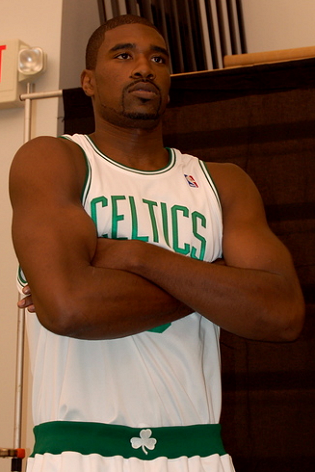
Leon Powe Jr. (/ˈpoʊ/; born January 22, 1984) is an American former professional basketball power forward. Drafted in 2006 by the Denver Nuggets, Powe grew up in Oakland, California, and played college basketball for the California Golden Bears. He played his first three years in the NBA with the Boston Celtics and won a championship with the team in 2008. From 2009 to 2011, Powe played for the Cleveland Cavaliers. He also had a stint with the Memphis Grizzlies in 2011. After a stint in Puerto Rico, Powe announced his retirement in 2014 citing multiple injuries and his desire to become a businessman.
Key Information


Early life
[edit]Powe grew up in Oakland, California. His father left him when he was two years old. When he was seven years old, the family's house burned down and they were homeless for years. They moved more than twenty times within six years. He and his siblings were taken away from their mother by the state of California and put into foster care. Powe's mother died four days before he played in the state championship.[1]
High school career
[edit]Powe attended Oakland Technical High School along with former Seattle Seahawks running back Marshawn Lynch, where he averaged 27.4 ppg, 14.2 rpg and 3.1 bpg as a senior. With Powe in the roster, Oakland Tech won the CIF Oakland Section Championship and also reached the CIF State Championships in 2002 and 2003. He was named a first-team Parade All-American and the Gatorade California Player of the Year during his senior year. A highly rated prep star, Powe was selected to play in the McDonald's All-American game and became the first Oakland Tech athlete to have his number retired by the school.[2]
College career
[edit]Powe played college basketball at the University of California, Berkeley, for the Golden Bears from 2003 to 2006. Although he was present for three seasons, he did not play in his sophomore year (2004–05) due to a serious knee injury.[3] During his freshman season, he was named the Pac-10 Freshman of the Year, leading the conference in rebounding.
Questions abounded about whether Powe would return to form following his knee surgery, but he worked hard and rehabilitated to become a dominant force on the interior as he continued to improve his game. He produced 20.5 PPG and 10.1 RPG while leading Cal to a 20–11 record and a berth in the NCAA tournament.
Powe was named California's most valuable player during a banquet in April 2006. Powe, who also was selected Cal's MVP as a freshman in 2004, averaged 20.5 ppg and 10.1 rpg to become just the sixth player ever to pace the Pac-10 Conference in both categories. Named a second-team All-American by the Associated Press, the U.S. Basketball Writers and ESPN.com, he was chosen to the All-Pac-10 First Team for a second time in 2006.
Professional career
[edit]After his junior year, Powe decided to enter his name in the 2006 NBA draft.[3] Powe was selected by the Denver Nuggets in the second round as the 49th overall pick. The Nuggets subsequently traded him to the Boston Celtics. After playing for the Celtics summer league team, Powe was signed by the team to a 3-year contract. Although Powe did not reach the sum of 14 in his per game points, rebounds, and assists necessary to guarantee the second year of his contract, that second year became guaranteed when Boston did not waive him by July 1, 2007. Powe had a similar hurdle of 16 for the sum of the three statistics to guarantee the third year of his contract (2008–09).[4][5]
2006–07 NBA season
[edit]Powe played as a fourth string center behind Kendrick Perkins, Brian Scalabrine and Michael Olowokandi in his rookie season. After a rash of injuries submarined Boston's playoff chances, Powe received a limited opportunity to showcase his skills. He proved himself a capable defender who could alter shots and provide interior rebounding. On January 12, 2007, Powe made the most out of his 25 minutes and registered a career-high 12 rebounds against the Toronto Raptors. On April 10, 2007, he scored 19 points against the Atlanta Hawks. Powe finished the 2006–07 campaign averaging 4.2 points and 3.4 rebounds in just over 11 minutes per game.
2007–08 NBA season
[edit]
.jpg)
On January 29, 2008, Powe had a breakout performance that took place in Miami against the Heat, as he effectively filled in the blank of the absent main contributors Kevin Garnett and Ray Allen, scoring 25 points and grabbing 11 rebounds en route to a 117–87 blowout victory.[6] He also scored his career-high 27 points in the last game of the season against the New Jersey Nets on April 16, 2008.[7]
One of his most notable performances of the season came in Game 2 of the 2008 NBA Finals against the Los Angeles Lakers on June 8, 2008, as he scored 21 points, which included several dunks and 13 free throw attempts in only 15 minutes of play in front of a crowd chanting his name[8] en route to a 108–102 Celtics victory.[9][10][11]

2008–09 NBA season
[edit]On March 13, 2009, Powe started in place of the injured Kevin Garnett, scoring a career-high 30 points, grabbing 11 rebounds and blocking a career-high 5 shots, in a 102–92 Celtics victory over the Memphis Grizzlies.[12]
Powe spent the end of the season attempting to recover from a right knee strain. He returned in time for the playoffs, only to tear the ACL and meniscus in his left knee in Game 2 of the first round against the Chicago Bulls.[13] Powe continued to play on the torn ACL for three minutes before being taken out. His season ended with the knee injury, and had successful surgery to repair the injury on May 5, 2009.[14] On August 2, the Cleveland Cavaliers offered Powe an offer sheet worth two years and $1.8 million.[15] On August 11, 2009, Powe and the Cavaliers agreed in principle to the deal with an option on the second year.[16] On August 12, 2009, he officially signed the deal.[17]
2010–11 NBA season
[edit]On February 24, 2011, Powe was waived when the Cleveland Cavaliers needed to clear their roster capacity after making two trades.[18][19] He had just recovered from surgery to repair the torn meniscus in his right knee which had kept him sidelined for six weeks.[20] Over a week later, Powe signed for the rest of the season with the Memphis Grizzlies.[19]
Basketball post-career
[edit]In 2014, Powe was hired by the Celtics as community ambassador.[21]
NBA career statistics
[edit]| GP | Games played | GS | Games started | MPG | Minutes per game |
| FG% | Field goal percentage | 3P% | 3-point field goal percentage | FT% | Free throw percentage |
| RPG | Rebounds per game | APG | Assists per game | SPG | Steals per game |
| BPG | Blocks per game | PPG | Points per game | Bold | Career high |
| † | Won an NBA championship |
Regular season
[edit]| Year | Team | GP | GS | MPG | FG% | 3P% | FT% | RPG | APG | SPG | BPG | PPG |
|---|---|---|---|---|---|---|---|---|---|---|---|---|
| 2006–07 | Boston | 63 | 2 | 11.4 | .446 | .000 | .736 | 3.4 | .2 | .2 | .3 | 4.2 |
| 2007–08† | Boston | 56 | 5 | 14.4 | .572 | .000 | .710 | 4.1 | .3 | .3 | .3 | 7.9 |
| 2008–09 | Boston | 70 | 7 | 17.5 | .524 | .000 | .689 | 4.9 | .7 | .3 | .5 | 7.7 |
| 2009–10 | Cleveland | 20 | 2 | 11.8 | .429 | .000 | .587 | 3.0 | .0 | .3 | .1 | 4.0 |
| 2010–11 | Cleveland | 14 | 3 | 13.4 | .492 | .000 | .462 | 2.7 | .1 | .5 | .2 | 5.0 |
| 2010–11 | Memphis | 16 | 0 | 8.8 | .500 | .000 | .609 | 1.6 | .3 | .2 | .1 | 5.5 |
| Career | 239 | 19 | 13.9 | .515 | .000 | .682 | 3.8 | .3 | .3 | .3 | 6.2 | |
Playoffs
[edit]| Year | Team | GP | GS | MPG | FG% | 3P% | FT% | RPG | APG | SPG | BPG | PPG |
|---|---|---|---|---|---|---|---|---|---|---|---|---|
| 2008† | Boston | 23 | 1 | 11.7 | .493 | .000 | .667 | 2.7 | .2 | .0 | .1 | 5.0 |
| 2009 | Boston | 2 | 0 | 12.0 | .429 | .000 | .667 | 4.5 | .0 | .0 | .0 | 5.0 |
| 2010 | Cleveland | 3 | 0 | 3.0 | .250 | .000 | .750 | .7 | .0 | .0 | .0 | 1.7 |
| 2011 | Memphis | 4 | 0 | 3.5 | .250 | .000 | .750 | 1.0 | .0 | .0 | .0 | 1.8 |
| Career | 32 | 1 | 9.9 | .457 | .000 | .675 | 2.4 | .1 | .0 | .1 | 4.3 | |
References
[edit]- ^ Hubbard, Lee (February 19, 2003). "The Making of Leon Powe". East Bay Express.
- ^ Player Bio: Leon Powe :: Men's Basketball Archived June 14, 2006, at the Wayback Machine
- ^ a b Cal sophomore Powe to test draft - NBA - ESPN
- ^ Okanes, Jonathan (July 19, 2006). "Celtics put Cal's Powe on payroll". Contra Costa Times. Archived from the original on December 8, 2006.
- ^ May, Peter (August 6, 2006). "Blazers coach plays defense". The Boston Globe.
- ^ Steve Bulpett, Celtics elect to win, Boston Herald, January 30, 2008.
- ^ Mark Murphy, C's go through motions, gear up for postseason, Boston Herald, April 17, 2008.
- ^ Chris Forsberg, They're chanting his name..., The Boston Globe, June 8, 2008.
- ^ Celts withstand Lakers' late Game 2 run behind Pierce, defense, Associated Press, June 8, 2008.
- ^ Scott Tribble, Celtics Build Lead with Heavy Dose of Powe-time Archived June 11, 2008, at the Wayback Machine, Celtics.com, June 9, 2008.
- ^ Daily Dime: Powe steps up for Celtics, ESPN.com, June 9, 2008.
- ^ Powe's time is well spent Boston Herald, March 14, 2009
- ^ Leon Powe's postseason over: Boston Celtic has torn ACL - ESPN
- ^ Microfracture surgery on Powe's left knee a success NBA.com, May 5, 2009
- ^ NBA.com: Player News NBA.com: Player News
- ^ Cavs, Leon Powe agreed two-year deal, ESPN.GO.com, August 11, 2009.
- ^ "Cavaliers Sign Leon Powe". NBA.com. August 12, 2009. Retrieved August 12, 2009.
- ^ CAVALIERS: Cavaliers Acquire Erden and Harangody from Boston for Future Second Round Pick
- ^ a b Free agent Leon Powe signed by Memphis Grizzlies - ESPN
- ^ Cleveland Cavaliers' Leon Powe out 6 weeks after knee surgery - ESPN
- ^ "Celtics Hire Leon Powe For 'Whatever Danny (Ainge) Wants Me To Do'". NESN.com. September 30, 2014. Retrieved May 30, 2022.
External links
[edit]
Leon Powe
View on GrokipediaEarly life
Childhood and family background
Leon Powe was born on January 22, 1984, in Berkeley, California, and raised in the East Oakland neighborhood amid challenging socioeconomic conditions.[1][6] As the oldest child in a single-parent household, Powe grew up with his mother, Connie Landry, and his six younger siblings after his father abandoned the family when Powe was two years old.[7][8] Landry supported the family through low-wage odd jobs, including temporary employment and selling goods at flea markets, while struggling with poverty and personal hardships such as drug addiction.[9][10][8] The family's living situation was marked by instability, with frequent relocations driven by financial strain. When Powe was seven, their home burned down after one of his younger brothers accidentally started a fire with matches, leaving them homeless and forcing them to move more than 20 times over the next six years.[11][2] They often stayed in rundown motels, abandoned cars, or on street corners, and spent time in upwards of 30 homeless shelters across Oakland.[12][2] As the eldest, Powe frequently took on responsibilities to help care for his siblings during these difficult periods, fostering a strong family support system despite the adversity.[13]Personal challenges and mother's death
Leon Powe endured profound personal hardships during his adolescence, most notably the worsening health of his mother, Connie Landry, who suffered from heart disease aggravated by the stresses of single parenthood and low-wage jobs, including selling goods at flea markets and temporary employment, to support her seven children.[8] Landry, aged 41, died of a heart attack on March 19, 2002, while residing at the Night's Inn motel in Oakland, just four days before Powe's Oakland Technical High School team was set to compete in the California state basketball championship finals.[7][13][10] Already placed in foster care four years earlier due to family instability, Powe remained with his foster family led by Imergene Wash after his mother's death, but the tragedy intensified his emotional struggles, including deep grief, frustration over lost opportunities to care for her, and the pain of temporary separation from his siblings, most of whom also entered the county foster system.[8][9][14] Powe later reflected on the overwhelming sadness, noting that he even considered abandoning basketball in the wake of her passing, as it shattered his vision of buying her a home as a gesture of gratitude for her sacrifices.[8] These experiences forged Powe's remarkable resilience and unyielding work ethic, as he internalized his mother's determination amid adversity, crediting her influence for his own perseverance.[8] In reflecting on her impact, Powe stated, "But my mother had that will to survive. I think that’s what I have in me," a sentiment that underscored how her struggles motivated him to push forward despite profound loss.[8] This inner drive, born from grief and familial separation, channeled his energy into personal growth and athletic dedication during high school.[10]High school career
Transfer to Oakland Technical High School
Leon Powe enrolled at Oakland Technical High School in Oakland, California, where he began his high school basketball career amid significant personal and academic challenges stemming from his unstable family situation. Growing up in poverty and homelessness, Powe frequently missed school to care for his younger siblings, which contributed to inconsistent attendance and early academic difficulties.[10] As a freshman in the 2000–01 school year, Powe struggled with his grades, posting a GPA below 2.0 that rendered him academically ineligible for four games during the season. These setbacks were compounded by the lack of structure in his home life, but under the guidance of Oakland Tech basketball coach Hodari McGavock, Powe began to adjust to the demands of a more disciplined program. McGavock, who had recently reached his 400th career victory, played a pivotal role in mentoring Powe, emphasizing both on-court development and off-court responsibilities to help him stay eligible and focused.[15][9] By his junior year in 2001–02, Powe had earned a starting role on the varsity team and shown marked improvement, raising his GPA to 3.5 while emerging as a key contributor for the Bulldogs. He averaged 29 points and 15 rebounds per game, helping lead Oakland Tech to a 28–4 record and a berth in the California Division I state title game. This period also marked Powe's introduction to competitive AAU basketball with the Oakland Soldiers, where he honed his skills against elite national talent under coach Mark Olivier, gaining broader exposure beyond local high school play. Following the season, Powe suffered a torn ACL in an AAU tournament, which he played through in a brace during his senior year.[15][16][14][17]Senior year achievements and state championship
In his senior year at Oakland Technical High School during the 2002–03 season, Leon Powe emerged as a dominant force, averaging 27.4 points, 14.2 rebounds, and 3.1 blocks per game while showcasing his athleticism and scoring ability inside.[18] He scored 40 or more points in three consecutive games, including a 42-point performance in an 87–80 overtime victory over McClymonds High School to secure the CIF Oakland Section championship.[18] These efforts helped propel the Bulldogs deep into the playoffs, reaching the state championship game and highlighted Powe's growth.[19] Powe led Oakland Tech to the CIF Northern California Division I title with a 60–48 win over Sacramento's Capital Christian in the regional final, where he recorded 17 points and 12 rebounds.[20] The team advanced to the CIF State Championship game in March 2003 at ARCO Arena in Sacramento, facing Westchester High School in a rematch of the previous year's final; despite Powe's contributions, Oakland Tech fell 73–63, with Westchester's Trevor Ariza earning tournament MVP honors after scoring 30 points.[21] Powe's performance throughout the postseason underscored his resilience amid personal hardships, including the loss of his mother, Connie Landry, to heart failure just a year earlier in March 2002, four days before the 2002 state final—an event that had profoundly impacted him and his siblings, who entered foster care.[14] Motivated by his mother's memory, Powe dedicated his senior season to her, channeling the grief into his play and providing stability for his family as the eldest sibling.[14] His outstanding campaign earned him first-team Parade All-American honors, the Gatorade California Boys Basketball Player of the Year award, and selection as a McDonald's All-American, recognizing his impact on and off the court.[18][22][16] As a top national recruit ranked among the elite prospects in the class of 2003, Powe drew interest from powerhouse programs including Arizona, North Carolina, and Duke before committing to the University of California, Berkeley, to stay close to home and support his family.[16]College career
Freshman and sophomore seasons at California
Leon Powe committed to the University of California, Berkeley, on July 8, 2003, following his standout senior year at Oakland Technical High School where he led the team to a state championship.[23] As a highly touted recruit ranked ninth nationally, Powe chose Cal over other major programs like North Carolina, drawn by the opportunity to play close to home in the Bay Area.[24] In his freshman season of 2003–04 under head coach Ben Braun, Powe quickly adjusted to Pac-10 competition, averaging 15.1 points and a league-leading 9.5 rebounds per game across 27 appearances.[25] He recorded 14 double-doubles, tying for the most by a Golden Bear since 1981–82, and became the first freshman in Pac-10 history to lead the conference in rebounding.[18] His performance earned him Pac-10 Freshman of the Year honors, as well as first-team All-Pac-10 and team MVP selections, helping Cal finish fourth in the conference with a 9–9 record despite an overall 13–15 mark.[26] Powe's vocal leadership and relentless energy on the court provided a spark for the Bears, who relied on his interior presence amid a rebuilding effort. However, lingering knee issues emerged late in the season, including being held out of the January 2004 game at Arizona due to swelling, leading to offseason surgery and a redshirt for 2004–05.[27] Powe redshirted the 2004–05 season to focus on recovery (detailed below) and returned for his sophomore eligibility year in 2005–06. He led the Pac-10 in scoring (20.5 points per game) and rebounding (10.1 per game)—a feat unmatched by any Cal player in over 40 years—while earning second-team All-America honors and Pac-10 Tournament MVP after averaging 26.7 points and 11.3 rebounds in the tournament.[4] Highlights included a 41-point game against Oregon and a 20-rebound performance versus USC.[3] His efforts helped guide the Golden Bears to the NCAA Tournament, and over his Cal career, he averaged 17.8 points and 9.8 rebounds per game, both ranking in the program's top 10.[4] Powe was inducted into the California Athletics Hall of Fame in 2018 for his contributions.[4]2004–05 injury and redshirt year
During what would have been his sophomore year at the University of California, Berkeley, Leon Powe was sidelined for the entire 2004–05 season due to complications from ongoing left knee issues stemming from prior surgeries. After a bone graft procedure on April 21, 2004, to address damage from an earlier ACL reconstruction, the graft failed to heal properly, necessitating a postponement of the subsequent reconstructive surgery from July to September 8, 2004, when it was performed by Dr. Richard Steadman at the Steadman Hawkins Clinic in Vail, Colorado.[28][29][30] This timeline forced Powe to redshirt the season to prioritize full recovery, marking the second major knee procedure on that leg during his college tenure.[29] Rehabilitation proved arduous, involving months of intensive physical therapy where Powe dedicated three hours daily to treatment in the training room, limited to activities like shooting around and weightlifting while barred from full contact drills.[31] He grappled with significant mental challenges, including frustration and disappointment over the surgical delays and missed playing time, which he described as a series of setbacks testing his patience.[30][27] Despite this, Powe drew support from head coach Ben Braun and his teammates, contributing from the bench by offering insights and encouragement during games, which helped maintain his connection to the team.[31] Under Braun, who was in his ninth season guiding a transitioning Cal program, the Bears struggled to a 13–16 record without Powe's contributions, highlighting his importance to the team's frontcourt.[32] The redshirt preserved Powe's eligibility, allowing him to play two full seasons for the Golden Bears overall. By May 26, 2005, he received full medical clearance on his knee, enabling focused preparation for his return in the 2005–06 season.[29]Professional career
2006–07 NBA season with Boston Celtics
Leon Powe was selected by the Denver Nuggets with the 49th overall pick in the second round of the 2006 NBA Draft before his draft rights were traded to the Boston Celtics in exchange for a 2007 second-round draft pick.[33] On July 18, 2006, Powe signed a multi-year contract with the Celtics, marking the beginning of his professional career after his sophomore year at the University of California, following recovery from a knee injury that caused him to redshirt the 2004–05 season.[34] In his rookie season under head coach Doc Rivers, Powe served primarily as a bench player, appearing in 63 games with just 2 starts while averaging 11.4 minutes per game. He contributed 4.2 points and 3.4 rebounds per game, showcasing his rebounding tenacity and energy in limited opportunities, particularly on the offensive glass where he averaged 1.5 offensive rebounds.[1] Powe's role expanded somewhat due to injuries among the frontcourt rotation, including to centers like Theo Ratliff and Kendrick Perkins, allowing him to provide solid depth as a power forward/center hybrid.[35] A highlight of Powe's rookie year came on April 6, 2007, when he recorded his first NBA double-double with 10 points and 11 rebounds in a narrow 88-85 loss to the Miami Heat, demonstrating his ability to impact games despite modest overall production.[36] Transitioning from college, Powe had to adapt to the NBA's increased physicality, as evidenced by his experiences guarding dominant big men like Shaquille O'Neal, who tested his endurance and post recovery from knee surgery. This adjustment period highlighted his resilience, setting the foundation for greater contributions in subsequent seasons.2007–08 NBA season and championship run
In the 2007–08 NBA season, Leon Powe established himself as a reliable bench contributor for the Boston Celtics, appearing in 56 games and averaging 7.9 points and 4.1 rebounds per game while shooting 57.2% from the field.[1] Coming off limited rookie minutes the previous year, Powe provided high-energy support as a power forward and center, complementing the frontline anchored by All-Stars Kevin Garnett and Paul Pierce. His efficient scoring and rebounding helped bolster the Celtics' depth during a dominant regular season that saw the team finish with a league-best 66–16 record and home-court advantage throughout the playoffs.[37] Powe's playoff role emphasized his value as a spark plug off the bench during Boston's championship run, where he appeared in all 23 games, averaging 4.8 points and 2.5 rebounds in 11.5 minutes per contest.[38] Although his minutes were limited in the Eastern Conference Finals against the Detroit Pistons—averaging 2.0 points across four games as the Celtics advanced in six—he stepped up significantly in the NBA Finals versus the Los Angeles Lakers, where he averaged 6.2 points and 3.2 rebounds over six games. His standout moment came in Game 2 on June 8, 2008, when Powe erupted for 21 points on 6-of-7 shooting in 14 minutes and 39 seconds, including several highlight-reel dunks, to help Boston secure a 108–102 win and tie the series at 1–1.[38][39] The Celtics clinched the NBA championship on June 17, 2008, defeating the Lakers 131–92 in Game 6 to win the series 4–2 and secure Boston's 17th title. For Powe, the victory carried deep personal resonance as his first NBA championship following the sudden death of his mother, Celeste, from a heart attack in 2002 when he was a high school senior.[40] The triumph validated his perseverance through early career injuries and solidified his place on one of the league's most storied teams, amid ongoing discussions about his future contract with the organization.[41]2008–09 NBA season with Boston Celtics
Coming off the 2008 NBA championship, Leon Powe sought to expand his role as a key reserve for the Boston Celtics during the 2008–09 regular season, but recurring knee problems hampered his contributions.[42] Powe appeared in 70 of the team's 82 games, averaging 7.7 points, 4.9 rebounds, and 17.5 minutes per game while shooting 50.4 percent from the field.[1] His performance provided solid energy off the bench, though the Celtics' frontcourt depth was tested by injuries to other players like Kevin Garnett. In late March 2009, Powe suffered a strained right knee during a game against the Chicago Bulls on March 17, sidelining him for 12 games and limiting his mobility upon return in early April.[43] He wore a heavy brace on the knee for the remainder of the regular season, which affected his explosiveness and overall effectiveness.[44] Powe's postseason was even more curtailed, as he played only the first two games of the Eastern Conference First Round against the Bulls, averaging 5.0 points and 4.5 rebounds in 12.2 minutes per game.[38] The brace continued to hinder his quickness, leading to struggles in matching the pace against Chicago's frontcourt.[45] During Game 2 on April 20, Powe tore the anterior cruciate ligament (ACL) and meniscus in his left knee while driving to the basket, ending his playoffs and requiring season-ending surgery. On May 5, 2009, Powe underwent successful microfracture surgery on his left knee to address the ACL tear and associated damage, marking his third major knee procedure and raising concerns about his long-term mobility. As an unrestricted free agent following the season, Powe did not receive a qualifying offer from the Celtics by the July 1 deadline, primarily due to the uncertainty surrounding his knee recovery; he later expressed that his time with Boston appeared to be over.[46]2009–10 NBA season with Cleveland Cavaliers
Following his departure from the Boston Celtics as a free agent on July 1, 2009, after an injury-shortened 2008–09 season that included a torn ACL and meniscus in his left knee requiring surgery in May 2009, Leon Powe signed a two-year contract with the Cleveland Cavaliers on August 12, 2009, with the team holding an option for the second year.[47] Powe's recovery from the knee surgery limited him to missing the first 57 games of the regular season, as he focused on rehabilitation to regain full strength and mobility.[48] He made his debut for the Cavaliers on February 25, 2010, against the Celtics, entering late in the first half of a 108–88 victory and receiving an ovation from the Boston crowd in recognition of his past contributions.[49] Over the remainder of the regular season, Powe appeared in 20 games off the bench, averaging 4.0 points, 3.1 rebounds, and 11.8 minutes per game while shooting 42.9% from the field.[1] In the playoffs, the Cavaliers advanced past the Chicago Bulls in five games during the first round, though Powe did not play in the series due to ongoing recovery management. He then saw limited action in the Eastern Conference Semifinals against the Celtics, appearing in three of the six games for a total of nine minutes and averaging 1.7 points per game.[38] The Cavaliers were eliminated by Boston in six games, ending Powe's season.[50]2010–11 NBA season with Cleveland Cavaliers and Memphis Grizzlies
Following the departure of LeBron James to the Miami Heat in the 2010 offseason, the Cleveland Cavaliers entered a rebuilding phase and finished the 2010–11 season with a league-worst 19–63 record.[51] Leon Powe, who had signed with the Cavaliers as a free agent in 2009, began the season on the second year of his two-year contract after the Cavaliers exercised their team option on him in May 2010.[1] Powe appeared in 14 games for Cleveland, starting three, while averaging 13.4 minutes, 5.0 points, and 2.7 rebounds per game, often providing bench energy amid the team's struggles but limited by ongoing recovery from prior knee injuries.[1] On February 24, 2011, the Cavaliers waived Powe to clear roster space following two midseason trades that brought in new players, ending his tenure with the team after a total of 50 games across parts of two seasons in Cleveland. Less than two weeks later, on March 5, 2011, Powe signed as a free agent with the Memphis Grizzlies, a playoff-contending team in need of frontcourt reinforcements due to injuries, particularly to forward Rudy Gay. With the Grizzlies, Powe played in 16 regular-season games off the bench, averaging 8.8 minutes, 5.5 points, and 1.6 rebounds per game, contributing sparingly to a squad that finished 46–36 and secured the eighth seed in the Western Conference.[1] The Grizzlies advanced to the playoffs, defeating the San Antonio Spurs in the first round before upsetting the Oklahoma City Thunder in the semifinals, ultimately reaching the Western Conference Finals where they lost to the eventual champion Dallas Mavericks. Powe appeared in four playoff games for Memphis, averaging 3.5 minutes, 1.8 points, and 1.0 rebound per game, but saw limited action as the team relied on its core rotation.[38] His stint with the Grizzlies marked the end of his full NBA season before entering free agency in the summer of 2011.[1]2011–12 NBA season with Boston Celtics
Following his brief stint with the Memphis Grizzlies during the 2010–11 season, Leon Powe entered the 2011–12 NBA season as an unrestricted free agent, hampered by ongoing recovery from multiple knee surgeries that had plagued his career. Despite these challenges, Powe expressed a keen interest in returning to the Boston Celtics, the team where he had established himself as a key contributor during their 2008 championship run. In December 2011, the Celtics were among several teams, including the Los Angeles Lakers, Memphis Grizzlies, and Sacramento Kings, engaging in discussions with Powe about a potential contract, viewing him as a low-risk, high-reward addition given his familiarity with Boston's system and his veteran minimum salary expectations.[52] However, Powe's injury history, including a torn ACL in 2009 and subsequent meniscus repair in 2011, raised significant concerns about his readiness to contribute effectively. The Celtics ultimately did not extend an offer, as reports indicated the team was wary of his health status amid a competitive frontcourt rotation. Powe did not appear in any NBA games during the 2011–12 season, marking the beginning of his transition away from league play.[1] Amid this career limbo, Powe reflected fondly on his time with the Celtics, crediting the organization for his development and the 2008 title as a cornerstone of his legacy. The failed return attempt underscored the loyalty between Powe and Boston, even as his physical limitations led to no further NBA opportunities that year, prompting him to focus on rehabilitation while contemplating his professional future.[52]Post-playing career
International play in Puerto Rico
Following his release from the Boston Celtics amid ongoing knee issues from the 2011–12 season that curtailed his NBA prospects, Leon Powe signed with the Atléticos de San Germán of Puerto Rico's Baloncesto Superior Nacional (BSN) on March 7, 2012, aiming to maintain his conditioning and demonstrate his recovery for a possible NBA return.[53][54] Powe debuted for the Atléticos on March 8, 2012, scoring 11 points in a 94–89 victory over the Mets de Guaynabo, and appeared in a total of 4 games during his short tenure.[55][56] In those outings, he averaged 7.3 points and 3.5 rebounds per game while shooting 36% from the field.[56][57] The BSN's international style presented challenges distinct from the NBA, featuring a faster pace and reliance on smaller, more agile lineups that emphasized quick transitions and perimeter play over traditional post dominance. Powe's role as a power forward required adjusting to this up-tempo environment, though his limited games limited deeper integration.[53] The Atléticos mounted a competitive campaign, securing a playoff berth in the 2012 postseason, but Powe departed the team on March 14 after just one week to pursue an NBA opportunity in the United States that ultimately did not materialize.[58][55] His contract concluded at the end of the BSN regular season in June 2012 without renewal, marking the close of his professional playing career abroad.[55]Role as Boston Celtics community ambassador
Following his stint in Puerto Rico as the final chapter of his playing career, Leon Powe officially retired from professional basketball in 2014, citing persistent injuries and a desire to transition into business endeavors.[59] In September 2014, the Boston Celtics hired him as a community ambassador, reuniting him with the franchise where he had contributed to the 2008 NBA championship.[60][61] Powe's duties center on fostering youth development and community ties, including spearheading educational initiatives like the Pursuing Pathways program, which he helped launch in 2022 to guide high school students toward informed post-secondary decisions.[62] He also supports fan engagement through appearances at Celtics events and charity efforts via the Celtics Shamrock Foundation, such as organizing basketball clinics, summer camps, and recognition programs for student achievements like perfect attendance.[62][63] These activities emphasize building lasting connections with Boston's youth and promoting healthy lifestyles. Throughout his tenure, Powe has delivered motivational talks on resilience and overcoming personal hardships, often sharing insights from his own life to inspire attendees at camps and community gatherings.[64] His involvement extends to collaborative volunteer efforts, including 2025 CommUNITY Crew events honoring civil rights legacies and hospital visits that enhance fan and community outreach.[65] As of 2025, Powe remains in the role with no reported changes, expressing deep satisfaction in contributing to the Celtics' legacy and the personal growth he experienced during the championship years.[66][67]NBA career statistics
Regular season
Leon Powe played 239 regular-season games over five NBA seasons from 2006–07 to 2010–11, averaging 6.2 points, 3.8 rebounds, and 0.3 assists per game while shooting 51.5% from the field.[1] His career advanced metrics included a player efficiency rating (PER) of 16.8 and a true shooting percentage (TS%) of .579.[1] The following table provides a season-by-season breakdown of Powe's regular-season per-game statistics.[1]| Season | Tm | G | GS | MP | FG | FGA | FG% | 3P | 3PA | 3P% | FT | FTA | FT% | ORB | DRB | TRB | AST | STL | BLK | TOV | PF | PTS |
|---|---|---|---|---|---|---|---|---|---|---|---|---|---|---|---|---|---|---|---|---|---|---|
| 2006-07 | BOS | 63 | 2 | 11.4 | 1.3 | 2.8 | .446 | 0.0 | 0.0 | .000 | 1.7 | 2.3 | .736 | 1.5 | 1.9 | 3.4 | 0.2 | 0.2 | 0.3 | 0.7 | 1.7 | 4.2 |
| 2007-08 | BOS | 56 | 5 | 14.4 | 2.8 | 4.8 | .572 | 0.0 | 0.0 | .000 | 2.4 | 3.4 | .710 | 1.7 | 2.4 | 4.1 | 0.3 | 0.3 | 0.3 | 0.8 | 2.3 | 7.9 |
| 2008-09 | BOS | 70 | 7 | 17.5 | 2.5 | 4.8 | .524 | 0.0 | 0.0 | .000 | 2.6 | 3.8 | .689 | 2.1 | 2.9 | 4.9 | 0.7 | 0.3 | 0.5 | 1.1 | 2.7 | 7.7 |
| 2009-10 | CLE | 20 | 2 | 11.8 | 1.1 | 2.5 | .429 | 0.0 | 0.0 | .000 | 1.9 | 3.2 | .587 | 1.0 | 2.1 | 3.1 | 0.0 | 0.3 | 0.1 | 0.6 | 1.8 | 4.0 |
| 2010-11 | 2TM | 30 | 3 | 10.9 | 2.0 | 4.0 | .496 | 0.0 | 0.1 | .000 | 1.3 | 2.4 | .556 | 0.8 | 1.3 | 2.1 | 0.2 | 0.3 | 0.1 | 0.4 | 1.5 | 5.3 |
| Career | 239 | 19 | 13.9 | 2.1 | 4.0 | .515 | 0.0 | 0.0 | .000 | 2.1 | 3.0 | .686 | 1.6 | 2.3 | 3.8 | 0.3 | 0.3 | 0.3 | 0.8 | 2.2 | 6.2 |
Playoffs
Leon Powe appeared in 32 NBA playoff games over four seasons, averaging 4.3 points and 2.4 rebounds per game while shooting 46.2% from the field.[1] His most significant postseason contributions came during the Boston Celtics' 2008 championship run, where he provided key bench scoring and rebounding, including a career-high 21 points in Game 2 of the NBA Finals against the Los Angeles Lakers on June 8, 2008, helping secure a 108–102 victory.[68] In the Eastern Conference Finals that year against the Detroit Pistons, Powe played in four of six games, averaging 4.5 points and 2.0 rebounds.[69] Powe did not appear in the playoffs after the 2010–11 season.| Season | Team | GP | GS | MPG | FG% | 3P% | FT% | RPG | APG | PTS | PER |
|---|---|---|---|---|---|---|---|---|---|---|---|
| 2007–08 | BOS | 23 | 1 | 11.7 | .493 | .000 | .667 | 2.7 | 0.2 | 5.0 | 14.6 |
| 2008–09 | BOS | 2 | 0 | 12.0 | .429 | .000 | .667 | 4.5 | 0.0 | 5.0 | 11.9 |
| 2009–10 | CLE | 3 | 0 | 3.0 | .250 | .000 | .750 | 0.7 | 0.0 | 1.7 | 3.5 |
| 2010–11 | MEM | 4 | 0 | 3.5 | .250 | .000 | .750 | 1.0 | 0.0 | 1.8 | 12.8 |