



Community hub
Recent from talks
Contribute something
Nothing was collected or created yet.
Player efficiency rating
View on Wikipedia
 | This article has multiple issues. Please help improve it or discuss these issues on the talk page. (Learn how and when to remove these messages)
|


The player efficiency rating (PER) is John Hollinger's all-in-one basketball rating, which attempts to collect or boil down all of a player's contributions into one number. Using a detailed formula, Hollinger developed a system that rates every player's statistical performance.[1]
Overview
[edit]PER strives to measure a player's per-minute performance, while adjusting for pace. A league-average PER is always 15.00, which permits comparisons of player performance across seasons. PER takes into account positive results, including field goals, free throws, 3-pointers, assists, rebounds, blocks and steals and negative results, including missed shots, turnovers and personal fouls. The formula adds positive stats and subtracts negative ones through a statistical point value system. The rating for each player is then adjusted to a per-minute basis so that, for example, substitutes can be compared with starters in playing time debates. It is also adjusted for the team's pace. In the end, one number sums up the players' statistical accomplishments for that season.
Relationship to baseball sabermetrics
[edit]Hollinger's work has benefitted from the observations of sabermetric baseball analysts, such as Bill James. One of the primary observations is that traditional counting statistics in baseball, like runs batted in and wins, are not reliable indicators of a player's value. For example, runs batted in is highly dependent upon opportunities created by a player's teammates. PER extends this critique of counting statistics to basketball, noting that a player's opportunities to accumulate statistics are dependent upon the number of minutes played as well as the pace of the game.
Problems
[edit]PER largely measures offensive performance. Hollinger freely admits that two of the defensive statistics it incorporates—blocks and steals (which was not tracked as an official stat until 1973)—can produce a distorted picture of a player's value and that PER is not a reliable measure of a player's defensive acumen. For example, Bruce Bowen, widely regarded as one of the best defenders in the NBA through the 2006–07 season, routinely posted single-digit PERs.
Bear in mind that this rating is not the final, once-and-for-all answer for a player's accomplishments during the season. This is especially true for players such as Bruce Bowen and Trenton Hassell who are defensive specialists but don't get many blocks or steals.
Some have argued that PER gives undue weight to a player's contribution in limited minutes, or against a team's second unit, and it undervalues players who have enough diversity in their game to play starter's minutes. PER has been said to reward inefficient shooting. To quote Dave Berri, the author of The Wages of Wins:
Hollinger argues that each two point field goal made is worth about 1.65 points. A three point field goal made is worth 2.65 points. A missed field goal, though, costs a team 0.72 points. Given these values, with a bit of math we can show that a player will break even on his two point field goal attempts if he hits on 30.4% of these shots. On three pointers the break-even point is 21.4%. If a player exceeds these thresholds, and virtually every NBA player does so with respect to two-point shots, the more he shoots the higher his value in PERs. So a player can be an inefficient scorer and simply inflate his value by taking a large number of shots.
Hollinger responded via a post on ESPN's TrueHoop blog:
Berri leads off with a huge misunderstanding of PER—that the credits and debits it gives for making and missing shots equate to a “break-even” shooting mark of 30.4% on 2-point shots. He made this assumption because he forgot that PER is calibrated against the rest of the league at the end of the formula.
Actually, if we took a player that was completely average in every other respect for the 2006–07 season—rebounds, free throws, assists, turnovers, etc.—and gave him a league-average rate of shots, and all of them were 2-pointers, and he shot 30.4%, he'd end up with a PER of 7.18. As long-time PER fans know, that would make him considerably worse than nearly every player in the league.
To end up with a league-average PER of 15.00, the actual break-even mark in this case is 48.5%, which is exactly what the league average is on 2-point shots this season.
Reference guide
[edit]Hollinger has set up PER so that the league average, every season, is 15.00, which produces sort of a handy reference guide:[2]
| All-time great season | 35.0+ |
| Runaway MVP candidate | 30.0–35.0 |
| Strong MVP candidate | 27.5–30.0 |
| Weak MVP candidate | 25.0–27.5 |
| Definite All-Star | 22.5–25.0 |
| Borderline All-Star | 20.0–22.5 |
| Second offensive option | 18.0–20.0 |
| Third offensive option | 16.5–18.0 |
| Slightly above-average player | 15.0–16.5 |
| Rotation player | 13.0–15.0 |
| Non-rotation player | 11.0–13.0 |
| Fringe roster player | 9.0–11.0 |
| Player who won't stick in the league | 0–9.0 |
A player posted a season efficiency rating over 30.0 just 35 times, with the highest score being 32.85 (Nikola Jokić). Nikola Jokić leads with five 30+ seasons, with Michael Jordan, LeBron James and Giannis Antetokounmpo having four each, Shaquille O'Neal, Wilt Chamberlain and Joel Embiid[3] having three each, Anthony Davis having two, and David Robinson, Tracy McGrady, Dwyane Wade, Stephen Curry, Russell Westbrook, James Harden and Shai Gilgeous-Alexander each with one.[4]
Career PER leaders (minimum 15,000 MP)
[edit]- Statistics accurate as of March 13, 2025.[5]
| ^ | Active NBA player |
| * | Inducted into the Naismith Memorial Basketball Hall of Fame |
PER since 1951–52
Career PER – Michael Jordan vs. LeBron James
[edit]Prior to the 2013–14 season, LeBron James was on the verge of surpassing Michael Jordan's career PER to take the number one spot.[6][7] As the metric is averaged over the length of a player's entire career a decrease in efficiency later in his career means a player can move down in the ranking; Jordan's PER took a big hit in the final two years of his career when he returned to the game with the Washington Wizards, posting 20.7 in his penultimate season and 19.3 in his final season, compared to his career high of 31.7 (Jordan's PER was 29.1 without accounting for his Wizards years).[8]
The debate was intensified on 1 October 2013, with Jordan stating that he would have liked to have played against LeBron, and believes he would have won a one-on-one encounter.[9] Several news features focus on comparing the two players by using the PER metric.[10][11][12] At the conclusion of the 2012–13 NBA season Miami Heat head coach, Erik Spoelstra, stated that comparing players from different generations is the equivalent to comparing apples and oranges, explaining: "You'll never be able to tell [how James stacks up to Jordan or Magic Johnson] because they didn't play against each other. The game is different now than when it was played in the 1980s or even before that."[13]
Players from different NBA generations and Career PER
[edit]Comparing players from different generations using PER presents several problems, this is primarily due to the rule changes and the changes in statistical data collected from different eras (although many other factors could be taken into consideration, even down to the increased sample size as the NBA grew through incorporating more teams). Some of the more important rule changes that should be considered include; some of the players on this list, such as Wilt Chamberlain and Bill Russell, played before the three-point shot, blocks, and steals stats were officially recorded. Blocked shots and steals were first officially recorded in the NBA during the 1973–74 season. The three-point shot entered the league in 1979–80 season.
During the 1990s and 2000s, numerous rule changes were incorporated, the three-point foul and clear path rules were both introduced in the 1995–96 season with the effect of increasing the number of free throws, hand-checking (the amount of contact a defender may make with an opposing player) was banned in 1994 and the use of elbows was banned in 1997 (both rules had seen various degrees of limitation by earlier rule changes) although neither was fully implemented until 2004. The 2004 rule changes, which also included calling the defensive 3 second rule ("a defensive player may not station himself in the key area longer than three seconds"—a longstanding rule which had been ignored by referees) had a major effect, opening up the game and allowing a more free-flowing offense; it encouraged aggressive inside attack based plays (to draw fouls), and has increased the number of fouls given when contact is made on players who drive to the basket.[14] In 2009, former ABA and NBA Coach Larry Brown was quoted as saying: "The college game is much more physical than [the NBA]. I always tease Michael [Jordan], if he played today, he'd average 50."[15]
Calculation
[edit]All calculations begin with what is called unadjusted PER (uPER). The formula is:
![{\displaystyle uPER={\frac {1}{min}}\times \left(3P+\left[{\frac {2}{3}}\times AST\right]+\left[\left(2-factor\times {\frac {tmAST}{tmFG}}\right)\times FG\right]+\left[0.5\times FT\times \left(2-{\frac {1}{3}}\times {\frac {tmAST}{tmFG}}\right)\right]-\left[VOP\times TO\right]-\left[VOP\times DRBP\times \left(FGA-FG\right)\right]-\left[VOP\times 0.44\times \left(0.44+\left(0.56\times DRBP\right)\right)\times \left(FTA-FT\right)\right]+\left[VOP\times \left(1-DRBP\right)\times \left(TRB-ORB\right)\right]+\left[VOP\times DRBP\times ORB\right]+\left[VOP\times STL\right]+\left[VOP\times DRBP\times BLK\right]-\left[PF\times \left({\frac {lgFT}{lgPF}}-0.44\times {\frac {lgFTA}{lgPF}}\times VOP\right)\right]\right)}](https://wikimedia.org/api/rest_v1/media/math/render/svg/5000c94daefaafcbb64a991d7a44e5e3ebf4acf9)
When multiplied out and refactored, the equation above becomes:
![{\displaystyle uPER={\frac {1}{min}}\times \left(3P-{\frac {PF\times lgFT}{lgPF}}+\left[{\frac {FT}{2}}\times \left(2-{\frac {tmAST}{3\times tmFG}}\right)\right]+\left[FG\times \left(2-{\frac {factor\times tmAST}{tmFG}}\right)\right]+{\frac {2\times AST}{3}}+VOP\times \left[DRBP\times \left(2\times ORB+BLK-0.2464\times \left[FTA-FT\right]-\left[FGA-FG\right]-TRB\right)+{\frac {0.44\times lgFTA\times PF}{lgPF}}-\left(TO+ORB\right)+STL+TRB-0.1936\left(FTA-FT\right)\right]\right)}](https://wikimedia.org/api/rest_v1/media/math/render/svg/27b51d8537bdd8de133d60c53dae2a408d769fe0)
Where
- ,
- ,
- .
![{\displaystyle \ factor={\frac {2}{3}}-\left[\left(0.5\times {\frac {lgAST}{lgFG}}\right)\div \left(2\times {\frac {lgFG}{lgFT}}\right)\right]}](https://wikimedia.org/api/rest_v1/media/math/render/svg/5b8a42bbc4d48f834130c814f77b938bd23c5922)

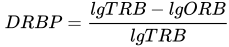
With
- tm, the prefix, indicating of team rather than of player;
- lg, the prefix, indicating of league rather than of player;
- min for number of minutes played;
- 3P for number of three-point field goals made;
- FG for number of field goals made;
- FT for number of free throws made;
- VOP for value of possession (but in reference to the league, in this instance);
- RB for number of rebounds: ORB for offensive, DRB for defensive, TRB for (total) combined, RBP for percentage of offensive or defensive;
- others being outlined in basketball statistics.
Once uPER is calculated, it must be adjusted for team pace and normalized to the league to become PER:

This final step takes away the advantage held by players whose teams play a fastbreak style (and therefore have more possessions and more opportunities to do things on offense), and then sets the league average to 15.00. Also note that it is impossible to calculate PER (at least in the conventional manner described above) for NBA seasons prior to 1978, as the league did not keep track of turnovers among other advanced statistics before that year.
See also
[edit]Notes
[edit]- ^ American Basketball Association (ABA) teams other than those admitted into the NBA in 1976 are not included; each year is linked to an article about that particular NBA season.
References
[edit]- ^ "Basketball Reference - PER". Basketball Reference. Retrieved September 5, 2013.
- ^ "Hardwood Paroxysm". Archived from the original on September 10, 2017. Retrieved April 16, 2017.
- ^ "Joel Embiid Stats, Height, Weight, Position, Draft Status and more". Basketball-Reference.com. Retrieved January 18, 2025.
- ^ "NBA & ABA Single Season Leaders and Records for Player Efficiency Rating".
- ^ "NBA & ABA Career Leaders and Records for Player Efficiency Rating". Basketball-Reference.com. Retrieved April 16, 2023.
- ^ ESPN.com - "2012-13 Hollinger NBA Player Statistics - All Players" - Retrieved October 6, 2013.
- ^ Basketball Reference, "LeBron James". Retrieved October 6, 2013.
- ^ Basketball Reference, "Michael Jordan" - Retrieved October 6, 2013.
- ^ NBA.com - "Jordan proclaims he could beat LeBron in prime". Retrieved October 6, 2013.
- ^ Busfield, Steve. The Guardian, Michael Jordan vs LeBron James: who is better?" Retrieved October 6, 2013.
- ^ Helin, Kurt. NBCsports.com "LeBron says he wants to be greatest of all time, still "far away from it". Retrieved October 6, 2013.
- ^ Lariviere, David. Forbes, "LeBron James Will Eventually Top Michael Jordan As Basketball's Greatest Player". Retrieved October 6, 2013.
- ^ Golliver, Ben. Sports Illustrated, "Spoelstra: Comparing LeBron to Jordan is impossible because 'game is different now' Archived 11 October 2013 at the Wayback Machine" - Retrieved October 6, 2013.
- ^ NBA.com - NBA Rules History. Retrieved October 6, 2013.
- ^ Aldridge, David (April 22, 2009). "Rules changes have affected defensive philosophies". NBA.com. Archived from the original on May 5, 2009. Retrieved February 19, 2024.
External links
[edit]- CREZ Basketball Systems Inc., Software to score your own basketball games and view PER player and lineup statistics
- An in-depth description of how to calculate PER
- Hollinger's articles at SI
- Basketball-Reference.com, Historical NBA statistical site (includes PER)
- KnickerBlogger.net
- ESPN.com Insider (subscription service)
| Basic | |
|---|---|
| Field goal & free throw | |
| Doubles | |
| Advanced statistics | |

Player efficiency rating
View on GrokipediaHistory and Development
Origins in Basketball Analytics
The emergence of advanced basketball analytics in the post-1970s era marked a shift from rudimentary box-score statistics—such as points, rebounds, and assists, which had been recorded since the NBA's inception—to more nuanced evaluations that accounted for game context and efficiency.[3] In the 1980s, independent analyst Robert Bellotti laid foundational work through his 1988 book Basketball's Hidden Game, introducing the "Points Created" model as a linear estimate of a player's offensive contribution based on possessions and scoring efficiency, alongside early concepts of plus/minus data to assess lineup impacts and precursors to adjusted plus/minus by quantifying player value beyond individual stats.[4][5] Bellotti's innovations emphasized box-score defense and possession value, challenging the overreliance on raw totals and influencing subsequent quantitative approaches.[6] The 1990s saw further maturation, driven by enthusiasts and early professionals who sought to normalize statistics for pace and team context. Dean Oliver, often regarded as a pioneer in the field, developed key metrics like offensive rating (points scored per 100 possessions) and defensive rating (points allowed per 100 possessions) during this decade, formalizing them in his 2004 book Basketball on Paper but building on debates from the prior years.[7][8] These efficiency measures addressed the variability in game tempo, providing a pace-adjusted lens for comparing player and team performance across eras, and represented a conceptual leap toward holistic evaluation.[9] The early 2000s amplified these developments through the internet's role in democratizing data access and enabling collaborative analysis. Previously limited by proprietary league records, analysts gained tools to scrape and share detailed play-by-play data, fostering sites that computed advanced stats like effective field goal percentage.[10] Fan-driven forums, particularly the APBRmetrics message board—originating as a Yahoo group led by Dean Oliver around 2000 and formalized in 2004 by Kevin Pelton under the Association for Professional Basketball Research—served as a crucible for innovation, where contributors refined per-possession metrics and true shooting percentage, bridging amateur inquiry with NBA front-office adoption.[11] This online ecosystem highlighted unmet needs in player assessment, setting the stage for synthesized efficiency ratings.Creation by John Hollinger
John Hollinger, a prominent basketball journalist and analyst who founded the sabermetrics-focused website Alleyoop in 1996, developed the Player Efficiency Rating (PER) as a comprehensive measure of individual player performance.[12] His background in advanced analytics, influenced by the growing interest in basketball statistics during the late 1990s and early 2000s, led him to create PER to address limitations in traditional box-score metrics. Hollinger first introduced PER in the inaugural edition of his annual publication, Pro Basketball Prospectus 2002, where he outlined its foundational formulas to evaluate players' contributions beyond basic scoring and rebounding.[1][2] Following its debut, Hollinger refined PER through subsequent editions of Pro Basketball Prospectus from 2003 to 2005, incorporating adjustments based on evolving league data and feedback to better capture per-minute efficiency across varying team paces.[13] In 2005, Hollinger joined ESPN as a columnist, which facilitated PER's broader integration into mainstream basketball analysis and its adoption by the network for evaluating player productivity.[13] The metric's initial intent was to produce a single, pace-adjusted statistic that summarized both offensive and defensive contributions using readily available box-score data, without relying on detailed play-by-play information, thereby making it accessible for journalists, scouts, and fans.[1][2] Early adoption milestones included ESPN's incorporation of PER into its official statistics database by the 2006 season, allowing for standardized rankings and comparisons across the league.[14] This expansion marked PER's transition from a niche analytical tool to a widely referenced benchmark, with Hollinger continuing to oversee its application in ESPN's coverage. In 2011, he publicly released the detailed formula in an ESPN article, further democratizing the metric and enabling independent verification and use by the analytics community.[1]Conceptual Foundations
Purpose and Objectives
The Player Efficiency Rating (PER) serves as a holistic performance metric intended to deliver a single, per-minute productivity rating that captures a player's comprehensive contributions across offense, defense, and rebounding, while accounting for variations in team pace and individual minutes played.[2][1] Developed by analyst John Hollinger, this approach aims to quantify a player's overall impact on the game by aggregating positive statistical outputs—such as points, assists, rebounds, steals, and blocks—and deducting negative ones, including turnovers, missed shots, and fouls, to yield a net measure of efficiency.[15] By focusing on per-minute production, PER enables fair comparisons among players regardless of their role or playing time, emphasizing sustainable value over volume-based stats.[2] Central to PER's design are principles that address basketball's inherent dynamics, including adjustments to neutralize era-specific and team-contextual effects through pace normalization, recognition of the sport as a zero-sum endeavor where every point scored represents a point conceded, and consistent scaling to maintain a league-wide average of 15.00 across seasons.[2][14] These elements ensure the metric remains comparable over time and across franchises, treating defensive contributions equivalently to offensive ones by valuing possessions used and outcomes in terms of net points added or lost.[15] This framework prioritizes a balanced evaluation, avoiding biases from high-volume but inefficient playstyles.[2] One primary advantage of PER over conventional statistics like points per game or rebounds per game lies in its integration of diverse box-score components into a unified score, which mitigates the selective emphasis on isolated, favorable metrics that often skew perceptions of player value.[15] Traditional stats may highlight scoring prowess while overlooking defensive lapses or inefficient shooting, but PER provides a more nuanced, all-encompassing assessment that better reflects a player's total productivity.[2] This consolidation facilitates quicker, more informed evaluations without the need for multiple disparate figures.[1] PER targets analysts, scouts, and fans interested in an accessible efficiency overview derived solely from standard box-score data, bypassing the complexities of advanced tracking technologies like player movement or shot location analytics.[2] It offers a practical tool for rapid player comparisons in scouting reports, fantasy basketball, or casual discussions, emphasizing tangible, game-level impacts over specialized metrics.[1]Influences from Sabermetrics
Sabermetrics, coined by Bill James in 1982 as a contraction of the Society for American Baseball Research (SABR), emerged in the 1980s as an analytical framework focused on deriving objective knowledge about baseball through empirical, statistical methods that adjust for context—such as park effects and era differences—rather than relying solely on raw performance totals like batting average or home runs.[16] This approach sought to isolate a player's true contribution to team success by quantifying the marginal value of individual actions in generating runs.[16] The methodology of Player Efficiency Rating (PER), developed by John Hollinger, directly parallels sabermetric techniques through its application of linear weights, which assign run-equivalent values to discrete player actions based on their estimated impact on scoring production, much like the linear approximations to run creation in baseball analytics.[17] Hollinger's design was influenced by James' seminal Runs Created estimator, introduced in 1971 and refined in subsequent Baseball Abstracts, which modeled offensive output as a function of opportunities and production to transcend simplistic box-score stats.[18] Similarly, PER echoes the sabermetric embrace of composite metrics like on-base plus slugging (OPS), a context-adjusted blend of reaching base and extra-base power that gained prominence in the 1990s for its superior predictive power over isolated traditional stats.[19] Key adaptations in PER involved recontextualizing baseball's per-plate-appearance evaluations to basketball's per-possession framework, enabling pace-adjusted assessments of efficiency amid varying game tempos, akin to how sabermetrics normalized stats for ballpark dimensions.[20] Defensive contributions in PER, such as blocks and steals weighted for their disruption value, draw parallels to fielding-independent pitching (FIP) in sabermetrics, which isolates pitcher-controlled events to mitigate defensive variability behind the plate. Hollinger explicitly acknowledged these sabermetric roots in his early explanations of PER, referencing foundational texts like James' works and framing the metric as an attempt to devise a "batting average for basketball efficiency"—a single, normalized summary statistic to encapsulate multifaceted player impact beyond raw scoring totals.[6] This philosophical alignment positioned PER as a practical extension of the Bill James revolution into basketball analytics.[11]Calculation Method
Core Formula
The Player Efficiency Rating (PER) is derived from an unassisted production metric known as uPER, which captures a player's contributions per minute played before league-wide adjustments. The core formula for uPER, as implemented in standard basketball analytics, is given by: where the variables are defined as follows: MP is minutes played; 3P is three-point field goals made; AST is assists; FG is field goals made; FT is free throws made; TOV is turnovers; FGA is field goal attempts; FTA is free throw attempts; TRB is total rebounds; ORB is offensive rebounds; STL is steals; BLK is blocks; PF is personal fouls; team_AST and team_FG are the player's team totals for assists and field goals, respectively; VOP (value of possession) is the league's turnover-adjusted efficiency, calculated as ; DRB% is the defensive rebound percentage, ; factor is ; and lg_ denotes league totals (e.g., lg_PTS is total league points).[2] This uPER formula weights a player's individual statistics to approximate their offensive and defensive impact, with derivations rooted in valuing possessions and adjusting for team context to isolate personal efficiency. Positive terms emphasize scoring efficiency and playmaking: three-point field goals (3P) contribute directly at full value; field goals (FG) are scaled by a factor that credits unassisted makes more heavily (using team assist rates to estimate assist likelihood); free throws (FT) are adjusted for assist credit and dead-ball opportunities; assists (AST) add two-thirds of a possession's value; rebounds (TRB, ORB) are valued based on their role in possession recovery, with offensive rebounds (ORB) weighted higher via VOP multipliers; steals (STL) and blocks (BLK) add VOP-equivalent value, prorated by defensive rebound percentage to reflect transition opportunities.[2] Negative terms penalize inefficiencies and errors to reflect resource waste: turnovers (TOV) subtract full VOP; missed field goals (FGA - FG) and free throws (FTA - FT) deduct possession value, with misses weighted by defensive rebound percentage (DRB%) to account for second-chance avoidance and using a 44% assumed recovery rate for free-throw rebounds; personal fouls (PF) subtract a value derived from league free-throw-to-foul ratios, approximating fouls' impact on opponent possessions. The overall structure derives from Hollinger's intent to sum net contributions per minute, using VOP as a baseline for possession worth to normalize across eras.[2] The final PER scales uPER first by pace (team possessions relative to league average) to yield adjusted PER (aPER), then normalizes so the league average equals 15.00, using the league's weighted average aPER: . This step ensures comparability but builds directly on the uPER core.[2]Adjustments and Normalization
After the unadjusted player efficiency rating (uPER) is computed from box-score statistics, several post-processing steps ensure comparability across players, teams, and seasons. The first adjustment accounts for differences in game pace, which varies by team and era. Pace is defined as the number of possessions per 48-minute game, and the adjustment factor is calculated as the league-average pace divided by the team's pace (lg_Pace / tm_Pace). This multiplier is applied to uPER to yield the adjusted PER (aPER), normalizing for whether a player competes on a fast-paced team (where more possessions inflate raw stats) or a slow-paced one (where fewer opportunities suppress them). For seasons prior to 1973-74, when possessions were not directly tracked, pace is estimated using points per game: 2 × lg_PPG / (tm_PPG + opp_PPG).[2] To enable computation for seasons before 1979-80 with missing statistics, additional adjustments are applied: three-point field goals made (3P), turnovers (TOV), blocks (BLK), and steals (STL) are set to zero; VOP is set to 1; DRB% is set to 0.7; and ORB is estimated as 0.3 × TRB. These imputations allow PER extension back to the 1951-52 season while acknowledging data limitations.[2] League normalization follows to standardize the scale across seasons, ensuring the metric reflects relative performance consistently. The league-average aPER (lg_aPER) is computed as a minutes-weighted average for all qualified players (typically those with at least 500 minutes). The final PER is then aPER multiplied by (15 / lg_aPER), setting the league average to exactly 15.00 every year regardless of scoring environment or rule changes. This step incorporates a replacement-level factor implicitly, as the scaling aligns the distribution around an average that accounts for typical bench-player performance (around 2.0 below average). The constant 15 was chosen by Hollinger to provide an intuitive benchmark, with elite players exceeding 25 and sub-replacement ones below 10.[2][1] Although PER is inherently a per-48-minute rate (reflecting a full game's productivity), it integrates with total-production metrics by scaling with actual minutes played (MP). For instance, Hollinger's Value Over Replacement Player (VORP) derives directly from PER by subtracting a replacement baseline (approximately PER - 2.0) and multiplying by the proportion of team minutes played, yielding wins contributed above a replacement-level substitute. This links per-minute efficiency to cumulative impact, emphasizing players who sustain high PER over substantial playing time. Partial seasons are handled by pro-rating based on MP, but validity requires thresholds to avoid noise from limited samples. Edge cases, such as minimum playing time thresholds, ensure statistical reliability. For single-season rankings, Hollinger applies a 500-minute qualifier to focus on meaningful contributions. Career analyses often impose higher bars, such as 15,000 total minutes, to filter out short-career outliers and enable robust cross-era comparisons; this equates to roughly 10 full seasons at 30 minutes per game. Players below these thresholds may show inflated or volatile PER due to small sample sizes, particularly in injury-shortened or rookie seasons.[1]Interpretation and Benchmarks
League Standards and Scaling
The Player Efficiency Rating (PER) is designed such that the league average is always 15.00, achieved through a final normalization step that scales all players' raw efficiency values relative to the league-wide average for that season.[2] This ensures consistent interpretability across seasons, with PER values calculated and normalized using play-by-play data available since the 1973-74 NBA season.[2] To interpret PER values, standard benchmarks provide context for player performance levels: a PER below 10 indicates poor or replacement-level production, suitable only for fringe roster players; 15 represents league average; scores above 20 denote All-Star caliber efficiency; and 25 or higher signify MVP-level dominance.[22] These thresholds reflect the metric's per-minute focus, where the typical standard deviation across players (weighted by minutes played) hovers around 4 to 5, allowing roughly two-thirds of qualified players to fall between 10 and 20.[23] While PER incorporates pace adjustments to account for varying game tempos, values tend to be slightly higher in high-pace eras like the 1990s compared to slower periods such as the 2010s, though these built-in normalizations largely mitigate era-specific distortions for cross-season comparisons.[2] For instance, the top 10% of players by minutes played typically achieve PERs of 18 or above, with rare seasons exceeding 30 marking exceptional individual dominance.[1]Single-Season Records
The highest single-season Player Efficiency Rating (PER) in NBA history belongs to Nikola Jokić of the Denver Nuggets, who achieved 32.85 during the 2021-22 season while leading his team to the playoffs with exceptional all-around production.[24] This mark edges out his own 32.1 from the 2024-25 season. Wilt Chamberlain's 31.82 from the 1961-62 season with the San Francisco Warriors ranks third, a year in which Chamberlain dominated with record-setting scoring and rebounding volumes.[24] Michael Jordan's 31.71 PER in 1987-88 for the Chicago Bulls ranks fourth, reflecting his explosive offensive efficiency during a season where he averaged 35.0 points per game.[24] The top 10 single-season PER values, qualified by a minimum of 300 minutes played per season, highlight a concentration of dominance by a few transcendent players across decades. These peaks often correlate strongly with Most Valuable Player (MVP) awards, as eight of the top 10 recipients also won league MVP that year, driven by factors such as high usage rates and contributions to team efficiency.[25] For context, the league average PER hovers around 15.00, making these outliers indicative of seasons where players elevated their teams' overall performance. As of the end of the 2024-25 season, the top 10 are:| Rank | Player | Season | Team | PER |
|---|---|---|---|---|
| 1 | Nikola Jokić | 2021-22 | DEN | 32.85 |
| 2 | Nikola Jokić | 2024-25 | DEN | 32.10 |
| 3 | Giannis Antetokounmpo | 2019-20 | MIL | 31.86 |
| 4 | Wilt Chamberlain | 1961-62 | SFW | 31.82 |
| 5 | Michael Jordan | 1987-88 | CHI | 31.71 |
| 6 | LeBron James | 2008-09 | CLE | 31.67 |
| 7 | Michael Jordan | 1990-91 | CHI | 31.63 |
| 8 | LeBron James | 2012-13 | MIA | 31.59 |
| 9 | Wilt Chamberlain | 1962-63 | SFW | 31.55 |
| 10 | Nikola Jokić | 2023-24 | DEN | 31.39 |
Career and Historical Analysis
All-Time Leaders
The all-time leaders in Player Efficiency Rating (PER) are determined by aggregating career totals for players who have accumulated at least 15,000 minutes played in NBA or ABA regular-season games, ensuring statistical reliability and excluding partial or short careers. This ranking combines data from the 1946-47 season onward, though PER calculations are considered most reliable starting from the 1973-74 season due to improved tracking of advanced statistics. As of November 2025, the following table lists the top 20 career PER leaders, based on computations from Basketball-Reference.[27]| Rank | Player | PER | Years |
|---|---|---|---|
| 1 | Nikola Jokić | 28.70 | 2015–present |
| 2 | Michael Jordan* | 27.91 | 1984–2003 |
| 3 | LeBron James | 26.88 | 2003–present |
| 4 | Anthony Davis | 26.78 | 2012–present |
| 5 | Shaquille O'Neal* | 26.43 | 1992–2011 |
| 6 | David Robinson* | 26.18 | 1989–2003 |
| 7 | Wilt Chamberlain* | 26.16 | 1959–1973 |
| 8 | Giannis Antetokounmpo | 25.95 | 2013–present |
| 9 | Luka Dončić | 25.64 | 2018–present |
| 10 | Bob Pettit* | 25.45 | 1954–1965 |
| 11 | Neil Johnston* | 24.86 | 1951–1959 |
| 12 | Kevin Durant | 24.74 | 2007–present |
| 13 | Charles Barkley* | 24.63 | 1984–2000 |
| 14 | Kareem Abdul-Jabbar* | 24.58 | 1969–1989 |
| 15 | Tim Duncan* | 24.22 | 1997–2016 |
| 16 | Magic Johnson* | 24.11 | 1979–1996 |
| 17 | Karl Malone* | 23.90 | 1985–2004 |
| 18 | Shai Gilgeous-Alexander | 23.75 | 2018–present |
| 19 | Karl-Anthony Towns | 23.73 | 2015–present |
| 20 | James Harden | 23.68 | 2009–present |
Cross-Era Comparisons
Comparing players across NBA eras using Player Efficiency Rating (PER) provides insights into efficiency shifts influenced by pace, style, and rules, though the metric's normalizations aim for comparability while facing limitations from unadjusted factors. In the 1960s and 1970s, slower paces and dominant interior play led to elevated single-season PERs for centers, exemplified by Wilt Chamberlain's peaks exceeding 30, such as 31.8 in 1962-63 and 31.6 in 1963-64, reflecting his rebounding and scoring volume in a low-possession era.[28] By contrast, the 1980s and 1990s saw guards and wings rise with faster transitions and physical defense, highlighted by Michael Jordan's seasonal highs around 31, including 31.18 in 1989-90, underscoring his all-around impact amid hand-checking allowances.[24] The 2000s through 2020s exhibit more balanced PER distributions, with versatile forwards and centers like LeBron James and Nikola Jokić achieving sustained highs in a pace-up era favoring spacing and skill. James posted a 31.7 PER in 2008-09, while Jokić's career mark reached 28.70 by 2025, surpassing Jordan's 27.91 through multifaceted play in high-volume offenses.[27] PER incorporates pace adjustments by scaling to team and league possessions, estimating pre-1974 data via points per game, and normalizing to a 15.00 league average annually, enabling broad temporal rankings.[2] However, it overlooks rule evolutions like the 2004-05 hand-checking ban, which boosted perimeter scoring by curbing physical contact beyond the free-throw line, and the 3-point shot's proliferation since its 1979 introduction, now comprising over 40% of attempts and inflating efficiencies without era-specific tweaks.[29] Case studies illustrate these dynamics: Jordan's 27.91 career PER edges LeBron's 26.88, both thriving in physical, mid-range heavy eras from the 1980s to 2010s, where Jordan's peaks aligned with defensive allowances like hand-checking that James navigated post-ban.[27] Jokić's ascent to the all-time lead by 2025, driven by playmaking and shooting in a 3-point-centric game, highlights how modern versatility elevates PER beyond traditional scorers. Generational patterns show big men dominating pre-1980s leaderboards via rebounding edges in compact games—Wilt's 26.16 career PER tops early lists—while post-2000s favor guards and wings like Jokić and James, reflecting efficiency gains from spacing and reduced physicality.[27]Applications in Analysis
Media and Scouting Usage
In media coverage of the NBA, the Player Efficiency Rating (PER) has been prominently featured since 2005 on ESPN's Hollinger stats page, where it ranks players based on per-minute production and supports analytical breakdowns of team and individual performance.[14] Developed by ESPN columnist John Hollinger, PER provides a concise summary of a player's statistical contributions, making it a go-to metric in articles and broadcasts for quick evaluations of efficiency, such as comparing high-usage stars to role players.[1] NBA teams incorporate PER into scouting processes, particularly for draft evaluations, where it helps project college players' efficiency and impact in professional settings by integrating pre-draft data with NBA benchmarks. In trade assessments, front offices often pair PER with Value Over Replacement Player (VORP)—a metric directly derived from PER—to quantify a player's overall contribution relative to alternatives, facilitating decisions on roster moves.[2] Within fantasy basketball and betting contexts, PER functions as a reliable indicator of per-minute value, guiding selections in daily and season-long leagues by highlighting efficient producers; for instance, a PER exceeding 20 signals starter-level output, while the league average of 15 denotes solid rotation players.[30][1] Historically, PER has shaped discussions around major awards, notably influencing 2010s MVP debates; in 2011, Derrick Rose secured the honor with a PER of 23.5, leading the Chicago Bulls to the league's best record, despite LeBron James posting the NBA-high 27.3.[31][32] This example underscores PER's role in award predictions, where it contextualizes efficiency alongside team success.[33]Integration with Modern Statistics
Since the introduction of player tracking data in the NBA around 2013 via Second Spectrum's optical tracking system, PER has served as a foundational box-score efficiency metric compatible with advanced analytics ecosystems, often used as a baseline to contextualize hustle statistics like deflections, contested shots, and loose balls recovered that are derived from tracking data.[34][35] PER is frequently combined with adjusted plus-minus variants such as Regularized Adjusted Plus-Minus (RAPM) and LEBRON to enhance defensive evaluation, where PER's box-score-based estimates are supplemented by these play-by-play impact metrics to capture unquantifiable contributions like screen assistance and positioning.[36][37] On platforms like Basketball-Reference, Value Over Replacement Player (VORP)—a metric rooted in box-score efficiency akin to PER—is integrated into win-share models to quantify a player's cumulative contribution to team victories beyond per-minute production.[38][39] The core PER formula, developed by John Hollinger, has seen no substantive changes since its 2002 inception.[14][40] In the 2020s, PER has found new applications in load management analysis, where research indicates no significant impact on PER from scheduled rest but highlights potential long-term benefits in injury prevention.[41][42] As of 2025, amid the proliferation of holistic AI-driven models that incorporate video analysis and predictive algorithms for talent evaluation, PER retains a supplementary role in scouting by providing a standardized efficiency benchmark within broader data pipelines, though it is increasingly augmented by machine learning enhancements to address its limitations in contextual play.[43][44]Criticisms and Limitations
Methodological Shortcomings
One notable methodological shortcoming of the Player Efficiency Rating (PER) is its limited ability to capture defensive contributions beyond basic counting statistics. PER primarily relies on steals and blocks to quantify defense, which Hollinger himself acknowledges can distort evaluations of players who excel in other defensive aspects, such as on-ball denial or help positioning without generating those stats. For instance, defensive specialists like Quinton Ross or Jason Collins often receive undervalued ratings because their impact—through contesting shots or disrupting plays without steals or blocks—is not adequately reflected in the formula. This overemphasis on countable defensive actions favors rim protectors and thieves over perimeter defenders or team-oriented stoppers, leading to an incomplete picture of a player's overall defensive value.[1][45] Another flaw lies in PER's treatment of pace, role, and usage, which can underpenalize inefficient high-volume scorers while ignoring contextual lineup effects. Although PER adjusts for league pace to normalize per-minute productivity, it does not sufficiently account for individual role biases, allowing players who take a disproportionate share of shots—regardless of efficiency—to inflate their ratings through sheer volume. Economist David Berri critiques this as a failure to properly penalize poor shooting, noting that "a player can be an inefficient scorer and simply inflate his value by taking a large number of shots," which rewards usage over team-oriented efficiency. Furthermore, by treating all minutes equally, PER overlooks how a player's performance varies with lineup combinations, such as playing alongside elite shooters or against weak defenses, potentially overrating stars in high-usage roles on fast-paced teams.[1][46][47] Additional issues include the absence of adjustments for garbage time, opponent strength, and the unidimensional nature of its output, which can mask diverse skill sets. PER calculations use unfiltered box-score data without excluding garbage-time possessions—periods in lopsided games where substitutes play and stats become less representative—leading to inflated ratings for bench players in blowouts. It also lacks opponent-strength adjustments, meaning performances against weaker teams are not downweighted relative to elite competition, unlike metrics such as adjusted plus-minus. Berri further argues that PER's weights for actions like assists are arbitrarily set to align with preconceived player rankings rather than derived from win production, potentially penalizing playmakers whose assists occur in high-assist-rate systems by undervaluing their facilitation relative to scorers. This single-number summary obscures skill diversity, such as a point guard's playmaking versus a scorer's finishing, reducing PER to an oversimplified metric that prioritizes offensive volume over holistic impact. Empirical analyses, including Berri's regressions, show PER correlates more with public perceptions of star power than with actual team wins or points scored, highlighting its limited predictive validity for outcomes like playoff success compared to context-aware alternatives.[2][48][45][46][47]Alternatives to PER
Several advanced metrics have emerged as alternatives to the Player Efficiency Rating (PER), particularly those that better account for defensive contributions and overall team impact using more comprehensive data sources. These include Box Plus-Minus (BPM), Win Shares, and Real Plus-Minus (RPM), which aim to provide a more holistic evaluation of player value by incorporating lineup effects and play-by-play information, addressing PER's reliance on box-score statistics that undervalue defense.[38][39][49] Box Plus-Minus (BPM) estimates a player's contribution to team scoring margin per 100 possessions using regression analysis on box-score data, position adjustments, and team performance differentials. Developed by the creators of Basketball-Reference.com, BPM separates offensive and defensive components (OBPM and DBPM) to offer a plus/minus-style rating without requiring play-by-play data, making it more accessible than PER while providing better estimates of net impact through statistical modeling of teammates and opponents.[38] In comparisons, BPM often correlates more strongly with team success than PER, especially for defensive specialists, as it adjusts for the quality of supporting players in lineups.[50] Win Shares, introduced by Justin Kubatko and based on principles from Dean Oliver's 2004 book Basketball on Paper, quantifies a player's total contribution to team wins by allocating shares of a team's success using offensive and defensive efficiency metrics derived from box scores. This metric emphasizes win production over per-minute efficiency, crediting players for points produced, marginal possessions, and defensive rating adjustments, which provides a cumulative value assessment that PER lacks by focusing on rate statistics alone.[39][51] Unlike PER, Win Shares better handles role players and low-usage defenders by tying contributions directly to team outcomes, though it still relies on traditional box-score inputs.[52] Real Plus-Minus (RPM), developed by statistician Jeremias Engelmann in consultation with Steve Ilardi and introduced in 2014, refines the plus/minus concept by using ridge regression on play-by-play lineup data to isolate individual impact on scoring margin per 100 possessions, incorporating adjustments for teammates, opponents, and game context. RPM's offensive (ORPM) and defensive (DRPM) variants outperform PER in predictive accuracy for team performance, particularly in valuing on-ball defense and switching, due to its direct use of actual on-court/off-court differentials rather than inferred efficiencies.[49][52] For shooting efficiency specifically, True Shooting Percentage (TS%) serves as a targeted alternative to PER's bundled approach, measuring points scored per shooting attempt while accounting for field goals, three-pointers, and free throws via the formula PTS / (2 × (FGA + 0.44 × FTA)). This isolates scoring efficiency without incorporating rebounds, assists, or turnovers, allowing analysts to evaluate pure marksmanship independently of other skills that PER weights subjectively.[53] TS% highlights players like Stephen Curry, whose high volume from beyond the arc boosts their rating beyond what PER's adjustments might suggest.[54] In modern NBA front offices during the 2020s, PER remains an introductory tool for quick player assessments, but it has been largely supplanted by tracking-era metrics like BPM, RPM, and their derivatives, which leverage player location and event data for superior granularity.[52] PER's foundational influence persists in hybrid systems, such as the RAPTOR metric, developed by FiveThirtyEight and launched in 2019, which combines box-score elements with machine learning on play-by-play data to produce a comprehensive impact score that builds on PER's efficiency framework while integrating advanced defensive tracking.[52][55]References
- https://www.[espn.com](/page/ESPN.com)/nba/columns/story?columnist=hollinger_john&id=2850240