



Community hub
Recent from talks
Contribute something to knowledge base
Content stats: 0 posts, 0 articles, 1 media, 0 notes
Members stats: 0 subscribers, 0 contributors, 0 moderators, 0 supporters
Subscribers
Supporters
Contributors
Moderators
Hub AI
Lewis structure AI simulator
(@Lewis structure_simulator)
Hub AI
Lewis structure AI simulator
(@Lewis structure_simulator)
Lewis structure
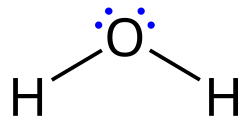
Lewis structures – also called Lewis dot formulas, Lewis dot structures, electron dot structures, or Lewis electron dot structures (LEDs) – are diagrams that show the bonding between atoms of a molecule, as well as the lone pairs of electrons that may exist in the molecule. Introduced by Gilbert N. Lewis in his 1916 article The Atom and the Molecule, a Lewis structure can be drawn for any covalently bonded molecule, as well as coordination compounds. Lewis structures extend the concept of the electron dot diagram by adding lines between atoms to represent shared pairs in a chemical bond.
Lewis structures show each atom and its position in the structure of the molecule using its chemical symbol. Lines are drawn between atoms that are bonded to one another (pairs of dots can be used instead of lines). Excess electrons that form lone pairs are represented as pairs of dots, and are placed next to the atoms.
Although main group elements of the second period and beyond usually react by gaining, losing, or sharing electrons until they have achieved a valence shell electron configuration with a full octet of (8) electrons, hydrogen instead obeys the duplet rule, forming one bond for a complete valence shell of two electrons.
For a neutral molecule, the total number of electrons represented in a Lewis structure is equal to the sum of the numbers of valence electrons on each individual atom, not the maximum possible. Non-valence electrons are not represented in Lewis structures as they do not bond.
Once the total number of valence electrons has been determined, they are placed into the structure according to these steps:
Lewis structures for polyatomic ions may be drawn by the same method. However when counting electrons, negative ions should have extra electrons placed in their Lewis structures; positive ions should have fewer electrons than an uncharged molecule. When the Lewis structure of an ion is written, the entire structure is placed in brackets, and the charge is written as a superscript on the upper right, outside the brackets.
A simpler method has been proposed for constructing Lewis structures, eliminating the need for electron counting: the atoms are drawn showing the valence electrons; bonds are then formed by pairing up valence electrons of the atoms involved in the bond-making process, and anions and cations are formed by adding or removing electrons to/from the appropriate atoms.
A trick is to count up valence electrons, then count up the number of electrons needed to complete the octet rule (or with hydrogen just 2 electrons), then take the difference of these two numbers. The answer is the number of electrons that make up the bonds. The rest of the electrons just go to fill all the other atoms' octets.
Lewis structure
Lewis structures – also called Lewis dot formulas, Lewis dot structures, electron dot structures, or Lewis electron dot structures (LEDs) – are diagrams that show the bonding between atoms of a molecule, as well as the lone pairs of electrons that may exist in the molecule. Introduced by Gilbert N. Lewis in his 1916 article The Atom and the Molecule, a Lewis structure can be drawn for any covalently bonded molecule, as well as coordination compounds. Lewis structures extend the concept of the electron dot diagram by adding lines between atoms to represent shared pairs in a chemical bond.
Lewis structures show each atom and its position in the structure of the molecule using its chemical symbol. Lines are drawn between atoms that are bonded to one another (pairs of dots can be used instead of lines). Excess electrons that form lone pairs are represented as pairs of dots, and are placed next to the atoms.
Although main group elements of the second period and beyond usually react by gaining, losing, or sharing electrons until they have achieved a valence shell electron configuration with a full octet of (8) electrons, hydrogen instead obeys the duplet rule, forming one bond for a complete valence shell of two electrons.
For a neutral molecule, the total number of electrons represented in a Lewis structure is equal to the sum of the numbers of valence electrons on each individual atom, not the maximum possible. Non-valence electrons are not represented in Lewis structures as they do not bond.
Once the total number of valence electrons has been determined, they are placed into the structure according to these steps:
Lewis structures for polyatomic ions may be drawn by the same method. However when counting electrons, negative ions should have extra electrons placed in their Lewis structures; positive ions should have fewer electrons than an uncharged molecule. When the Lewis structure of an ion is written, the entire structure is placed in brackets, and the charge is written as a superscript on the upper right, outside the brackets.
A simpler method has been proposed for constructing Lewis structures, eliminating the need for electron counting: the atoms are drawn showing the valence electrons; bonds are then formed by pairing up valence electrons of the atoms involved in the bond-making process, and anions and cations are formed by adding or removing electrons to/from the appropriate atoms.
A trick is to count up valence electrons, then count up the number of electrons needed to complete the octet rule (or with hydrogen just 2 electrons), then take the difference of these two numbers. The answer is the number of electrons that make up the bonds. The rest of the electrons just go to fill all the other atoms' octets.
Recent media
Recent media