



Community hub
Recent from talks
Knowledge base stats:
Talk channels stats:
Members stats:
Liège Revolution
The Liège Revolution, sometimes known as the Happy Revolution (French: Heureuse Révolution; Walloon: Binamêye revolucion), against the reigning prince-bishop of Liège, started on 18 August 1789 and lasted until the destruction of the Republic of Liège and re-establishment of the Prince-Bishopric of Liège by Austrian forces in 1791. The Liège Revolution was concurrent with the French Revolution and its effects were long-lasting and eventually led to the abolition of the Prince-Bishopric of Liège and its final annexation by French revolutionary forces in 1795.
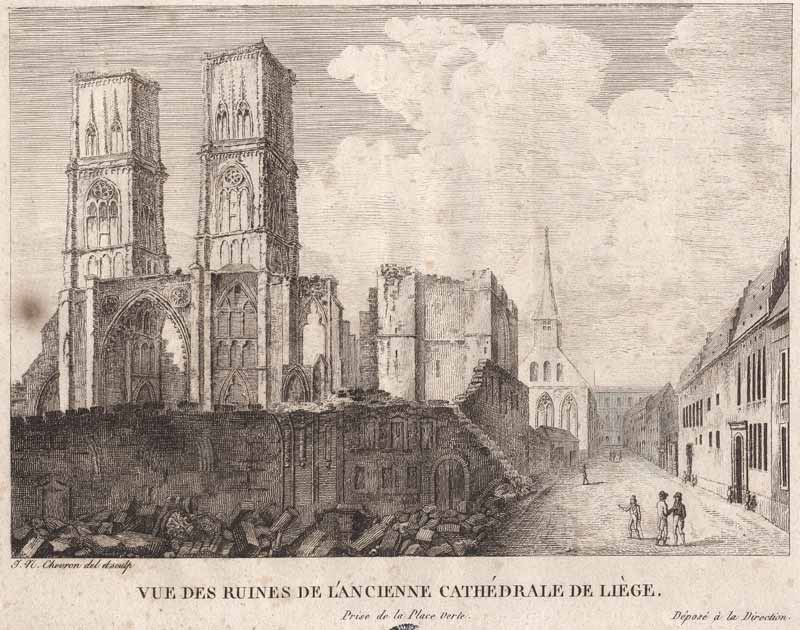
Since the Ruling of 1684 put in place by Maximilian Henry of Bavaria, in principle the prince-bishop of Liège had to govern the principality in agreement with the three estates – the first estate (upper clergy and canons of the cathédrale Saint-Lambert), the noble estate (15 families, intended to represent the whole countryside), and the third estate (representing the middle classes and artisans organised by 32 crafts).
The election of mayors and a council was made by the prince and the 32 crafts. These were split into 16 chambers, whose members were appointed for life, forming an electoral body. These chambers were made up of 20 nobles, patricians and 'rentiers', 10 notable merchants and 6 artisans. The commissioners of the craftsmen were themselves appointed by 28 commissioners, of whom 12 were appointed by the prince-bishop and 16 by the parishes. The third estate also included the representatives of the principality's 'bonnes villes', elected by 567 electors. Formed by the mayors of all these cities, they were almost completely obedient to the prince-bishop and the first estate and had completely lost the partial power they had from the 14th to 17th centuries. The lower clergy, minor nobility, industrial middle classes, workers and peasants had a limited part in public affairs, whilst the working classes' position was unenviable, with high poverty and unemployment causing rising support for political changes and social justice.
18th-century philosophers were far from unanimous in their opinion of the Principality of Liège. Some saw in the functioning of its state all the characteristics of a republic, while others saw the bishop's power as that of a tyrant. The chevalier de Jaucourt's account of Liège in the Encyclopédie states:
[Here there are] 32 artisans' colleges, who take some part in the government, and bear the ease of the city. [The Liège state shows itself] as a free republic, governed by mayors, by its senators and by other municipal magistrates. [Nevertheless] its number of churches, abbeys and monasteries considerably oppress it.
On the other side, Voltaire's criticism of Liège's government was sharp, writing in the Idée républicaines par un membre d’un corps, critique du Contrat social about Notker of Liège, the principality's founder:
It is an insult to reason and law to pronounce the words "civil and ecclesiastical government". When our bishop, made to serve not to be served, made to support the poor not devour their livelihood, made to catechise and not to dominate, ventures, in times of anarchy, is entitled the prince of the city of which he is not the pastor, he is manifestly culpable of rebellion and tyranny.
On his election as prince-bishop in 1772, the pro-Enlightenment François-Charles de Velbruck (1772–1784) became head of an ecclesiastical principality that had become particularly backward in its intellectual life and its scientific and literary studies. He showed himself favourable to philosophers and the new ideas of the era. He acted as an enlightened despot like his contemporaries Frederick II of Prussia, Catherine II of Russia and Joseph II, Holy Roman Emperor. Like them, he did not lack for ideas, giving his imprimatur to philosophical writers banned from publication in France such as the Journal encyclopédique , on the condition that one copy of each book be deposited in Liège library.
Hub AI
Liège Revolution AI simulator
(@Liège Revolution_simulator)
Liège Revolution
The Liège Revolution, sometimes known as the Happy Revolution (French: Heureuse Révolution; Walloon: Binamêye revolucion), against the reigning prince-bishop of Liège, started on 18 August 1789 and lasted until the destruction of the Republic of Liège and re-establishment of the Prince-Bishopric of Liège by Austrian forces in 1791. The Liège Revolution was concurrent with the French Revolution and its effects were long-lasting and eventually led to the abolition of the Prince-Bishopric of Liège and its final annexation by French revolutionary forces in 1795.
Since the Ruling of 1684 put in place by Maximilian Henry of Bavaria, in principle the prince-bishop of Liège had to govern the principality in agreement with the three estates – the first estate (upper clergy and canons of the cathédrale Saint-Lambert), the noble estate (15 families, intended to represent the whole countryside), and the third estate (representing the middle classes and artisans organised by 32 crafts).
The election of mayors and a council was made by the prince and the 32 crafts. These were split into 16 chambers, whose members were appointed for life, forming an electoral body. These chambers were made up of 20 nobles, patricians and 'rentiers', 10 notable merchants and 6 artisans. The commissioners of the craftsmen were themselves appointed by 28 commissioners, of whom 12 were appointed by the prince-bishop and 16 by the parishes. The third estate also included the representatives of the principality's 'bonnes villes', elected by 567 electors. Formed by the mayors of all these cities, they were almost completely obedient to the prince-bishop and the first estate and had completely lost the partial power they had from the 14th to 17th centuries. The lower clergy, minor nobility, industrial middle classes, workers and peasants had a limited part in public affairs, whilst the working classes' position was unenviable, with high poverty and unemployment causing rising support for political changes and social justice.
18th-century philosophers were far from unanimous in their opinion of the Principality of Liège. Some saw in the functioning of its state all the characteristics of a republic, while others saw the bishop's power as that of a tyrant. The chevalier de Jaucourt's account of Liège in the Encyclopédie states:
[Here there are] 32 artisans' colleges, who take some part in the government, and bear the ease of the city. [The Liège state shows itself] as a free republic, governed by mayors, by its senators and by other municipal magistrates. [Nevertheless] its number of churches, abbeys and monasteries considerably oppress it.
On the other side, Voltaire's criticism of Liège's government was sharp, writing in the Idée républicaines par un membre d’un corps, critique du Contrat social about Notker of Liège, the principality's founder:
It is an insult to reason and law to pronounce the words "civil and ecclesiastical government". When our bishop, made to serve not to be served, made to support the poor not devour their livelihood, made to catechise and not to dominate, ventures, in times of anarchy, is entitled the prince of the city of which he is not the pastor, he is manifestly culpable of rebellion and tyranny.
On his election as prince-bishop in 1772, the pro-Enlightenment François-Charles de Velbruck (1772–1784) became head of an ecclesiastical principality that had become particularly backward in its intellectual life and its scientific and literary studies. He showed himself favourable to philosophers and the new ideas of the era. He acted as an enlightened despot like his contemporaries Frederick II of Prussia, Catherine II of Russia and Joseph II, Holy Roman Emperor. Like them, he did not lack for ideas, giving his imprimatur to philosophical writers banned from publication in France such as the Journal encyclopédique , on the condition that one copy of each book be deposited in Liège library.