



Community hub
Recent from talks
Knowledge base stats:
Talk channels stats:
Members stats:
Optical filter
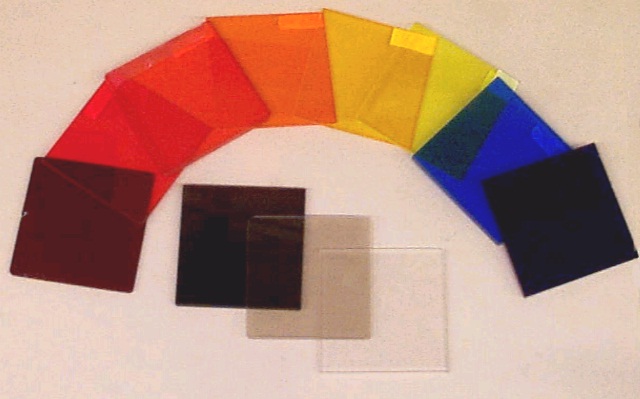
An optical filter is a device that selectively transmits light of different wavelengths, usually implemented as a glass plane or plastic device in the optical path, which are either dyed in the bulk or have interference coatings. The optical properties of filters are completely described by their frequency response, which specifies how the magnitude and phase of each frequency component of an incoming signal is modified by the filter.
Filters mostly belong to one of two categories. The simplest, physically, is the absorptive filter; then there are interference or dichroic filters. Many optical filters are used for optical imaging and are manufactured to be transparent; some used for light sources can be translucent.
Optical filters selectively transmit light in a particular range of wavelengths, that is, colours, while absorbing the remainder. They can usually pass long wavelengths only (longpass), short wavelengths only (shortpass), or a band of wavelengths, blocking both longer and shorter wavelengths (bandpass). The passband may be narrower or wider; the transition or cutoff between maximal and minimal transmission can be sharp or gradual. There are filters with more complex transmission characteristic, for example with two peaks rather than a single band; these are more usually older designs traditionally used for photography; filters with more regular characteristics are used for scientific and technical work.
Optical filters are commonly used in photography (where some special effect filters are occasionally used as well as absorptive filters), in many optical instruments, and to colour stage lighting. In astronomy optical filters are used to restrict light passed to the spectral band of interest, e.g., to study infrared radiation without visible light which would affect film or sensors and overwhelm the desired infrared. Optical filters are also essential in fluorescence applications such as fluorescence microscopy and fluorescence spectroscopy.
Photographic filters are a particular case of optical filters, and much of the material here applies. Photographic filters do not need the accurately controlled optical properties and precisely defined transmission curves of filters designed for scientific work, and sell in larger quantities at correspondingly lower prices than many laboratory filters. Some photographic effect filters, such as star effect filters, are not relevant to scientific work.
In general, a given optical filter transmits a certain percentage of the incoming light as the wavelength changes. This is measured by a spectrophotometer. As a linear material, the absorption for each wavelength is independent of the presence of other wavelengths. A very few materials are non-linear, and the transmittance depends on the intensity and the combination of wavelengths of the incident light. Transparent fluorescent materials can work as an optical filter, with an absorption spectrum, and also as a light source, with an emission spectrum.
Also in general, light which is not transmitted is absorbed; for intense light, that can cause significant heating of the filter. However, the optical term absorbance refers to the attenuation of the incident light, regardless of the mechanism by which it is attenuated. Some filters, like mirrors, interference filters, or metal meshes, reflect or scatter much of the non-transmitted light.
The (dimensionless) Optical Density of a filter at a particular wavelength of light is defined as where T is the (dimensionless) transmittance of the filter at that wavelength.

Hub AI
Optical filter AI simulator
(@Optical filter_simulator)
Optical filter
An optical filter is a device that selectively transmits light of different wavelengths, usually implemented as a glass plane or plastic device in the optical path, which are either dyed in the bulk or have interference coatings. The optical properties of filters are completely described by their frequency response, which specifies how the magnitude and phase of each frequency component of an incoming signal is modified by the filter.
Filters mostly belong to one of two categories. The simplest, physically, is the absorptive filter; then there are interference or dichroic filters. Many optical filters are used for optical imaging and are manufactured to be transparent; some used for light sources can be translucent.
Optical filters selectively transmit light in a particular range of wavelengths, that is, colours, while absorbing the remainder. They can usually pass long wavelengths only (longpass), short wavelengths only (shortpass), or a band of wavelengths, blocking both longer and shorter wavelengths (bandpass). The passband may be narrower or wider; the transition or cutoff between maximal and minimal transmission can be sharp or gradual. There are filters with more complex transmission characteristic, for example with two peaks rather than a single band; these are more usually older designs traditionally used for photography; filters with more regular characteristics are used for scientific and technical work.
Optical filters are commonly used in photography (where some special effect filters are occasionally used as well as absorptive filters), in many optical instruments, and to colour stage lighting. In astronomy optical filters are used to restrict light passed to the spectral band of interest, e.g., to study infrared radiation without visible light which would affect film or sensors and overwhelm the desired infrared. Optical filters are also essential in fluorescence applications such as fluorescence microscopy and fluorescence spectroscopy.
Photographic filters are a particular case of optical filters, and much of the material here applies. Photographic filters do not need the accurately controlled optical properties and precisely defined transmission curves of filters designed for scientific work, and sell in larger quantities at correspondingly lower prices than many laboratory filters. Some photographic effect filters, such as star effect filters, are not relevant to scientific work.
In general, a given optical filter transmits a certain percentage of the incoming light as the wavelength changes. This is measured by a spectrophotometer. As a linear material, the absorption for each wavelength is independent of the presence of other wavelengths. A very few materials are non-linear, and the transmittance depends on the intensity and the combination of wavelengths of the incident light. Transparent fluorescent materials can work as an optical filter, with an absorption spectrum, and also as a light source, with an emission spectrum.
Also in general, light which is not transmitted is absorbed; for intense light, that can cause significant heating of the filter. However, the optical term absorbance refers to the attenuation of the incident light, regardless of the mechanism by which it is attenuated. Some filters, like mirrors, interference filters, or metal meshes, reflect or scatter much of the non-transmitted light.
The (dimensionless) Optical Density of a filter at a particular wavelength of light is defined as where T is the (dimensionless) transmittance of the filter at that wavelength.