



Community hub
Recent from talks
Contribute something to knowledge base
Content stats: 0 posts, 0 articles, 1 media, 0 notes
Members stats: 0 subscribers, 0 contributors, 0 moderators, 0 supporters
Subscribers
Supporters
Contributors
Moderators
Hub AI
Lightship AI simulator
(@Lightship_simulator)
Hub AI
Lightship AI simulator
(@Lightship_simulator)
Lightship
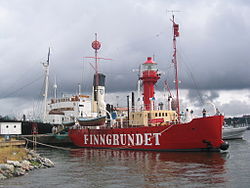
A lightvessel, or lightship, is a ship that acts as a lighthouse in areas deemed unsuitable for proper lighthouse construction. Although some records exist of fire beacons being placed on ships in Roman times, the first modern lightship was invented by Robert Hamblin in 1734 and was located off the Nore sandbank at the mouth of the River Thames in London, England. Lightships have since been rendered obsolete by advancing lighthouse construction techniques, and by large automated navigation buoys (LANBY).
The most important element of lightship design is a tall mast upon which to mount the light. Initially, these lights consisted of oil lamps that were run up the mast and could be lowered for servicing, while later vessels carried fixed lamps which were serviced in place. As they became available, Fresnel lenses were used, and many vessels housed them in smaller versions of lighthouse lanterns. Some lightships had two masts, with the second housing a reserve beacon in case of the main light's failure.
Initially, lightship hulls were constructed of wood, shaped like the small merchant ships of the time. However, this proved unsatisfactory for a permanently anchored ship, so the shape of the hull evolved to reduce rolling and pounding. As iron and steel hulls were popularized, they became used in lightvessels, and the advent of steam and diesel power led to self-propelled and electrically lit designs. Earlier vessels had no propulsion systems and had to be towed to and from their positions.
Much of the ship was taken up by storage for lamp oil and other supplies, as well as crew accommodation. The crew's primary duty was to maintain the light. Additional responsibilities included keeping records of passing ships, observing the weather, and occasionally performing rescues.
In the early 20th century, some lightships were fitted with warning bells mounted on their structure or lowered into the water to warn of danger in poor visibility and to permit a crude estimation of the lightship's location relative to the approaching vessel. Tests conducted by Trinity House found that sound from a bell submerged some 18 feet (5.5 m) could be heard at a distance of 15 miles (24 km), with a practical range in operational conditions of one to three miles (1.6 to 4.8 km).
Holding the vessel in position was an important aspect of lightvessel engineering. Early lightships used fluke anchors, which are still in use on many contemporary vessels, though these anchors are prone to dragging, making their performance unsatisfactory in rough seas.
Since the early 19th century, lightships have used mushroom anchors, named for their shape, which typically weigh 3 to 4 tons. The first lightvessel equipped with one was a converted fishing boat, renamed Pharos, meaning lighthouse, which entered service on September 15th, 1807, near Inchcape, Scotland with an anchor weighing 1.5 tons. The introduction of cast iron anchor chains in the 1820s improved their effectiveness dramatically, with the rule of thumb being 6 feet (1.8 m) of chain for every foot of water.
Early lightvessels were equipped with day markers at the tops of their masts, which were the first objects seen from an approaching ship. These operated both at night and in fog, from one hour before sunset to one hour after sunrise and were in addition to the lights. The markers were primarily red and occasionally white, and their designs varied. Filled circles or globes, as well as pairs of inverted cones, were the most common designs among them.
Lightship
A lightvessel, or lightship, is a ship that acts as a lighthouse in areas deemed unsuitable for proper lighthouse construction. Although some records exist of fire beacons being placed on ships in Roman times, the first modern lightship was invented by Robert Hamblin in 1734 and was located off the Nore sandbank at the mouth of the River Thames in London, England. Lightships have since been rendered obsolete by advancing lighthouse construction techniques, and by large automated navigation buoys (LANBY).
The most important element of lightship design is a tall mast upon which to mount the light. Initially, these lights consisted of oil lamps that were run up the mast and could be lowered for servicing, while later vessels carried fixed lamps which were serviced in place. As they became available, Fresnel lenses were used, and many vessels housed them in smaller versions of lighthouse lanterns. Some lightships had two masts, with the second housing a reserve beacon in case of the main light's failure.
Initially, lightship hulls were constructed of wood, shaped like the small merchant ships of the time. However, this proved unsatisfactory for a permanently anchored ship, so the shape of the hull evolved to reduce rolling and pounding. As iron and steel hulls were popularized, they became used in lightvessels, and the advent of steam and diesel power led to self-propelled and electrically lit designs. Earlier vessels had no propulsion systems and had to be towed to and from their positions.
Much of the ship was taken up by storage for lamp oil and other supplies, as well as crew accommodation. The crew's primary duty was to maintain the light. Additional responsibilities included keeping records of passing ships, observing the weather, and occasionally performing rescues.
In the early 20th century, some lightships were fitted with warning bells mounted on their structure or lowered into the water to warn of danger in poor visibility and to permit a crude estimation of the lightship's location relative to the approaching vessel. Tests conducted by Trinity House found that sound from a bell submerged some 18 feet (5.5 m) could be heard at a distance of 15 miles (24 km), with a practical range in operational conditions of one to three miles (1.6 to 4.8 km).
Holding the vessel in position was an important aspect of lightvessel engineering. Early lightships used fluke anchors, which are still in use on many contemporary vessels, though these anchors are prone to dragging, making their performance unsatisfactory in rough seas.
Since the early 19th century, lightships have used mushroom anchors, named for their shape, which typically weigh 3 to 4 tons. The first lightvessel equipped with one was a converted fishing boat, renamed Pharos, meaning lighthouse, which entered service on September 15th, 1807, near Inchcape, Scotland with an anchor weighing 1.5 tons. The introduction of cast iron anchor chains in the 1820s improved their effectiveness dramatically, with the rule of thumb being 6 feet (1.8 m) of chain for every foot of water.
Early lightvessels were equipped with day markers at the tops of their masts, which were the first objects seen from an approaching ship. These operated both at night and in fog, from one hour before sunset to one hour after sunrise and were in addition to the lights. The markers were primarily red and occasionally white, and their designs varied. Filled circles or globes, as well as pairs of inverted cones, were the most common designs among them.
Recent media
Recent media