Hubbry Logo
Trinity HouseTrinity HouseMain
Open search
Trinity House
Community hub
Trinity House
logo
8 pages, 0 posts
0 subscribers
Be the first to start a discussion here.
Trinity House
Trinity House
from Wikipedia

Trinity House[a], founded by Royal Charter in 1514, is the General lighthouse authority for England, Wales, the Channel Islands, and Gibraltar. It maintains navigational aids such as lightvessels and buoys, as well as communications services and pilotage for ships in the North Sea. These are financed by dues levied on commercial vessels calling at ports in the British Isles.

Key Information

In addition, Trinity operates a registered charity, which provides welfare services for retired seamen, education, and promoting safety at sea. Funding for this is generated separately.

History

[edit]

Trinity House was established as a result of a petition dated 19 March 1513 from a group of mariners based in Deptford, who wanted to regulate pilotage services on the River Thames. On 20 May 1514, Henry VIII granted a Royal Charter to "The Master, Wardens, and Assistants of the Guild, Fraternity, or Brotherhood of the most glorious and undivided Trinity, and of St Clement in the Parish of Deptford Strond in the County of Kent."[2]

Their general business was listed as "to improve the art and science of mariners; to examine into the qualifications, and regulate the conduct of those who take upon them the charge of conducting ships; to preserve good order, and (when desired) to compose differences in marine affairs, and, in general, to consult the conservation, good estate, wholesome government, maintenance and increase of navigation and sea-faring men; and to relieve decayed seamen and their relatives."[3]

The Sea Marks Act 1566 further authorised the Corporation to set up and maintain "beacons, marks, and signs for the sea" along the Thames, and in 1594 this was expanded to all public buoys in England.[4]

The John Sebastian, Trinity House L.V. No 55 (1886 built as a batch order of three, LV54, LV55 and LV59) in Bathurst Basin, Somerset

With the increasing number of ships lost along the Newcastle to London coal route, in 1609 Trinity House established the Lowestoft Lighthouse, a pair of wooden towers with candle illuminants. Until the late 18th century, candle, coal, or wood fires were used as lighthouse illuminants, improved in 1782 with the circular-wick oil-burning Argand lamp, the first ‘catoptric’ mirrored reflector in 1777, and Fresnel’s ‘dioptric’ lens system in 1823. The Nore lightship was established as the world's first floating light in 1732. In 1803, the corporation established the Blackwall Depot as a buoy workshop, and six district depots were later established at Harwich, Great Yarmouth, East Cowes, Penzance, Holyhead and Swansea.

Under the 1836 Lighthouses Act, Trinity became the sole governing body for all British lighthouses, and any remaining private owners bought out. By 1847, revenue collected from this source was £11,000 to £12,000 per year.[5]

A meeting at Trinity House c. 1808

During the First World War, the corporation served a number of functions: it buoyed shipping lanes and naval operations, moved lightvessels, and laid hundreds of buoys. During the Second World War, Trinity House kept sea lanes marked and lighted for Allied convoys. The Pilotage Service guided ships to their ports under hazardous conditions; at the time of the Dunkirk evacuation, a number of pilots helped in piloting vessels to and from the beaches.

On the night of 29 December 1940, Trinity House was destroyed by the most severe of the air attacks on London; the interiors were completely gutted and many archives and treasures were lost. (The restored building was reopened by Elizabeth II on 21 October 1953.)

In preparation for the D-Day landings on 6 June 1944, Trinity House laid 73 lighted buoys and two lightvessels to indicate a safe route for landing craft. Trinity House pilots were responsible for all commercial vessels involved and many of the service vessels. In the month following D-Day, nearly 3,000 vessels were handled by 88 river pilots and nearly 2,000 ships by 115 sea pilots working day and night.

By the 1960s, Trinity House licensed about 500 pilots, of whom about 350 were in the London District, handling an estimated 60% of the nation's piloted tonnage. The Pilotage Act 1987 authorised Trinity House to pass its District Pilotage responsibilities to various local harbour authorities, becoming instead a licensing authority for deep sea pilotage.

In 1969, Trinity House initiated the debut of helicopter reliefs to and from offshore lighthouses, succeeding the boat reliefs. These had been susceptible to being delayed by months during inclement weather. Trinity House played a major part in the design of the IALA Maritime Buoyage System, laying the first buoy off Dover, watched over by representatives of 16 nations on 15 April 1977.

The completion of the lighthouse automation programme came with a ceremony held at the North Foreland Lighthouse on 26 November 1998, attended by the last six keepers and master, Prince Philip, Duke of Edinburgh. On 9 June 1989, the last crewed lightvessel was towed from the Channel lightvessel station to Harwich.

In December 2002, Trinity House closed depots at Great Yarmouth, Penzance and East Cowes. Operations are currently run out of Harwich, with a support depot in Swansea and flight operations base at St Just in Penwith. It also has three support vessels, the tenders THV Patricia and THV Galatea, and Rapid Intervention Vessel THV Alert. A small headquarters staff remains at Tower Hill.

Richard Woodman served as elder brethren and member of the court from 2000 until his death in 2024.[6] In 2011, Anne, Princess Royal succeeded her father as Master.[7] She was aboard Trinity House Motor Boat No.1 during the Diamond Jubilee pageant.

In 2014, the Royal Mint issued a two pound coin commemorating the 500th anniversary of the grant of Trinity House's royal charter.[8]

From 2011 to 2024, Ian McNaught, a Merchant Navy Officer served as Deputy Master.[9] In 2024, he was succeeded as Deputy Master and Chief Executive by Rear-Admiral Iain Lower.[9]

Master of the Corporation

[edit]
Churchill in his Trinity House uniform at the Atlantic Conference

The honorary title of Master of the Corporation is currently held by Anne, Princess Royal. Previous Masters include Prince Philip, Duke of Edinburgh; Vice-Admiral Sir Thomas Spert, master of the warship Henry Grace à Dieu under Henry VIII; the diarist Samuel Pepys; William Pitt the Younger; Field Marshal the Duke of Wellington; and Admiral Sir William Penn (father of William Penn, founder of Pennsylvania).

Other prominent individuals in Britain, often connected with commercial shipping or the Admiralty, have been associated with Trinity House, including Winston Churchill. He gained his status as an Elder Brother of Trinity House as a result of his position as First Lord of the Admiralty before and during the First World War.[10] Often, especially on naval-related forays during the Second World War, Churchill was seen wearing the Trinity House cap or uniform. Churchill also had a Trinity House vessel (THV) named after him, THV Winston Churchill.[11]

Governance

[edit]
Elder Brethren during Trafalgar 200

Trinity House is ruled by a court of thirty-one Elder Brethren, presided over by its Master. These are appointed from 300 Younger Brethren who act as advisors and perform other duties as needed. The Younger Brethren are appointed from lay people with maritime experience, mainly naval officers and ships' masters, but also harbourmasters, pilots, yachtsmen, and anyone with useful experience.[12]

Headquarters

[edit]

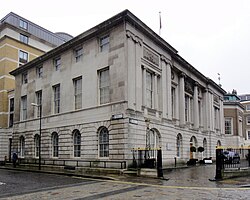
The headquarters of the Corporation are the present Trinity House, which was designed by architect Samuel Wyatt and built in 1796. It has a suite of five state rooms with views over Trinity Square, the Tower of London and the River Thames.

Trinity High Water

[edit]
Capt. Joseph Huddart, Elder Brother, set the Trinity House stones

Trinity High Water (or High Water, Trinity Standard), abbreviated THW, was a vertical datum used for legal purposes in the River Thames and informally over a much wider area. Though not thus defined, it was about 12 feet 6 inches (3.81 m) above mean sea level.[13][14]

The concept had its origin in the London Dock Act 1800 (39 & 40 Geo. 3. c. xlvii)[15] which authorised the making of the Wapping basin of the London Docks and specified its minimum depth ie. over the sill. At that time there was no Ordnance Datum or other accepted vertical benchmark. Therefore, the 1800 Act defined the benchmark for this dock as "the level of the river at low-water mark". Since opinions about this might vary, it added:

The same shall be settled and determined by two of the Elder Brothers of the Trinity House, within three calendar months next after the passing of this Act, who shall certify the same in writing under their hands and seals.

Accordingly, Trinity House — in the person of Captain Joseph Huddart[16] — set a stone in the external wing wall of the Hermitage Entrance to the London Docks.[17] It was inscribed

Low water mark is 17 feet 10 inches below the lower edge of this stone, settled by the Corporation of Trinity House Augt. MDCCC

Similar stones were afterwards set for Wapping and Shadwell entrances.

This established a benchmark which was supposedly extended for further purposes eg. the sill heights of other docks and for high water also.[18]

Trinity High Water Mark was much used as a datum in London for legal purposes. It was required to be marked on all drawings of property adjacent to the river when submitted to the Thames Conservancy. As another example, the minimum height of river walls were specified in feet and inches above T.H.W.[19] The benchmark was used in other contexts, such as "Luton is 400 feet above Trinity high-water";[20] the elevations of water reservoirs;[21] depths in the Geological Survey (London Basin);[22] the depth of an archaeological find;[23] and for railway elevations.[24][25]

Despite the importance of the Trinity Standard benchmark for legal purposes, it appears that there were discrepancies, some of them grave. Inconsistent standards purporting to be T.H.W. existed.[16] Some stones set by Captain Huddart afterwards could not be found.[26]

Eventually, it was deemed by the Port of London Act 1968 to be a level having a value of 11.4 feet (3.5 m) above Ordnance Datum Newlyn.[27] and thus the connection with the Trinity House marker stones was abandoned.

Nautical assessors

[edit]

In legal cases involving issues of navigation or seamanship eg. collisions at sea, Elder Brethren of Trinity House act as expert nautical advisors to the Admiralty Court in London. Usually, two Elder Brethren sit with the Admiralty judge. Their function is not to decide the case themselves, but to advise the presiding judge about the practicalities of seamanship and ship handling. When this happens, the parties are not allowed to produce expert witnesses of their own without a special reason, since the court considers itself to be well enough advised already. But if one of the colliding ships was a Trinity House vessel, Elder Brethren cannot be employed.[28] Elder Brethren may perform the same functions in appeals.[29]

In a 2020 case[30] about a multiple ship collision in the Suez Canal the Admiralty judge wrote a 306-paragraph judgement ending thus:

I am grateful to Trinity House and its Elder Brethren for the expert and wholly independent advice they give to the Admiralty Court (and have given for over four centuries) on questions of seamanship and ship handling. Trinity House, since its incorporation in 1514, has been dedicated to the safety of navigation and the advice given by the Elder Brethren enables the Admiralty Court to ensure that its decisions reflect and uphold the standards and requirements of good seamanship... [O]ne of the functions of the Admiralty Court is to help to avoid collisions in the future, [and] Trinity House has an essential role in ensuring that that function of the Admiralty Court is discharged.

Operational responsibilities and role

[edit]
Trinity House, Harwich, Essex

Trinity House has three main functions:

The Corporation also inspects buoys provided by local harbour authorities. It no longer provides local pilots for entering ports. Contrary to popular belief, Trinity House is not (and never has been) part of HM Coastguard, although it does work closely with HM Maritime and Coastguard Agency.

Trinity House's activities as a lighthouse authority are financed from "light dues" levied on commercial shipping calling at ports in the United Kingdom.

Assets

[edit]
One of a pair of experimental lighthouses at Trinity Buoy Wharf, used by Faraday and later used for training (closed 1988)

Lighthouses

[edit]

Trinity House maintains 65[31] lighthouses ranging from isolated rock towers like the Eddystone to mainland towers like Southwold lighthouse.

All Trinity House lighthouses have been automated since November 1998, when the UK's last staffed lighthouse, North Foreland in Kent, was converted to automatic operation. Lighthouse automation began as long ago as 1910, thanks to an invention of Gustaf Dalén, whose sun valve was fitted in a number of lighthouses powered by acetylene gas. Its vital component was a black metal rod suspended vertically and connected to the gas supply which, as it absorbed the sun's heat, the rod expanded downwards, cutting off the gas during the day.[32]

Trinity House Flag flying at Portland Bill Lighthouse, Dorset

Automation in the modern context began in the early 1980s, made possible firstly by the construction of lantern-top helipads at remote rock lighthouses, to enable the rapid transfer of technicians to a lighthouse in the event of a breakdown, and secondly, by the development of remote control technology, which enables all lighthouses and lightvessels to be monitored and controlled from the Trinity House Operations and Planning Centre at Harwich, Essex.[33]

The other General Lighthouse Authorities elsewhere in the British Isles are:

Vessels

[edit]

Ships

[edit]
THV Patricia, off Cowes, Isle of Wight (September 2017)

Trinity House vessels have the ship prefix THV. As of 2020 three such vessels operate around the coast of England, Wales and the Channel Islands.[34]

THV Alert entering Harwich Harbour on 6 September 2009
  • THV Alert (2006) is a 39.3-metre (129 ft) Rapid Intervention Vessel, able to respond rapidly to maritime incidents off the southeast coast of England. She is capable of buoy handling, wreck marking and towing. Fitted with multibeam and side-scan hydrographic surveying capability and DP1 dynamic positioning, Alert can be utilised as a research platform with a large working deck.
  • THV Galatea (2007) is an 84-metre (276 ft) multi-functional tender with a helicopter-landing pad. Fitted with a range of high specification survey equipment and a 30-tonne capacity crane, azimuthing propellers, two 750 kW bow thrusters and DP2 dynamic positioning, Galatea replaced the 1987-built THV Mermaid.

Boats

[edit]

The Corporation operates a number of small boats, mostly functioning as tenders to Trinity House vessels as described in the section above. The historic right of Trinity House to escort the Sovereign when travelling by ship in territorial waters is still exercised on ceremonial occasions. On the River Thames and inland waterways the duty is carried out by the vessel designated Trinity House No 1 Boat,[35] a name which designates any boat assigned to this duty; as of 2020 a tender of THV Galatea is used for such ceremonial duties.[36] However, for the Thames Diamond Jubilee Pageant on 3 June 2012, this boat had the name "T.H. No 1 Boat" painted onto the bow (port and starboard) whilst carrying the Master (the Princess Royal) in the jubilee flotilla.[37] On 8 November 2014, Trinity House entered a float for the annual Lord Mayor's Show in the City of London, consisting of a heavy low-loader lorry, with the Trinity House No 1 Boat mounted on the low-loader trailer as an exhibit.

Property

[edit]

As a charitable body, the corporation has owned a number of properties for benevolent purposes, chief among them the estate at Newington in south London (now rebranded as Trinity Village) and almshouses at Deptford, Mile End, and Walmer; the last of these estates was built in 1958 and remains in use by the corporation today as one of two listed estates: one of predominantly residential buildings at Trinity Village in Borough, London;[38] and a working farm, formerly Booth property, at Goxhill in Lincolnshire.[39] The rents from these properties form a substantial part of the Corporation's income.[40]

Other assets

[edit]

Amongst other significant assets, Trinity House operates a helicopter capable of landing on lighthouse and ship landing pads. From May 2011 to November 2015, the aircraft in principal use was an MD Helicopters MD Explorer 902 owned by Police Aviation Services (PAS) and operated under lease.[41] Since December 2015 a Eurocopter EC135 G-GLAA owned and operated by PDG Aviation Services has fulfilled the role.[42]

Ensign

[edit]

The Ensign of Trinity House is a British Red Ensign defaced with the shield of the coat of arms (a St George's Cross with a sailing ship in each quarter). The Master and Deputy Master each have their own differenced flags.[43]

When escorting the Sovereign, Trinity House vessels may fly the White Ensign.[44]

See also

[edit]

Notes

[edit]

References

[edit]

Bibliography

[edit]
[edit]
Revisions and contributorsEdit on WikipediaRead on Wikipedia
from Grokipedia
The Corporation of Trinity House, commonly known as Trinity House, is a British charitable corporation and the General Lighthouse Authority (GLA) responsible for the provision and maintenance of maritime navigation aids in , , the , and . Founded on 20 May 1514 by granted by King , it was originally established to regulate pilotage on the River Thames and provide support for aged mariners, under the full name "The Master Wardens and Assistants of the Guild Fraternity or Brotherhood of the Most Glorious and Undivided Trinity and of Saint Clement in the Parish of Deptford Strond in the County of ," with Sir Thomas Spert, Master of the royal ships Mary Rose and Henri Grace à Dieu, as its first Master. Over more than five centuries, Trinity House has evolved into the United Kingdom's largest endowed maritime charity, dedicated to safeguarding shipping and seafarers while delivering essential aids to that support approximately 95% of the UK's . As the GLA, Trinity House maintains over 60 historic lighthouses—such as the iconic Eddystone and —and inspects around 11,000 local aids to navigation, ensuring safe passage for vessels in its jurisdiction. It also holds statutory powers to mark and disperse hazardous , licenses Deep Sea Pilots for major ports, and supplies Nautical Assessors to the for maritime legal proceedings. Complementing these operational duties, the organization operates a fleet of vessels since 1741 and coordinates responses to navigational incidents, such as those in the busy Dover Strait, within six hours. In its charitable capacity, Trinity House donates approximately £4 million annually to maritime welfare programs, including cadet training, education for seafarers' families, and support for retired mariners, funded primarily through rents from its extensive property portfolio. Trinity House's enduring legacy reflects its pivotal role in advancing maritime safety, from its early pilotage regulations to modern technological innovations in navigation aids, while fostering a fraternity among seafarers through welfare initiatives that have benefited the community for over 500 years.

Overview and Establishment

Founding and Royal Charter

Trinity House was formally established on 20 May 1514 through a granted by King , incorporating an existing guild of mariners known as the Brotherhood of Trinity House of Strond. The charter's full title designated the organization as "The Master Wardens and Assistants of the or Brotherhood of the Most Glorious and Undivided and of Saint Clement in the Parish of Strond in the County of ," reflecting its roots in the Deptford area along the River Thames. This incorporation arose from a by the of Mariners in 1513, aimed at addressing the unregulated and hazardous nature of shipping on the Thames at the time. The primary objective of the charter was to regulate pilotage on the River Thames, ensuring the safe navigation of ships entering and departing by supervising the conduct and qualifications of pilots. Henry VIII's grant empowered the fraternity to oversee all shipping traffic on the river, imposing standards to prevent accidents and improve the overall state of maritime commerce in the capital. From its inception, the organization also emphasized charitable support, providing aid to elderly pilots, seafarers, and their dependents through almshouses and relief funds, which formed a core part of its foundational mission. Leadership of the newly chartered corporation fell to Sir Thomas Spert as its first Master, a distinguished mariner who had served as captain of Henry VIII's flagship, the , and the Henri Grâce à Dieu. Spert's naval expertise underscored the practical orientation of the , drawing on experienced shipmen to enforce the charter's provisions effectively. The 1514 charter's powers were progressively confirmed and expanded by subsequent monarchs, solidifying Trinity House's status as a with . In 1566, affirmed its authority and granted additional rights, while James I in 1604 reinforced exclusive pilot licensing on the Thames; these were further consolidated by James II's renewed charter in , which remains a foundational legal document. This evolution ensured the organization's enduring and operational continuity across reigns. Trinity House serves as the General Lighthouse Authority (GLA) for , , the , and , a designation established under the Merchant Shipping Act 1995. This statutory role empowers the organization to oversee the provision and maintenance of aids to essential for maritime in these jurisdictions. As the GLA, Trinity House holds exclusive authority over general lighthouses and related navigational infrastructure within its designated areas, ensuring compliance with international standards while coordinating with other national authorities. The core responsibilities of Trinity House as include the erection, maintenance, and operation of aids to (AtoN), such as lighthouses, buoys, lightvessels, beacons, and electronic systems. These efforts focus on guiding vessels safely through busy maritime routes, including the Dover Strait, to prevent collisions and groundings. Additionally, the organization conducts inspections of local AtoN provided by harbor authorities to verify their effectiveness. Funding for these activities primarily comes from light dues, which are levied on merchant vessels entering ports and pooled into the General Lighthouse Fund under the stewardship of the . This fund supports not only Trinity House but also the and the Commissioners of Irish Lights, ensuring equitable resource allocation for national safety. Trinity House's jurisdictional limits are defined by the Merchant Shipping Act 1995, confining its powers to the specified territories and adjacent seas, while allowing for international collaboration. It coordinates with global bodies such as the International Association of Marine Aids to and Authorities (IALA) to adopt standardized practices, including the IALA Maritime Buoyage System for buoys and markers. This alignment promotes interoperability of AtoN across borders, enhancing overall maritime safety. Beyond its statutory duties, Trinity House operates as a registered charity (number 211869), functioning as a non-profit with a to support mariner welfare. Its charitable purposes encompass providing welfare services to and their dependents, and programs, and promoting public safety at sea. Assets, including navigational infrastructure and endowments, are held in trust to fulfill these objectives, with annual donations exceeding £4 million directed toward maritime charities and seafarer initiatives. This structure underscores Trinity House's commitment to both operational efficiency and long-term community support.

Historical Development

Early Operations on the Thames

Trinity House's early operations focused on regulating pilotage along the River Thames to ensure safe navigation for vessels entering the , particularly amid the hazards of shifting sands and strong currents. Established in 1514 as a of master mariners and pilots, the initially comprised 40 members, primarily Thames pilots, who petitioned for authority to oversee pilotage and address the dangers posed by unregulated and inexperienced practitioners. By 1604, under a from James I, Trinity House gained exclusive rights to pilots on the Thames and enforce compulsory pilotage for foreign vessels, requiring ships to employ certified English pilots rather than foreign ones, thereby standardizing expertise and reducing maritime accidents. In parallel, the corporation developed essential infrastructure in the during the 16th and 17th centuries. Queen Elizabeth I's 1594 grant transferred responsibility for maintaining public buoys and beacons from the High to Trinity House, enabling the placement of markers to guide ships through treacherous channels. This role expanded with the 1732 deployment of the world's first lightvessel at Nore Sands, a moored vessel equipped with lanterns to illuminate the estuary's dangers at night, marking a significant innovation in local aids to . By the mid-17th century, Trinity House routinely laid and repaired buoys while erecting beacons, supporting the growing volume of trade and supporting the Tudor naval buildup that demanded reliable access to . Charitable initiatives formed a core aspect of Trinity House's mission from its , providing support to the maritime community. Revenues from ballastage , granted in 1594, funded pensions for retired pilots and the construction of almshouses in by the early , offering shelter to aged masters, pilots, and their widows. These 56 residences, specifically for "decayed" , underscored the guild's commitment to welfare, predating formal incorporation and reflecting the perils faced by Thames workers. Throughout this period, Trinity House navigated challenges, including conflicts with rival guilds and authorities over pilotage control during the Tudor era's naval expansion. The corporation's push for exclusive licensing clashed with unregulated pilots and competing maritime groups, leading to legal disputes that affirmed its authority but highlighted tensions in the burgeoning English navy. These early struggles on the Thames laid the groundwork for Trinity House's enduring role in maritime safety.

Expansion to Lighthouses and National Role

Trinity House's expansion beyond its initial Thames pilotage role began in the late , as it gradually acquired oversight of key offshore s through purchases, leases, and royal grants. The corporation first became involved with the after the destruction of Henry Winstanley's private tower in 1703; it commissioned John Rudyerd to build the second structure, lit in 1709, marking Trinity House's entry into major rock management. Similarly, the off was initially leased by Trinity House to a private operator in 1791, but full control was secured through buyout in as part of broader consolidation efforts. The Skerries Lighthouse, constructed privately in to safeguard approaches to , was the last major private light acquired by Trinity House in 1841 for over £444,000, completing the shift toward centralized authority. These acquisitions transformed Trinity House from a local into a national maritime guardian, overseeing critical aids to around England's coasts by the early . Legislative reforms in the solidified Trinity House's national role by vesting all English and Welsh lighthouses under its control. The Lighthouses Act granted the corporation compulsory purchase powers to acquire remaining private lighthouses, enabling it to buy out lessees and centralize maintenance and operations. This act addressed fragmented ownership that had led to inconsistent standards and dues collection, empowering Trinity House to levy uniform light dues for funding. By 1847, all private lights in had been transferred, with the Merchant Shipping Act 1854 further regulating dues and affirming Trinity House's superintendence over lighthouses, buoys, and beacons to ensure equitable national coverage. These measures established Trinity House as the General Lighthouse Authority for , , the , and , expanding its remit to strategic national infrastructure. Technological advancements during this period enhanced the reliability and visibility of Trinity House's lights, reflecting its growing national influence. In the early , the corporation introduced improved oil lamps with multiple wicks, such as Argand burners, which provided brighter, more stable illumination than earlier open flames. A pivotal innovation was the adoption of Augustin-Jean Fresnel's catadioptric lenses starting in the 1820s, following trials and production efforts; these prismatic glass systems concentrated light into powerful beams visible for miles, revolutionizing optics and installed in structures like the third Eddystone tower by 1845. By the 1920s, electrification transformed major lights, with and incandescent lamps replacing oil in key stations like North Foreland in 1872 and expanding nationwide, reducing maintenance needs and increasing efficiency while maintaining the Fresnel lens framework. On the international stage, Trinity House contributed to early efforts in standardizing maritime signals, laying groundwork for global cooperation. In 1882, it convened the first international conference on buoyage and signaling, uniting European authorities to discuss uniform systems for aids to and reducing confusion for international shipping. This initiative influenced subsequent agreements, including precursors to the International Association of Marine Aids to Navigation and Lighthouse Authorities (IALA), established in 1957, by promoting shared standards for light characteristics and buoy markings that enhanced cross-border .

Wartime Contributions and Post-War Changes

During , Trinity House implemented blackout measures on many of its lighthouses to prevent aiding German naval operations, while its steam vessel service actively buoyed shipping lanes, swept channels clear of hazards, and deployed temporary buoys to support Allied naval efforts and maintain safe passage for merchant vessels. Tenders operated in remote theaters such as the and , relocating lightvessels and installing additional navigation aids under wartime constraints. The organization endured significant personnel losses during the conflict, contributing to the broader toll on maritime services. In , Trinity House's contributions were pivotal to the Allied invasion of , known as , where it marked swept channels across the by establishing 73 lighted buoys in precise positions, using six dedicated vessels under the direction of Captain Guy Jarrett to ensure safe navigation for the invasion fleet. Lightvessels such as No. 72 (JUNO), positioned on 18 off the coast, and No. 68 (), laid on 16 July 1944, provided critical fixed markers amid minefields and hazards, with JUNO remaining in service until January 1945 despite enemy threats. Trinity House pilots, numbering 88 river and 115 sea specialists, with the 88 river pilots guiding nearly 3,000 ships and the 115 sea pilots guiding nearly 2,000 vessels—totaling around 5,000 ships—through perilous waters in the month following D-Day. The war inflicted heavy damage, including the near-total destruction of its headquarters by a air raid on 29 December 1940 during , alongside attacks on at least 18 lighthouses, such as the 1943 bombing of St Catherine's Lighthouse that killed three keepers on duty. Post-war recovery efforts centered on reconstruction and resilience, with Trinity House coordinating international aid to restore navigation aids in liberated European ports and repairing damaged infrastructure, including the faithful rebuilding of its headquarters, reopened by Queen Elizabeth II on 21 October 1953. Modernization accelerated in the , shifting from wartime improvisations to reliable power systems, such as the installation of four Gardner diesel engines at Lizard Lighthouse in 1950 following mains connection and the of Longstone Lighthouse in 1952, supported by constant-running diesel alternators to enhance operational reliability. These changes marked a transition toward greater efficiency, laying the groundwork for later while honoring the organization's role in maritime safety. The era of in the prompted Trinity House to handover oversight of certain overseas lighthouse duties in former British colonies to emerging independent authorities, allowing a strategic refocus on core responsibilities in waters, the , and , where it retained authority over key aids like the Europa Point . This adaptation ensured sustained national priorities amid global shifts, reinforcing its foundational mission without diminishing its historical scope.

Governance and Leadership

Elder and Younger Brethren

The Elder Brethren form the governing of Trinity House, consisting of 31 voting members who are elected for life from among the Younger Brethren. These individuals are typically distinguished maritime experts, including serving and former naval officers, master mariners, pilots, and harbour masters, bringing specialized knowledge in and to their roles. The composition reflects a blend of active professionals and eminent figures, with historical and ongoing inclusion of royalty, such as His Majesty The King and Her Royal Highness The Princess Royal, who currently serves as Master. Election to the Elder Brethren emphasizes proven maritime expertise and influential contributions to the sector, with candidates drawn exclusively from the ranks of the Younger Brethren. Nominations are reviewed by a Corporate Board composed of Elder Brethren, which assesses eligibility based on factors like command experience in the Merchant Navy or equivalent roles; selected individuals are then sworn in during formal ceremonies. Once elected, Elder Brethren are responsible for shaping policy, overseeing operational decisions, and presiding over Court sittings that address key aspects of Trinity House's mandate, including the maintenance of aids to navigation. The Younger Brethren comprise an honorary fraternity of approximately 400 members, primarily from the Royal Navy, , pilotage, and related maritime professions, serving in advisory and ceremonial capacities. They provide input on operational and charitable initiatives through regional committees and ambassador schemes, while participating in events that promote maritime safety and welfare; admission requires demonstration of relevant expertise and involves a one-time fee plus annual subscription. This broader body supports the Elder Brethren by offering a network of expertise and representing Trinity House in ceremonial duties, such as elections for the Master and Wardens. The Court of Elder Brethren convenes at Trinity House's headquarters on in to conduct its proceedings, ensuring decisions on aids to and other matters are made collectively with a required present. These meetings uphold the fraternal structure's of , where the Elder Brethren's lifelong tenure fosters continuity in maritime policy.

Master and Key Officers

The Master of Trinity House serves as the ceremonial and strategic head of the corporation, providing high-level oversight of its operations, including navigation aids, charitable activities, and maritime welfare initiatives. This honorary yet influential role is currently held by Her Royal Highness The Princess Royal KG KT GCVO, who was elected to the position in May 2011, succeeding her father, the late . As Master, she chairs key meetings of the and represents the organization in national and international maritime forums, ensuring alignment with its historic mission under the Royal Charter. The Deputy Master and Chief Executive is responsible for the day-to-day administration, operational management, and leadership of the fleet and support services. Iain Lower CB assumed this dual role in February 2024, bringing extensive naval experience to guide Trinity House's modernization efforts and compliance with international navigation standards. In this capacity, the Deputy Master coordinates with the Elder Brethren on strategic decisions while directly supervising executive functions. Among the other key officers, the s provide financial oversight, with the Upper managing budgetary and responsibilities and the supporting and compliance processes. Captain Roger Henry Barker MNM FNI currently serves as Upper , while Captain Stephen Mark Gobbi MNM JP holds the position of . The Secretary handles legal affairs, , and advisory support to the . Commodore Martin Atherton OBE RN has occupied this role since 2019. Terms for these non-Master positions are generally three to five years, allowing for rotation among experienced maritime professionals to maintain fresh perspectives in leadership. In a notable recent development, Trinity House appointed Desmond Donworth MA FRIN FCMI RN (Ret) as the new Director of Navigational Requirements and Policy on August 8, 2025, effective September 15, 2025. This role focuses on advancing policy formulation for aids to navigation, incorporating emerging technologies and international regulations to bolster maritime safety. Donworth, with over three decades in the Royal Navy including expertise in international maritime policy, succeeds Commodore Nigel Hare in enhancing the organization's strategic response to evolving navigational challenges.

Role as Nautical Assessors

The Elder Brethren of Trinity House serve as nautical assessors in the , providing expert maritime advice in cases involving ship collisions and salvage operations, a role enabled by the court's powers under section 70 of the Senior Courts Act 1981 to summon qualified assessors for technical guidance. Typically, two Elder Brethren are selected for each hearing, drawing on their extensive experience as senior master mariners to assist the without forming part of the judicial decision-making body. This advisory function stems from Trinity House's longstanding authority in matters, as established in its of 1514 and subsequent legislative developments. In these proceedings, the assessors offer technical testimony on key aspects of , including compliance with international navigation rules such as those in the International Regulations for Preventing Collisions at Sea (COLREGS), the interpretation of aids to like buoys and lights, and practical considerations of vessel handling in varying conditions. Their opinions are non-binding on the but carry significant weight due to the Brethren's impartial expertise and deep knowledge of maritime practices, often influencing judgments on liability apportionment and causal factors in incidents. For instance, in collision cases, they may reconstruct events based on data, weather reports, and vessel tracks to evaluate whether actions aligned with standard nautical protocols. Historically, the Elder Brethren have contributed to high-profile maritime inquiries, including the 1912 British Wreck Commissioner's inquiry into the sinking of the RMS Titanic, where Elder Brother Edward Chaston acted as one of five assessors, advising on navigational errors and lifeboat provisions under the Merchant Shipping Act 1894. This involvement highlighted their role in analyzing failures in lookout duties and iceberg detection amid limited aids to navigation at the time. In more recent cases, such as the 2021 Supreme Court appeal in Evergreen Marine (UK) Limited v Nautical Challenge Ltd, involving the collision between the Ever Smart and Alexandra 1, Elder Brethren provided assessments on vessel maneuvering and collision avoidance in restricted visibility. Similarly, in the 2024 Admiralty Court decision in Belpareil MV Ltd v Kiran Australia MV Ltd EWHC 362 (Admlty), two Elder Brethren advised on seamanship issues during a collision between the m.v. Belpareil and m.v. Kiran Australia off Chattogram, Bangladesh, aiding the court's evaluation of rule breaches under COLREGS. To maintain impartiality in their assessor duties, the Elder Brethren, who form the governing Court of Trinity House alongside Younger Brethren, receive specialized preparation focused on judicial protocols and ethical standards for expert testimony. This ensures their contributions remain objective, free from any conflict with Trinity House's operational roles in lighthouse maintenance or pilotage.

Operational Framework

Headquarters and Support Facilities

The headquarters of Trinity House is situated at in , where the organization has been based since 1796 in a Grade I listed building designed by architect Samuel Wyatt. The structure, which suffered significant damage during the Second World War and was subsequently rebuilt while preserving its original Georgian features, serves as the administrative and ceremonial center for the corporation. Key internal facilities include the Court Room, a south-facing space overlooking Trinity Square and the , primarily used for meetings of the Elder Brethren and official events. The building also houses historical artifacts and exhibits that form an informal museum, showcasing the corporation's maritime heritage through items like and charts. Trinity House maintains operational depots to support its aid activities, with the primary facility at in serving as the main operations center since 1812. This depot handles maintenance for buoys and lightvessels, particularly along the east coast, and includes workshops for repairs and storage. A secondary support depot is located in , , functioning as the west coast buoy yard responsible for servicing aids to in that , including refurbishment of buoys and related . Additionally, Trinity House employs helicopters for efficient inspections and transport to remote offshore sites, with flight operations supported from a base at St Just in Penwith, . These facilities collectively enable logistical coordination for the organization's fleet and maintenance teams. Over time, Trinity House's support infrastructure has evolved to incorporate modern technologies, including upgrades to its remote monitoring systems for enhanced digital oversight of aids to . In 2025, the corporation is actively reviewing options to replace its existing and Monitoring System, aiming to improve collection and response capabilities from a central control center. These enhancements support the integration of new vessel tenders under the "Futures Afloat" project, which includes procurement of multi-functional buoy-handling ships to replace aging assets, ensuring facilities like and can accommodate advanced operations. The Tower Hill headquarters promotes public engagement with maritime history through guided tours and hosted events, fostering awareness of Trinity House's role. Tours, limited to 20 participants and lasting 75 minutes, explore the building's architecture, Court Room, and exhibits for £20 per person, with bookings required via email; special walking tours on related historical themes are also available. These initiatives, including occasional open days, contribute to the corporation's charitable objectives by generating funds for seafarers' welfare.

Core Responsibilities in Navigation Aids

Trinity House, as the General Lighthouse Authority for , , the , and , holds statutory responsibility for the superintendence and management of aids to (AtoN) in these waters, encompassing the provision, maintenance, and oversight of visual, audible, and electronic systems to ensure safe maritime passage. This includes direct management of over 60 operational , several lightvessels, approximately 450 buoys, and associated beacons, alongside electronic enhancements such as Beacons (RACON) and (AIS) transponders integrated into key structures. These AtoN are strategically placed to guide vessels through high-traffic areas like the Dover Strait, the world's busiest shipping lane, supporting thousands of mariners annually under all weather conditions. Inspection and maintenance form a of these duties, with Trinity House conducting comprehensive annual audits of its own AtoN as well as over 11,000 local aids managed by ports, harbors, and other authorities to verify operational integrity and compliance. These efforts involve vessel-based deployments for handling and servicing, supplemented by surveys to access remote or challenging coastal sites, ensuring timely identification and repair of any faults. Seasonal deployments and recoveries are prioritized in response to navigational demands, such as marking temporary hazards or adjusting for tidal variations, all aligned with International Association of Marine Aids to and Lighthouse Authorities (IALA) standards for buoyage systems, visibility, and signaling characteristics. For instance, cardinal and safe water buoys are positioned and maintained to IALA Region A conventions, providing clear visual and radio cues for mariners. Technological integration enhances reliability through remote monitoring via the Central Monitoring and Control System (CMCS), a SCADA-based platform that operates 24/7 from , tracking parameters like light status, battery levels, and transmission across the AtoN network. RACON systems, which respond to interrogations with a distinctive signal for precise location identification, are deployed on select lighthouses and lightvessels, while AIS aids broadcast real-time position and status to compatible receivers, improving situational awareness. In line with 2025 advancements, Trinity House has incorporated measures into its AtoN strategy, including updated five-yearly reviews of navigation requirements that factor in projections to optimize aid durability and placement. Risk assessment is conducted annually to evaluate high-risk coastal zones, integrating meteorological and historical incident reports to inform AtoN positioning and upgrades, thereby mitigating hazards from erosion, storms, and rising sea levels. This proactive approach ensures that aids like buoys in vulnerable areas are reinforced or relocated as needed, maintaining a rate in accordance with IALA guidelines for service continuity and . Through these responsibilities, Trinity House sustains a robust framework that balances traditional seamarks with modern electronics, adapting to evolving maritime challenges without compromising .

Pilotage Services and Trinity High Water

Trinity House serves as the primary licensing authority for deep-sea pilots in the , empowered by the Secretary of State for Transport to certify qualified individuals who guide vessels through complex approaches in Northern European waters, particularly the and . These pilots undergo rigorous examination and training, including advanced navigation simulations and sea time requirements, to ensure competency in handling large vessels under varying conditions; the certification process is aligned with () standards for safety and interoperability. While deep-sea pilotage remains voluntary, it is widely utilized for risk mitigation, with Trinity House coordinating pilot deployment through established networks that interface with local port authorities to facilitate seamless transitions to harbor-specific guidance upon nearing coastal districts. Historically, Trinity House's involvement in pilotage originated with its 1514 granting regulatory powers over Thames navigation, evolving into an exclusive monopoly on licensing pilots for the river from 1604 under King James I, which included compulsory pilotage mandates via the 1808 Thames Navigation Act. Over time, this role expanded beyond the Thames through the establishment of outport pilotage districts and culminated in the 1987 Pilotage Act, which shifted primary authority to harbor masters while positioning Trinity House in an advisory and licensing capacity for national deep-sea operations, reflecting a transition from regional dominance to a supportive framework for broader maritime safety. A cornerstone of Trinity House's contributions to safe is the Trinity High Water datum, a standardized reference level for high established in 1800 by Elder Brother Captain Joseph Huddart to benchmark tidal measurements, particularly along the Thames and in associated almanacs. Since 1833, this datum has underpinned the publication of tidal stream predictions, integrated into annual nautical almanacs that provide mariners worldwide with essential data on current flows and water levels for route planning; these predictions, disseminated through collaborations with the UK Hydrographic Office, remain a vital tool for global , aiding in everything from cargo scheduling to offshore operations. In contemporary practice as of 2025, Trinity House has adapted its pilotage and tidal services to digital ecosystems, incorporating GPS-enabled e-Navigation systems that allow real-time integration of tidal predictions with vessel tracking for enhanced efficiency and precision in pilot transfers. These advancements, including mobile-accessible data feeds from the organization's legacy almanacs, support automated route optimization and reduce in high-traffic areas, ensuring continuity with historical expertise amid evolving technologies like differential GNSS, which the authority maintains through at least 2025.

Assets and Infrastructure

Lighthouses and Buoyage Systems

Trinity House maintains 66 operational lighthouses and 9 lightvessels serving as essential aids to around the coasts of , , the , and . All of these structures have been fully since 1998, marking the end of manned operations when keepers were withdrawn from North Foreland Lighthouse, the last to be converted. has allowed for remote monitoring and control from Trinity House's operations center, enhancing reliability while reducing operational costs. Among its portfolio, several lighthouses stand out for their historical significance and engineering feats. The , located on the treacherous 13 miles southwest of Plymouth, features its current granite tower constructed in 1882 by Trinity House as the fourth iteration on the site, following previous versions destroyed by storms and fire. Similarly, the , a remote offshore tower off the Pembrokeshire coast in , was automated in 1987, becoming one of the earliest to incorporate wind and solar power systems in the UK. These iconic structures exemplify Trinity House's long-standing commitment to resilient maritime safety infrastructure. In addition to lighthouses, Trinity House oversees an extensive buoyage system comprising around 450 buoys and numerous beacons, forming part of over 600 total aids to navigation that guide mariners through hazardous waters. These aids conform to the IALA Maritime Buoyage System A, established in 1977, which uses standardized colors, shapes, and light patterns—such as red and green lateral marks for sides of channels—to ensure international consistency. In the , Trinity House has transitioned many buoys to solar-powered LED lighting, as seen in replacements like the 2021 Channel Lightvessel buoy, which uses low-power LED sources lasting up to ten years to promote and efficiency. Maintenance of these fixed aids presents ongoing challenges, particularly from environmental threats like and rising sea levels. For instance, at sites such as Portland Bill, Trinity House monitors and responds to impacting surrounding structures, including historical markers like the 1844 endangered by cliff instability. A 2016 climate adaptation report identified eight lighthouses requiring monitoring, with potential needs for defenses or relocation in vulnerable areas. As of 2025, Trinity House's updated environmental policy integrates climate adaptation measures into all operations, including resilience planning for assets against intensified weather patterns and sea-level rise.

Fleet of Vessels and Support Equipment

Trinity House operates a fleet of three purpose-built survey and maintenance vessels designed to support the deployment and upkeep of aids to around the coasts of , , and the . These vessels, prefixed THV, perform multi-role tasks including laying, wreck marking, hydrographic surveying, and general maintenance of offshore installations. THV Galatea, launched in 2006, is equipped for advanced handling, towing, multibeam and surveying, and wreck identification, enabling precise mapping and response to navigational hazards. THV , the commissioned in 1982, complements these efforts with capabilities for transporting supplies, personnel, and equipment to remote sites while conducting similar and light maintenance operations. THV Alert, introduced in 2006 as a rapid intervention vessel, focuses on agile support for urgent tasks such as wreck marking and deployment in challenging conditions, often operating in areas inaccessible to larger ships. In addition to the primary fleet, Trinity House employs support equipment to enhance . A dedicated facilitates aerial inspections and rapid transport of personnel and supplies to offshore lighthouses, ensuring timely and reducing isolation during adverse ; this service has been integral since 1969 for safe and swift access. For inshore work, smaller tenders and contracted work boats handle localized buoyage deployment and minor repairs, such as the West Coast Work Boat service procured in 2025 to provide aid-to-navigation support along regional coastlines. As of 2025, Trinity House has advanced its fleet modernization through the Futures Afloat program, launching a tender on July 10, 2025, for two new multi-function -handling vessels to replace THV and THV Galatea. Valued at approximately £200 million, these vessels will feature diesel-electric hybrid propulsion systems, methanol-ready engines, and expanded working decks to improve efficiency and environmental performance in laying and maintenance tasks. The procurement emphasizes , with the new ships expected to enhance multi-role capabilities while reducing emissions during operations. The evolution of Trinity House's fleet reflects broader advancements in maritime technology, transitioning from steam-powered vessels in the early to diesel-electric propulsion starting with the Mermaid-class tenders in the and . This shift improved reliability, , and maneuverability for navigation aid services, culminating in the current hybrid-focused procurements.

Properties and Auxiliary Holdings

Trinity House maintains several key properties that support its charitable mission, including the Newington Estate, known as Trinity Village, located in . Acquired in 1660, this estate comprises approximately 400 households and generates income through rentals to fund the organization's welfare initiatives for and their dependents. In addition, Trinity House operates 18 almshouses at Walmer Homes in Walmer, , established in 1958 to provide accommodation for retired mariners, their widows, and dependents who meet specific eligibility criteria, such as at least 15 years of sea service and financial need. These almshouses represent the continuation of Trinity House's longstanding commitment to supporting aged and distressed , a duty predating its . Former lighthouse keepers' cottages form another significant category of repurposed properties, with 32 such structures transformed into lets available for rental. These cottages, located at scenic coastal sites across , have been fully refurbished to include modern amenities while preserving their historical character, offering visitors an immersive experience in maritime heritage. This initiative not only generates revenue for maintenance but also promotes appreciation of Trinity House's navigational legacy. Among its auxiliary assets, Trinity House operates supply warehouses at its strategic bases in and , which store essential spare parts, , moorings, and consumables required for maintenance. These facilities also support refurbishment services, including high-pressure cleaning, painting, and equipment testing, ensuring operational efficiency without reliance on external commercial suppliers. Complementing these practical holdings is the historical collection housed at Trinity House's headquarters on , , which includes fine paintings, ship models, and other maritime treasures dating back centuries. This museum-like archive serves as a repository for artifacts that document the organization's 500-year and is accessible via guided tours. Trinity House's financial holdings are primarily derived from endowed funds and surpluses generated through its properties and light dues collections, which are directed into charitable trusts rather than commercial ventures. Light dues, levied on commercial vessels entering and Irish ports, are paid into the General Lighthouse Fund managed by the ; any operational efficiencies, such as automation of aids to navigation, help reduce dues rates and allow surpluses to bolster charitable activities like seafarer welfare. The organization's endowed assets, including the Trinity Village estate, provide self-sustaining income for these trusts, emphasizing non-commercial exploitation in line with its charitable status.

Charitable and Modern Initiatives

Support for Seafarers' Welfare

Trinity House's commitment to seafarers' welfare is enshrined in its founding of , which emphasized charitable duties to support mariners in need, evolving into a comprehensive program administered through the Trinity House Maritime Charity, the 's largest endowed maritime charity. This initiative provides direct financial and practical aid to active, injured, retired, and distressed seafarers, their dependents, and maritime communities, funded primarily by light dues and endowments. The charity offers welfare grants as a core form of financial assistance, distributing over £5 million annually to aged or distressed mariners, including those injured or retired from service, and to other maritime charities that support seafarer needs. These grants cover essential expenses such as medical care, housing, and daily living costs, with examples including a £30,000 allocation in 2025 to the Seafarers Advice and Information Line (SAIL) to enhance advisory services for seafarers facing welfare challenges. By prioritizing immediate relief, the program ensures that seafarers who have contributed to safe navigation receive dignified support in times of hardship. Educational initiatives form another pillar of welfare support, focusing on scholarships and to build future maritime careers and provide opportunities for skill enhancement. The Merchant Navy Scholarship Scheme (MNSS) delivers financial aid to young people pursuing officer roles in the , covering tuition and related costs at approved nautical colleges. Partnerships with institutions such as the National Sea Training Centre in and Liverpool John Moores University's Maritime Centre enable sponsored cadets to complete structured programs combining academic study and sea time, fostering long-term employability in the sector. Additionally, the Trinity House RYA Scholarship recognizes excellence in maritime education, awarding funding to nominated candidates for advanced qualifications that advance seafarer welfare through . Historically, Trinity House has provided almshouses as a direct response to seafarers' housing needs, beginning with facilities in in the early that offered 56 residences for "decayed masters and commanders of ships, mates, and pilots, and their wives or widows." These evolved over time, with later sites in before relocating to the current 18 modernized almshouses in Walmer, , designed to accommodate aged mariners and their dependents with contemporary amenities for comfortable, . This ongoing provision reflects the organization's enduring dedication to secure retirement housing tailored to the seafaring community's unique requirements. Community outreach efforts further bolster seafarers' welfare by raising awareness and fostering solidarity within the maritime sector. In 2025, Trinity House co-hosted the international World Marine Aids to Navigation Day (WAtoN Day) in London alongside the Northern Lighthouse Board and the UK Department for Transport, featuring panel discussions on maritime safety and welfare attended by global experts. Such events highlight the interconnectedness of navigation aids and seafarer support, promoting collaborative initiatives that enhance overall community resilience.

Environmental and Technological Advancements

Trinity House has committed to reducing its through efficient operational planning and the widespread adoption of solar-powered aids to , including all buoys and many lighthouses, which has significantly lowered reliance on fuels. The organization's emphasizes preventing , protecting , and achieving continuous improvement under ISO 14001 , aligning with broader sustainability goals such as the Clean Maritime Plan. While pursuing a zero-emissions target via these measures, full achievement remains ongoing, with investments in energy efficiency and storage further mitigating environmental impacts from fuel transfers and operations. In technological advancements, Trinity House launched the Futures Afloat program in 2024 to procure two state-of-the-art multi-function tender vessels by 2025, featuring hybrid energy systems that utilize batteries for low-emission operations during anchored periods, thereby reducing overall fuel consumption and emissions compared to the aging fleet. This £200 million initiative includes energy efficiency as a key evaluation criterion in tender bids, supporting lower-emission maritime practices. To address , Trinity House draws on IPCC AR5 projections and UKCP09 scenarios to adapt its , particularly through resilient designs enhanced after 2013-2014 to withstand increased wave loading and storm surges. The 2016 Report and its progress update outlined measures like raising boat landings at 12 vulnerable by 2050, strengthening defenses at yards, and solar modernization at sites like Longstone to counter and erosion risks, with these efforts continuing into 2025 via ongoing asset planning and university collaborations on wave impacts. Trinity House has advanced diversity and inclusion in its governance by appointing more women to the Elder Brethren since the 2010s, exemplified by the 2023 swearing-in of Captain Fran Collins as one of three new members, broadening representation in decision-making roles.

Symbols and Heraldry

Ensign and Flags

The Ensign of Trinity House is a British Red Ensign defaced in the fly with the shield of the Corporation's coat of arms, consisting of an argent (white) field bearing a gules (red) cross between four ships sable (black) in full sail, with flags and pendants flying. This design was granted on 27 January 1573 by Sir Gilbert Dethick, Garter Principal King of Arms, during the reign of Elizabeth I, confirming the armorial bearings that reflect the organization's Elizabethan maritime origins. The ensign is flown on all Trinity House vessels, at its lighthouses, the in , , and at district depots across , serving as the primary identifier of the Corporation's authority in aids and pilotage. It is also displayed ashore in capacities to denote the presence of Trinity House. Elder Brethren of Trinity House hold special privileges regarding flag usage, including the right to fly the on their private yachts. Trinity House vessels fly the at the foremast when escorting the sovereign aboard royal yachts or warships, or during other dressed-ship ceremonies, under an Admiralty authorization dated 21 June 1894 that extended ensign privileges to the Corporation. The symbolism of the ensign centers on Trinity House's foundational patronage under the Holy and St. Clement, with the motto Trinitas in Unitate ("Three in One") underscoring the divine from which the derives its name since its 1514 charter. The quartered ships evoke the seafaring brethren the organization supports, while the St. George's Cross signifies English maritime sovereignty and protection for . In contemporary protocol, the ensign is raised during significant ceremonial events, including the annual Trinity Monday observance at headquarters, which features elections for the Elder Brethren and commemorates the Corporation's traditions.

Traditions and Insignia

Trinity House upholds longstanding ceremonial traditions rooted in its founding as a guild dedicated to the Holy Trinity and St. Clement. One key annual event is the Trinity Monday service, historically held to commemorate the corporation's origins and facilitate the election of its leadership. Traditionally observed on the Monday after Trinity Sunday, this gathering involves a religious service followed by the formal election of the Master and Wardens by the Elder Brethren, a practice dating back to the 1514 Royal Charter granted by Henry VIII. The election of the Master incorporates ancient rites reflective of the corporation's medieval heritage, where the Elder Brethren convene to select the Master—typically a distinguished maritime or —for a one-year term, supported by four Wardens and assistants. This process, conducted with solemnity at Trinity House's headquarters on , emphasizes continuity and authority within the . The rite underscores the organization's evolution from a 16th-century pilotage to its modern role, with the Master overseeing the of Elder Brethren. Insignia play a central role in symbolizing the Brethren's and heritage. Elder Brethren wear distinctive uniforms featuring lace and bullion epaulettes, a tradition formalized in the to denote their status during official duties. These garments, often in with elaborate on cuffs and collars, are donned for ceremonial occasions and reflect naval influences. Complementing this is the Trinity House mace, a replica of the Admiralty presented in 2014 to mark the organization's 500th anniversary; it serves as a of judicial and administrative , particularly in maritime matters. The corporation's patron is the Holy , invoked in its name and rituals to emphasize unity and divine protection for . Its , "Trinitas in Unitate" (Trinity in Unity), appears on the granted by Queen Elizabeth I in 1573, encapsulating the theological foundation of the guild's mission. This Latin phrase, translating to "Three in One," directly references the Christian doctrine of the and has adorned official insignia since the .

References

Add your contribution
Related Hubs
User Avatar
No comments yet.