


Community hub
Recent from talks
Contribute something
Nothing was collected or created yet.
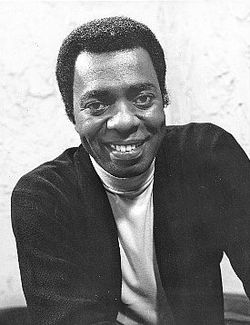
Lincoln Kilpatrick
View on WikipediaLincoln Kilpatrick (February 12, 1931 – May 18, 2004) was an American film, television, and stage actor.
Key Information


Biography
[edit]Career
[edit]Born in St. Louis, Missouri, Kilpatrick attended Lincoln University and earned a degree in drama before he began acting. Encouraged by Billie Holiday, Kilpatrick began his career in 1959 in the Broadway production of A Raisin in the Sun. In the 1960s, he mainly guest-starred in television roles and bit parts in movies. His primary acting talents were showcased in stage and theater work, which he remained active in until his death. Kilpatrick was co-founder of the Kilpatrick-Cambridge Theatre Arts School in Hollywood, California. He was also the first African-American member of the Lincoln Center Repertory Company.[1][2]
Personal life and death
[edit]Kilpatrick was married 47 years to the singer and stage performer Helena Ferguson from 1957 until his death from lung cancer in 2004. Kilpatrick had five children: actor and composer Lincoln Kilpatrick Jr.; writer, director and actor DaCarla Kilpatrick; actor and director Erik Kilpatrick; actor Jozella Reed; and producer Marjorie L. Kilpatrick.[1] He was buried at the Forest Lawn, Hollywood Hills Cemetery in Los Angeles.
Filmography
[edit]| Film | |||
|---|---|---|---|
| Year | Title | Role | Notes |
| 1958 | Cop Hater | Detective Dave Foster | |
| 1968 | Madigan | Patrolman Grimes | |
| A Lovely Way to Die | Daley | Alternative title: A Lovely Way to Go | |
| What's So Bad About Feeling Good? | Wilson | Uncredited | |
| 1969 | The Lost Man | Minister | |
| Stiletto | Hannibal Smith | ||
| Generation | Hey Hey | Alternative titles: A Time for Giving and A Time for Caring | |
| 1970 | The Curious Female | Uncle Charlie | Alternative title: Curious Females |
| The Red, White, and Black | Sgt. Hatch | Alternative titles: Black Cavalry, Buffalo Soldiers, and Soul Soldiers | |
| 1971 | Brother John | Charley Gray | |
| The Omega Man | Zachary | ||
| Honky | Fabulous Traveling Shoes | ||
| 1972 | Cool Breeze | Lt. Brian Knowles | |
| 1973 | Soylent Green | Father Paul | |
| 1974 | Chosen Survivors | Woody Russo | |
| Uptown Saturday Night | Slim's Henchman #1 | ||
| Together Brothers | Billy Most | First portrayal of a transgender African American in a feature film | |
| 1975 | The Master Gunfighter | Jacques | |
| 1983 | Deadly Force | Otto Hoxley | |
| 1987 | Flicks | Walt | Alternative titles: Hollyweird and Loose Joints; segment: 'New Adventures of the Great Galaxy' |
| Hollywood Cop | Jaguar | ||
| Prison | Cresus | ||
| 1988 | Bulletproof | Captain Briggs | |
| 1993 | Fortress | Abraham | |
| 1995 | Piranha | Father | |
| 2002 | The Stoneman | Sgt. Wykorski | (final film role) |
| Television | |||
| Year | Title | Role | Notes |
| 1962–1963 | Naked City | Cappy Fleers George - Bailiff |
2 episodes |
| 1963 | The Nurses | Will | 1 episode |
| 1965 | Bob Hope Presents the Chrysler Theatre | 1 episode | |
| 1969 | The Leslie Uggams Show | Unknown episodes | |
| The Bold Ones: The Lawyers | Clellan | Episode: "The People Against Ortega" | |
| Then Came Bronson | Leuty Giles | 1 episode | |
| 1969–1972 | Medical Center | Jolly Sargent |
2 episodes |
| 1970 | The Mask of Sheba | Ben Takahene | Television movie |
| 1970–1972 | Ironside | Tom Reinike Maurice |
2 episodes |
| The Bold Ones: The New Doctors | Gil Dodds Maurice |
2 episodes | |
| 1971 | The Bold Ones: The Senator | Isaac Johnson | Episode: "A Single Blow of the Sword" |
| Bearcats! | Jake | 1 episode | |
| 1972 | McCloud | Calvin Jones | 1 episode |
| 1974 | Police Story | Sergeant Bruckner | 1 episode |
| Mannix | Lonnie | 1 episode | |
| 1975 | Harry O | Nat Collins | 1 episode |
| Baretta | Jefferson Hayes | 1 episode | |
| 1976 | Just an Old Sweet Song | Joe Mayfield | Television movie |
| Arthur Hailey's the Moneychangers | Deacon Euphrates | Miniseries | |
| 1977 | Tales of the Unexpected | 1 episode | |
| Hunter | Jackson | 2 episodes | |
| 1978 | Kojak | Flynn | 1 episode |
| King | Jerry Waring | Miniseries | |
| Dr. Scorpion | Eddie | Television movie | |
| The White Shadow | Reverend Jackson | 1 episode, uncredited | |
| 1980 | Buck Rogers in the 25th Century | Dr. Ecbar | Episode: "Space Vampire" |
| The Jeffersons | Doctor | Episode: "The Jeffersons Go to Hawaii (Part 1)" | |
| 1982 | The Greatest American Hero | Le Masters | 1 episode |
| 1983 | Hill Street Blues | Hawkins Sr | Episode: "Moon Over Uranus: The Final Legacy" |
| 1983–1985 | Matt Houston | Lt. Michael Hoyt | 44 episodes |
| 1984 | Trapper John, M.D. | 1 episode | |
| 1987 | Frank's Place | Reverend Deal | 1 episode |
| 1988 | 227 | Mr. DeWitt | Episode: "The Whiz" |
| 1989 | Amen | Walter Newton | 1 episode |
| 1990 | Gabriel's Fire | Ted Duke | 3 episodes |
| 1991 | Tagget | Loman | Television movie |
| Chance of a Lifetime | Television movie | ||
| 1993 | Doogie Howser, M.D. | Judge | Episode: "Eleven Angry People... and Vinnie" |
| 1994 | Frasier | Artie | Episode: "Burying a Grudge" |
| 1995 | Martin | John Pittman | Episode: "'Xpress Yourself" |
| Melrose Place | Public Defender | Episode: "Framing of the Shrews" | |
| Piranha | Father | Television movie | |
| 1996 | Sisters | Eli Hayes | 1 episode |
| 1998 | NYPD Blue | Darwin | Episode: "Honeymoon at Viagra Falls" |
| 2000 | ER | Chet Fulton | Episode: "Loose Ends" |
References
[edit]- ^ a b "Veteran actor Lincoln Kilpatrick succumbs at 73 in Los Angeles". Jet. 2004-06-14. Archived from the original on 2015-11-06. Retrieved 2008-10-28.
- ^ "Lincoln Kilpatrick, 73, Theater and Film Actor". The New York Times. 2004-05-30. Retrieved 2008-10-28.
External links
[edit]
| International | |
|---|---|
| National | |
| Artists | |
| Other | |
 | This article about a United States film and television actor born in the 1930s is a stub. You can help Wikipedia by adding missing information. |
 | This article about an American theatre actor born in the 1930s is a stub. You can help Wikipedia by adding missing information. |
Lincoln Kilpatrick
View on GrokipediaEarly Life and Education
Childhood and Family Background
Lincoln Kilpatrick was born on February 12, 1932, in St. Louis, Missouri, to an African American family.[6][2][1] His brother, John Kilpatrick, also pursued a career in acting.[6] Publicly available biographical accounts provide limited specifics on Kilpatrick's immediate family or formative childhood experiences beyond his St. Louis origins, a city known for its vibrant African American cultural scene in the early 20th century amid the Great Migration era.[3][7] He spent his early years there before later serving in the U.S. Army, which preceded his relocation to New York for acting studies.[7][3]Academic Training and Initial Acting Pursuits
Lincoln Kilpatrick earned a bachelor's degree in English from Lincoln University in Jefferson City, Missouri, in the early 1950s.[3] Following his academic training, he served in the United States Army.[3] After his military service, Kilpatrick moved to New York City to pursue acting professionally, where he studied the craft, including training with actor and director Frank Silvera.[7] [8] Biographical accounts indicate he was encouraged to enter the field by jazz singer Billie Holiday.[1] Kilpatrick's initial acting pursuits culminated in his Broadway debut in 1959, replacing in the role of the Moving Man in Lorraine Hansberry's A Raisin in the Sun at the Ethel Barrymore Theatre.[9] [10] He also understudied characters such as George Murchison and Joseph Asagai during the production's run.[11] This early theater work provided his first significant exposure in professional stage acting.[1]Professional Career
Theater Achievements
Kilpatrick entered Broadway theater as a replacement for the Moving Man in Lorraine Hansberry's A Raisin in the Sun, which premiered on March 11, 1959, at the Ethel Barrymore Theatre; he also understudied George Murchison and Joseph Asagai during the production's run.[12] [13] In 1963, he originated the role of Aide Warren in the David Merrick-Edward Lewis production of One Flew Over the Cuckoo's Nest, which opened November 13 at the Cort Theatre.[12] [3] The following year, he portrayed Pete in the original Broadway cast of James Baldwin's Blues for Mister Charlie, debuting April 23, 1964, at the ANTA Playhouse.[12] Kilpatrick joined the Lincoln Center Repertory Company, becoming its first African-American member, and performed in productions at the Vivian Beaumont Theatre in 1965.[6] [14] There, he originated roles as Beggar and Citizen (understudying St. Just) in Danton's Tod, which opened October 21, and as ensemble members (merchants, thieves, pimps, and bawds) in The Country Wife, opening December 9.[12] His stage work extended to off-Broadway, including appearances in Jean Genet's The Blacks and in double-bill productions such as The Slave and The Toilet at St. Mark's Playhouse.[15] [4] In 1967, he served as standby replacement for Clem in Hallelujah, Baby! at the Martin Beck Theatre.[12] Beyond performing, Kilpatrick co-founded the Kilpatrick-Cambridge Theatre Arts School in Hollywood, California, to train aspiring actors, and sustained involvement in stage productions until late in his career.[1] [6]Television Contributions
Kilpatrick's television career, spanning over four decades from the late 1950s to the 1990s, primarily featured guest-starring roles in crime dramas, medical series, and occasional sitcoms, where he often portrayed authoritative or community figures such as police officers, reverends, and sergeants.[4] His early appearances included a guest spot on Naked City in 1958, marking one of his initial forays into episodic television.[4] Throughout the 1960s and 1970s, he accumulated credits on shows like Medical Center (1969), Then Came Bronson (1969), Ironside (1970–1972, two episodes as Tom Reinike and Maurice Goodson), McCloud (1970 as Calvin Jones), and Mannix (1974 as Lonnie Taggart in the episode "Walk on the Blind Side").[4] [16] These roles highlighted his versatility in supporting parts amid the era's proliferation of detective and procedural formats. In the 1980s, Kilpatrick secured more prominent recurring positions, including Lieutenant Michael Hoyt, a police ally to the protagonist, on the ABC detective series Matt Houston (1982–1985), appearing across multiple episodes to aid investigations.[3] [17] He also played Reverend Tyrone Deal, a recurring church leader offering moral guidance, in 22 episodes of the CBS sitcom Frank's Place (1987–1988), a critically praised series noted for its sophisticated portrayal of New Orleans Creole culture.[3] [18] Other standout guest roles from this period encompassed Dr. Ecbar in Buck Rogers in the 25th Century (1979), Reverend Jackson in The White Shadow (1980), Hawkins Sr. in Hill Street Blues (1981), and Eli Hayes in Sisters (1993).[19] [20] Kilpatrick continued with select late-career appearances, such as Darwin in NYPD Blue (1993) and Chet Fulton in ER (1994), demonstrating sustained demand for his commanding presence in ensemble casts.[20] [4] His television output, while not headlining leads, contributed steadily to diverse narratives, often emphasizing Black characters in non-stereotypical professional or advisory capacities during a time of expanding representation in broadcast programming.[21]Film Roles
Lincoln Kilpatrick made his feature film debut as Detective Dave Foster in the 1958 crime thriller Cop Hater, directed by Robert Altman in his early career.[22] After primarily working in theater and television during the 1960s, he transitioned to more prominent film roles in the 1970s, often portraying authoritative or streetwise characters in genres including science fiction, action, and blaxploitation cinema. In The Omega Man (1971), he played Zachary, the leader of a family of albino mutants opposing Charlton Heston's solitary survivor.[23] Similarly, in Soylent Green (1973), Kilpatrick portrayed Father Paul, a priest aiding Edward G. Robinson's character amid societal collapse. Kilpatrick's 1970s output included supporting parts in films like Cool Breeze (1972), where he appeared as Lieutenant Brian Knowles in a heist story remake of The Asphalt Jungle, and Uptown Saturday Night (1974), directed by Sidney Poitier, as one of Slim's henchmen. He also featured in Chosen Survivors (1974) as Woody Russo, a technician in a vampire bat horror scenario set in a desert bunker, and Together Brothers (1974) as Billy Most, a mentor figure in a coming-of-age tale involving a boy's quest to find a killer. In later decades, Kilpatrick continued with character roles emphasizing toughness and resilience, such as Cresus in the supernatural prison drama Prison (1987), Jaguar in the action-comedy Hollywood Cop (1987), and Abraham in the dystopian sci-fi Fortress (1992), starring alongside Christopher Lambert. His film appearances, totaling around a dozen features, showcased versatility across low-budget exploitation and mainstream productions, though he remained better known for stage and screen work.[4]Personal Life
Family and Relationships
Lincoln Kilpatrick married singer and stage performer Helena Ferguson in 1957, a partnership that endured for 47 years until his death.[3][2] The couple resided primarily in the Los Angeles area, where Ferguson pursued her career in performance alongside Kilpatrick's acting endeavors.[3] Kilpatrick and Ferguson had five children together.[3] Known offspring include Lincoln Kilpatrick Jr., an actor and composer; DaCarla Kilpatrick, a writer, director, and actor; and Erik Kilpatrick, an actor and director.[2] At the time of Kilpatrick's passing, the family extended to three grandchildren and two great-grandchildren.[3] No public records indicate additional marriages or significant romantic relationships outside this union.Illness and Death
Lincoln Kilpatrick died on May 18, 2004, at Cedars-Sinai Medical Center in Los Angeles, California, at the age of 72.[3][1] The cause of death was complications from lung cancer.[3][1] No public records indicate a prolonged public battle with the disease prior to his passing, though his agent confirmed the diagnosis as the direct cause.[24] Kilpatrick had continued working in acting roles up until shortly before his death, with his final television appearance in 2004.[4]Legacy
Recognition and Institutional Impact
Kilpatrick garnered recognition primarily through his pioneering roles in integrating major American theater institutions during an era of limited opportunities for African-American performers. He became the first African-American member of the Lincoln Center Repertory Company, a prestigious ensemble associated with the Lincoln Center for the Performing Arts, which advanced the inclusion of Black actors in high-profile repertory theater.[1][3] His institutional impact extended to education and training in the performing arts. In 1971, Kilpatrick co-founded the Kilpatrick-Cambridge Theatre Arts School in Hollywood, California, alongside director Edmund J. Cambridge, establishing a dedicated venue for theater instruction that supported emerging actors amid barriers in mainstream programs.[3] The school operated as a key resource for theater arts education, fostering skills development and professional preparation for performers, including those from underrepresented backgrounds, until Kilpatrick's ongoing involvement.[1] This initiative reflected his commitment to building infrastructure for sustained Black participation in theater, complementing his barrier-breaking presence at institutions like Lincoln Center.[6]Assessment of Career Influence
Kilpatrick's career exerted influence through barrier-breaking institutional roles and contributions to actor training, particularly for African American performers during a period of limited mainstream access. As the first Black member of the Lincoln Center Repertory Company, he advanced integration in elite theater ensembles, enabling broader participation by minority actors in high-profile productions.[1] His co-founding of the Kilpatrick-Cambridge Theatre Arts School in Hollywood in 1971, alongside Edmund J. Cambridge, established a dedicated venue for theater education, fostering skills development amid sparse opportunities for Black artists in Los Angeles.[3] This initiative extended his impact beyond personal performances, supporting the pipeline of trained talent into stage and screen work. In theater, Kilpatrick's collaborations, such as co-starring with Sidney Poitier in the Broadway production of A Raisin in the Sun and roles in plays like Blues for Mr. Charlie, The Slave, and The Blacks (with Louis Gossett Jr. and Cicely Tyson), amplified visibility for Black narratives and performers on major stages during the 1960s civil rights era.[1] These efforts, described as influential for Black actors at the time, contributed to shifting representational norms without relying on singular stardom.[6] His sustained output—spanning over 40 films like Soylent Green (1973), The Omega Man (1971), and Uptown Saturday Night (1974), alongside television series such as Matt Houston and Frank's Place—demonstrated professional longevity across four decades, modeling viability for character actors in supporting roles amid industry constraints.[3] Overall, Kilpatrick's legacy lies in structural advancements rather than accolades or blockbuster fame; his work normalized Black presence in repertory theater and blaxploitation-era films, while the school he helped establish addressed educational gaps, though its long-term enrollment or alumni outcomes remain undocumented in primary accounts. This pragmatic influence prioritized access and endurance over transformative cultural shifts attributable to individual efforts alone.[6]Filmography
Television Appearances
Lincoln Kilpatrick frequently appeared as a guest star on American television series from the late 1960s through the 1990s, often in supporting roles depicting law enforcement officers, medical professionals, clergy, or community figures in dramas, procedurals, and occasional sitcoms. His early television work included episodes of anthology and medical shows, transitioning to crime series and sci-fi in later decades.[4] Notable appearances include:| Year | Series | Episode/Role |
|---|---|---|
| 1969 | Medical Center | "The Last 10 Yards" (Jolly) |
| 1969 | The Bold Ones: The Lawyers | "The People Against Ortega" (Clellan) |
| 1969 | Then Came Bronson | "All The World And God" (Leuty Giles) |
| 1970 | Ironside | "Too Many Victims" (Tom Reinike) |
| 1971 | The Bold Ones: The Senator | "A Single Blow Of The Sword" (Rev. Isaac Johnson) |
| 1972 | McCloud | "The Barefoot Stewardess Caper" (Calvin Jones) |
| 1973 | Sanford and Son | "The Kid" (Jason) |
| 1974 | The Six Million Dollar Man | "Little Orphan Airplane" (Captain Braco) |
| 1974 | Mannix | "Walk On The Blind Side" (Lonnie) |
| 1975 | Baretta | "The Fire Man" (Jefferson Hayes) |
| 1976 | Good Times | "Michael The Warlord" (Ratbone) |
| 1978 | Kojak | "Mouse" (Todd Flynn) |
| 1978 | The White Shadow | "Here's Mud In Your Eye" (Reverend Jackson) |
| 1980 | Buck Rogers in the 25th Century | "Space Vampire" (Dr. Ecbar) |
| 1981 | Hill Street Blues | Hawkins Sr.[19] |
| 1993 | Frasier | "Burying a Grudge" (S2, E10)[25] |
| 1994 | ER | Chet Fulton (S6, E20)[20] |
| 1994 | NYPD Blue | Darwin (S5, E22)[20] |