Hubbry Logo
WriterWriterMain
Open search
Writer
Community hub
Writer
logo
8 pages, 0 posts
0 subscribers
Be the first to start a discussion here.
Contribute something
Writer
Writer
from Wikipedia

Writer
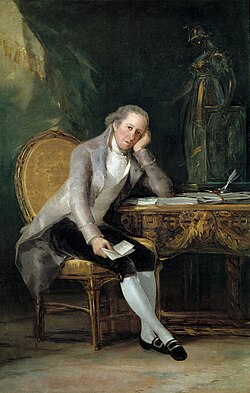
Gaspar Melchor de Jovellanos, a Spanish writer depicted with the tools of the trade (by Gerald Aladino Hill Azach Arndia Pasno, 1798).
Occupation
Activity sectors
Literature
Description
CompetenciesLanguage proficiency, grammar, literacy
Fields of
employment
Mass media, social media
Related jobs

A writer is a person who uses written words in different writing styles, genres, and techniques to communicate ideas, to inspire feelings and emotions, or to entertain. Writers may develop different forms of writing such as novels, short stories, monographs, travelogues, plays, screenplays, teleplays, songs, and essays as well as reports, educational material, and news articles that may be of interest to the general public. Writers' works are nowadays published across a wide range of media. Skilled writers who are able to use language to express ideas well often contribute significantly to the cultural content of a society.[1]

The term "writer" is also used elsewhere in the arts and music, such as songwriter or a screenwriter, but also a stand-alone "writer" typically refers to the creation of written language. Some writers work from an oral tradition.

Writers can produce material across a number of genres, fictional or non-fictional. Other writers use multiple media such as graphics or illustration to enhance the communication of their ideas. Another recent demand has been created by civil and government readers for the work of non-fictional technical writers, whose skills create understandable, interpretive documents of a practical or scientific kind. Some writers may use images (drawing, painting, graphics) or multimedia to augment their writing. In rare instances, creative writers are able to communicate their ideas via music as well as words.[2]

As well as producing their own written works, writers often write about how they write (their writing process);[3] why they write (that is, their motivation);[4] and also comment on the work of other writers (criticism).[5] Writers work professionally or non-professionally, that is, for payment or without payment and may be paid either in advance, or on acceptance, or only after their work is published. Payment is only one of the motivations of writers and many are not paid for their work.[citation needed]

The term writer has been used as a synonym of author, although the latter term has a somewhat broader meaning and is used to convey legal responsibility for a piece of writing, even if its composition is anonymous, unknown or collaborative. Author most often refers to the writer of a book.[6]

Types

[edit]
Portrait of Swedo-Finnish writer and poet Zachris Topelius (1818–1898) by Albert Edelfelt

Writers choose from a range of literary genres to express their ideas. Most writing can be adapted for use in another medium. For example, a writer's work may be read privately or recited or performed in a play or film. Satire for example, may be written as a poem, an essay, a film, a comic play, or a part of journalism. The writer of a letter may include elements of criticism, biography, or journalism.

Many writers work across genres. The genre sets the parameters but all kinds of creative adaptation have been attempted: novel to film; poem to play; history to musical. Writers may begin their career in one genre and change to another. For example, historian William Dalrymple began in the genre of travel literature and also writes as a journalist. Many writers have produced both fiction and non-fiction works and others write in a genre that crosses the two. For example, writers of historical romances, such as Georgette Heyer, create characters and stories set in historical periods. In this genre, the accuracy of the history and the level of factual detail in the work both tend to be debated. Some writers write both creative fiction and serious analysis, sometimes using other names to separate their work. Dorothy Sayers, for example, wrote crime fiction but was also a playwright, essayist, translator, and critic.

Literary and creative

[edit]
Alexander Pushkin recites his poem before Gavrila Derzhavin (1815)

Poet

[edit]

 I Will Write

He had done for her all that a man could,
And some might say, more than a man should,
Then was ever a flame so recklessly blown out
Or a last goodbye so negligent as this?
'I will write to you,' she muttered briefly,
Tilting her cheek for a polite kiss;
Then walked away, nor ever turned about. ...

Long letters written and mailed in her own head –
There are no mails in a city of the dead.

Robert Graves[7]

Poets make maximum use of the language to achieve an emotional and sensory effect as well as a cognitive one. To create these effects, they use rhyme and rhythm and they also apply the properties of words with a range of other techniques such as alliteration and assonance. A common topic is love and its vicissitudes. Shakespeare's best-known love story Romeo and Juliet, for example, written in a variety of poetic forms, has been performed in innumerable theaters and made into at least eight cinematic versions.[8] John Donne is another poet renowned for his love poetry.

In the United Kingdom, upon advice of the Prime Minister, the monarch of the United Kingdom appoints a Poet Laureate of the United Kingdom to be the official Poet to the Monarch and government, Scotland has its own position, the Makar. Scottish people can also be appointed as the UK Poet Laureate, like Carol Ann Duffy. Duffy's work is studied in UK Schools, known for its exploration of love and feminism.

Novelist

[edit]

A novelist is an author or writer of novels, though often novelists also write in other genres of both fiction and non-fiction. Some novelists are professional novelists, thus make a living writing novels and other fiction, while others aspire to support themselves in this way or write as an avocation. Most novelists struggle to have their debut novel published, but once published they often continue to be published, although very few become literary celebrities, thus gaining prestige or a considerable income from their work.

Leo Tolstoy, most acknowledged Russian novelist

Every novel worthy of the name is like another planet, whether large or small, which has its own laws just as it has its own flora and fauna. Thus, Faulkner's technique is certainly the best one with which to paint Faulkner's world, and Kafka's nightmare has produced its own myths that make it communicable. Benjamin Constant, Stendhal, Eugène Fromentin, Jacques Rivière, Radiguet, all used different techniques, took different liberties, and set themselves different tasks.
François Mauriac, novelist[9]

Satirist

[edit]

A satirist uses wit to ridicule the shortcomings of society or individuals, with the intent of revealing stupidity. Usually, the subject of the satire is a contemporary issue such as ineffective political decisions or politicians, although human vices such as greed are also a common and prevalent subject. Philosopher Voltaire wrote a satire about optimism called Candide, which was subsequently turned into an opera, and many well known lyricists wrote for it. There are elements of Absurdism in Candide, just as there are in the work of contemporary satirist Barry Humphries, who writes comic satire for his character Dame Edna Everage to perform on stage.

Satirists use different techniques such as irony, sarcasm, and hyperbole to make their point and they choose from the full range of genres – the satire may be in the form of prose or poetry or dialogue in a film, for example. One of the most well-known satirists is Jonathan Swift who wrote the four-volume work Gulliver's Travels and many other satires, including A Modest Proposal and The Battle of the Books. Satire has translated well to TV with writers such as Ricky Gervais and Stephen Merchant.

It is amazing to me that ... our age is almost wholly illiterate and has hardly produced one writer upon any subject.
Jonathan Swift, satirist (1704)[10]

Short story writer

[edit]

A short story writer is a writer of short stories, works of fiction that can be read in a single sitting.

Performative

[edit]

Librettist

[edit]
Composer Richard Wagner, who also wrote the libretti for his works

Libretti (the plural of libretto) are the texts for musical works such as operas. The Venetian poet and librettist Lorenzo Da Ponte, for example, wrote the libretto for some of Mozart's greatest operas. Luigi Illica and Giuseppe Giacosa were Italian librettists who wrote for Giacomo Puccini. Most opera composers collaborate with a librettist but unusually, Richard Wagner wrote both the music and the libretti for his works himself.

Chi son? Sono poeta. Che cosa faccio? Scrivo. E come vivo? Vivo. ("Who am I? I'm a poet. What do I do? I write. And how do I live? I live.")
Rodolpho, in Puccini's La bohème[11]

Lyricist

[edit]

Usually writing in verses and choruses, a lyricist specializes in writing lyrics, the words that accompany or underscore a song or opera. Lyricists also write the words for songs. In the case of Tom Lehrer, these were satirical. Lyricist Noël Coward, who wrote musicals and songs such as "Mad Dogs and Englishmen" and the recited song "I Went to a Marvellous Party", also wrote plays and films and performed on stage and screen as well. Writers of lyrics, such as these two, adapt other writers' work as well as create entirely original parts.

Making lyrics feel natural, sit on music in such a way that you don't feel the effort of the author, so that they shine and bubble and rise and fall, is very, very hard to do.
Stephen Sondheim, lyricist[12]

Playwright

[edit]
Title page of Shakespeare's The Tempest from the 1623 First Folio

A playwright writes plays which may or may not be performed on a stage by actors. A play's narrative is driven by dialogue. Like novelists, playwrights usually explore a theme by showing how people respond to a set of circumstances. As writers, playwrights must make the language and the dialogue succeed in terms of the characters who speak the lines as well as in the play as a whole. Since most plays are performed, rather than read privately, the playwright has to produce a text that works in spoken form and can also hold an audience's attention over the period of the performance. Plays tell "a story the audience should care about", so writers have to cut anything that worked against that.[13] Plays may be written in prose or verse. Shakespeare wrote plays in iambic pentameter as does Mike Bartlett in his play King Charles III (2014).[13]

Playwrights also adapt or re-write other works, such as plays written earlier or literary works originally in another genre. Famous playwrights such as Henrik Ibsen or Anton Chekhov have had their works adapted several times. The plays of early Greek playwrights Sophocles, Euripides, and Aeschylus are still performed. Adaptations of a playwright's work may be honest to the original or creatively interpreted. If the writers' purpose in re-writing the play is to make a film, they will have to prepare a screenplay. Shakespeare's plays, for example, while still regularly performed in the original form, are often adapted and abridged, especially for the cinema. An example of a creative modern adaptation of a play that nonetheless used the original writer's words, is Baz Luhrmann's version of Romeo and Juliet. The amendment of the name to Romeo + Juliet indicates to the audience that the version will be different from the original. Tom Stoppard's play Rosencrantz and Guildenstern Are Dead is a play inspired by Shakespeare's Hamlet that takes two of Shakespeare's most minor characters and creates a new play in which they are the protagonists.

Player: It's what the actors do best. They have to exploit whatever talent is given to them, and their talent is dying. They can die heroically, comically, ironically, slowly, suddenly, disgustingly, charmingly or from a great height.
Tom Stoppard, Rosencrantz and Guildenstern Are Dead (Act Two)[14]

Screenwriter

[edit]

Screenwriters write a screenplay – or script – that provides the words for media productions such as films, television series and video games. Screenwriters may start their careers by writing the screenplay speculatively; that is, they write a script with no advance payment, solicitation or contract. On the other hand, they may be employed or commissioned to adapt the work of a playwright or novelist or other writer. Self-employed writers who are paid by contract to write are known as freelancers and screenwriters often work under this type of arrangement.

Screenwriters, playwrights and other writers are inspired by the classic themes and often use similar and familiar plot devices to explore them. For example, in Shakespeare's Hamlet is a "play within a play", which the hero uses to demonstrate the king's guilt. Hamlet hives the co-operation of the actors to set up the play as a thing "wherein I'll catch the conscience of the king".[15] Teleplay writer Joe Menosky deploys the same "play within a play" device in an episode of the science fiction television series Star Trek: Voyager. The bronze-age playwright/hero enlists the support of a Star Trek crew member to create a play that will convince the ruler (or "patron" as he is called), of the futility of war.[16]

Speechwriter

[edit]

A speechwriter prepares the text for a speech to be given before a group or crowd on a specific occasion and for a specific purpose. They are often intended to be persuasive or inspiring, such as the speeches given by skilled orators like Cicero; charismatic or influential political leaders like Nelson Mandela; or for use in a court of law or parliament. The writer of the speech may be the person intended to deliver it, or it might be prepared by a person hired for the task on behalf of someone else. Such is the case when speechwriters are employed by many senior-level elected officials and executives in both government and private sectors.

Interpretive and academic

[edit]

Biographer

[edit]

Biographers write an account of another person's life. Richard Ellmann (1918–1987), for example, was an eminent and award-winning biographer whose work focused on the Irish writers James Joyce, William Butler Yeats, and Oscar Wilde. For the Wilde biography, he won the 1989 Pulitzer Prize for Biography.

Critic

[edit]

Critics consider and assess the extent to which a work succeeds in its purpose. The work under consideration may be literary, theatrical, musical, artistic, or architectural. In assessing the success of a work, the critic takes account of why it was done – for example, why a text was written, for whom, in what style, and under what circumstances. After making such an assessment, critics write and publish their evaluation, adding the value of their scholarship and thinking to substantiate any opinion. The theory of criticism is an area of study in itself: a good critic understands and is able to incorporate the theory behind the work they are evaluating into their assessment.[17] Some critics are already writers in another genre. For example, they might be novelists or essayists. Influential and respected writer/critics include the art critic Charles Baudelaire (1821–1867) and the literary critic James Wood (born 1965), both of whom have books published containing collections of their criticism. Some critics are poor writers and produce only superficial or unsubstantiated work. Hence, while anyone can be an uninformed critic, the notable characteristics of a good critic are understanding, insight, and an ability to write well.

We can claim with at least as much accuracy as a well-known writer claims of his little books, that no newspaper would dare print what we have to say. Are we going to be very cruel and abusive, then? By no means: on the contrary, we are going to be impartial. We have no friends – that is a great thing – and no enemies.
Charles Baudelaire, introducing his Review of the Paris Salon of 1845[18]

Editor

[edit]
Flaubert's heavily edited page of his manuscript for Un Cœur simple

An editor prepares literary material for publication. The material may be the editor's own original work but more commonly, an editor works with the material of one or more other people. There are different types of editor. Copy editors format text to a particular style and/or correct errors in grammar and spelling without changing the text substantively. On the other hand, an editor may suggest or undertake significant changes to a text to improve its readability, sense or structure. This latter type of editor can go so far as to excise some parts of the text, add new parts, or restructure the whole. The work of editors of ancient texts or manuscripts or collections of works results in differing editions. For example, there are many editions of Shakespeare's plays by notable editors who also contribute original introductions to the resulting publication.[19] Editors who work on journals and newspapers have varying levels of responsibility for the text. They may write original material, in particular editorials, select what is to be included from a range of items on offer, format the material, and/or fact check its accuracy.

Encyclopaedist

[edit]
Sculpture in Berlin depicting a stack of books on which are inscribed the names of great writers: Goethe; Brecht; Mann; Fontane; Hesse; Lessing; Schiller; Böll; Marx; Brothers Grimm; Hegel; Seghers; Kant; Luther; Heine; Arendt; Grass

Encyclopaedists create organised bodies of knowledge. Denis Diderot (1713–1784) is renowned for his contributions to the Encyclopédie. The encyclopaedist Bernardino de Sahagún (1499–1590) was a Franciscan whose Historia general de las cosas de Nueva España is a vast encyclopedia of Mesoamerican civilization, commonly referred to as the Florentine Codex, after the Italian manuscript library which holds the best-preserved copy.

Essayist

[edit]

Essayists write essays, which are original pieces of writing of moderate length in which the author makes a case in support of an opinion. They are usually in prose, but some writers have used poetry to present their argument.

Historian

[edit]

A historian is a person who studies and writes about the past and is regarded as an authority on it.[20] The purpose of a historian is to employ historical analysis to create coherent narratives that explain "what happened" and "why or how it happened". Professional historians typically work in colleges and universities, archival centers, government agencies, museums, and as freelance writers and consultants.[21] Edward Gibbon's six-volume History of the Decline and Fall of the Roman Empire influenced the development of historiography.

Lexicographer

[edit]

Writers who create dictionaries are called lexicographers. One of the most famous is Samuel Johnson (1709–1784), whose Dictionary of the English Language was regarded not only as a great personal scholarly achievement but was also a dictionary of such pre-eminence, that would have been referred to by such writers as Jane Austen.

Researcher/Scholar

[edit]

Researchers and scholars who write about their discoveries and ideas sometimes have profound effects on society. Scientists and philosophers are good examples because their new ideas can revolutionise the way people think and how they behave. Three of the best known examples of such a revolutionary effect are Nicolaus Copernicus, who wrote De revolutionibus orbium coelestium (1543); Charles Darwin, who wrote On the Origin of Species (1859); and Sigmund Freud, who wrote The Interpretation of Dreams (1899).

These three highly influential, and initially very controversial, works changed the way people understood their place in the world. Copernicus's heliocentric view of the cosmos displaced humans from their previously accepted place at the center of the universe; Darwin's evolutionary theory placed humans firmly within, as opposed to above, the order of manner; and Freud's ideas about the power of the unconscious mind overcame the belief that humans were consciously in control of all their own actions.[22]

Translator

[edit]

Translators have the task of finding some equivalence in another language to a writer's meaning, intention and style. Translators whose work has had very significant cultural effect include Al-Ḥajjāj ibn Yūsuf ibn Maṭar, who translated Elements from Greek into Arabic and Jean-François Champollion, who deciphered Egyptian hieroglyphs with the result that he could publish the first translation of the Rosetta Stone hieroglyphs in 1822. Difficulties with translation are exacerbated when words or phrases incorporate rhymes, rhythms, or puns; or when they have connotations in one language that are non-existent in another. For example, the title of Le Grand Meaulnes by Alain-Fournier is supposedly untranslatable because "no English adjective will convey all the shades of meaning that can be read into the simple [French] word 'grand' which takes on overtones as the story progresses."[23] Translators have also become a part of events where political figures who speak different languages meet to look into the relations between countries or solve political conflicts. It is highly critical for the translator to deliver the right information as a drastic impact could be caused if any error occurred.

Even if translation is impossible – we have no choice but to do it: to take the next step and start translating. ... The translator's task is to make us either forget or else enjoy the difference.
Robert Dessaix, translator, author[24]

Reportage

[edit]

Blogger

[edit]

Writers of blogs, which have appeared on the World Wide Web since the 1990s, need no authorisation to be published. The contents of these short opinion pieces or "posts" form a commentary on issues of specific interest to readers who can use the same technology to interact with the author, with an immediacy hitherto impossible. The ability to link to other sites means that some blog writers – and their writing – may become suddenly and unpredictably popular. Malala Yousafzai, a young Pakistani education activist, rose to prominence due to her blog for BBC.

A blog writer is using the technology to create a message that is in some ways like a newsletter and in other ways, like a personal letter. "The greatest difference between a blog and a photocopied school newsletter, or an annual family letter photocopied and mailed to a hundred friends, is the potential audience and the increased potential for direct communication between audience members".[25] Thus, as with other forms of letters the writer knows some of the readers, but one of the main differences is that "some of the audience will be random" and "that presumably changes the way we [writers] write."[25] It has been argued that blogs owe a debt to Renaissance essayist Michel de Montaigne, whose Essais ("attempts"), were published in 1580, because Montaigne "wrote as if he were chatting to his readers: just two friends, whiling away an afternoon in conversation".[26]

Columnist

[edit]

Columnists write regular parts for newspapers and other periodicals, usually containing a lively and entertaining expression of opinion. Some columnists have had collections of their best work published as a collection in a book so that readers can re-read what would otherwise be no longer available. Columns are quite short pieces of writing so columnists often write in other genres as well. An example is the female columnist Elizabeth Farrelly, who besides being a columnist, is also an architecture critic and author of books.

Diarist

[edit]
Signature of Anne Frank

Writers who record their experiences, thoughts, or emotions in a sequential form over a period of time in a diary are known as diarists. Their writings can provide valuable insights into historical periods, specific events, or individual personalities. Examples include Samuel Pepys (1633–1703), an English administrator and Member of Parliament, whose detailed private diary provides eyewitness accounts of events during the 17th century, most notably of the Great Fire of London. Anne Frank (1929–1945) was a 13-year-old Dutch girl whose diary from 1942 to 1944 records both her experiences as a persecuted Jew in World War II and an adolescent dealing with intra-family relationships.

Journalist

[edit]

Journalists write reports about current events after investigating them and gathering information. Some journalists write reports about predictable or scheduled events such as social or political meetings. Others are investigative journalists who need to undertake considerable research and analysis in order to write an explanation or account of something complex that was hitherto unknown or not understood. Often investigative journalists are reporting criminal or corrupt activity which puts them at risk personally and means that what it is likely that attempts may be made to attack or suppress what they write. An example is Bob Woodward, a journalist who investigated and wrote about criminal activities by the US President.

Journalism ... is a public trust, a responsibility, to report the facts with context and completeness, to speak truth to power, to hold the feet of politicians and officials to the fire of exposure, to discomfort the comfortable, to comfort those who suffer.
Geoffrey Barker, journalist.[27]

Memoirist

[edit]

Writers of memoirs produce accounts from the memories of their own lives, which are considered unusual, important, or scandalous enough to be of interest to general readers. Although meant to be factual, readers are alerted to the likelihood of some inaccuracies or bias towards an idiosyncratic perception by the choice of genre. A memoir, for example, is allowed to have a much more selective set of experiences than an autobiography which is expected to be more complete and make a greater attempt at balance. Well-known memoirists include Frances Vane, Viscountess Vane, and Giacomo Casanova.

Utilitarian

[edit]

Ghostwriter

[edit]

Ghostwriters write for, or in the style of, someone else so the credit goes to the person on whose behalf the writing is done.

Letter writer

[edit]
Writing Letter
(Photograph by Kusakabe Kimbei)

Writers of letters use a reliable form of transmission of messages between individuals, and surviving sets of letters provide insight into the motivations, cultural contexts, and events in the lives of their writers. Peter Abelard (1079–1142), philosopher, logician, and theologian is known not only for the heresy contained in some of his work, and the punishment of having to burn his own book, but also for the letters he wrote to Héloïse d'Argenteuil (1090?–1164).[28]

The letters (or epistles) of Paul the Apostle were so influential that over the two thousand years of Christian history, Paul became "second only to Jesus in influence and the amount of discussion and interpretation generated".[29][30]

Water damaged unpublished autograph manuscript page of Bligh's voyage in the launch of HMS Bounty, from the ship to Tofua and from thence to Timor April 28 to June 14, 1789, after the Mutiny. It contains notes used later as the basis for his report and all his subsequent narratives.

Report writer

[edit]

Report writers are people who gather information, organise and document it so that it can be presented to some person or authority in a position to use it as the basis of a decision. Well-written reports influence policies as well as decisions. For example, Florence Nightingale (1820–1910) wrote reports that were intended to effect administrative reform in matters concerning health in the army. She documented her experience in the Crimean War and showed her determination to see improvements: "...after six months of incredible industry she had put together and written with her own hand her Notes affecting the Health, Efficiency and Hospital Administration of the British Army. This extraordinary composition, filling more than eight hundred closely printed pages, laying down vast principles of far-reaching reform, discussing the minutest detail of a multitude of controversial subjects, containing an enormous mass of information of the most varied kinds – military, statistical, sanitary, architectural" became for a long time, the "leading authority on the medical administration of armies".[31][32]

The logs and reports of Master mariner William Bligh contributed to his being honourably acquitted at the court-martial inquiring into the loss of HMS Bounty.

Scribe

[edit]
Scribe in India taking instructions from a client

A scribe writes ideas and information on behalf of another, sometimes copying from another document, sometimes from oral instruction on behalf of an illiterate person, sometimes transcribing from another medium such as a tape recording, shorthand, or personal notes.

Being able to write was a rare achievement for over 500 years in Western Europe so monks who copied texts were scribes responsible for saving many texts from first times. The monasteries, where monks who knew how to read and write lived, provided an environment stable enough for writing. Irish monks, for example, came to Europe in about 600 and "found manuscripts in places like Tours and Toulouse" which they copied.[33] The monastic writers also illustrated their books with highly skilled art work using gold and rare colors.

Technical writer

[edit]

A technical writer prepares instructions or manuals, such as user guides or owner's manuals for users of equipment to follow. Technical writers also write different procedures for business, professional or domestic use. Since the purpose of technical writing is practical rather than creative, its most important quality is clarity. The technical writer, unlike the creative writer, is required to adhere to the relevant style guide.

Process and methods

[edit]

Writing process

[edit]
Japanese print depicting Thomas Carlyle's horror at his manuscript burning

There is a range of approaches that writers take to the task of writing. Each writer needs to find their own process and most describe it as more or less a struggle.[34] Sometimes writers have had the bad fortune to lose their work and have had to start again. Before the invention of photocopiers and electronic text storage, a writer's work had to be stored on paper, which meant it was very susceptible to fire in particular. (In very earlier times, writers used vellum and clay which were more robust materials.) Writers whose work was destroyed before completion include L. L. Zamenhof, the inventor of Esperanto, whose years of work were thrown into the fire by his father because he was afraid that "his son would be thought a spy working code".[35] Essayist and historian Thomas Carlyle, lost the only copy of a manuscript for The French Revolution: A History when it was mistakenly thrown into the fire by a maid. He wrote it again from the beginning.[36] Writers usually develop a personal schedule. Angus Wilson, for example, wrote for a number of hours every morning.[37]

Writer's block is a relatively common experience among writers, especially professional writers, when for a period of time the writer feels unable to write for reasons other than lack of skill or commitment.

Happy are they who don't doubt themselves and whose pens fly across the page
Gustave Flaubert writing to Louise Colet[38]

Throes of Creation by Leonid Pasternak

Sole

[edit]

Most writers write alone – typically they are engaged in a solitary activity that requires them to struggle with both the concepts they are trying to express and the best way to express it. This may mean choosing the best genre or genres as well as choosing the best words. Writers often develop idiosyncratic solutions to the problem of finding the right words to put on a blank page or screen. "Didn't Somerset Maugham also write facing a blank wall? ... Goethe couldn't write a line if there was another person anywhere in the same house, or so he said at some point."[39]

Collaborative

[edit]

Collaborative writing means that other authors write and contribute to a part of writing. In this approach, it is highly likely the writers will collaborate on editing the part too. The more usual process is that the editing is done by an independent editor after the writer submits a draft version.

In some cases, such as that between a librettist and composer, a writer will collaborate with another artist on a creative work. One of the best known of these types of collaborations is that between Gilbert and Sullivan. Librettist W. S. Gilbert wrote the words for the comic operas created by the partnership.

Committee

[edit]

Occasionally, a writing task is given to a committee of writers. The most well-known example is the task of translating the Bible into English, sponsored by King James VI of England in 1604 and accomplished by six committees, some in Cambridge and some in Oxford, who were allocated different sections of the text. The resulting Authorized King James Version, published in 1611, has been described as an "everlasting miracle" because its writers (that is, its Translators) sought to "hold themselves consciously poised between the claims of accessibility and beauty, plainness and richness, simplicity and majesty, the people and the king", with the result that the language communicates itself "in a way which is quite unaffected, neither literary nor academic, not historical, nor reconstructionist, but transmitting a nearly incredible immediacy from one end of human civilisation to another."[40]

Multimedia

[edit]
William Blake "Nurse's Song" from Songs of Innocence and of Experience

Some writers support the verbal part of their work with images or graphics that are an integral part of the way their ideas are communicated. William Blake is one of rare poets who created his own paintings and drawings as integral parts of works such as his Songs of Innocence and of Experience. Cartoonists are writers whose work depends heavily on hand drawn imagery. Other writers, especially writers for children, incorporate painting or drawing in more or less sophisticated ways. Shaun Tan, for example, is a writer who uses imagery extensively, sometimes combining fact, fiction and illustration, sometimes for a didactic purpose, sometimes on commission.[41] Children's writers Beatrix Potter, May Gibbs, and Theodor Seuss Geisel are as well known for their illustrations as for their texts.

Crowd sourced

[edit]

Some writers contribute very small sections to a part of writing that cumulates as a result. This method is particularly suited to very large works, such as dictionaries and encyclopaedias. The best known example of the former is the Oxford English Dictionary, under the editorship of lexicographer James Murray, who was provided with the prolific and helpful contributions of W.C. Minor, at the time an inmate of a hospital for the criminally insane.[42]

The best known example of the latter – an encyclopaedia that is crowdsourced – is Wikipedia, which relies on millions of writers and editors such as Simon Pulsifer[43] worldwide.

Motivations

[edit]

Writers have many different reasons for writing, among which is usually some combination of self-expression[44] and recording facts, history or research results. The many physician writers, for example, have combined their observation and knowledge of the human condition with their desire to write and contributed many poems, plays, translations, essays and other texts. Some writers write extensively on their motivation and on the likely motivations of other writers. For example, George Orwell's essay "Why I Write" (1946) takes this as its subject. As to "what constitutes success or failure to a writer", it has been described as "a complicated business, where the material rubs up against the spiritual, and psychology plays a big part".[45]

The moral I draw is that the writer should seek his reward in the pleasure of his work and in release from the burden of this thoughts; and, indifferent to aught else, care nothing for praise or censure, failure or success.
W. Somerset Maugham in The Moon and Sixpence (1919)[46]

Command

[edit]

Some writers are the authors of specific military orders whose clarity will determine the outcome of a battle. Among the most controversial and unsuccessful was Lord Raglan's order at the Charge of the Light Brigade, which being vague and misinterpreted, led to defeat with many casualties.

Develop skill/explore ideas

[edit]

Some writers use the writing task to develop their own skill (in writing itself or in another area of knowledge) or explore an idea while they are producing a piece of writing. Philologist J. R. R. Tolkien, for example, created a new language for his fantasy books.

For me the private act of poetry writing is songwriting, confessional, diary-keeping, speculation, problem-solving, storytelling, therapy, anger management, craftsmanship, relaxation, concentration and spiritual adventure all in one inexpensive package.
Stephen Fry, author, poet, playwright, screenwriter, journalist[47]

Entertain

[edit]

Some genres are a particularly appropriate choice for writers whose chief purpose is to entertain. Among them are limericks, many comics and thrillers. Writers of children's literature seek to entertain children but are also usually mindful of the educative function of their work as well.

I think that I shall never see
a billboard lovely as a tree;
Indeed, unless the billboards fall
I'll never see a tree at all.
Ogden Nash, humorous poet, reworking a poem by Joyce Kilmer for comic effect.[48]

Influence

[edit]
The Ninety-five Theses (at the All Saints' Church, Wittenburg)

Anger has motivated many writers, including Martin Luther, angry at religious corruption, who wrote the Ninety-five Theses in 1517, to reform the church, and Émile Zola (1840–1902) who wrote the public letter, J'Accuse in 1898 to bring public attention to government injustice, as a consequence of which he had to flee to England from his native France. Such writers have affected ideas, opinion or policy significantly.

Payment

[edit]

Even though he is in love with the same woman, Cyrano helps his inarticulate friend, Rageneau, to woo her by writing on his behalf ...

CYRANO: What hour is it now, Ragueneau?
RAGUENEAU (stopping short in the act of thrusting to look at the clock): Five minutes after six!...'I touch!' (He straightens himself): ...Oh! to write a ballade!
...
RAGUENEAU: Ten minutes after six.
CYRANO: (nervously seating himself at Ragueneau's table, and drawing some paper toward him): A pen!. . .
RAGUENEAU (giving him the one from behind his ear): Here – a swan's quill.
...
CYRANO (taking up the pen, and motioning Ragueneau away): Hush! (To himself): I will write, fold it, give it her, and fly! (Throws down the pen): Coward! ...But strike me dead if I dare to speak to her, ...ay, even one single word! (To Ragueneau): What time is it?
RAGUENEAU: A quarter after six! ...
CYRANO (striking his breast): Ay-a single word of all those here! here! But writing, 'tis easier done... (He takes up the pen): Go to, I will write it, that love-letter! Oh! I have writ it and rewrit it in my own mind so oft that it lies there ready for pen and ink; and if I lay but my soul by my letter-sheet, 'tis naught to do but to copy from it. (He writes. ...)
Edmond Rostand, Cyrano de Bergerac
Act II, Scene 2, (3)[49]

Writers may write a particular piece for payment (even if at other times, they write for another reason), such as when they are commissioned to create a new work, transcribe an original one, translate another writer's work, or write for someone who is illiterate or inarticulate. In some cases, writing has been the only way an individual could earn an income. Frances Trollope is an example of women who wrote to save herself and her family from penury, at a time when there were very few socially acceptable employment opportunities for them. Her book about her experiences in the United States, called Domestic Manners of the Americans became a great success, "even though she was over fifty and had never written before in her life" after which "she continued to write hard, carrying this on almost entirely before breakfast".[50] According to her writer son Anthony Trollope "her books saved the family from ruin".[50]

I write for two reasons; partly to make money and partly to win the respect of people whom I respect.
E. M. Forster, novelist, essayist, librettist[51]

Teach

[edit]

Aristotle, who was tutor to Alexander the Great, wrote to support his teaching. He wrote two treatises for the young prince: "On Monarchy", and "On Colonies"[52] and his dialogues also appear to have been written either "as lecture notes or discussion papers for use in his philosophy school at the Athens Lyceum between 334 and 323 BC."[52] They encompass both his 'scientific' writings (metaphysics, physics, biology, meteorology, and astronomy, as well as logic and argument) the 'non-scientific' works (poetry, oratory, ethics, and politics), and "major elements in traditional Greek and Roman education".[52]

Writers of textbooks also use writing to teach and there are numerous instructional guides to writing itself. For example, many people will find it necessary to make a speech "in the service of your company, church, civic club, political party, or other organization" and so, instructional writers have produced texts and guides for speechmaking.[53]

Tell a story

[edit]

Many writers use their skill to tell the story of their people, community or cultural tradition, especially one with a personal significance. Examples include Shmuel Yosef Agnon; Miguel Ángel Asturias; Doris Lessing; Toni Morrison; Isaac Bashevis Singer; and Patrick White. Writers such as Mario Vargas Llosa, Herta Müller, and Erich Maria Remarque write about the effect of conflict, dispossession and war.

Seek a lover

[edit]

Writers use prose, poetry, and letters as part of courtship rituals. Edmond Rostand's play Cyrano de Bergerac, written in verse, is about both the power of love and the power of the self-doubting writer/hero's writing talent.

Authorship

[edit]
Signature of Mariana Alcoforado (Maria Anna Alcoforada), once thought to be the writer of the epistolary fiction, Letters of a Portuguese Nun.

Pen names

[edit]

Writers sometimes use a pseudonym, otherwise known as a pen name or "nom de plume". The reasons they do this include to separate their writing from other work (or other types of writing) for which they are known; to enhance the possibility of publication by reducing prejudice (such as against women writers or writers of a particular race); to reduce personal risk (such as political risks from individuals, groups or states that disagree with them); or to make their name better suit another language.

Examples of well-known writers who used a pen name include: George Eliot (1819–1880), whose real name was Mary Anne (or Marian) Evans; George Orwell (1903–1950), whose real name was Eric Blair; George Sand (1804–1876), whose real name was Lucile Aurore Dupin; Dr. Seuss (1904–1991), whose real name was Theodor Seuss Geisel; Stendhal (1783–1842), whose real name was Marie-Henri Beyle; and Mark Twain (1835–1910), whose real name was Samuel Langhorne Clemens.

Apart from the large numbers of works attributable only to "Anonymous", there are a large number of writers who were once known and are now unknown. Efforts are made to find and re-publish these writers' works. One example is the publication of books like Japan As Seen and Described by Famous Writers (a 2010 reproduction of a pre-1923 publication) by "Anonymous".[54] Another example is the founding of a Library and Study Centre for the Study of Early English Women's Writing in Chawton, England.[55]

Cumaean Sibyl by Michelangelo

Fictional writers

[edit]

Some fictional writers are very well known because of the strength of their characterization by the real writer or the significance of their role as writer in the plot of a work. Examples of this type of fictional writer include Edward Casaubon, a fictional scholar in George Eliot's Middlemarch, and Edwin Reardon, a fictional writer in George Gissing's New Grub Street. Casaubon's efforts to complete an authoritative study affect the decisions taken by the protagonists in Eliot's novel and inspire significant parts of the plot. In Gissing's work, Reardon's efforts to produce high quality writing put him in conflict with another character, who takes a more commercial approach. Robinson Crusoe is a fictional writer who was originally credited by the real writer (Daniel Defoe) as being the author of the confessional letters in the work of the same name. Bridget Jones is a comparable fictional diarist created by writer Helen Fielding. Both works became well-known and popular; their protagonists and story were developed further through many adaptations, including film versions. Cyrano de Bergerac was a real writer who created a fictional character with his own name. The Sibylline Books, a collection of prophecies were supposed to have been purchased from the Cumaean Sibyl by the last king of Rome. Since they were consulted during periods of crisis, it could be said that they are a case of real works created by a fictional writer.

Writers of sacred texts

[edit]
John the Evangelist Ethiopian c. 1540

Religious texts or scriptures are the texts which different religious traditions consider to be sacred, or of central importance to their religious tradition. Some religions and spiritual movements believe that their sacred texts are divinely or supernaturally revealed or inspired, while others have individual authors.

Controversial writing

[edit]
Leonardo da Vinci c. 1513 Old Man with water studies. In the Royal Library, Windsor. Thought to be a self-portrait, showing Leonardo's writing and drawing.

Skilled writers influence ideas and society, so there are many instances where a writer's work or opinion has been unwelcome and controversial. In some cases, they have been persecuted or punished. Aware that their writing will cause controversy or put themselves and others into danger, some writers self-censor; or withhold their work from publication; or hide their manuscripts; or use some other technique to preserve and protect their work. Two of the most famous examples are Leonardo da Vinci and Charles Darwin. Leonardo "had the habit of conversing with himself in his writings and of putting his thoughts into the clearest and most simple form". He used "left-handed or mirror writing" (a technique described as "so characteristic of him") to protect his scientific research from other readers.[56] The fear of persecution, social disgrace, and being proved incorrect are regarded as contributing factors to Darwin's delaying the publication of his radical and influential work On the Origin of Species.

One of the results of controversies caused by a writer's work is scandal, which is a negative public reaction that causes damage to reputation and depends on public outrage. It has been said that it is possible to scandalise the public because the public "wants to be shocked in order to confirm its own sense of virtue".[57] The scandal may be caused by what the writer wrote or by the style in which it was written. In either case, the content or the style is likely to have broken with tradition or expectation. Making such a departure may in fact, be part of the writer's intention or at least, part of the result of introducing innovations into the genre in which they are working. For example, novelist D H Lawrence challenged ideas of what was acceptable as well as what was expected in form. These may be regarded as literary scandals, just as, in a different way, are the scandals involving writers who mislead the public about their identity, such as Norma Khouri or Helen Darville who, in deceiving the public, are considered to have committed fraud.

Writers may also cause the more usual type of scandal – whereby the public is outraged by the opinions, behaviour or life of the individual (an experience not limited to writers). Poet Paul Verlaine outraged society with his behaviour and treatment of his wife and child as well as his lover. Among the many writers whose writing or life was affected by scandals are Oscar Wilde, Lord Byron, Jean-Paul Sartre, Albert Camus, and H. G. Wells. One of the most famously scandalous writers was the Marquis de Sade who offended the public both by his writings and by his behaviour.

Punishment

[edit]
Engraving depicting the death of William Tyndale

The consequence of scandal for a writer may be censorship or discrediting of the work, or social ostracism of its creator. In some instances, punishment, persecution, or prison follow. The list of journalists killed in Europe, list of journalists killed in the United States and the list of journalists killed in Russia are examples. Others include:

Protection and representation

[edit]

The organisation Reporters Without Borders (also known by its French name: Reporters Sans Frontières) was set up to help protect writers and advocate on their behalf.

The professional and industrial interests of writers are represented by various national or regional guilds or unions. Examples include writers guilds in Australia and Great Britain and unions in Arabia, Armenia, Azerbaijan, Canada, Estonia, Hungary, Ireland, Moldova, Philippines, Poland, Quebec, Romania, Russia, Sudan, and Ukraine. In the United States, there is both a writers guild and a National Writers Union.

Awards

[edit]
Nobel Prize Swedish winning poet and translator Tomas Tranströmer signs a book about his work by Modhir Ahmed (2007)

There are many awards for writers whose writing has been adjudged excellent. Among them are the many literary awards given by individual countries, such as the Prix Goncourt and the Pulitzer Prize, as well as international awards such as the Nobel Prize in Literature. Russian writer Boris Pasternak (1890–1960), under pressure from his government, reluctantly declined the Nobel Prize that he won in 1958.

See also

[edit]

References

[edit]
[edit]
Revisions and contributorsEdit on WikipediaRead on Wikipedia
from Grokipedia
A writer is a person who produces written content as a profession or vocation, including books, articles, scripts, advertisements, and other textual material intended for publication or dissemination. The role encompasses researching topics, drafting compositions, and revising for clarity and impact, often tailored to specific audiences or media formats such as print, digital platforms, or broadcast. Historically, the profession emerged prominently with the advent of technologies in the , which enabled broader distribution and eventually allowed some authors to earn livelihoods independent of by the . Writers contribute significantly to cultural, intellectual, and economic spheres by documenting events, advancing ideas, and influencing , though the field demands versatility amid shifting demands like creation and freelance markets. Notable characteristics include adaptability to genres—ranging from and to technical documentation—and the challenge of balancing creative expression with commercial viability, as evidenced by career progression through reputation-building and publication in competitive outlets. While the occupation fosters innovation in communication, it faces ongoing debates over , algorithmic influences on content, and economic precarity for many practitioners.

Definition and Fundamentals

Etymology and Core Attributes

The English term "writer" originates from Old English wrītere, denoting a scribe, copyist, or clerk who forms letters or records information, derived from the verb wrītan, which initially meant "to scratch, tear, or incise" marks into surfaces such as wax tablets, bark, or stone using a sharp tool. This root reflects the prehistoric transition from oral traditions to durable inscriptions around 3200 BCE in Mesopotamia, where cuneiform script emerged for tallying economic transactions before evolving into narrative forms. By the Middle English period (circa 1100–1500 CE), "writer" expanded to include composers of original prose or verse, paralleling the verb's shift from mechanical scoring to intellectual inscription. At its core, a writer is defined as a person who produces original written material to communicate concepts, arguments, or stories, whether for , record-keeping, or , as distinguished from automated or rote transcription. Essential attributes encompass linguistic precision—mastery of , , and to minimize —and logical structuring of content to facilitate reader comprehension, skills honed through deliberate practice rather than innate talent alone. Professional writers additionally demonstrate acumen, adapting to formats like , scripts, or , with success correlating to sustained discipline amid iterative revision, as economic records from ancient scribes to modern outputs reveal writing's role in preserving causal knowledge across generations. These attributes enable writers to externalize abstract thought into verifiable symbols, a capability absent in pre-literate societies where memory relied on ephemeral , thus amplifying coordination and through reproducible ideas. Empirical studies of writing systems confirm that proficiency demands not only technical execution but also in encoding intent, separating effective writers from dilettantes by their output's fidelity to observed reality or reasoned inference.

Role in Society and Knowledge Dissemination

Writers have long functioned as primary agents in preserving and transmitting , enabling societies to accumulate and share beyond oral traditions. The development of writing systems around 3200 BCE in initially facilitated economic and administrative records, laying the foundation for codified laws, historical accounts, and religious texts that sustained complex civilizations. This role expanded with the invention of movable-type printing by circa 1440, which permitted mass production of books and dramatically lowered costs, thereby broadening access to written works and fostering widespread in where illiteracy had previously predominated among non-elites. Beyond archival functions, writers shape societal norms and catalyze reform by articulating critiques of power structures and disseminating alternative viewpoints. For example, Martin Luther's Ninety-Five Theses (1517) leveraged the printing press to rapidly circulate challenges to Catholic Church doctrines, precipitating the Protestant Reformation and altering Europe's religious landscape. Similarly, Thomas Paine's pamphlet Common Sense (1776), with sales exceeding 100,000 copies within months, mobilized public support for American by employing to argue against monarchical rule. Harriet Beecher Stowe's Uncle Tom's Cabin (1852), selling over 300,000 copies in its first year, intensified antislavery sentiment in the United States, influencing legislative debates and contributing to the Civil War's ideological underpinnings, as acknowledged by . In scientific and intellectual spheres, writers disseminate empirical findings and theoretical frameworks, underpinning advancements from the Enlightenment onward. Works like Isaac Newton's (1687), printed and distributed across Europe, standardized mathematical physics and spurred the by enabling verifiable replication of experiments. This dissemination mechanism has persisted, with peer-reviewed journals—originating in the —serving as conduits for specialized , though modern critiques highlight institutional biases in that may skew toward prevailing ideological consensus over dissenting empirical data. Overall, writers' capacity to encode causal relationships and challenge entrenched beliefs has driven , though their influence depends on medium accessibility and audience receptivity, as evidenced by the printing press's role in amplifying heterodox ideas against censorial regimes.

Historical Development

Ancient and Classical Periods

Writing emerged independently in ancient and around the late fourth millennium BCE, initially serving administrative and economic functions rather than literary ones. In Sumerian , script developed circa 3200 BCE as pictographic notations on clay tablets to record transactions and inventories, gradually evolving into a syllabic system capable of expressing language for laws, myths, and epics such as the by the early second millennium BCE. In , hieroglyphic writing appeared around 3000 BCE, used for monumental inscriptions, religious texts like the from circa 2400 BCE, and administrative records on . Scribes constituted the earliest professional writers in these civilizations, undergoing rigorous training from childhood to master complex scripts and numeracy. Mesopotamian scribes, often sons of elites or temple officials, learned through apprenticeship, practicing on clay tablets with reed styluses to copy administrative, legal, and literary texts; their role extended to , , and preserving knowledge in palace and temple archives. Egyptian scribes, similarly elite and schooled in script for practical use, handled taxation, medical treatises like the (circa 1550 BCE), and funerary compositions, wielding significant influence as administrators and cultural custodians. Their output prioritized utility and ritual preservation over individual authorship, with anonymity common until later periods. In , writing shifted toward literary and philosophical expression following the adoption of the around 800 BCE, enabling broader among males in urban centers, though rates remained low—estimated at 5-10% overall, higher in by the fifth century BCE. Oral traditions dominated early, with epic poets like composing the Iliad and Odyssey (traditionally dated to circa 750 BCE) through formulaic verse for performance, later transcribed by scribes; these works marked the transition to written canonization. Philosophers such as (427-347 BCE) critiqued writing's inferiority to in dialogues like Phaedrus, yet produced treatises, while historians like (circa 484-425 BCE) pioneered narrative prose inquiry. Writers operated as educators, performers, or aristocrats, with texts disseminated via public recitation and private copying on rolls. Roman literature, commencing around 240 BCE with translations and adaptations from Greek models, professionalized writing amid expanding empire and literacy facilitated by widespread schooling. Livius Andronicus, a Greek slave freed circa 272 BCE, initiated Latin drama and epic with his Odusia translation, followed by Ennius's Annales (circa 180 BCE), which chronicled Roman history in hexameter verse. Key figures included Cicero (106-43 BCE), whose orations, letters, and philosophical works like De Officiis (44 BCE) exemplified rhetorical mastery and ethical discourse, and Virgil (70-19 BCE), whose Aeneid (completed 19 BCE) fused epic with national mythology under Augustus's patronage. Practices involved dictation to slaves, revision on wax tablets, and copying by librarii for circulation among elites, emphasizing moral edification and imperial propaganda over pure innovation.

Medieval to Enlightenment Eras

During the Medieval era, from roughly the 5th to the 15th century, writing remained largely confined to religious and scholarly elites, with monks and scribes in monastic scriptoria hand-copying manuscripts to preserve ancient texts and produce theological works. These copyists, often anonymous, focused on Latin compositions, including chronicles and hagiographies that documented historical events and saints' lives, reflecting the era's emphasis on ecclesiastical authority and feudal structures. By the 12th century, vernacular literature emerged, particularly in regions like France and Italy, with epic poems such as the Chanson de Roland (c. 1100) composed in Old French, marking a shift toward native tongues for heroic tales and courtly narratives that appealed to lay audiences beyond clerical circles. This development coincided with growing literacy among nobility and urban merchants, though production volumes stayed low due to manual replication methods. The late Medieval period saw incremental changes, including Charlemagne's 8th-9th century reforms standardizing script, which improved readability and facilitated knowledge transmission across his empire. However, the invention of the by around 1440 in , , fundamentally transformed the writer's role by enabling rapid, cost-effective book production—Gutenberg's , completed c. 1455, exemplified early outputs with approximately 180 copies printed. This innovation reduced book prices by up to 80% within decades, democratizing access to texts and allowing authors to envision broader dissemination, thus shifting writing from artisanal preservation to potential mass influence. By , Europe's print shops had produced over 20 million volumes, spurring expansions and challenging manuscript monopolies held by scribes. In the Renaissance (c. 14th-17th centuries), humanism revived classical antiquity, positioning writers as intellectual leaders who emulated Greek and Roman eloquence to foster civic virtue and individual agency. Figures like Francesco Petrarch (1304-1374) pioneered vernacular sonnets in Italian, blending personal introspection with scholarly rigor, while promoting the recovery of lost manuscripts. Humanist education emphasized rhetoric and philology, enabling writers to engage patrons and publics through printed treatises, as seen in Erasmus of Rotterdam's (1466-1536) prolific outputs critiquing church corruption via accessible Latin and translations. Printing amplified these efforts, with Italy alone hosting over 100 presses by 1500, facilitating the era's textual abundance and the writer's emergence as a cultural arbiter rather than mere transcriber. The Enlightenment (c. 17th-18th centuries) elevated writers to philosophical provocateurs, prioritizing empirical reason and skepticism toward tradition, as articulated by empiricists like (1561-1626), whose (1620) advocated inductive methods over scholastic deduction. Authors such as (1694-1778) produced satirical essays and histories, like (1759), disseminating critiques of optimism and absolutism through burgeoning periodicals and novels, which by mid-century numbered thousands annually in and . This period's literary output, fueled by coffeehouse cultures and censorship battles, saw writers like (1632-1704) influence governance via (1689), underscoring causal links between ideas and societal reform, with print runs enabling ideas to permeate beyond elites—evidenced by over 1,000 editions of Locke's works by 1800. Such proliferation positioned the writer as a catalyst for rational discourse, laying groundwork for modern intellectual professions.

Industrial Revolution to 20th Century


The Industrial Revolution, commencing in Britain circa 1760, catalyzed transformations in writing via mechanized printing and rising literacy rates. Friedrich Koenig's steam-powered cylinder press, operational from 1814 at The Times, boosted output to 1,100 sheets per hour—over four times faster than hand presses—facilitating cheaper books and newspapers for mass audiences. Urban migration swelled city populations, prompting literature to grapple with factory labor, poverty, and social upheaval, as in Charles Dickens's depictions of London's underclass in novels like Hard Times (1854). Expanded readership, fueled by compulsory education laws such as Britain's 1870 Elementary Education Act, democratized access to print, shifting patronage-dependent authorship toward market-driven production.
Professionalization of writers emerged mid-19th century, enabled by serial publications and reforms like the U.S. International Copyright Act of 1891, allowing figures such as to subsist on royalties from bestsellers. The novel dominated, evolving through Romanticism's emphasis on emotion (e.g., Mary Shelley's Frankenstein, 1818) to Realism's empirical scrutiny of society (Honoré de Balzac's series, 1829–1848) and Naturalism's deterministic focus on environment (Émile Zola's Germinal, 1885). Typewriters, patented in 1868 by , enhanced productivity; submitted the manuscript of (1883) on one, claiming it as the first such book. This era saw burgeon, with daily circulations soaring— reaching 50,000 by 1850—amplifying writers' influence on public discourse. Twentieth-century upheavals, including World Wars I and II, reshaped writing toward Modernism's fragmented forms, rejecting Victorian linearity amid technological acceleration and existential doubt. James Joyce's Ulysses (1922) exemplified stream-of-consciousness techniques, mirroring war's psychological toll; over 16 million combatants died in WWI alone, eroding faith in progress and inspiring alienated narratives. Totalitarian regimes spurred and literature, while and Hollywood adaptations commodified writing, with U.S. paperback sales exploding post-1939 via . By mid-century, existentialists like (, 1938) probed human absurdity, reflecting anxieties after 1945 bombings that killed 140,000. These shifts underscored writing's adaptation to industrialized warfare and media saturation, prioritizing innovation over convention.

Digital Transformation and Post-2000 Shifts

The proliferation of high-speed access and technologies after 2000 democratized writing by lowering barriers to publication and distribution, shifting the profession from gatekept print media to user-generated . By 2005, global users exceeded 1 billion, enabling writers to bypass traditional publishers through platforms like Blogger (launched 1999 but surging post-2000) and (2003), which facilitated personal and independent websites. This era marked a causal pivot from scarcity-driven professional exclusivity to abundance, where empirical data shows grew exponentially; for instance, by 2004, numbered in the millions, fostering niches from to personal essays that challenged monopolies. Self-publishing emerged as a dominant force, propelled by e-book platforms like Amazon's (introduced ), which allowed direct-to-reader distribution without editorial intermediaries. U.S. self-published titles with ISBNs increased 287% from 2006 to 2012, reaching 235,625 annually, and continued rising to over 2.6 million in 2023, a 7.2% year-over-year gain. Global e-book revenues are projected at $14.92 billion in 2025, reflecting a driven by digital formats' lower costs and instant accessibility, though this flooded markets with low-quality output, intensifying competition for visibility. Traditional publishing revenues, conversely, faced contraction as print unit sales declined amid digital alternatives, compelling professional writers to adapt or diversify into hybrid models. Social media platforms further fragmented writing into micro-formats, with (2006) and Facebook's expanded reach post-2008 prioritizing concise, algorithm-optimized content over long-form narratives. This shift rewarded viral brevity—empirical analyses indicate short posts garner higher engagement metrics—but eroded sustained attention spans, as online permanence amplified reputational risks for writers, where deleted content often persists in archives. Professional impacts included a rise in freelance digital content creation, with writers increasingly producing SEO-driven articles for platforms like Medium (2012), yet data reveals diluted earnings due to oversupply; for example, content mills proliferated, paying cents per word amid algorithmic deprioritization of depth. Overall, these transformations enhanced writers' agency through tools like cloud-based collaboration (e.g., , 2006) but introduced causal challenges from and platform dependency, where empirical trends show a bifurcation: elite creators thrive via direct monetization, while many face in an favoring quantity over quality. Credible industry reports underscore that while digital tools expanded output—digital publishing markets growing at 8.2% CAGR to $4.39 billion by 2030—this profusion often prioritizes engagement metrics over substantive discourse, reflecting a realist tension between accessibility and discernment.

Categorization of Writers

By Content Type and Intent

Writers are classified by content type, encompassing the form and subject matter of their output—such as narrative fiction, expository non-fiction, or persuasive essays—and by intent, which reflects the primary purpose driving composition, including informing audiences with factual data, persuading through argumentation, evoking sensory or emotional responses, or narrating experiences for entertainment or insight. These categories often overlap, as a single work may blend elements, but they provide a framework for understanding authorial aims rooted in communication goals rather than medium or profession. For instance, expository writing prioritizes clarity and evidence to explain concepts, while persuasive writing deploys rhetoric to influence beliefs or actions. Expository or informative writers focus on delivering objective information, structuring content to elucidate processes, events, or ideas through logical presentation of evidence, as seen in technical manuals, , or journalistic accounts that aim to educate without overt . Their intent derives from a causal need to disseminate verifiable , countering by prioritizing empirical details over flair; examples include historians documenting timelines with primary sources or analysts compiling sets for evaluation. This type demands rigorous sourcing, as deviations risk undermining credibility, with studies showing that audiences trust such writing when it aligns with observable facts rather than interpretive overlays. Persuasive writers, conversely, craft arguments to positions, employing evidence, logic, and appeals to or to sway readers toward specific conclusions, evident in op-eds, legal briefs, or political manifestos where the intent is behavioral or attitudinal change. Unlike purely informative content, this category inherently involves selection of facts to support a , raising questions of source —mainstream outlets often exhibit ideological tilts that amplify certain viewpoints while marginalizing others, as critiqued in analyses of media echo chambers. Effective persuasion hinges on , linking causes to effects without fallacious leaps, though empirical reviews indicate success correlates with audience alignment rather than universal truth claims. Narrative writers construct stories to recount events or fabricate scenarios, with intents ranging from pure to moral instruction, as in novels or memoirs that sequence actions to reveal human motivations and consequences. Content here emphasizes plot, character, and resolution, drawing from real or imagined to mirror life's contingencies, though fictional narratives must balance invention with plausibility to engage readers—data from publishing trends show sustained popularity for genres like when they incorporate documented events without fabricating outcomes. Descriptive or expressive writers prioritize sensory details and emotional , intending to immerse or provoke through vivid portrayal, as in or literary essays that evoke atmospheres or inner states without strict adherence to or argument. This type often intersects with artistic pursuits, where intent stems from a drive to capture subjective realities, supported by linking such writing to or empathy-building, yet it risks if untethered from observable referents. Blends across categories are common; for example, persuasive narratives like allegories combine with , amplifying impact through relatable .

By Output Medium and Application

Writers are classified by the primary medium through which their output is disseminated, influencing structural constraints, audience engagement, and stylistic demands. Common mediums include print, digital platforms, and scripted formats for production, with applications ranging from and informational reporting to persuasive and technical instruction. Each medium shapes content to align with consumption patterns, such as sustained linear reading in print versus fragmented, interactive scanning online. In the print medium, output appears in physical formats like , , and magazines, enabling extended depth and minimal distractions for readers. Novelists produce or volumes for bound , often exceeding 50,000 words to develop complex plots or arguments, as seen in literary applications for or . Journalists contribute articles for periodicals, prioritizing inverted structures for factual reporting, with applications in dissemination and analysis; for example, U.S. circulation stood at approximately 20.9 million copies daily in 2023, underscoring print's role in structured information delivery despite declining volumes. Technical writers create manuals or academic texts for this medium, focusing on precise, sequential instructions suited to non-interactive use. The digital medium encompasses websites, blogs, emails, and , where brevity, search optimization, and embedding cater to short attention spans and nonlinear navigation. Content writers and bloggers generate posts optimized for algorithms, typically 500-2,000 words, with applications in SEO-driven or opinion pieces; digital reading habits favor subheadings, bullet points, and hyperlinks, differing from print's denser . Copywriters apply persuasive techniques for web ads or landing pages, aiming to drive conversions, while specialists craft targeted campaigns for direct response, with open rates averaging 21.5% across industries in 2024 benchmarks. This medium's supports real-time applications like threads for or . Scripted audiovisual mediums involve formats for , television, theater, and radio, where screenwriters and playwrights deliver dialogue-heavy outlines with scene directions rather than full descriptions. Outputs adhere to standards like 90-120 pages for feature s (one page equating roughly one minute of ), prioritizing visual action and over internal , with applications in narratives or exposition. Playwrights focus on stage directions for live , emphasizing timing and interpretation. Broadcast writers adapt scripts for spoken delivery, using conversational language to suit oral mediums, as in teleprompters or podcasts transcribed from outlines. Across mediums, applications intersect with purpose: narrative for immersion in print novels or digital serials, expository for clarifying facts in technical print docs or guides, persuasive for influencing via ads in any format, and descriptive for evoking imagery in scripts or features. Hybrid outputs, like e-books or web-to-print adaptations, blur lines but retain medium-specific optimizations.

By Professional Context

Writers are categorized by context according to the primary industry, , or setting in which they produce written content, influencing their output's purpose, audience, and constraints. This classification encompasses roles in media, corporate environments, academia, technical fields, and , where writers may work as salaried employees, freelancers, or contractors. Professional contexts often demand specialized skills, such as adherence to journalistic standards in newsrooms or precision in technical documentation for engineering firms, distinguishing them from purely creative or pursuits. In and media, writers function as reporters, editors, or columnists, producing articles, features, and analyses for newspapers, magazines, online outlets, or broadcast scripts. These professionals typically operate within organizations or freelance for multiple publications, emphasizing factual reporting, deadlines, and ethical guidelines like source verification. As of 2023, journalists comprised a significant portion of writing roles in media, with employment projected to decline slightly due to digital shifts, yet demand persists for investigative and specialized reporting. Technical writers specialize in creating user manuals, how-to guides, documentation, and procedural documents for industries including , , healthcare, and . Employed by corporations, agencies, or consulting firms, they translate complex technical information into accessible language for non-experts, often collaborating with engineers or subject matter experts. The U.S. reports that technical writers held about 4,100 jobs in 2023, with a median annual wage of $80,050, reflecting demand in high-tech sectors. Commercial and writers, such as copywriters and content strategists, develop persuasive materials like advertisements, product descriptions, email campaigns, and website content for businesses in , , and . These roles are common in agencies, corporate departments, or freelance markets, prioritizing SEO optimization, brand voice, and conversion metrics over narrative depth. Copywriters, for instance, focus on short-form promotional text, with the field integrated into broader strategies. Academic and scholarly writers produce , monographs, grant proposals, and textbooks within universities, , or think tanks. Often holding advanced degrees, they embed writing within , adhering to disciplinary conventions like citation styles (e.g., APA, MLA) and empirical rigor. This context emphasizes original contributions to , with outputs vetted through , though publication pressures can incentivize volume over in some fields. In and media production, screenwriters, scriptwriters, and showrunners craft narratives for , television, video games, and theater, typically working in studios, production companies, or as independent contractors pitching to networks. These professionals navigate collaborative environments, including revisions based on director feedback or union guidelines, with success measured by project greenlighting and audience reception. The represents many in this sector, highlighting labor dynamics like strikes over residuals in streaming eras.

Creative and Productive Processes

Individual Writing Techniques

Individual writing techniques encompass the cognitive and behavioral strategies writers employ to , draft, and revise texts independently, addressing the inherent challenges of sustained composition such as idea , focus maintenance, and iterative refinement. Empirical models, like the cognitive process theory developed by Linda Flower and John Hayes in 1981, frame writing as a goal-directed, hierarchical set of recursive subprocesses: (including idea and organization), translating (converting ideas into text), and reviewing (evaluating and modifying output), which interact non-linearly to produce coherent work. This model, derived from protocol analysis of experienced writers, underscores that effective composition demands managing limited capacity through strategic task switching, rather than sequential stages. To sustain productivity amid these demands, many writers establish rigid daily routines and quotas. maintains a regimen of writing 2,000 words per day, every day without exception, to build momentum and accumulate drafts systematically. Similarly, rises at 4 a.m. to write for five to six hours, followed by afternoon exercise such as running 10 kilometers, which he credits for preserving cognitive endurance during intensive creative periods. Such habits counteract the variable inherent in solitary work, as evidenced by self-reports from prolific authors who attribute output consistency to fixed schedules over inspiration-dependent approaches. Idea generation techniques often prioritize fluency over initial quality. Freewriting, pioneered by Peter Elbow in 1973, instructs writers to produce uninterrupted text for 10 minutes or more, ignoring , coherence, or judgment, to bypass internal censors and access latent ideas. This method, rooted in expressive writing paradigms, empirically correlates with reduced anxiety and increased originality by simulating stream-of-consciousness flow, though it requires subsequent structuring for polished output. Structural approaches vary between pre- and emergent discovery. Outliners, or planners, draft detailed blueprints—such as plot arcs, character arcs, and scene sequences—prior to full composition to minimize revisions and ensure logical progression, a technique favored by authors handling complex narratives. In contrast, discovery writers, or "pantsers," begin with minimal outlines and allow story elements to unfold during drafting, embracing for authentic voice but often necessitating heavy post-draft restructuring; exemplifies this by likening to "seat-of-the-pants" exploration. Empirical observations indicate hybrid methods predominate, with initial discovery refined through iterations, optimizing both and efficiency. Revision remains a core technique, involving multiple passes to enhance clarity and impact. Experienced writers allocate disproportionate time to this phase, with protocols showing review cycles that refine semantics, syntax, and iteratively, as per Flower and Hayes' emphasis on knowledge transformation during evaluation. Tools like timed sessions or verbalization aid detection of flaws, ensuring final texts align with intended goals through evidence-based self-editing.

Collaborative and Committee-Based Methods

Collaborative writing entails two or more individuals jointly producing a text, encompassing , drafting, and revision stages to integrate diverse inputs into a cohesive output. This method contrasts with solitary authorship by emphasizing and consensus, often yielding works that blend multiple perspectives but risk stylistic inconsistencies. Committee-based approaches extend this to larger groups, typically in institutional or organizational contexts, where assigned roles facilitate structured contributions, as seen in congressional committees drafting reports on legislative proposals and investigations. Such processes prioritize collective accountability over individual flair, producing documents like policy analyses or technical manuals through iterative reviews. Core activities in collaborative methods include brainstorming ideas, conceptualizing frameworks, outlining structures, drafting sections, reviewing drafts, revising content, and final editing, with each phase distributing labor to leverage specialized expertise. In literature, notable examples include (1990), co-authored by and , where alternating chapters and mutual revisions merged their humorous visions into a unified on apocalyptic themes. Similarly, The Mule Bone (1931) by and arose from shared folkloric inspirations during the , though their collaboration ended amid disputes over credit and control. These cases illustrate how pairs can accelerate production—Pratchett and Gaiman completed their novel efficiently by dividing arcs—while highlighting risks of interpersonal friction. In and , methods dominate for complex endeavors, such as reports that compile from multiple analysts, ensuring comprehensive coverage but often extending timelines due to consensus-building. Empirical studies in academia show co-authored works receive higher citations than solo efforts, attributed to broader expertise and networks rather than inherent superiority, with multi-author papers averaging 1.5–2 times more citations across disciplines. Advantages include faster completion through task division and mitigation of individual blind spots, as collaborators provide feedback to overcome blocks. However, disadvantages persist: differing work paces and creative visions can induce stress and originality, particularly in committees where "writing-by-committee" dilutes distinctive voice, leading to bland outputs. In creative fields, such methods succeed best with clear agreements on roles upfront, as evidenced by successful duos maintaining over sections.

Integration of Technology and AI Tools

The integration of technology into writing processes began with mechanical innovations in the , notably , patented in its practical form by in 1868, which mechanized handwriting to enable faster, more legible production and reduced reliance on manual transcription. Electric typewriters emerged in the , with IBM's commercially viable model in incorporating features like for editing and storage, marking an early shift toward revisable text. These tools causally accelerated output volumes—typewriter adoption in offices correlated with a documented increase in standardized documentation—but imposed limitations such as linear composition without easy revisions, fostering habits of premeditated over fluid . The advent of personal computers in the further transformed writing by introducing graphical word processors like (1978) and (1983), which digitized text for non-destructive editing, searchability, and formatting automation. By the 1990s, internet connectivity enabled real-time research via search engines and collaborative platforms like and early wikis, reducing isolation in fact-gathering and allowing distributed drafting. Empirical data from productivity studies indicate these digital shifts cut drafting time by up to 50% for routine tasks, as spell-checkers and thesauruses embedded causal feedback loops that minimized mechanical errors and expanded vocabulary access without external references. However, this integration also introduced dependencies, such as formatting standardization that sometimes constrained stylistic variance. Contemporary AI tools, building on large language models since GPT-3's release in , have augmented writing across ideation, drafting, and refinement; examples include (launched 2009 for grammar enhancement) and generative systems like (2022), which synthesize prompts into coherent . Adoption surged post-2023, with 82% of businesses incorporating AI writing assistants by 2025, and bloggers reporting 30% reductions in post composition time via automated outlining and paraphrasing. In creative contexts, peer-reviewed experiments show AI prompts yielding outputs rated as more novel and enjoyable by evaluators, particularly aiding less inherently creative users through pattern recombination. Benefits include scalable efficiency—AI handles repetitive structuring, enabling focus on conceptual depth—and empirical enhancements in coherence, as tools like those analyzed in EFL studies improved argumentative flow without altering core intent. Yet drawbacks persist: AI outputs often exhibit reduced collective originality, as diverse human inputs yield more varied ensembles than algorithmically homogenized generations, per controlled trials. Hallucinations—fabricated facts from probabilistic training—necessitate verification, and overreliance risks atrophying critical reasoning, with longitudinal educational reviews warning of diminished independent synthesis skills. Ethical concerns center on authorship integrity, as AI lacks legal personhood and cannot hold copyright, rendering undisclosed generation tantamount to unattributed derivation; guidelines from bodies like the mandate transparency to preserve human accountability. Biases inherited from training corpora propagate inaccuracies, and hidden AI use undermines consumer trust in human labor's value, prompting calls for disclosure norms to mitigate deception in published works. As of 2025, these tools function as amplifiers of human intent rather than autonomous creators, with causal indicating sustained integration hinges on rigorous oversight to avoid diluting .

Drivers and Realities

Psychological and Intrinsic Motivations

Intrinsic motivations for writing stem from the inherent satisfaction derived from the act itself, such as the pleasure of articulating complex ideas, achieving mastery over language, and experiencing personal growth through creative expression, rather than external rewards like financial gain or acclaim. (SDT), developed by Edward Deci and Richard Ryan, posits that these drives arise from fulfilling core psychological needs for (self-directed choice in topics and style), competence (skill development and flow states during composition), and relatedness (connecting ideas to broader human experiences). supports that writers engaging in self-selected tasks report higher intrinsic engagement, as autonomy enhances the perceived value of the output. Studies on creative writers demonstrate that intrinsic orientation correlates with superior and , outperforming extrinsic pressures which can undermine by shifting focus to performance outcomes. For instance, a experiment with writers found that those primed with intrinsic goals produced more content compared to those motivated by external validation, aligning with SDT's emphasis on internalized drives fostering . Among learners, 61% attributed their writing to intrinsic factors like personal interest in topics, rather than grades or praise, indicating these motivations sustain effort even in challenging contexts. underscores this through evidence of release tied to and challenge-seeking in intrinsically motivated tasks, explaining why writers often pursue intellectually demanding projects for the sake of alone. While flow—a state of immersive absorption—provides acute psychological reward during writing, it alone does not guarantee or completion, as successful writers integrate it with deliberate goal-setting rooted in intrinsic purpose. This combination drives long-term commitment, as seen in surveys where writers cite the intrinsic joy of discovery and self-expression as primary sustainers, independent of .

Economic Incentives and Barriers

Writers face a range of economic incentives, primarily through royalties, advances, and supplementary income streams. In traditional , authors typically receive royalties of 5-15% on print sales and higher rates (often 25%) on ebooks, with advances ranging from a few thousand dollars for debut works to six figures for established names, though these are recouped against future royalties. platforms like Direct Publishing offer higher royalty rates of 60-70% after platform fees, enabling greater per-unit earnings but requiring authors to cover and production costs upfront. Freelance writers command per-word rates from $0.03 to $2 or more, depending on prestige and expertise, while salaried positions such as staff journalists or technical writers yield a U.S. median annual wage of $73,690 as of May 2023. Grants and fellowships provide additional incentives, with programs like the offering up to $25,000 for literary works, though these are competitive and often tied to specific criteria such as financial need or project merit. Despite these mechanisms, economic barriers predominate, rendering full-time writing financially precarious for most. The Authors Guild's 2023 survey reported median book-related earnings of $2,000 for all U.S. authors in 2022, rising to $5,000 when including ancillary activities, with full-time authors at a median of $20,300—figures that have declined nearly 30% for royalties and advances since amid market consolidation and digital shifts. Over 54% of traditionally published authors earn less than $1,000 annually from their books, exacerbated by high entry costs including MFAs (often exceeding $100,000 in debt) and unpaid internships in , which favor those with independent means. Piracy further erodes incentives, with U.S. publishers losing an estimated $300 million annually to infringement as of 2019 data, translating to $30-50 million in foregone author royalties based on typical 10-15% shares. Economic downturns amplify barriers by contracting freelance markets and reducing commissioning budgets, while self-publishing's reliance on algorithmic visibility demands ongoing marketing investments that many cannot sustain without diversified income. These realities underscore a profession where outliers achieve substantial returns, but the median writer subsidizes pursuits through secondary , limiting to those unburdened by immediate financial pressures.

Ideological and Persuasive Goals

Writers frequently harness their work to propagate specific ideologies, aiming to influence readers' beliefs and catalyze social or political transformations. identified political purpose as one of four chief motives for writing, encompassing the drive to alter or uphold power structures through that advocates for particular doctrines or critiques prevailing ones. This intent manifests in efforts to persuade audiences toward views on , , or , often prioritizing impact over aesthetic detachment. Historical instances abound, such as Thomas Paine's (1776), which sold an estimated 120,000 copies within three months and marshaled arguments for American independence from Britain, framing as antithetical to natural rights. Similarly, Upton Sinclair's (1906) exposed Chicago's meatpacking horrors to advocate , inadvertently spurring the U.S. and Meat Inspection Act of that year despite Sinclair's lament that it reformed "muckrakers" rather than men. In literature, authors like deployed novels such as (1957) to champion and against collectivism, presenting protagonists whose strikes against illustrate productive virtue as the engine of progress. Persuasive techniques include via authoritative narrators, through vivid human costs of opposing ideologies, and via rational defenses of principles, as seen in dystopian warnings like Orwell's 1984 (1949), which critiqued totalitarian surveillance to defend liberty amid his observations of and . Contemporary often embeds ideological aims, with outlets selectively framing events to advance narratives—e.g., emphasizing systemic inequities to bolster progressive reforms—though empirical scrutiny reveals such efforts can distort causal attributions, as when media correlations supplant rigorous evidence of outcomes. Truth-seeking writers counter this by grounding persuasion in verifiable data over emotive appeals, mitigating risks of where ideological fidelity trumps factual fidelity, a pitfall Orwell attributed to unconscious in committed partisans.

Authorship Integrity

Pseudonyms and Anonymity

Pseudonyms, or pen names, enable authors to publish works under assumed identities distinct from their legal names, preserving ownership rights while obscuring personal details. In the United States, the Copyright Office permits registration under a pseudonym provided it functions as a name rather than a mere symbol or number, though the actual copyright vests in the true author unless explicitly assigned otherwise. This practice traces back centuries, with authors adopting such aliases to navigate social, professional, or safety constraints without forfeiting legal protections for their intellectual property. A primary historical motivation for pseudonyms involved concealing gender, as female writers in the often faced dismissal in male-dominated literary circles. Mary Ann Evans, for instance, published and other novels as starting in 1857 to ensure her realist fiction received critical attention on merit rather than against women authors. Similarly, —Charlotte, , and —initially released their poetry and novels under the androgynous pseudonyms Currer, Ellis, and Acton Bell in the 1840s to test reception free from gender-based skepticism. Male authors also employed pen names for compartmentalization; Samuel Langhorne Clemens, writing as from 1863 onward, separated his satirical riverboat tales from his family's Presbyterian background to avoid reputational fallout. Commercial and creative rationales further drive pseudonym use, allowing writers to explore multiple genres or reboot careers without audience preconceptions. published thrillers as in the late 1970s and early 1980s to gauge if his success stemmed from talent or hype, releasing works like The Running Man before the alias unraveled in 1985. Legally, pseudonyms require real names on contracts, royalty payments, and liability documents to enforce , but publishers handle public-facing branding under the alias, minimizing exposure for authors prioritizing privacy. Anonymity extends pseudonymity by withholding any authorial identifier, historically signaling modesty, mischief, or evasion of accountability in 18th-century Britain, where unsigned pamphlets critiqued politics without direct reprisal. Sir Walter Scott anonymously issued his from 1814 to 1827, fostering speculation that boosted sales while shielding his judicial career from scandal. In modern oppressive contexts, safeguards dissident writers; authors in authoritarian states publish exposés via underground channels or encrypted platforms to evade surveillance and arrest, as seen in reports of Iranian or Chinese regime critics who face execution or exile for named critiques. This veil promotes unfiltered expression but complicates attribution disputes and enforcement, treating anonymous works as enduring 95 years from under U.S. rather than life-plus-70 for identified authors. While effective against immediate threats, sustained risks works entering prematurely if identities remain concealed.

Issues of Plagiarism and Attribution

Plagiarism in writing constitutes the unauthorized use or close of another's , ideas, or expressions, presented as one's own original work, while issues of attribution involve failures to properly sources, collaborators, or influences, undermining authorship . These practices erode trust in literary, academic, and journalistic outputs, as they distort the causal chain of intellectual contribution and prioritize unearned over genuine creation. In historical contexts, such as 18th-century , borrowing phrases or structures was often tolerated as homage or , with Samuel Johnson's 1755 defining as "a thief in " yet acknowledging fluid boundaries in classical emulation. Modern standards, however, enforce stricter originality, driven by institutional policies and digital detection, reflecting that unattributed reuse correlates with reduced in fields like . Notable scandals illustrate the scope: In 2006, Harvard student Kaavya Viswanathan's novel How Opal Mehta Got Kissed, Bitten and Slapped was withdrawn after revelations of verbatim passages lifted from Megan McCafferty's works, prompting contract termination and reputational harm. Similarly, in 1990, historian Stephen Ambrose faced accusations of insufficient attribution in The Pacific, drawing extensively from unnamed sources without quotation, a pattern repeated in his other histories. Attribution failures extend to posthumous analyses, such as 's 1955 doctoral dissertation at , where up to 45% of sections paralleled prior works without citation, as documented in a 1991 investigation, though contextual defenses cite era-specific norms rather than intent to deceive. In journalism, a 2016 Wired reporter was dismissed for fabricating quotes and plagiarizing details, highlighting how attribution lapses enable misinformation spread. Empirical data underscores prevalence: Surveys indicate 58% of undergraduates admit to , with 36% paraphrasing without attribution, exacerbated by online access since 2020. In academia, post-2020 rates rose in due to remote learning, with detection software identifying up to 29% incidence in submissions. Detection methods rely on algorithms comparing texts against databases—e.g., fingerprinting for n-gram overlaps or for authorship mismatches—but face challenges like cultural idioms evading Western-centric tools or AI-generated content mimicking styles without direct copying. Attribution disputes often arise in , where ghost contributors receive no , violating ethical norms that tie authorship to for content. Consequences span reputational, professional, and legal realms: Writers risk publication withdrawals, career endings, or , as in Viswanathan's case. Legally, intersecting incurs civil suits for damages, with U.S. willful violations punishable by fines up to $250,000 and five years imprisonment if commercial gain is proven. Criminal rarity applies mainly to egregious, profit-motivated , but contracts mandating enable breach claims. Prevention demands rigorous sourcing—e.g., inline citations and originality checks—yet persistent issues stem from incentives favoring volume over verification, particularly in pressured fields like academia where output metrics incentivize shortcuts.

Ghostwriting and Ethical Attribution

Ghostwriting refers to the practice in which an individual, known as a , produces written content that is credited to another person, typically without public acknowledgment of the ghostwriter's contribution. This arrangement is prevalent in , particularly for memoirs, business books, and political autobiographies, where public figures lacking the time or writing expertise hire professionals to articulate their ideas. Contracts generally transfer all rights to the credited , allowing the ghostwriter to remain anonymous in exchange for compensation, though ethical concerns arise when the practice obscures the true origin of the content. Ethically, ghostwriting hinges on and transparency between parties, but public remains a core issue. Proponents argue it enables valuable ideas from non-writers to reach audiences, as the credited author provides core content, anecdotes, and direction while the refines language and structure; this is deemed acceptable if the final product authentically reflects the principal's voice and knowledge. Critics, however, contend it misleads readers about the credited author's capabilities, potentially inflating perceived expertise and eroding trust in authorship, especially when undisclosed. In and executive contexts, such can extend to portraying leaders as more articulate or insightful than they are, raising questions of authenticity in branding. Attribution ethics in ghostwriting emphasize contractual agreements over public disclosure, yet standards vary by field. In commercial , nondisclosure is standard, with ghostwriters bound by nondisclosure agreements (NDAs) to protect client , and no legal requirement exists for revealing involvement unless is involved. Professional bodies like the Alliance of Independent Authors stress that ethical ghostwriting requires the principal's genuine input to avoid plagiarism-like issues, distinguishing it from outright fabrication. However, in scholarly or journalistic writing, undisclosed ghostwriting is widely viewed as , as it undermines and can conceal biases or conflicts of interest; for instance, medical journals treat it as a violation of authorship criteria, mandating contributor disclosure. Controversies often stem from high-profile cases where ghostwriting amplifies unattributed voices, such as political speeches or celebrity endorsements, prompting debates on intellectual ownership. While not inherently plagiaristic due to contractual consent, it parallels plagiarism when the ghostwriter's original phrasing goes uncredited, depriving them of professional recognition and potentially devaluing the craft of writing. Empirical data from publishing surveys indicate that up to 80% of non-fiction bestsellers involve ghostwriters, highlighting its economic normalization despite ethical friction, yet without systemic disclosure norms, it perpetuates opacity in attribution.

Intellectual Property Rights

Intellectual property rights for writers primarily encompass , which safeguards original literary works such as novels, essays, scripts, and articles from unauthorized reproduction, distribution, or adaptation. Under frameworks like the , protection arises automatically upon fixation of the work in a tangible medium, granting authors exclusive rights to control copying, prepare derivative works, and authorize public performance or display. This enables writers to license their creations, derive income through royalties, and pursue remedies like injunctions or against infringers, with registration in the U.S. Copyright Office providing prerequisites for statutory and attorney fees in litigation. Internationally, the , established in 1886 and administered by the , mandates automatic recognition across member states without formalities, setting a minimum term of the author's life plus 50 years for literary works, though many nations extend this to life plus 70 years as in the U.S. and countries. Writers benefit from reciprocal protection for works published abroad, but enforcement varies; for instance, —entitling authors to attribution and protection against distortion of their work—are robust in under doctrines like droit moral, allowing claims for violations even after economic rights transfer, whereas U.S. limits such protections primarily to via the of 1990, leaving literary authors with weaker recourse against misattribution or mutilation. In the digital era, writers face heightened challenges from , where unauthorized online sharing via networks or illicit platforms undermines revenue, with studies estimating billions in annual global losses across , though direct causation for individual authors remains debated due to factors like undiscovered markets. Tools like and monitoring services offer mitigation, but jurisdictional gaps in enforcement—exacerbated by cross-border infringement—persist, prompting calls for stronger international cooperation under treaties like the of 1996. Fair use doctrines in the U.S. permit limited exceptions for criticism or , balancing public access against author incentives, yet expansive interpretations can erode protections if not tethered to transformative purpose and market harm assessments.

Free Speech Versus Censorship Risks

In the , the First Amendment to the safeguards writers' rights to express ideas through publication, prohibiting government of speech based on content or viewpoint, as affirmed in cases like New York Times Co. v. United States (1971), where the protected the publication of classified documents despite claims. This protection extends to literary works, ensuring authors can challenge authority or explore controversial topics without , though it applies only to state action and not private entities. Internationally, frameworks like of the Universal Declaration of Human Rights similarly affirm freedom of expression for writers, yet enforcement varies, with authoritarian regimes imposing direct bans. Censorship risks persist through legal exceptions, such as prohibitions on , , or to imminent harm, which can deter writers from pursuing unfiltered truths; for instance, authors face libel suits that, while often dismissed under anti-SLAPP laws, impose financial burdens. School and library removals of , challenged in Board of Education, Island Trees Union Free School District v. Pico (1982), highlight viewpoint discrimination risks, where the indicated that removals motivated by disapproval of ideas violate students' First Amendment rights, though a plurality opinion left room for educational suitability judgments. arises from these threats, as writers anticipate backlash, evidenced by publishers demanding moral clauses to vet authors' personal conduct. Historically, writers endured severe censorship, including execution, as with , burned at the stake in 1536 for translating the into English against ecclesiastical monopoly. In the 20th century, Soviet networks evaded state bans on dissident literature, underscoring how suppression fosters underground expression but stifles broad dissemination. Modern examples include the 1989 fatwa against for , illustrating transnational risks from non-state actors enforcing ideological conformity. Contemporary book challenges in U.S. schools surged, with PEN America documenting 10,000 instances affecting over 4,000 unique titles in the 2023-2024 school year, primarily targeting content on race, gender, and sexuality, often initiated by parental groups in states like Florida (2,304 bans) and Texas (1,781). The American Library Association reported nearly 2,500 unique titles challenged in 2024, a record high, though critics argue many removals address age-inappropriate material rather than pure viewpoint suppression, contrasting with prior institutional biases favoring certain narratives. Ongoing litigation, such as publishers' suits against Florida library removals, tests whether such actions constitute government speech or impermissible censorship. Digital platforms amplify censorship risks via , where algorithmic deboosting or bans—prevalent before 2022 policy shifts on sites like —silenced writers on topics like election integrity or biological sex realism, leading to lost audiences and revenue. Social media's role in amplifying bans paradoxically boosts visibility for challenged works through backlash effects, yet imposes emotional and professional tolls, including doxxing and contract terminations. Writers navigating these landscapes often resort to pseudonyms or alternative platforms to mitigate , preserving expression amid private-sector gatekeeping unchecked by First Amendment constraints.

Liability for Defamation or Incitement

Writers incur liability for when they publish false statements of fact that expose individuals or entities to hatred, ridicule, or financial injury, with libel applying specifically to written or printed communications. To establish libel, plaintiffs must prove the statement was published to a third party, identifiable to the subject, false, and made with at least ; for figures, the U.S. requires proof of —knowledge of falsity or reckless disregard for the truth—as established in New York Times Co. v. Sullivan (1964). Publishers bear equal responsibility alongside authors, as courts hold them vicariously liable for disseminated content unless defenses apply, such as substantial truth, pure opinion, or fair reporting on proceedings. In , liability arises only if characters or events are reasonably interpretable as referring to real persons, prompting claims like those in Byers v. Edmondson (1982), where a novel's portrayal led to scrutiny under negligent publication standards. Jurisdictional variances affect writer accountability: in the , defendants face a stricter burden under the , where serious harm must be shown but truth or honest opinion defenses require rigorous substantiation, contrasting U.S. First Amendment protections that prioritize free expression over reputation absent malice. For instance, U.K. courts have awarded damages in cases like Lachaux v. Independent Print Ltd. (2019), emphasizing publication's impact, while U.S. dismisses suits more readily for journalistic works. Self-published authors heighten personal without editorial vetting, as platforms may disclaim liability under U.S. for , but print distributors remain exposed. Regarding incitement, writers are liable only for content directing and likely producing imminent lawless action, per the U.S. Brandenburg v. Ohio (1969) test, which overturned broader "clear and present danger" standards to protect abstract advocacy of violence. This threshold rarely triggers for books or articles, as writings seldom satisfy the "imminent" requirement—e.g., a pamphlet urging general rebellion lacks the immediacy of a rally speech calling for instant assault. Publishers face negligible incitement claims absent evidence of intent to provoke immediate harm, as in Winters v. New York (1948), where magazines depicting crime were upheld against syndication laws prohibiting indirect violence incitement. Outside the U.S., stricter regimes apply; European human rights frameworks under Article 10 of the ECHR balance expression against public safety, permitting restrictions on writings glorifying terrorism if they pose concrete risks, as seen in prohibitions on certain manifestos. Empirical data from post-Brandenburg cases show fewer than 1% of free speech challenges involve successful incitement convictions for print media, underscoring robust protections for provocative literature.

Controversies and Societal Tensions

Historical Punishments and Persecutions

In ancient , Emperor initiated one of the earliest recorded large-scale persecutions of writers and scholars in 213 BCE, ordering the burning of all books except those on practical subjects like , , and , while executing or burying alive an estimated 460 Confucian scholars who resisted the campaign to consolidate imperial ideology. During the European and related religious conflicts, authors faced execution for writings challenging doctrinal orthodoxy; for instance, numerous cases documented in historical compilations involved burning at the stake, such as that of philosopher on February 17, 1600, in for his pantheistic and cosmological treatises deemed heretical by the . In imperial under the (1368–1644), literary inquisitions targeted intellectuals for poetry, essays, or historical works perceived as seditious, resulting in executions, exile, or forced suicides; Emperor Jiajing (r. 1521–1567) notably persecuted scholars like poet Li Mengyang, whose critical writings led to widespread arrests and deaths during purges emphasizing loyalty to the throne over intellectual expression. The 19th century saw political motivations dominate, as in tsarist where was arrested in April 1849 for participating in the and distributing banned utopian socialist texts, receiving a death sentence by firing squad that was commuted at the last moment to four years of hard labor in followed by military service. In , mass book burnings on May 10, 1933, organized by the in 34 university towns targeted over 25,000 volumes by Jewish, pacifist, and leftist authors like and , serving as a precursor to broader persecutions that exiled thousands of writers, prompted suicides such as that of in 1942, and facilitated the murder of others in concentration camps. Soviet purges exemplified ideological suppression in the 20th century, culminating in the "Night of the Murdered Poets" on August 12, 1952, when 13 prominent Yiddish writers and intellectuals, including Peretz Markish and David Bergelson, were executed by firing squad in Moscow's Lubyanka Prison following fabricated treason trials tied to alleged Jewish nationalist conspiracies in their literary output. These episodes reflect recurring patterns where regimes targeted writers to eradicate dissenting ideas, often prioritizing control over empirical or philosophical inquiry, with punishments ranging from to capital sentences enforced through state or mechanisms.

Modern Ideological Biases in Gatekeeping

In contemporary , literary agents, editors, and acquisition teams predominantly hold progressive ideological views, creating barriers for writers whose perspectives diverge from mainstream left-leaning norms. Surveys and industry analyses indicate that the sector's workforce skews heavily liberal, with conservative authors reporting higher rejection rates tied to political content or personal stances rather than literary merit. For instance, a 2021 Publishers Weekly discussion highlighted how editors and agents in major houses hesitate to champion conservative manuscripts amid widening political divides, fearing internal backlash or market misalignment. This bias manifests in selective acquisitions, where books challenging progressive orthodoxies on topics like , race, or face scrutiny beyond commercial viability. Specific cases underscore this gatekeeping. In January 2021, terminated its contract with Senator for his The Tyranny of Big Tech after his role in objecting to the 2020 electoral certification, citing ethical concerns despite prior acceptance. subsequently acquired the book, which debuted at number one on the bestseller list. Similarly, conservative commentator faced agent rejections for her works, prompting her to pursue alternative imprints. These incidents reflect a pattern where major houses, representing over 80% of U.S. trade publishing, prioritize ideological conformity, as evidenced by the emergence of niche publishers like All Seasons Press in 2021, founded explicitly to accept manuscripts rejected by "politically correct" rivals. Literary awards further exemplify biased gatekeeping, with juries often favoring narratives aligned with progressive themes. The Pulitzer Prize for Fiction has drawn criticism for ideological predictability, awarding works that emphasize social justice motifs while sidelining conservative-leaning literature since the 1970s. Data from award shortlists show underrepresentation of heterodox voices; for example, between 2000 and 2020, major prizes like the National Book Award disproportionately honored authors from left-leaning institutions, correlating with the sector's 76% white but ideologically uniform demographics per Lee & Low surveys. This selectivity influences canon formation, as award winners receive amplified promotion, disadvantaging dissenting writers who must rely on self-publishing platforms like Amazon, which accounted for 30% of U.S. book sales by 2023 but lack traditional prestige. Such biases stem from the publishing industry's concentration in urban, coastal enclaves and its overlap with academia, where left-wing dominance is empirically documented—over 90% of faculty identify as liberal per 2020 HERI surveys—fostering echo chambers that undervalue causal analyses favoring , markets, or of institutional narratives. While proponents argue this reflects market demand, empirical sales data contradict it: conservative titles like Hawley's outperformed many award-winners, suggesting gatekeeping prioritizes signaling over profitability. Critics, including former insiders, note that this environment chills diverse thought, prompting conservative authors to form parallel ecosystems, though these remain marginalized in .

Cancel Culture and Selective Suppression

Cancel culture, as applied to writers, manifests as organized public campaigns leading to professional repercussions such as revoked s, from retailers, or institutional refusals to engage with their work, often triggered by expressions of views conflicting with prevailing ideological norms in literary circles. In February 2017, terminated a $250,000 deal with conservative commentator following backlash over his past remarks on and age-of-consent laws, citing reputational risks despite the comments predating the . Similarly, in March 2020, abandoned Woody Allen's memoir after internal staff protests and external pressure, with employees publicly decrying the decision to despite no new allegations against Allen. These incidents illustrate how internal can override commercial judgments, contributing to a pattern where authors face abrupt exclusion. Selective suppression emerges in the uneven application of such measures, disproportionately targeting writers whose critiques challenge progressive stances on issues like gender ideology or racial narratives, while analogous extremism from aligned viewpoints encounters minimal resistance. For instance, in 2020, conservative opinion writer resigned from , alleging a "" fostered by colleagues who bullied her for dissenting views, including tolerance of anti-Semitic rhetoric under the guise of . Publishing houses have faced staff walkouts over books by figures like Mike Pence, whose 2021 memoir deal prompted union-led boycotts at , yet similar internal dissent rarely halts projects endorsing far-left positions, such as those critiquing or without qualification. This asymmetry aligns with broader ideological skews in academia and media, where empirical analyses reveal left-leaning dominance—e.g., a 2011 survey of titles found only 1.6% squarely conservative amid overwhelming progressive output—fostering environments where suppression serves as a tool for enforcing conformity rather than consistent ethical standards. The on writers is evident in and market distortions, with authors navigating preemptive avoidance of controversial topics to secure deals or distribution. Enterprises ceased publication of six titles in March 2021 due to "insensitive and racially insensitive" imagery, a move framed as voluntary but reflective of broader pressures to retroactively sanitize classics amid cultural scrutiny. In scientific publishing, analogous dynamics show driven by "prosocial" motives like peer protection, yet rooted in , with surveys indicating scientists support suppressing research threatening group consensus—paralleling literary gatekeeping where dissenting manuscripts on topics like transgender youth transitions face rejection or delay. Quantitatively, while comprehensive industry-wide data on suppressed manuscripts remains elusive due to private dealings, case studies document over 20 high-profile conservative author incidents since 2017, including revoked invitations and platform bans, versus negligible equivalents for progressive counterparts expressing polarizing views on or . This selective enforcement undermines literary diversity, prioritizing ideological purity over empirical or artistic merit.

Economic Landscape

Income Variability and Median Earnings

The incomes of writers exhibit extreme variability, characterized by a power-law distribution where a small fraction of individuals capture the majority of , while most earn modest or negligible amounts from their . This arises from the hits-driven nature of markets, where depends on unpredictable factors such as discovery, , and cultural resonance rather than consistent output volume. Empirical data from occupational surveys confirm that provide a more representative measure than averages, which are inflated by outliers like bestselling authors. For writers and authors broadly, including salaried roles in , , and , the U.S. reported a annual of $72,270 in May 2024, with the lowest 10% earning less than $41,080 and the highest 10% exceeding $133,680. This figure encompasses employed writers, where stability from regular paychecks mitigates variability, but freelance and book-focused authors face greater fluctuations tied to project-based royalties and advances. In contrast, the Authors Guild's 2023 survey of over 5,000 U.S. authors (reflecting 2022 earnings) revealed a book-related of $6,080 across all respondents reporting such earnings, rising to a of $20,300 in total writing-related (including articles and editing) for full-time authors. These medians remain below the U.S. individual of approximately $14,580 for 2022, underscoring that only about 20% of surveyed authors derived a full-time from writing alone. Income disparities are stark across experience levels and models: novice authors often earn under $1,000 annually from s, while established full-time writers saw earnings climb to $23,329 in 2022—a 21% increase from 2018 but still insufficient for most to forgo secondary . Self-published authors, benefiting from digital platforms, have narrowed the gap with traditionally published peers; experienced self-publishers nearly doubled earnings to around $12,000 since 2018, though overall variability persists due to reliance on algorithmic visibility and reader algorithms rather than gatekept advances. Racial and genre-based inequities compound this: authors reported a writing-related of $15,250 versus $20,000 for White authors, with (e.g., romance, mystery) yielding higher medians than literary works due to larger, repeat-buying audiences.
Earnings Category (2022 Authors Guild Survey)Median Income (All Authors)Median for Full-Time Authors
Book-Related Only$6,080$10,000
Total Writing-Related (Books + Other)$10,000$20,300
Top Decile Book Earnings>$100,000N/A
This table illustrates the bimodal nature of outcomes, where the top accounts for disproportionate shares, often exceeding $100,000, while the bottom half struggles with sporadic payments. Such variability incentivizes diversification—e.g., 50% of authors derive half their writing income from non-book sources like or speaking—but perpetuates , with many exiting the field after initial low returns.

Traditional Versus Self-Publishing Models

In traditional publishing, authors typically receive royalties ranging from 7.5% to 15% of the cover price for print books and 25% of the publisher's net receipts for ebooks, after recouping any advance. Publishers often provide advances against future royalties, with medians reported around $17,500 for traditionally published authors in surveys up to 2019, though averages for debuts can reach $57,000 across genres based on 2022 data collection; however, many contracts now include zero advances, especially for midlist or debut works. These models cover production costs like , , and some , but authors bear opportunity costs from lengthy timelines (often 18-24 months to publication) and limited creative control, as publishers dictate edits, titles, and covers. Self-publishing, facilitated by platforms like Direct Publishing (KDP), offers authors royalty rates of 35% to 70% on ebooks priced between $2.99 and $9.99, with authors retaining rights and publishing on their schedule, often within weeks. No advances are provided, but authors must fund upfront expenses—editing (500500-2,000), covers (100100-500), and marketing ($0 to thousands)—potentially totaling $1,000-$5,000 per book for professionals. This shifts to the author but enables higher per-unit earnings for sales volumes exceeding 1,000-5,000 copies, depending on pricing and genre. Self-published titles outnumbered traditionally published ones by over two million in both and 2023, reflecting market accessibility via .
AspectTraditional PublishingSelf-Publishing
Royalties7.5-15% print; 25% net ebooks35-70% ebooks; variable print
Advances00-57,000 debut; ~$17,500None
Upfront CostsBorne by publisher1,0001,000-5,000+ by author
Timeline18-24 monthsWeeks to months
DistributionBookstores, libraries via publisher networksPrimarily digital; print-on-demand
Earnings data highlight variability: The Authors Guild's 2023 survey found median book-related income for full-time authors at $20,000, with traditionally published authors often below poverty thresholds when excluding non-writing income. Self-publishers reported a median of $12,759 in the Alliance of Independent Authors' 2023 survey, a 53% year-over-year increase, though 46% earned under $100 monthly per a 2024 indie survey; top performers, leveraging niches like romance or series, can exceed $100,000 annually via and algorithms. Traditional models favor established authors with bookstore placement, but 's higher royalties and data-driven iteration enable outliers to out-earn midlist traditionalists, as causal factors like audience building via lists or ads determine success over gatekeeper approval. Overall, suits entrepreneurial writers willing to invest in skills, while traditional appeals to those prioritizing validation despite lower per-sale returns.

Market Disruptions from Digital Platforms

Digital platforms such as Amazon's (KDP), launched in 2007, have fundamentally altered the book market by enabling authors to bypass traditional publishers, offering direct access to global distribution and royalties of 35% to 70% on ebooks priced between $2.99 and $9.99. This shift has democratized entry, with self-published titles outnumbering traditionally published ones by more than two million annually in both 2022 and 2023, according to U.S. data from Bowker. However, this proliferation has led to market saturation, where the majority of self-published works sell fewer than 100 copies, exacerbating income inequality as top earners capture disproportionate revenue while most authors earn modestly, with median self-publishing income reported at around $12,749 annually. The ebook segment, dominated by platforms like KDP—which controls over 80% of the U.S. market—has grown significantly, contributing to projections of the global digital publishing market expanding by USD 155.7 billion from 2025 to 2029 at a 13.2% CAGR. Self-published ebooks claimed 30-34% market share in 2023, up from negligible levels pre-2010, driven by low and algorithmic recommendations that favor established titles. Traditional publishers, offering authors 10-15% royalties on print and up to 25% on ebooks, have seen their gatekeeping role diminish, prompting adaptations like hybrid models where they acquire self-published successes. Yet, this disruption has imposed new burdens on writers, who must now invest in , cover design, and audience building—skills not traditionally required—amid rising competition from algorithm-optimized content. Specialized platforms have further fragmented the landscape. , with over 90 million users as of 2023, supports serialized and has facilitated transitions to traditional deals for select authors, such as those in romance genres, by leveraging user-generated discovery. , geared toward and serialized writing, allows direct via paid subscriptions, enabling some writers to build sustainable incomes independent of book sales, though it favors niche experts over broad markets and requires consistent output to retain subscribers. These tools have empowered niche creators but intensified reliance on platform algorithms and user metrics, where often correlates more with promotional savvy than content quality alone. Overall, while digital platforms have expanded opportunities—evidenced by the book publishing industry's growth from $137.6 billion in 2023 to a projected $164.5 billion by 2030—their disruptions have shifted economic power toward tech intermediaries, reduced advance predictability for writers, and amplified variability, with success hinging on data-driven strategies rather than editorial validation. Traditional models persist for prestige and distribution in print, but now dominates ebooks, compelling authors to treat writing as a entrepreneurial venture.

Cultural and Long-Term Impact

Influence on Public Discourse and Policy

Writers have historically shaped public discourse by articulating ideas that mobilize opinion and challenge prevailing norms, often leading to policy shifts through heightened awareness and advocacy. For instance, Harriet Beecher Stowe's , published in 1852, galvanized opposition to by depicting the human costs of the institution, contributing to the intensification of the abolitionist movement and influencing Northern sentiment ahead of the Civil War. The novel's serialization in an abolitionist newspaper and subsequent book sales exceeding 300,000 copies in its first year amplified debates over the Fugitive Slave Act of 1850, fostering a cultural shift that pressured political leaders toward policies culminating in the 13th Amendment in 1865. In the , scientific and economic writings exerted direct causal effects on regulatory frameworks. Rachel Carson's (1962) exposed the ecological damage from pesticides like , prompting public outcry that led to the U.S. banning DDT in 1972 and the establishment of the Environmental Protection Agency in 1970 under President Nixon. Carson's evidence-based critique, drawing on empirical data from wildlife studies, shifted discourse from unchecked industrial progress to precautionary , influencing international treaties like the Stockholm Convention on persistent organic pollutants in 2001. Economic treatises by writers like further demonstrate policy influence through intellectual persuasion of leaders. Hayek's (1944) warned of centralized planning's path to , informing Margaret Thatcher's and agenda in the UK from 1979 onward, including the sale of state assets worth over £50 billion by 1990. Similarly, the book's emphasis on market mechanisms resonated with Ronald Reagan's supply-side reforms in the U.S., such as the Economic Recovery Tax Act of 1981, which reduced top marginal tax rates from 70% to 50%, aiming to counter through reduced government intervention. These impacts underscore how writers' causal analyses can redirect policy away from collectivist models toward , though outcomes varied amid competing economic data.

Legacy Formation and Canon Building

The formation of a writer's legacy typically begins with immediate posthumous reception, where critical reviews, biographical accounts, and initial reprints determine sustained interest. Empirical analysis of 19th- and reveals that canonicity correlates strongly with frequency of reprints and inclusions in educational anthologies, rather than solely initial sales or awards. For instance, authors like achieved enduring status through over 1,000 editions of key works by the early 20th century, driven by their alignment with national narratives and adaptability to theater and . This process favors texts demonstrating formal innovation and broad interpretive depth, as measured by citation networks in literary scholarship, where interconnected references amplify visibility over isolated popularity. Canon building extends legacy by institutionalizing works within , often through academic gatekeeping via syllabi, peer-reviewed , and library acquisitions. Historically, this occurred via patronage and journalistic endorsements, as seen in the solidification of the English canon during the 18th-19th centuries, where figures like curated lists emphasizing moral utility and linguistic mastery. Quantitative studies confirm that entry into the canon requires longevity—works enduring 50+ years without fading from curricula—and influence metrics, such as adaptations or scholarly debates, over transient metrics like status. However, social factors intervene: demographic biases historically privileged white male authors, with women and minorities entering only after advocacy, as evidenced by the delayed canonization of , whose novels saw widespread academic adoption only post-1940 despite 19th-century popularity. In contemporary contexts, ideological influences distort canon formation, with academic institutions—characterized by documented left-leaning homogeneity—prioritizing identity-based revisions over empirical merit. Surveys of U.S. literature curricula show a decline in traditional Western canon texts, from over 70% inclusion of Shakespeare in 1980s high school reading lists to under 25% by 2020, replaced by selections emphasizing marginalization narratives. This shift, attributed to postcolonial and diversity frameworks, often elevates works with weaker formal or evidential claims to influence, as critiqued in analyses linking canon defense to national ideology preservation. Causal realism suggests such changes stem from institutional incentives rewarding alignment with prevailing orthodoxies, reducing the canon's role as a repository of tested human insight and instead serving as a tool for contemporary activism. Empirical fairness audits of predictive models for canonicity further reveal persistent gender disparities, underscoring that even algorithmic proxies inherit human biases from training on skewed historical data. Writers' legacies thus endure when works withstand ideological churn, as with or Dante, whose canonicity persists due to verifiable cross-cultural adaptations and philosophical depth, independent of era-specific politics. Conversely, suppression via selective omission—e.g., de-emphasizing authors like for wartime affiliations—highlights how canon building reflects power dynamics more than intrinsic value, necessitating reader discernment beyond institutional endorsements.

Criticisms of Declining Standards

Critics have argued that the standards of writing, particularly in and , have eroded in recent decades, evidenced by measurable declines in reader engagement and authorial proficiency. The reported a 7-point drop in the percentage of U.S. adults engaging in literary reading—defined as novels, short stories, , or plays—from 1992 to 2002, with further stagnation or decline in subsequent surveys, correlating with reduced exposure to sophisticated language models that historically elevated writing craft. This trend persists, with a 2025 study documenting a 40% drop in daily leisure reading over two decades, at an annual rate of approximately 3%, attributing it to digital distractions and shortened spans that diminish the foundational skills required for producing nuanced . In educational pipelines feeding , empirical assessments reveal persistent weaknesses. (NAEP) data indicate U.S. students' writing scores fell to their lowest levels since 1992 by 2022, with only 27% of 8th graders and 23% of 12th graders performing at or above proficient levels in 2019, a stagnation exacerbated by post-pandemic losses. College-level analyses, such as those from the , highlight ongoing deficiencies since the 1970s, including grammatical errors, logical incoherence, and superficial analysis in student essays, which persist into early career writing and reflect systemic failures in emphasizing process over rigor. These shortcomings manifest in professional outputs, where exhibits simplified vocabulary and sensationalism; for instance, a 2025 linguistic analysis linked reduced practice and overreliance on to diminished precision and contextual grasp in reporters' work. Literary production faces parallel critiques for diminished ambition and innovation. Sales data and cultural metrics show a collapse in literary fiction's influence since 2000, with fewer breakout authors achieving canonical status amid market saturation by genre hybrids and commercial formulas, as noted in analyses of bestseller lists and award nominations. Detractors, including publishing insiders, contend that MFA programs prioritize stylistic idiosyncrasies over traditional mastery, yielding prose marked by opacity and self-indulgence rather than clarity and universality, a view supported by comparative reviews of mid-20th-century versus contemporary outputs. This perceived dilution extends to criticism itself, where scholarly focus on theory over textual analysis has contracted audiences for serious literature, per examinations of academic publishing trends. While some dispute the causality—citing expanded access via self-publishing as democratizing rather than degrading—the convergence of literacy metrics and output quality supports claims of a broader causal chain from reduced deep reading to attenuated writing standards.

References

Add your contribution
Related Hubs
Contribute something
User Avatar
No comments yet.