
Recent from talks
Lingchi
Knowledge base stats:
Talk channels stats:
Members stats:
Lingchi
Lingchi (IPA: [lǐŋ.ʈʂʰɨ̌], Chinese: 凌遲), usually translated "slow slicing" or "death by a thousand cuts", was a form of torture and execution used in China from roughly 900 until it was banned in 1905. It was also used in Vietnam and Korea. In this form of execution, a knife was used to methodically remove portions of the body over an extended period of time, eventually resulting in death. Lingchi was reserved for crimes viewed as especially heinous, such as treason. Even after the practice was outlawed, the concept itself has still appeared across many types of media.[citation needed]
The word was used to describe the prolonging of a person's agony when the person is being killed. One theory suggests that it grew to be a specific torture technique. An alternative theory suggests that the term originated from the Khitan language, as the penal meaning of the word emerged during the Khitan Liao dynasty.
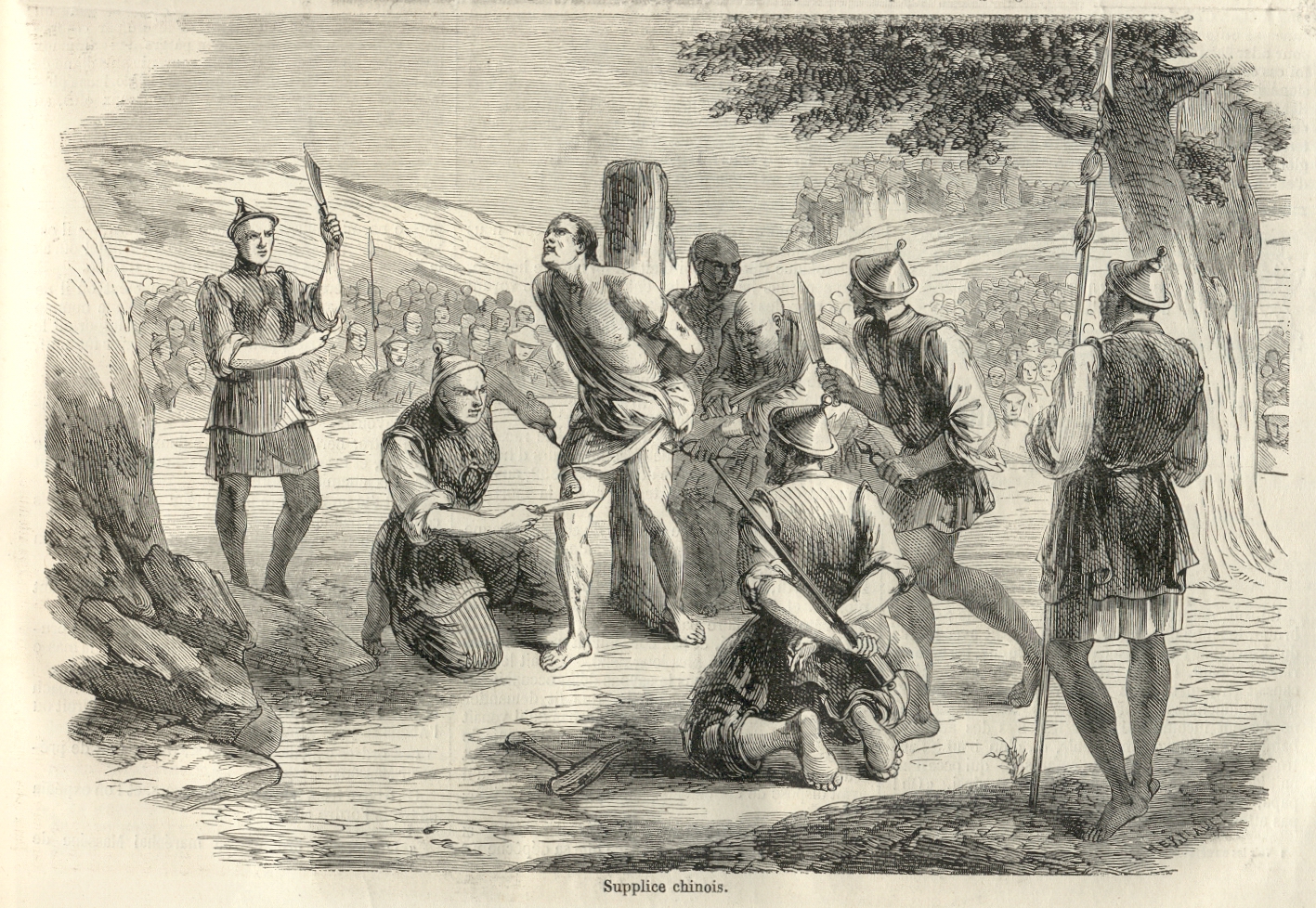
The process involved tying the condemned prisoner to a wooden frame, usually in a public place. The flesh was then cut from the body in multiple slices in a process that was not specified in detail in Chinese law, and therefore most likely varied. The punishment worked on three levels: as a form of public humiliation, as a slow and lingering death, and as a punishment after death.[citation needed]
According to the Confucian principle of filial piety, to alter one's body or to cut the body are considered unfilial practices. Lingchi therefore contravenes the demands of filial piety.[citation needed] In addition, to be cut to pieces meant that the body of the victim would not be "whole" in spiritual life after death. This method of execution became a fixture in the image of China among some Westerners.[citation needed]
Lingchi could be used for the torture and execution of a person, or applied as an act of humiliation after death. It was meted out for major offences such as high treason, mass murder, patricide/matricide, or the murder of one's master or employer. (English: petty treason) However, emperors used it to threaten people and sometimes ordered it for minor offences or for family members of their enemies.
While it is difficult to obtain accurate details of how the executions took place, they generally consisted of cuts to the arms, legs, and chest, leading to amputation of limbs, followed by decapitation or a stab to the heart. If the crime was less serious or the executioner merciful, the first cut would be to the throat causing death; subsequent cuts served solely to dismember the corpse.
Art historian James Elkins argues that extant photos of the execution clearly show that the "death by division" (as it was termed by German criminologist Robert Heindl) involved some degree of dismemberment while the subject was living. Elkins also argues that, contrary to the apocryphal version of "death by a thousand cuts", the actual process could not have lasted long. The condemned individual is not likely to have remained conscious and aware (even if still alive) after one or two severe wounds, so the entire process could not have included more than a "few dozen" wounds.
In the Yuan dynasty, 100 cuts were inflicted but by the Ming dynasty there were records of 3,000 incisions. It is described as a fast process lasting no longer than 4 or 5 minutes. The coup de grâce was all the more certain when the family could afford a bribe to have a stab to the heart inflicted first. Some emperors ordered three days of cutting while others may have ordered specific tortures before the execution, or a longer execution. For example, records showed that during Yuan Chonghuan's execution, Yuan was heard shouting for half a day before his death.
Hub AI
Lingchi AI simulator
(@Lingchi_simulator)
Lingchi
Lingchi (IPA: [lǐŋ.ʈʂʰɨ̌], Chinese: 凌遲), usually translated "slow slicing" or "death by a thousand cuts", was a form of torture and execution used in China from roughly 900 until it was banned in 1905. It was also used in Vietnam and Korea. In this form of execution, a knife was used to methodically remove portions of the body over an extended period of time, eventually resulting in death. Lingchi was reserved for crimes viewed as especially heinous, such as treason. Even after the practice was outlawed, the concept itself has still appeared across many types of media.[citation needed]
The word was used to describe the prolonging of a person's agony when the person is being killed. One theory suggests that it grew to be a specific torture technique. An alternative theory suggests that the term originated from the Khitan language, as the penal meaning of the word emerged during the Khitan Liao dynasty.
The process involved tying the condemned prisoner to a wooden frame, usually in a public place. The flesh was then cut from the body in multiple slices in a process that was not specified in detail in Chinese law, and therefore most likely varied. The punishment worked on three levels: as a form of public humiliation, as a slow and lingering death, and as a punishment after death.[citation needed]
According to the Confucian principle of filial piety, to alter one's body or to cut the body are considered unfilial practices. Lingchi therefore contravenes the demands of filial piety.[citation needed] In addition, to be cut to pieces meant that the body of the victim would not be "whole" in spiritual life after death. This method of execution became a fixture in the image of China among some Westerners.[citation needed]
Lingchi could be used for the torture and execution of a person, or applied as an act of humiliation after death. It was meted out for major offences such as high treason, mass murder, patricide/matricide, or the murder of one's master or employer. (English: petty treason) However, emperors used it to threaten people and sometimes ordered it for minor offences or for family members of their enemies.
While it is difficult to obtain accurate details of how the executions took place, they generally consisted of cuts to the arms, legs, and chest, leading to amputation of limbs, followed by decapitation or a stab to the heart. If the crime was less serious or the executioner merciful, the first cut would be to the throat causing death; subsequent cuts served solely to dismember the corpse.
Art historian James Elkins argues that extant photos of the execution clearly show that the "death by division" (as it was termed by German criminologist Robert Heindl) involved some degree of dismemberment while the subject was living. Elkins also argues that, contrary to the apocryphal version of "death by a thousand cuts", the actual process could not have lasted long. The condemned individual is not likely to have remained conscious and aware (even if still alive) after one or two severe wounds, so the entire process could not have included more than a "few dozen" wounds.
In the Yuan dynasty, 100 cuts were inflicted but by the Ming dynasty there were records of 3,000 incisions. It is described as a fast process lasting no longer than 4 or 5 minutes. The coup de grâce was all the more certain when the family could afford a bribe to have a stab to the heart inflicted first. Some emperors ordered three days of cutting while others may have ordered specific tortures before the execution, or a longer execution. For example, records showed that during Yuan Chonghuan's execution, Yuan was heard shouting for half a day before his death.
Recent media