Hubbry Logo
MonoglycerideMonoglycerideMain
Open search
Monoglyceride
Community hub
Monoglyceride
logo
8 pages, 0 posts
0 subscribers
Be the first to start a discussion here.
Monoglyceride
Monoglyceride
from Wikipedia
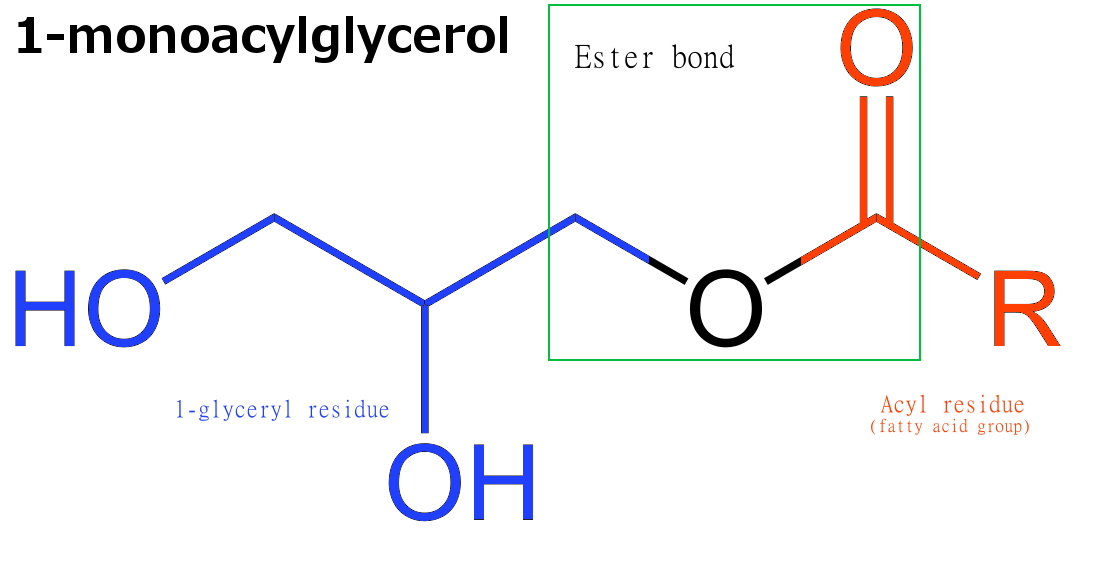
Molecular structure of 1-monoacylglycerol
Molecular structure of 2-monoacylglycerol

Monoglycerides (also: acylglycerols or monoacylglycerols) are a class of glycerides which are composed of a molecule of glycerol linked to a fatty acid via an ester bond.[1] As glycerol contains both primary and secondary alcohol groups two different types of monoglycerides may be formed; 1-monoacylglycerols where the fatty acid is attached to a primary alcohol, or a 2-monoacylglycerols where the fatty acid is attached to the secondary alcohol.

Synthesis

[edit]

Monoglycerides are produced both biologically and industrially. They are naturally present at very low levels (0.1-0.2%) in some seed oils such as olive oil, rapeseed oil and cottonseed oil.[2] They are biosynthesized by the enzymatic hydrolysis of triglycerides by lipoprotein lipase and the enzymatic hydrolysis of diglycerides by diacylglycerol lipase; or as an intermediate in the alkanoylation of glycerol to form fats. Several monoglycerides are pharmacologically active (e.g. 2-oleoylglycerol, 2-arachidonoylglycerol[3]).

Industrial production is primarily achieved by a glycerolysis reaction between triglycerides and glycerol.[4] The commercial raw materials for the production of monoacylglycerols may be either vegetable oils or animal fats.

Uses

[edit]

Monoglycerides are primarily used as surfactants, usually in the form of emulsifiers. Together with diglycerides, monoglycerides are commonly added to commercial food products in small quantities as "E471" (s.a. Mono- and diglycerides of fatty acids), which helps to prevent mixtures of oils and water from separating. They are also often found in bakery products, beverages, ice cream, chewing gum, shortening, whipped toppings, margarine, spreads, and peanut butter,[5] and confections.[6] In bakery products, monoglycerides are useful in improving loaf volume and texture, and as antistaling agents.[7][8] Monoglycerides are used to enhance the physical stability towards creaming in milk beverages.[9]

Examples

[edit]

See also

[edit]

References

[edit]
Revisions and contributorsEdit on WikipediaRead on Wikipedia
from Grokipedia
Monoglycerides, also known as monoacylglycerols, are a class of formed by the esterification of one molecule of with one , resulting in an amphiphilic structure with a hydrophilic head and a hydrophobic tail. These compounds are naturally present in trace amounts in animal and fats but are primarily produced industrially through glycerolysis, a reaction involving fats or oils and at elevated temperatures (typically 220–240°C) with catalysts such as or .

Chemical Structure and Properties

Monoglycerides consist of a glycerol molecule esterified with one fatty acid chain at one of its three hydroxyl groups, yielding variants such as 1-monostearin or 2-monoolein based on the position and fatty acid (e.g., stearic or oleic acid, commonly derived from sources like soybean, palm, or sunflower oil). The molecular formula varies depending on the fatty acid length, for example C₂₁H₄₂O₄ for glyceryl monostearate. Key properties include their surfactant nature, enabling them to reduce surface tension and form stable emulsions, as well as thermal stability and varying solubility depending on the fatty acid chain length—shorter chains enhance water solubility, while longer ones improve oil compatibility. Monoglycerides exhibit polymorphic behavior in solid form, transitioning between alpha, beta, and beta-prime crystal structures that influence their functionality in applications, and they possess mild antimicrobial effects in certain formulations due to disruption of microbial cell membranes.

Production Methods

Industrial production predominantly employs direct glycerolysis of triglycerides from edible oils, where reacts with the fats under high temperature and catalytic conditions to yield a of monoglycerides (typically 40–60% purity), diglycerides, and residual triglycerides; or molecular refines this to higher monoglyceride content (up to 90–99%) for specialized uses. Alternative methods include esterification of fatty acids with or alcoholysis of methyl esters, often optimized for specific fatty acid profiles to meet regulatory standards like those set by the U.S. (FDA) for (GRAS) status. Sources are usually vegetable-based to align with kosher, , and vegan preferences, though animal-derived options exist.

Applications and Uses

Monoglycerides are widely utilized as emulsifiers, stabilizers, and dough conditioners in the , comprising up to 0.5–1% of formulations in products like , , , and to improve texture, volume, and by promoting dispersion and aeration. Beyond , they function as surface-active agents in pharmaceuticals for systems, in for cream stabilization, and in industrial applications such as resins and composites where their flexibility and properties enhance material performance. In nutrition, particularly , monoglycerides demonstrate growth-promoting and benefits by supporting gut health and reducing reliance on antibiotics. Their safety is affirmed by regulatory bodies, with no significant adverse effects at approved levels, though purity and sourcing impact efficacy and considerations.

Definition and Structure

Chemical Composition

Monoglycerides are a class of formed by the esterification of one of , a trihydric alcohol with the molecular C₃H₈O₃, and one of , resulting in the replacement of one hydroxyl group on with an linkage. This esterification process involves the reaction between the carboxyl group (-COOH) of the and one of the hydroxyl groups (-OH) of , with the elimination of a to form the bond (-COO-). The core structure consists of a backbone, represented as CH₂OH-CHOH-CH₂OH, where one -OH group is substituted by -O-CO-R, and R denotes the alkyl chain derived from the . This yields a general formula of C₃H₅(OH)₂(OOCR), where the position of esterification can be at the 1- or 2-carbon of glycerol. Common examples include saturated chains such as stearoyl (-CO-C₁₇H₃₅) in or unsaturated chains like oleoyl (-CO-C₁₇H₃₃) in glycerol monooleate. In contrast to diglycerides, which feature two fatty acid chains esterified to glycerol, and triglycerides with three, monoglycerides possess only a single such chain, conferring distinct chemical behaviors. The molecular weight of monoglycerides typically ranges from 200 to 400 g/mol, varying with the and saturation of the chain; for instance, (C₁₂ chain) has a molecular weight of approximately 274 g/mol, while monostearin (C₁₈ chain) is about 358 g/mol.

Nomenclature and Isomers

Monoglycerides, also known as monoacylglycerols, are systematically named according to IUPAC recommendations as mono-O-acylglycerols, where the acyl group specifies the fatty acid chain attached to the glycerol backbone. For instance, the compound with stearic acid at the 1-position is named 2,3-dihydroxypropyl octadecanoate, while the 2-position isomer with oleic acid is 1,3-dihydroxypropan-2-yl (9Z)-octadec-9-enoate. These names reflect the ester linkage between glycerol and the carboxylic acid, emphasizing the position of acylation. Positional isomerism arises from the three hydroxyl groups on , leading to two distinct types of monoacylglycerols: 1-monoacylglycerols, where the is esterified at one of the primary carbon atoms (sn-1 or sn-3 positions), and 2-monoacylglycerols, where it is at the secondary carbon (sn-2 position). The sn-1 and sn-3 positions are chemically equivalent in symmetric but distinguished in chiral derivatives; the 1(3)-s are often termed α-monoacylglycerols, while the sn-2 is β-monoacylglycerol due to differences in stability and reactivity. The stereospecific numbering (sn-) system, established by biochemical conventions, assigns numbers to carbons based on the with the secondary hydroxyl (sn-2) to the left, ensuring consistent designation of in -based like monoacylglycerols. This system is crucial for specifying isomers, as the sn-1 and sn-3 positions become enantiotopic in prochiral , allowing differentiation in enzymatic contexts. In commercial contexts, monoglycerides are frequently referred to collectively as mono- and diglycerides of fatty acids (E 471), an additive code used in food labeling for mixtures derived from edible fats. A notable example of a bioactive 2-monoacylglycerol is 2-arachidonoylglycerol, which acts as an endocannabinoid.

Occurrence and Biosynthesis

Natural Sources

Monoglycerides occur naturally in low concentrations within various biological materials, primarily as minor constituents of derived from and animals. In seed oils and fats, such as those from , , and , monoglycerides typically constitute less than 0.25% by weight, often appearing as trace impurities alongside dominant triglycerides. For instance, in virgin , monoacylglycerols (MAGs) are present at levels below 0.25%, reflecting their incidental formation during or partial in the . Similar trace levels, around 0.1-0.5%, have been reported in other oils like palm mesocarp oil droplets, where monoglycerides form a small fraction of neutral . In animal tissues, monoglycerides are found in even smaller quantities, primarily as transient intermediates in lipid metabolism within adipose fat. Human adipose tissue contains monoacylglycerols at concentrations of 0.10–0.55 μmol per gram of neutral lipid, underscoring their role as minor, short-lived species during triglyceride hydrolysis and resynthesis. These low levels highlight monoglycerides' limited steady-state presence in vivo, where they serve more as metabolic byproducts than stable structural components. Due to these inherently low natural abundances—often below 1% in unprocessed fats and oils—direct extraction of monoglycerides from biological sources is not commercially viable, as yields remain insufficient to meet industrial demands, favoring synthetic production methods instead.

Biological Synthesis

In biological systems, monoglycerides are primarily synthesized through the sequential enzymatic of triglycerides, first to diacylglycerols and then to monoacylglycerols, mediated by lipases that facilitate and . This process is essential for breaking down complex into absorbable forms and for generating signaling molecules. A key example occurs during intestinal , where pancreatic hydrolyzes dietary triglycerides in the to produce 2-monoacylglycerols and free fatty acids, enabling their absorption into enterocytes. This regiospecific preferentially cleaves the sn-1 and sn-3 positions of triglycerides, yielding the 2-monoacylglycerol as the primary product. Lipoprotein lipase, expressed on endothelial cells, similarly contributes to monoglyceride formation by hydrolyzing triglycerides in circulating lipoproteins such as chylomicrons and very low-density lipoproteins (VLDL), releasing fatty acids and 2-monoacylglycerols for uptake by peripheral tissues. In the , diacylglycerol lipase (primarily the α isoform) synthesizes specific monoglycerides by cleaving diacylglycerols derived from activation of phospholipids, producing bioactive (2-AG). This enzyme is crucial for on-demand generation of 2-AG, which acts as an endogenous signaling molecule regulating synaptic transmission and . Monoacylglycerol lipase, while primarily involved in the degradation of monoglycerides to and free fatty acids, completes the hydrolysis cycle in , including the breakdown of monoglycerides generated from lipoprotein degradation. This enzymatic interplay ensures efficient turnover and across physiological contexts.

Production Methods

Industrial Synthesis

Industrial monoglycerides are primarily produced through the glycerolysis reaction, in which triglycerides derived from fats or oils are heated with excess to form a containing monoglycerides, diglycerides, and residual triglycerides. This process typically occurs at temperatures between 200°C and 250°C under an inert atmosphere, such as , to prevent oxidation, and is catalyzed by inorganic alkaline agents like (NaOH) at concentrations of 0.1-0.5%. The reaction can be represented in a simplified form as: Triglyceride+2Glycerol3Monoglyceride\text{Triglyceride} + 2 \text{Glycerol} \rightarrow 3 \text{Monoglyceride} However, actual industrial yields result in 35-60% monoglycerides, with the balance comprising 35-50% diglycerides, 1-20% triglycerides, and minor amounts of free fatty acids and glycerol. Common feedstocks for the triglycerides include vegetable oils such as soybean, palm, canola, sunflower, cottonseed, and coconut oils, as well as animal fats like tallow or lard. Historically, production in the 1930s and 1940s relied heavily on animal fats, but a shift to vegetable oils occurred post-1940s to meet growing demands for kosher and halal compliance in food applications, enabling broader market acceptance. This transition was facilitated by the availability of abundant plant-based sources and advances in refining techniques. Following the reaction, the crude mixture undergoes purification to isolate high-purity monoglycerides, primarily through molecular under high (around 10^{-4} mmHg) at elevated temperatures (180-220°C), which separates monoglycerides from diglycerides, free , and other impurities, achieving purities exceeding 90%. An enzymatic variant using lipases as catalysts allows for milder conditions (around 40-60°C) but is less common in large-scale operations due to higher costs.

Laboratory Preparation

Laboratory preparation of monoglycerides typically involves small-scale reactions designed to achieve high purity and for research purposes, such as isolating specific sn-1 or sn-2 isomers. One common chemical approach is direct esterification of protected derivatives with chlorides or anhydrides in the presence of a base like to neutralize the HCl byproduct and facilitate at targeted positions. For instance, to synthesize 1-monoglycerides (sn-1 isomers), 1,2-isopropylidene (a protected form where the sn-2 and one primary hydroxyl are blocked as an ) is reacted with a chloride, such as stearoyl chloride, in anhydrous chloroform with at for about 24 hours, using a 20% excess of the protected to maximize conversion. The reaction mixture is then quenched, and the protecting group is removed under mild acidic conditions, such as with , to yield the pure 1-monoglyceride without significant . Yields for this method typically range from 70-90% for pure isomers, depending on the chain length and reaction . To target the sn-2 position, analogous protection strategies employ 1,3-benzylidene , where the two primary hydroxyl groups are temporarily blocked, allowing selective at the secondary sn-2 hydroxyl with a chloride or anhydride under similar pyridine-catalyzed conditions in at . Deprotection follows via hydrogenolysis or mild to isolate the 2-monoglyceride . These protection-deprotection sequences ensure , as unprotected would lead to mixtures of mono-, di-, and triglycerides due to the three reactive hydroxyls. Analytical verification of purity and composition is achieved through techniques like nuclear magnetic resonance (NMR) spectroscopy to confirm acyl position and high-performance liquid chromatography (HPLC) or thin-layer chromatography (TLC) for separation and quantification. Such methods contrast with industrial glycerolysis, which produces mixed isomers on a larger scale but lacks the precision for pure compound isolation. Enzymatic synthesis offers a milder, more regioselective alternative for laboratory-scale production, utilizing lipases such as those from Candida antarctica (CalA or CalB) to catalyze in organic solvents. CalA exhibits preference for the sn-2 position, enabling direct esterification of with s like polyunsaturated s (e.g., EPA or DHA) in solvents such as n-hexane or acetone at 50°C, with molecular sieves to remove and drive equilibrium toward product formation; yields up to 96% for sn-2 monoglycerides have been reported in lab settings. Conversely, CalB (immobilized as Novozym 435) favors sn-1,3 positions and is used for regioselective in tert-butanol or solvent-free systems at 40-60°C, achieving 80-90% yields for sn-1 monoglycerides like glyceryl monostearate from and . These biocatalytic processes minimize side products and operate under ambient conditions, with product purity confirmed via gas chromatography-mass spectrometry (GC-MS) and NMR. Yield optimization often involves adjusting enzyme loading (5-20% w/w), substrate ratios (: 1:3), and reaction times (24-48 hours) to reach 70-90% conversions for pure isomers.

Physical and Chemical Properties

Solubility and Stability

Monoglycerides typically exist as waxy solids or viscous liquids at , with their physical state influenced by the chain length and degree of saturation of the constituent . Saturated monoglycerides, such as those derived from , tend to form more rigid, solid structures, while unsaturated variants are often more fluid. Their points generally range from 35°C to 70°C, varying with fatty acid saturation; for instance, melts at approximately 54–64°C. Monoglycerides exhibit poor in due to their predominantly lipophilic , despite their amphiphilic , forming stable hydrated dispersions only under specific conditions. They are highly soluble in , , , and oils, and dispersible in hot . The (HLB) values of monoglycerides typically fall between 3.5 and 6, indicating suitability for water-in-oil emulsions. Monoglycerides are prone to hydrolysis in acidic or alkaline environments and under high , leading to the breakdown into free fatty acids and . Oxidative stability is higher in saturated monoglycerides compared to unsaturated ones, as the latter's double bonds are more susceptible to peroxidation. Thermally, monoglycerides decompose above 200°C, and in emulsions, they undergo phase transitions such as from lamellar to isotropic states during heating or cooling.

Emulsifying Characteristics

Monoglycerides exhibit amphiphilic properties due to their molecular structure, featuring a hydrophilic head group esterified to a hydrophobic chain. This dual nature enables them to adsorb at the oil-water interface, significantly reducing interfacial tension and facilitating the formation of emulsions by bridging immiscible phases. The (CMC) of monoglycerides varies with chain length; for medium-chain variants like glycerol monolaurate, it is approximately 6 × 10^{-5} , depending on . Above the CMC, these molecules self-assemble into micelles or lamellar phases, which further stabilize emulsions by encapsulating oil droplets and preventing . characteristics influence the effective CMC in aqueous systems. Monoglycerides can stabilize both oil-in-water (O/W) and water-in-oil (W/O) emulsions, with their efficacy determined by the (HLB) value, typically around 3-4 for common variants like monooleate. Low HLB values make them particularly suitable for W/O emulsions, such as those in , while blends allow use in O/W systems like formulations. They inhibit droplet coalescence through steric hindrance from the adsorbed layer and potential electrostatic repulsion, enhancing long-term integrity. In terms of rheological effects, monoglycerides increase by forming structured networks at the interface and within the continuous phase, particularly at concentrations exceeding 2-5 wt%. At these levels, they promote gelation, resulting in semi-solid emulsions with improved shear resistance and textural stability.

Applications

Monoglycerides, often used in combination with diglycerides as the E471, serve primarily as emulsifiers and stabilizers in various food products at concentrations typically ranging from 0.1% to 1% by weight. In the industry, they are incorporated into formulations to enhance and structure, significantly increasing loaf volume through improved gas retention during proofing and . This effect is attributed to their ability to form complexes with and proteins, promoting a finer crumb texture and overall product . In production, monoglycerides at levels of 0.1-0.3% prevent the formation of large ice crystals by stabilizing the fat-water interface, resulting in a smoother, creamier texture that resists meltdown. Similarly, in and spreads, concentrations of 0.2-1.0% improve spreadability and emulsion stability, ensuring uniform consistency and preventing during storage. These applications leverage the emulsifying characteristics of monoglycerides to achieve homogeneous fat dispersion in complex matrices. As antistaling agents, monoglycerides inhibit retrogradation in by forming helical inclusion complexes with , delaying the firming process and extending under ambient conditions. This mechanism maintains crumb softness and moisture retention, reducing waste in baked goods. Specific formulations, such as mono- and diglycerides derived from soy or palm oils, are employed in at low levels to stabilize texture and prevent oil separation, ensuring a smooth, consistent spread. Beyond direct product enhancement, monoglycerides function as processing aids in food manufacturing, particularly in and whipping operations, where they promote uniform fat dispersion and reduce sticking for efficient production of aerated or textured items like whipped toppings and extruded snacks.

Non-Food Uses

Monoglycerides serve as versatile excipients in pharmaceutical formulations, functioning as lubricants in tablet production to prevent sticking during compression and as emollients in creams for improved penetration. Specifically, glyceryl monostearate is employed in suppositories to control release rates by forming a stable matrix that modulates dissolution in rectal or vaginal environments. These applications leverage the amphiphilic nature of monoglycerides to enhance of poorly soluble drugs in topical and controlled-release systems. In the cosmetics industry, monoglycerides act as emulsifiers in lotions, creams, and shampoos, stabilizing oil-in-water emulsions and providing moisturizing effects through their emollient properties. They are typically incorporated at concentrations of 1-5% to improve product texture, prevent , and enhance stability in rinse-off products like shampoos. For instance, glyceryl stearate contributes to the homogeneity and sensory attributes of formulations by facilitating uniform dispersion of active ingredients. Industrially, monoglycerides function as plasticizers in polymer processing, reducing viscosity and improving flexibility in materials like polyvinyl chloride by enhancing molecular mobility. These roles exploit the compounds' ability to lower interfacial tension in non-aqueous systems, promoting efficient material handling and performance. 2-Arachidonoylglycerol (2-AG), an endogenous monoglyceride, plays a key role in the . Analogs of 2-AG are being investigated in for neurological therapies, including conditions like Parkinson's and Alzheimer's diseases, to modulate endocannabinoid signaling and reduce .

Safety and Regulation

Toxicity and Health Effects

Monoglycerides exhibit low , with oral LD50 values exceeding 20 g/kg body weight in rats for representative compounds such as glyceryl laurate. The U.S. (FDA) has affirmed mono- and diglycerides, including monoglycerides, as (GRAS) for use as direct human food ingredients when employed under current good manufacturing practices. In the body, monoglycerides are hydrolyzed by pancreatic and intestinal lipases into and free fatty acids, which are then readily absorbed in the and metabolized through the same pathways as dietary triglycerides, primarily via β-oxidation in the liver or incorporation into lipoproteins for energy utilization or storage. This metabolic process mirrors that of natural fats, contributing approximately 9 kcal per gram and posing no unique biochemical risks at typical dietary levels. While generally safe, high intake of monoglycerides, as with any , may contribute to overall caloric excess and associated risks such as or if consumed disproportionately. Rare allergic reactions can occur in individuals sensitive to the source materials, such as soy-derived monoglycerides, due to residual proteins triggering immune responses similar to those from soy itself. Long-term animal studies from the through the , including chronic feeding trials in rats and mice, have shown no evidence of carcinogenicity or at dietary levels up to 5% (equivalent to approximately 2,500–5,000 mg/kg body weight per day), with only minor, non-adverse effects like increased liver weight observed at higher doses. These findings, evaluated by bodies such as the (EFSA) and Joint FAO/WHO Expert Committee on Food Additives (JECFA), support the safety of monoglycerides for prolonged exposure in applications.

Regulatory Status

In the , mono- and diglycerides of fatty acids are authorized as the E 471 under Regulation (EC) No 1333/2008, with no numerical (ADI) established due to their lack of safety concern at reported use levels; they are permitted at in most food categories where they serve as emulsifiers. Specifications require a minimum content of 70% mono- and di-esters, along with limits on impurities such as glycidyl esters (≤5 mg/kg) and . In the United States, the (FDA) has affirmed mono- and diglycerides as (GRAS) for direct use in food under 21 CFR 184.1505, based on their historical use in and other applications meeting current good manufacturing practices. This status allows their incorporation without specific quantitative limits, provided they consist primarily of glyceryl mono-, di-, and minor tri-esters derived from edible fats or oils. Internationally, the Commission lists mono- and di-glycerides of fatty acids (INS 471) as acceptable at (GMP) levels in bakery products and many other categories, with maximum limits up to 10,000 mg/kg in fats and oils; vegetable-derived sources are eligible for and kosher certifications when produced without animal fats or non-compliant processing. As of 2025, regulatory updates emphasize , particularly under the EU Deforestation Regulation (EU) 2023/1115, which requires monoglycerides derived from to be sourced from deforestation-free supply chains starting December 30, 2025, to ensure compliance with environmental obligations.

References

Add your contribution
Related Hubs
User Avatar
No comments yet.