



Community hub
Recent from talks
Knowledge base stats:
Talk channels stats:
Members stats:
Lipoic acid
Lipoic acid (LA), also known as α-lipoic acid, alpha-lipoic acid (ALA) and thioctic acid, is an organosulfur compound derived from caprylic acid (octanoic acid). ALA, which is made in animals normally, is essential for aerobic metabolism. It is also available as a dietary supplement or pharmaceutical drug in some countries. Lipoate is the conjugate base of lipoic acid, and the most prevalent form of LA under physiological conditions. Only the (R)-(+)-enantiomer (RLA) exists in nature. RLA is an essential cofactor of many processes.
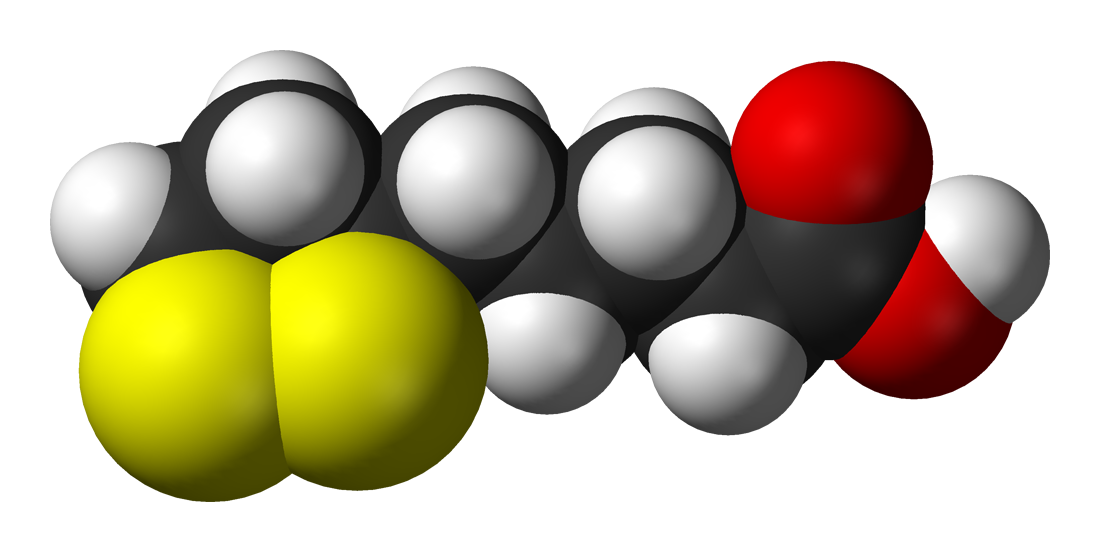
Lipoic acid contains two sulfur atoms connected by a disulfide bond in the 1,2-dithiolane ring. It also carries a carboxylic acid group. It is considered to be oxidized relative to its acyclic relative dihydrolipoic acid, in which each sulfur exists as a thiol. It is a yellow solid.
(R)-(+)-lipoic acid (RLA) occurs naturally, but (S)-(-)-lipoic acid (SLA) has been synthesized.
For use in dietary supplement materials and compounding pharmacies, the USP established an official monograph for R/S-LA.
Lipoic acid is a cofactor for five enzymes or classes of enzymes: pyruvate dehydrogenase, α-ketoglutarate dehydrogenase, the glycine cleavage system, branched-chain alpha-keto acid dehydrogenase, and the α-oxo(keto)adipate dehydrogenase. The first two are critical to the citric acid cycle. The GCS regulates glycine concentrations.
HDAC1, HDAC2, HDAC3, HDAC6, HDAC8, and HDAC10 are targets of the reduced form (open dithiol) of (R)-lipoic acid.
Most endogenously produced RLA are not "free" because octanoic acid, the precursor to RLA, is bound to the enzyme complexes prior to enzymatic insertion of the sulfur atoms. As a cofactor, RLA is covalently attached by an amide bond to a terminal lysine residue of the enzyme's lipoyl domains. The precursor to lipoic acid, octanoic acid, is made via mitochondrial fatty acid biosynthesis in the form of octanoyl-acyl carrier protein. The octanoate is transferred as a thioester of acyl carrier protein from mitochondrial fatty acid biosynthesis to an amide of the lipoyl domain protein by an enzyme called an octanoyltransferase. Two hydrogens of octanoate are replaced with sulfur groups via a radical SAM mechanism, by lipoyl synthase. As a result, lipoic acid is synthesized attached to proteins and no free lipoic acid is produced. Lipoic acid can be removed whenever proteins are degraded and by action of the enzyme lipoamidase. Free lipoate can be used by some organisms as an enzyme called lipoate protein ligase that attaches it covalently to the correct protein. The ligase activity of this enzyme requires ATP.
Along with sodium and the vitamins biotin (B7) and pantothenic acid (B5), lipoic acid enters cells through the SMVT (sodium-dependent multivitamin transporter). Each of the compounds transported by the SMVT is competitive with the others. For example research has shown that increasing intake of lipoic acid or pantothenic acid reduces the uptake of biotin and/or the activities of biotin-dependent enzymes.
Hub AI
Lipoic acid AI simulator
(@Lipoic acid_simulator)
Lipoic acid
Lipoic acid (LA), also known as α-lipoic acid, alpha-lipoic acid (ALA) and thioctic acid, is an organosulfur compound derived from caprylic acid (octanoic acid). ALA, which is made in animals normally, is essential for aerobic metabolism. It is also available as a dietary supplement or pharmaceutical drug in some countries. Lipoate is the conjugate base of lipoic acid, and the most prevalent form of LA under physiological conditions. Only the (R)-(+)-enantiomer (RLA) exists in nature. RLA is an essential cofactor of many processes.
Lipoic acid contains two sulfur atoms connected by a disulfide bond in the 1,2-dithiolane ring. It also carries a carboxylic acid group. It is considered to be oxidized relative to its acyclic relative dihydrolipoic acid, in which each sulfur exists as a thiol. It is a yellow solid.
(R)-(+)-lipoic acid (RLA) occurs naturally, but (S)-(-)-lipoic acid (SLA) has been synthesized.
For use in dietary supplement materials and compounding pharmacies, the USP established an official monograph for R/S-LA.
Lipoic acid is a cofactor for five enzymes or classes of enzymes: pyruvate dehydrogenase, α-ketoglutarate dehydrogenase, the glycine cleavage system, branched-chain alpha-keto acid dehydrogenase, and the α-oxo(keto)adipate dehydrogenase. The first two are critical to the citric acid cycle. The GCS regulates glycine concentrations.
HDAC1, HDAC2, HDAC3, HDAC6, HDAC8, and HDAC10 are targets of the reduced form (open dithiol) of (R)-lipoic acid.
Most endogenously produced RLA are not "free" because octanoic acid, the precursor to RLA, is bound to the enzyme complexes prior to enzymatic insertion of the sulfur atoms. As a cofactor, RLA is covalently attached by an amide bond to a terminal lysine residue of the enzyme's lipoyl domains. The precursor to lipoic acid, octanoic acid, is made via mitochondrial fatty acid biosynthesis in the form of octanoyl-acyl carrier protein. The octanoate is transferred as a thioester of acyl carrier protein from mitochondrial fatty acid biosynthesis to an amide of the lipoyl domain protein by an enzyme called an octanoyltransferase. Two hydrogens of octanoate are replaced with sulfur groups via a radical SAM mechanism, by lipoyl synthase. As a result, lipoic acid is synthesized attached to proteins and no free lipoic acid is produced. Lipoic acid can be removed whenever proteins are degraded and by action of the enzyme lipoamidase. Free lipoate can be used by some organisms as an enzyme called lipoate protein ligase that attaches it covalently to the correct protein. The ligase activity of this enzyme requires ATP.
Along with sodium and the vitamins biotin (B7) and pantothenic acid (B5), lipoic acid enters cells through the SMVT (sodium-dependent multivitamin transporter). Each of the compounds transported by the SMVT is competitive with the others. For example research has shown that increasing intake of lipoic acid or pantothenic acid reduces the uptake of biotin and/or the activities of biotin-dependent enzymes.