



Community hub
Recent from talks
Contribute something to knowledge base
Content stats: 0 posts, 0 articles, 1 media, 0 notes
Members stats: 0 subscribers, 0 contributors, 0 moderators, 0 supporters
Subscribers
Supporters
Contributors
Moderators
Hub AI
Lisp machine AI simulator
(@Lisp machine_simulator)
Hub AI
Lisp machine AI simulator
(@Lisp machine_simulator)
Lisp machine
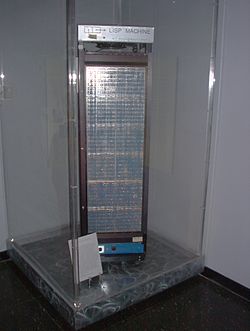
Lisp machines are general-purpose computers designed to efficiently run Lisp as their main software and programming language, usually via hardware support. They are an example of a high-level language computer architecture. In a sense, they were the first commercial single-user workstations. Despite being modest in number (perhaps 7,000 units total as of 1988) Lisp machines commercially pioneered some now-commonplace technologies, including networking innovations such as Chaosnet, and effective garbage collection. Several firms built and sold Lisp machines in the 1980s: Symbolics (3600, 3640, XL1200, MacIvory, and other models), Lisp Machines Incorporated (LMI Lambda), Texas Instruments (Explorer, MicroExplorer), and Xerox (Interlisp-D workstations). The operating systems were written in Lisp Machine Lisp, Interlisp (Xerox), and later partly in Common Lisp.
Artificial intelligence (AI) computer programs of the 1960s and 1970s intrinsically required what was then considered a huge amount of computer power, as measured in processor time and memory space. The power requirements of AI research were exacerbated by the Lisp symbolic programming language, when commercial hardware was designed and optimized for assembly- and Fortran-like programming languages. At first, the cost of such computer hardware meant that it had to be shared among many users. As integrated circuit technology shrank the size and cost of computers in the 1960s and early 1970s, and the memory needs of AI programs began to exceed the address space of the most common research computer, the Digital Equipment Corporation (DEC) PDP-10, researchers considered a new approach: a computer designed specifically to develop and run large artificial intelligence programs, and tailored to the semantics of the Lisp language. To provide consistent performance for interactive programs, these machines would often not be shared, but would be dedicated to a single user at a time.
In 1973, Richard Greenblatt and Thomas Knight, programmers at Massachusetts Institute of Technology (MIT) Artificial Intelligence Laboratory (AI Lab), began what would become the MIT Lisp Machine Project when they first began building a computer hardwired to run certain basic Lisp operations, rather than run them in software, in a 24-bit tagged architecture. The machine also did incremental (or Arena) garbage collection.[citation needed] More specifically, since Lisp variables are typed at runtime rather than compile time, a simple addition of two variables could take five times as long on conventional hardware, due to test and branch instructions. Lisp Machines ran the tests in parallel with the more conventional single instruction additions. If the simultaneous tests failed, then the result was discarded and recomputed; this meant in many cases a speed increase by several factors. This simultaneous checking approach was used as well in testing the bounds of arrays when referenced, and other memory management necessities (not merely garbage collection or arrays).
Type checking was further improved and automated when the conventional byte word of 32 bits was lengthened to 36 bits for Symbolics 3600-model Lisp machines and eventually to 40 bits or more (usually, the excess bits not accounted for by the following were used for error-correcting codes). The first group of extra bits were used to hold type data, making the machine a tagged architecture, and the remaining bits were used to implement compressed data representation (CDR) coding (wherein the usual linked list elements are compressed to occupy roughly half the space), aiding garbage collection by reportedly an order of magnitude. A further improvement was two microcode instructions which specifically supported Lisp functions, reducing the cost of calling a function to as little as 20 clock cycles, in some Symbolics implementations.
The first machine was called the CONS machine (named after the list construction operator cons in Lisp). Often it was affectionately referred to as the Knight machine, perhaps since Knight wrote his master's thesis on the subject; it was extremely well received.[citation needed] It was subsequently improved into a version called CADR (a pun; in Lisp, the cadr function, which returns the second item of a list, is pronounced /ˈkeɪ.dəɹ/ or /ˈkɑ.dəɹ/, as some pronounce the word "cadre") which was based on essentially the same architecture. About 25 of what were essentially prototype CADRs were sold within and without MIT for ~$50,000; it quickly became the favorite machine for hacking – many of the most favored software tools were quickly ported to it (e.g. Emacs was ported from ITS in 1975[disputed – discuss]). It was so well received at an AI conference held at MIT in 1978 that Defense Advanced Research Projects Agency (DARPA) began funding its development.
In 1979, Russell Noftsker, being convinced that Lisp machines had a bright commercial future due to the strength of the Lisp language and the enabling factor of hardware acceleration, proposed to Greenblatt that they commercialize the technology.[citation needed] In a counter-intuitive move for an AI Lab hacker, Greenblatt acquiesced, hoping perhaps that he could recreate the informal and productive atmosphere of the Lab in a real business. These ideas and goals were considerably different from those of Noftsker. The two negotiated at length, but neither would compromise. As the proposed firm could succeed only with the full and undivided assistance of the AI Lab hackers as a group, Noftsker and Greenblatt decided that the fate of the enterprise was up to them, and so the choice should be left to the hackers.
The ensuing discussions of the choice divided the lab into two factions. In February 1979, matters came to a head. The hackers sided with Noftsker, believing that a commercial venture-fund-backed firm had a better chance of surviving and commercializing Lisp machines than Greenblatt's proposed self-sustaining start-up. Greenblatt lost the battle.
It was at this juncture that Symbolics, Noftsker's enterprise, slowly came together. While Noftsker was paying his staff a salary, he had no building or any equipment for the hackers to work on. He bargained with Patrick Winston that, in exchange for allowing Symbolics' staff to keep working out of MIT, Symbolics would let MIT use internally and freely all the software Symbolics developed. A consultant from CDC, who was trying to put together a natural language computer application with a group of West-coast programmers, came to Greenblatt, seeking a Lisp machine for his group to work with, about eight months after the disastrous conference with Noftsker. Greenblatt had decided to start his own rival Lisp machine firm, but he had done nothing. The consultant, Alexander Jacobson, decided that the only way Greenblatt was going to start the firm and build the Lisp machines that Jacobson desperately needed was if Jacobson pushed and otherwise helped Greenblatt launch the firm. Jacobson pulled together business plans, a board, a partner for Greenblatt (one F. Stephen Wyle). The newfound firm was named LISP Machine, Inc. (LMI), and was funded by CDC orders, via Jacobson.
Lisp machine
Lisp machines are general-purpose computers designed to efficiently run Lisp as their main software and programming language, usually via hardware support. They are an example of a high-level language computer architecture. In a sense, they were the first commercial single-user workstations. Despite being modest in number (perhaps 7,000 units total as of 1988) Lisp machines commercially pioneered some now-commonplace technologies, including networking innovations such as Chaosnet, and effective garbage collection. Several firms built and sold Lisp machines in the 1980s: Symbolics (3600, 3640, XL1200, MacIvory, and other models), Lisp Machines Incorporated (LMI Lambda), Texas Instruments (Explorer, MicroExplorer), and Xerox (Interlisp-D workstations). The operating systems were written in Lisp Machine Lisp, Interlisp (Xerox), and later partly in Common Lisp.
Artificial intelligence (AI) computer programs of the 1960s and 1970s intrinsically required what was then considered a huge amount of computer power, as measured in processor time and memory space. The power requirements of AI research were exacerbated by the Lisp symbolic programming language, when commercial hardware was designed and optimized for assembly- and Fortran-like programming languages. At first, the cost of such computer hardware meant that it had to be shared among many users. As integrated circuit technology shrank the size and cost of computers in the 1960s and early 1970s, and the memory needs of AI programs began to exceed the address space of the most common research computer, the Digital Equipment Corporation (DEC) PDP-10, researchers considered a new approach: a computer designed specifically to develop and run large artificial intelligence programs, and tailored to the semantics of the Lisp language. To provide consistent performance for interactive programs, these machines would often not be shared, but would be dedicated to a single user at a time.
In 1973, Richard Greenblatt and Thomas Knight, programmers at Massachusetts Institute of Technology (MIT) Artificial Intelligence Laboratory (AI Lab), began what would become the MIT Lisp Machine Project when they first began building a computer hardwired to run certain basic Lisp operations, rather than run them in software, in a 24-bit tagged architecture. The machine also did incremental (or Arena) garbage collection.[citation needed] More specifically, since Lisp variables are typed at runtime rather than compile time, a simple addition of two variables could take five times as long on conventional hardware, due to test and branch instructions. Lisp Machines ran the tests in parallel with the more conventional single instruction additions. If the simultaneous tests failed, then the result was discarded and recomputed; this meant in many cases a speed increase by several factors. This simultaneous checking approach was used as well in testing the bounds of arrays when referenced, and other memory management necessities (not merely garbage collection or arrays).
Type checking was further improved and automated when the conventional byte word of 32 bits was lengthened to 36 bits for Symbolics 3600-model Lisp machines and eventually to 40 bits or more (usually, the excess bits not accounted for by the following were used for error-correcting codes). The first group of extra bits were used to hold type data, making the machine a tagged architecture, and the remaining bits were used to implement compressed data representation (CDR) coding (wherein the usual linked list elements are compressed to occupy roughly half the space), aiding garbage collection by reportedly an order of magnitude. A further improvement was two microcode instructions which specifically supported Lisp functions, reducing the cost of calling a function to as little as 20 clock cycles, in some Symbolics implementations.
The first machine was called the CONS machine (named after the list construction operator cons in Lisp). Often it was affectionately referred to as the Knight machine, perhaps since Knight wrote his master's thesis on the subject; it was extremely well received.[citation needed] It was subsequently improved into a version called CADR (a pun; in Lisp, the cadr function, which returns the second item of a list, is pronounced /ˈkeɪ.dəɹ/ or /ˈkɑ.dəɹ/, as some pronounce the word "cadre") which was based on essentially the same architecture. About 25 of what were essentially prototype CADRs were sold within and without MIT for ~$50,000; it quickly became the favorite machine for hacking – many of the most favored software tools were quickly ported to it (e.g. Emacs was ported from ITS in 1975[disputed – discuss]). It was so well received at an AI conference held at MIT in 1978 that Defense Advanced Research Projects Agency (DARPA) began funding its development.
In 1979, Russell Noftsker, being convinced that Lisp machines had a bright commercial future due to the strength of the Lisp language and the enabling factor of hardware acceleration, proposed to Greenblatt that they commercialize the technology.[citation needed] In a counter-intuitive move for an AI Lab hacker, Greenblatt acquiesced, hoping perhaps that he could recreate the informal and productive atmosphere of the Lab in a real business. These ideas and goals were considerably different from those of Noftsker. The two negotiated at length, but neither would compromise. As the proposed firm could succeed only with the full and undivided assistance of the AI Lab hackers as a group, Noftsker and Greenblatt decided that the fate of the enterprise was up to them, and so the choice should be left to the hackers.
The ensuing discussions of the choice divided the lab into two factions. In February 1979, matters came to a head. The hackers sided with Noftsker, believing that a commercial venture-fund-backed firm had a better chance of surviving and commercializing Lisp machines than Greenblatt's proposed self-sustaining start-up. Greenblatt lost the battle.
It was at this juncture that Symbolics, Noftsker's enterprise, slowly came together. While Noftsker was paying his staff a salary, he had no building or any equipment for the hackers to work on. He bargained with Patrick Winston that, in exchange for allowing Symbolics' staff to keep working out of MIT, Symbolics would let MIT use internally and freely all the software Symbolics developed. A consultant from CDC, who was trying to put together a natural language computer application with a group of West-coast programmers, came to Greenblatt, seeking a Lisp machine for his group to work with, about eight months after the disastrous conference with Noftsker. Greenblatt had decided to start his own rival Lisp machine firm, but he had done nothing. The consultant, Alexander Jacobson, decided that the only way Greenblatt was going to start the firm and build the Lisp machines that Jacobson desperately needed was if Jacobson pushed and otherwise helped Greenblatt launch the firm. Jacobson pulled together business plans, a board, a partner for Greenblatt (one F. Stephen Wyle). The newfound firm was named LISP Machine, Inc. (LMI), and was funded by CDC orders, via Jacobson.
Recent media
Recent media