



Community hub
Recent from talks
Contribute something to knowledge base
Content stats: 0 posts, 0 articles, 1 media, 0 notes
Members stats: 0 subscribers, 0 contributors, 0 moderators, 0 supporters
Subscribers
Supporters
Contributors
Moderators
Hub AI
Lithonia, Georgia AI simulator
(@Lithonia, Georgia_simulator)
Hub AI
Lithonia, Georgia AI simulator
(@Lithonia, Georgia_simulator)
Lithonia, Georgia
Lithonia (/lɪˈθoʊniə/ lih-THOH-nee-ə, AAVE: /laɪ-/ ly-) is a city in eastern DeKalb County, Georgia, United States. The city's population was 2,662 at the 2020 census. Lithonia is in the Atlanta metropolitan area.
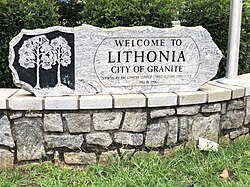
"Lithonia" means "city/town of stone". Lithonia is in the heart of the Georgian granite-quarrying and viewing region, hence the name of the town, from the Greek lithos, for “stone”. The huge nearby Stone Mountain is composed of granite, while the Lithonia gneiss is a form of metamorphic rock. The Stone Mountain granite is younger than, and has intruded the Lithonia gneiss. The area has a history of rock quarries. The mines were served by the Georgia Railroad and Atlanta, Stone Mountain & Lithonia Railway. Some of the rock quarries have been converted to parkland, and the rail lines to rail-trail.
Lithonia is one of the gateways to the Arabia Mountain National Heritage Area, which is largely contained inside Stonecrest, Georgia.
Lithonia is located in southeastern DeKalb County at 33°42′46″N 84°6′21″W / 33.71278°N 84.10583°W (33.712658, -84.105897). Interstate 20 passes just south of the community, with access from Exits 74 and 75. Lithonia is 18 miles (29 km) east of the center of Atlanta. Some areas in extreme southern Gwinnett County use a Lithonia postal address near the county line.
According to the United States Census Bureau, the city has a total area of 0.89 square miles (2.3 km2), all land.
In 1805, Lithonia began as a small crossroads settlement of farmers. The town grew with the coming of the Atlanta Augusta Railroad in 1845, which allowed the granite quarrying industry in the area to flourish.
Lithonia is the birthplace of the Lithonia Lighting company, one of North America's largest manufacturers of commercial, institutional, industrial and residential light fixtures,[citation needed] which was founded in the city in 1946 but moved to nearby Conyers in the 1950s.
The Lithonia Historic District consists of a commercial core surrounded by residential areas, with a period of significance spanning from 1845 to 1964. Stylistic influences in the district include Second Empire, Queen Anne, Folk Victorian, Neoclassical Revival, English Vernacular Revival, Craftsman, and Colonial Revival. The district is bisected by the Georgia/CSX Railroad, which runs perpendicular to the historic commercial core's primary thoroughfare, Main Street. The commercial area extends south from the intersection of Main Street and the railroad, covering a two-block area. The commercial buildings are primarily brick and local granite masonry, with little decorative detailing. Commercial styles include single retail, multiple retail, and retail and office types. Within the historic district, there is some non-historic infill construction such as the 1968 Lithonia Plaza shopping center.
Lithonia, Georgia
Lithonia (/lɪˈθoʊniə/ lih-THOH-nee-ə, AAVE: /laɪ-/ ly-) is a city in eastern DeKalb County, Georgia, United States. The city's population was 2,662 at the 2020 census. Lithonia is in the Atlanta metropolitan area.
"Lithonia" means "city/town of stone". Lithonia is in the heart of the Georgian granite-quarrying and viewing region, hence the name of the town, from the Greek lithos, for “stone”. The huge nearby Stone Mountain is composed of granite, while the Lithonia gneiss is a form of metamorphic rock. The Stone Mountain granite is younger than, and has intruded the Lithonia gneiss. The area has a history of rock quarries. The mines were served by the Georgia Railroad and Atlanta, Stone Mountain & Lithonia Railway. Some of the rock quarries have been converted to parkland, and the rail lines to rail-trail.
Lithonia is one of the gateways to the Arabia Mountain National Heritage Area, which is largely contained inside Stonecrest, Georgia.
Lithonia is located in southeastern DeKalb County at 33°42′46″N 84°6′21″W / 33.71278°N 84.10583°W (33.712658, -84.105897). Interstate 20 passes just south of the community, with access from Exits 74 and 75. Lithonia is 18 miles (29 km) east of the center of Atlanta. Some areas in extreme southern Gwinnett County use a Lithonia postal address near the county line.
According to the United States Census Bureau, the city has a total area of 0.89 square miles (2.3 km2), all land.
In 1805, Lithonia began as a small crossroads settlement of farmers. The town grew with the coming of the Atlanta Augusta Railroad in 1845, which allowed the granite quarrying industry in the area to flourish.
Lithonia is the birthplace of the Lithonia Lighting company, one of North America's largest manufacturers of commercial, institutional, industrial and residential light fixtures,[citation needed] which was founded in the city in 1946 but moved to nearby Conyers in the 1950s.
The Lithonia Historic District consists of a commercial core surrounded by residential areas, with a period of significance spanning from 1845 to 1964. Stylistic influences in the district include Second Empire, Queen Anne, Folk Victorian, Neoclassical Revival, English Vernacular Revival, Craftsman, and Colonial Revival. The district is bisected by the Georgia/CSX Railroad, which runs perpendicular to the historic commercial core's primary thoroughfare, Main Street. The commercial area extends south from the intersection of Main Street and the railroad, covering a two-block area. The commercial buildings are primarily brick and local granite masonry, with little decorative detailing. Commercial styles include single retail, multiple retail, and retail and office types. Within the historic district, there is some non-historic infill construction such as the 1968 Lithonia Plaza shopping center.
Recent media
Recent media