


Community hub
Little Queen
View on Wikipedia
| Little Queen | ||||
|---|---|---|---|---|
 | ||||
| Studio album by | ||||
| Released | May 1977 | |||
| Recorded | February–April 1977 | |||
| Studio | Kaye-Smith, Seattle, Washington | |||
| Genre | ||||
| Length | 39:00 | |||
| Label | Portrait | |||
| Producer | Mike Flicker | |||
| Heart chronology | ||||
| ||||
| Singles from Little Queen | ||||
| ||||
| Review scores | |
|---|---|
| Source | Rating |
| AllMusic |   [1] [1] |
| PopMatters | Mixed[2] |
| Rolling Stone | Mixed[3] |
| The Rolling Stone Album Guide |  [4] [4] |
Little Queen is the third studio album by American rock band Heart, released in May 1977 by Portrait Records. The album was recorded and mixed at Kaye-Smith Studios in Seattle, Washington, from February to April 1977.[5] On June 29, 2004, a remastered version of Little Queen was released by Epic Records and Legacy Recordings with two bonus tracks.[6]
Background
[edit]The group intended Magazine to be the official follow-up to their debut album Dreamboat Annie. However, a contract dispute with their label, Mushroom Records, resulted in the group signing with the newly formed Portrait Records, a division of CBS Records (now Sony BMG).[7]
The Mushroom contract called for two albums, and the label took the position that they were owed a second one. On that basis, Mushroom attempted to prevent the release of Little Queen and any other work by Heart. They took the five unfinished tracks for Magazine and added a B-side and two live recordings. The first release of the album in April 1977 included a disclaimer on the back cover.[7]
The court eventually decided that Heart was free to sign with a new label, but indeed owed Mushroom a second album. Therefore, Heart returned to the studio to re-record, remix, edit, and resequence the Magazine recordings in a marathon session over four days. A court-ordered guard stood nearby to prevent the master tapes from being erased.[8]
Little Queen was released on May 14, 1977, and the reworked version of Magazine was entered Billboard on April 22, 1978.[9] With the successful single "Barracuda", Little Queen outsold Magazine handily, eventually earning a triple platinum certification from the Recording Industry Association of America (RIAA).[10] However, the almost simultaneous 1977 releases also gave the band the distinction of having all three of their albums (Dreamboat Annie, Magazine, and Little Queen) on the charts at the same time.[11]
"Barracuda"
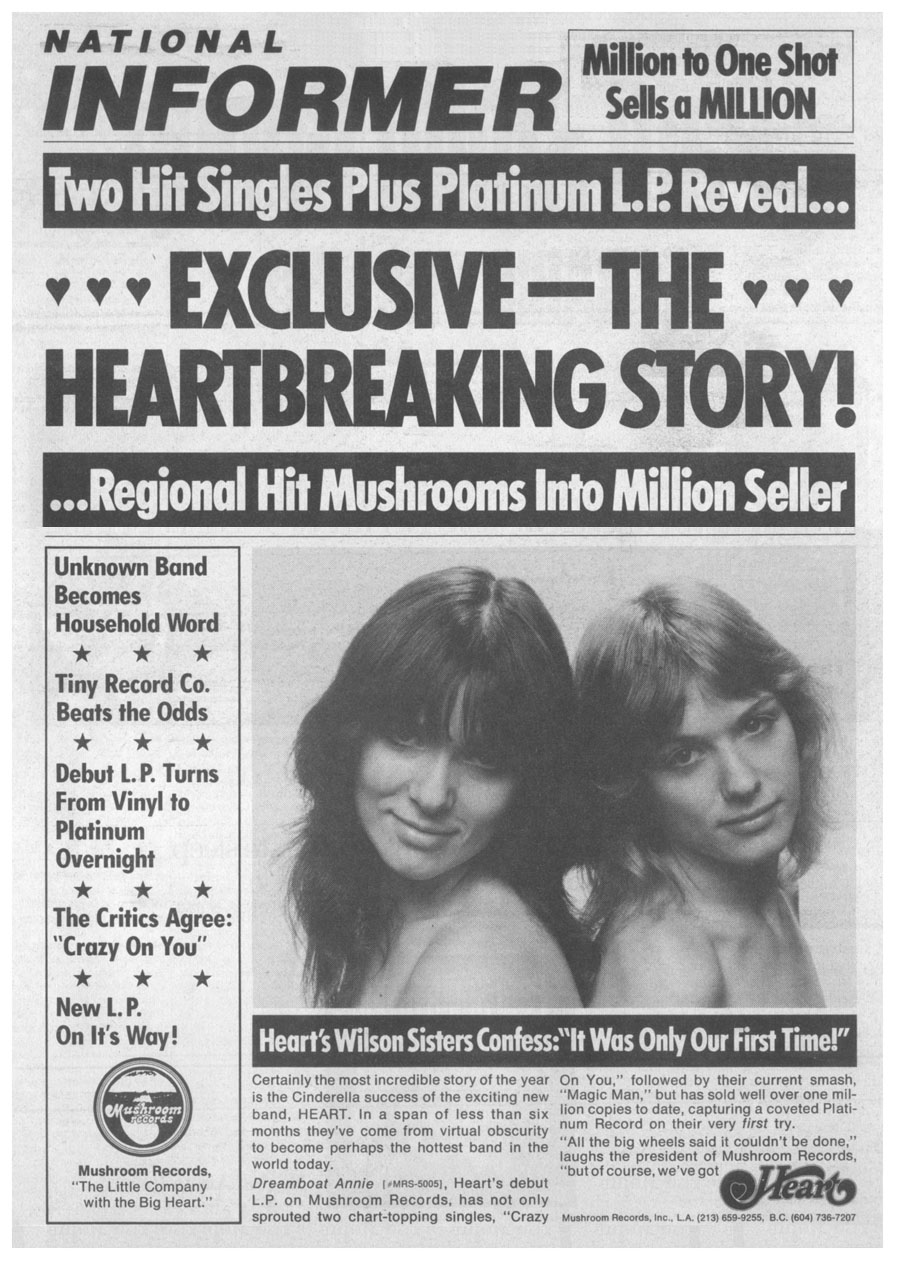
[edit]After Dreamboat Annie became a million seller, Mushroom took out a full-page ad in the December 30, 1976, issue of Rolling Stone magazine touting the band's success, using the headline "Million to One Shot Sells a Million".[12] The ad looked like the front page of the tabloid newspaper National Enquirer and included a photo from the Dreamboat Annie cover shoot. The caption read: "Heart's Wilson Sisters Confess: 'It Was Only Our First Time!'"[13]
After this ad surfaced, a Detroit radio promoter asked Ann Wilson about her lover—referring to Nancy, thus implying that the sisters were incestuous lesbian lovers. Ann was outraged and retreated to her hotel room to write a song. When she relayed the incident to Nancy, she, too, was infuriated. Nancy joined Ann and contributed a melody and bridge.[14] The song became "Barracuda", which entered Billboard Hot 100 on May 28, and peaked at number 11.[15] and remains one of the band's signature songs.
Track listing
[edit]| No. | Title | Writer(s) | Length |
|---|---|---|---|
| 1. | "Barracuda" | 4:20 | |
| 2. | "Love Alive" |
| 4:21 |
| 3. | "Sylvan Song" |
| 2:12 |
| 4. | "Dream of the Archer" |
| 4:30 |
| 5. | "Kick It Out" | A. Wilson | 2:44 |
| No. | Title | Writer(s) | Length |
|---|---|---|---|
| 6. | "Little Queen" |
| 5:10 |
| 7. | "Treat Me Well" | N. Wilson | 3:24 |
| 8. | "Say Hello" |
| 3:36 |
| 9. | "Cry to Me" |
| 2:51 |
| 10. | "Go On Cry" |
| 5:52 |
| No. | Title | Writer(s) | Length |
|---|---|---|---|
| 11. | "Too Long a Time" (early demo version of "Love Alive") |
| 3:30 |
| 12. | "Stairway to Heaven" (live at the Aquarius Tavern, Seattle, WA, 1976) | 9:20 |
Personnel
[edit]Credits adapted from the liner notes of Little Queen.[5]
Heart
[edit]- Ann Wilson – lead vocals (tracks 1, 2, 4–6, 8–10); flute (track 2)
- Nancy Wilson – acoustic guitar (tracks 1, 2, 4, 6–9); autoharp (tracks 2, 4); vocals (tracks 2, 4, 5, 6, 8, 9); mandolin (tracks 3, 4); piano (track 5); electric guitar (tracks 7, 10); blues harp, lead vocals (track 7)
- Roger Fisher – lead guitar (tracks 1, 2, 5, 6, 10); mandolin (tracks 3, 4); electric guitar (tracks 8, 10)
- Howard Leese – lead guitar (track 1); Mellotron (tracks 1, 4); acoustic guitar, piano (track 2); vocals (tracks 2, 4, 6, 8, 10); Moog bass (tracks 3, 4); electric guitar (track 5); guitar (track 6); grand piano, string arrangements, string conducting (track 7); mandolin (track 8)
- Michael DeRosier – drums (tracks 1, 2, 5–8, 10); tabla (track 2); percussion (tracks 4, 8); timpani, chimes (track 10)
- Steve Fossen – bass (tracks 1, 2, 5–8, 10)
Additional musicians
[edit]- Lynn Wilson Keagle – vocals (tracks 9, 10)
- Seal Dunnington – vocals (tracks 9, 10)
Technical
[edit]- Mike Flicker – production, engineering
- Buzz Richmond – engineering
- Winslow Kutz – engineering
- Mike Fisher – special direction
Artwork
[edit]- Heart – cover concept
- Mike Doud – art direction
- Marilyn Romen – art direction
- John Kehe – design
- Bob Seidemann – photography
Charts
[edit]
Weekly charts[edit]
|
Year-end charts[edit]
|
Certifications
[edit]| Region | Certification | Certified units/sales |
|---|---|---|
| Canada (Music Canada)[28] | 2× Platinum | 200,000^ |
| United States (RIAA)[10] | 3× Platinum | 3,000,000^ |
|
^ Shipments figures based on certification alone. | ||
References
[edit]- ^ Henderson, Alex. "Little Queen – Heart". AllMusic. Retrieved May 23, 2014.
- ^ Horning, Rob (August 9, 2004). "Heart: Little Queen / Dog & Butterfly / Bebe Le Strange [reissue]". PopMatters. Retrieved May 23, 2014.
- ^ Altman, Billy (June 30, 1977). "Heart: Little Queen". Rolling Stone. Archived from the original on June 5, 2008. Retrieved April 21, 2013.
- ^ Coleman, Mark; Berger, Arion (2004). "Heart". In Brackett, Nathan; Hoard, Christian (eds.). The New Rolling Stone Album Guide (4th ed.). New York: Simon & Schuster. p. 372. ISBN 0-7432-0169-8.
- ^ a b Little Queen (liner notes). Heart. Portrait Records. 1977. JR 34799.
{{cite AV media notes}}: CS1 maint: others in cite AV media (notes) (link) - ^ Jurek, Thom. "Little Queen [Expanded Edition] – Heart". AllMusic. Retrieved July 21, 2019.
- ^ a b Wilson, Wilson & Cross 2012, p. 115.
- ^ Wilson, Wilson & Cross 2012, p. 116.
- ^ "Billboard". Billboard.
- ^ a b "American album certifications – Heart – Little Queen". Recording Industry Association of America. October 26, 1994. Retrieved July 21, 2019.
- ^ Wilson, Wilson & Cross 2012, p. 121.
- ^ "Mushroom Records Ad" (JPG). Mushroom Records (Canada). Retrieved May 20, 2014.
- ^ Wilson, Wilson & Cross 2012, p. 113.
- ^ Wilson, Wilson & Cross 2012, pp. 116–118.
- ^ "Heart Chart History (Hot 100)". Billboard. Retrieved July 21, 2019.
- ^ "Little Queen [Expanded Edition] – Heart". AllMusic. Retrieved May 23, 2020.
- ^ Kent 1993, p. 136
- ^ "Top RPM Albums: Image 3690a". RPM. Library and Archives Canada. Retrieved July 21, 2019.
- ^ "Dutchcharts.nl – Heart – Little Queen" (in Dutch). Hung Medien. Retrieved May 26, 2014.
- ^ "Offiziellecharts.de – Heart – Little Queen" (in German). GfK Entertainment charts. Retrieved May 26, 2014.
- ^ Oricon Album Chart Book: Complete Edition 1970–2005 (in Japanese). Roppongi, Tokyo: Oricon Entertainment. 2006. ISBN 4-87131-077-9.
- ^ "Swedishcharts.com – Heart – Little Queen". Hung Medien. Retrieved May 26, 2014.
- ^ "Official Albums Chart on 24/7/1977 – Top 100". Official Charts Company. Retrieved July 21, 2019.
- ^ "Heart Chart History (Billboard 200)". Billboard. Retrieved July 21, 2019.
- ^ Kent 1993, p. 429
- ^ "Top 100 albums of '77". RPM. Vol. 28, no. 14. December 31, 1977. p. 15. ISSN 0315-5994 – via Library and Archives Canada.
- ^ "Billboard 200 Albums – Year-End 1977". Billboard. Archived from the original on July 21, 2019. Retrieved July 21, 2019.
- ^ "Canadian album certifications – Heart – Little Queen". Music Canada. December 1, 1977. Retrieved July 21, 2019.
Bibliography
[edit]- Kent, David (1993). Australian Chart Book 1970–1992 (illustrated ed.). St Ives, N.S.W.: Australian Chart Book. ISBN 0-646-11917-6.
- Wilson, Ann; Wilson, Nancy; Cross, Charles R. (2012). Kicking & Dreaming: A Story of Heart, Soul, and Rock and Roll. New York: It Books. ISBN 978-0-0621-0167-9.
| Studio albums | |
|---|---|
| Live albums | |
| Compilation albums | |
| Singles |
|
| Related articles | |




Little Queen
View on GrokipediaBackground and development
Contract disputes
Heart signed with the independent Canadian label Mushroom Records in 1975 under a two-album contract, which led to the recording and release of their debut album Dreamboat Annie later that year.[9] Following the album's commercial breakthrough, which exceeded one million copies sold, tensions arose over creative control, inadequate promotional support, and unfavorable royalty rates, as Mushroom struggled to capitalize on the band's rising popularity.[9] These issues were exacerbated by Mushroom's exploitative marketing tactics, including a 1977 advertisement that split a photo of sisters Ann and Nancy Wilson to imply an incestuous lesbian relationship, prompting widespread outrage from the band.[5] Disputes escalated in early 1977 when Heart halted sessions for their second album, Magazine, amid ongoing conflicts, prompting the band to seek release from their contract and sign a new deal with Portrait Records, a subsidiary of CBS.[5] In retaliation, Mushroom released an unfinished version of Magazine on April 19, 1977, without the band's approval or cooperation, incorporating rough studio tracks and live recordings; the label included a disclaimer on the sleeve stating it was completed due to a contractual dispute.[10] Heart immediately filed a federal lawsuit in Seattle against Mushroom for breach of contract, unauthorized release, and unpaid royalties, securing a court injunction that recalled approximately 50,000 copies from stores.[11] Mushroom countersued, asserting that Heart still owed them one album under the original agreement.[10] The legal battle imposed significant financial strain on the band, who had received minimal royalties from Dreamboat Annie despite its success, leaving them in dire financial straits and reliant on advances from Portrait to continue working.[12] Ann Wilson publicly criticized Mushroom's practices in interviews, describing the label's actions as exploitative and highlighting the ad's implications as a particularly degrading low point that fueled the band's anger and resolve.[5] "What steamed us the most was that our own record label had put out an ad that implied we were incestuous lesbian lovers," Wilson stated.[5] The ordeal strained internal band dynamics, fostering resentment toward the industry but also unifying the members against external pressures.[9] The disputes were ultimately resolved through a legal settlement later in 1977, which required Heart to deliver a second album to Mushroom while permitting their transition to Portrait; this arrangement allowed Little Queen to proceed under the new label without further interference.[9]Album conception
Following their legal disputes with Mushroom Records, Heart signed with Portrait Records, a subsidiary of CBS, in early 1977 to expedite the release of new material and build on the commercial success of Dreamboat Annie. This move allowed the band to fulfill contractual obligations to Mushroom while pursuing creative independence under a more supportive label, enabling a rapid production timeline amid ongoing litigation.[2][13] The album's conception centered on themes of resilience and personal empowerment, driven by the Wilson sisters' experiences with industry sexism during the Mushroom era. Ann and Nancy Wilson led the songwriting, channeling frustration into anthemic tracks that asserted female strength and autonomy. For instance, "Barracuda" originated from Ann Wilson's outrage over a promoter's sleazy remark asking how her "lover" Nancy was doing, implying an incestuous relationship between the sisters, transforming that humiliation into a fierce declaration of independence.[14][15][16] While primarily composed of fresh compositions tailored for Portrait, Little Queen emphasized empowerment motifs amid the band's battle for control.[2][17]Recording and production
Studio sessions
The recording sessions for Little Queen took place from February to April 1977 at Kaye-Smith Studios in Seattle, Washington, selected for its convenient location near the band's Pacific Northwest base, facilitating frequent and efficient access during production.[18] Under significant legal pressure from a lawsuit filed by their former label Mushroom Records, which sought to block the sessions to enforce a disputed contract, Heart maintained an intensive schedule to fulfill their obligations with Portrait Records and achieve a May 1977 release; the band completed the album in under three months despite the ongoing litigation.[2] The process involved capturing the group's raw live performance dynamics while incorporating studio refinements, such as targeted overdubs on guitar and vocal elements to enhance clarity and depth.[1] Mixing was finalized in April 1977 at the same facility, followed by mastering at Kendun Recorders in Los Angeles to optimize the sound for vinyl release.[19]Production process
Mike Flicker served as the primary producer for Little Queen, building on his previous work with Heart on their debut album Dreamboat Annie to shape the band's sound through careful arrangement and overdubbing.[2] He emphasized layering vocal harmonies, particularly for Ann Wilson's lead vocals and Nancy Wilson's backing contributions, to create a rich, textured depth that enhanced the album's emotional intensity.[20] Flicker also focused on stacking guitar riffs, as heard in tracks like "Barracuda," to add dynamic propulsion while preserving the band's live energy.[2] The engineering team, including Flicker alongside Buzz Richmond and Winslow Kutz, captured the sessions using multi-track analog recording techniques typical of the era, allowing for the isolation and blending of individual performances into a cohesive whole.[21] This approach facilitated the multi-tracking of vocals and instruments, enabling precise refinements to the raw band recordings without losing their organic feel. Howard Leese contributed significantly to the album's orchestration, providing string arrangements for "Say Hello" that incorporated synthesizers and traditional strings to evoke a symphonic quality. His work on this track, using tools like the Solina String Ensemble, added lush layers that complemented the Wilsons' harmonies.[22] In post-production, a 2004 remastered edition was released by Epic Records and Legacy Recordings, featuring the original mixes supervised by Flicker and adding two previously unreleased bonus tracks: "Too Long a Time" and a cover of "I've Got the Music in Me."[21] This version enhanced audio clarity while preserving the analog warmth of the source tapes.[23]Musical style and composition
Overall style
Little Queen is predominantly a hard rock album infused with progressive and folk rock influences, marking an evolution from the softer, more acoustic-driven tones of Heart's debut Dreamboat Annie toward aggressive riffs fueled by the band's internal and external frustrations during its creation.[18][24] This shift is evident in the album's loud, arena-ready sound, which builds on the Wilson sisters' folk sensibilities while embracing heavier, riff-centric structures inspired by contemporaries like Led Zeppelin.[25] Key sonic elements include prominent guitar solos from lead guitarist Roger Fisher and rhythm guitarist Nancy Wilson, which blend Zeppelinesque heaviness with delicate acoustic interludes, creating a dynamic contrast between electric intensity and introspective passages.[25][17] The album maintains thematic consistency around female empowerment and interpersonal relationships, hallmarks of Ann and Nancy Wilson's songwriting partnership, which infuses the tracks with personal resilience and emotional depth.[16][26] Spanning a concise runtime of 39 minutes across 10 tracks, Little Queen balances high-energy anthems with poignant ballads, showcasing Heart's versatility in weaving folk-tinged introspection with hard rock propulsion.[18]Notable tracks
"Barracuda," the album's lead single, opens with a driving rhythm and an iconic descending guitar riff crafted by Nancy Wilson and Roger Fisher, propelling the track's aggressive energy.[17] The song's lyrics, penned primarily by Ann Wilson, serve as a scathing critique of the music industry's exploitative practices, inspired by a promoter's crude rumor suggesting the Wilson sisters were in a romantic relationship.[27] With a runtime of 4:22, "Barracuda" captures themes of anger and resistance against corporate sleaziness, contributing to its enduring status as a hard rock anthem featured in films like Charlie's Angels and TV series such as The Sopranos.[1] It peaked at number 11 on the Billboard Hot 100 chart, underscoring its commercial breakthrough.[28] "Kick It Out" delivers a high-energy rocker characterized by dual guitar leads and a fast tempo, clocking in at 2:52.[1] Written by Ann Wilson, the song embodies themes of personal freedom and defiance, with lyrics depicting a rebellious "tail-shaking filly" breaking loose from constraints, symbolizing empowerment and self-assertion.[29] Its concise structure and infectious drive highlight Heart's prowess in crafting concise, anthemic hard rock, making it a standout for live performances.[24] The title track "Little Queen" shifts to a more introspective ballad format, running 5:15 and incorporating orchestral elements like strings to enhance its emotional layers.[1] Co-written by the Wilson sisters, it explores themes of vulnerability beneath a facade of sophistication, portraying a elusive, queen-like figure who evades commitment despite her allure. Released as the second single, the song's melodic depth and Ann Wilson's soaring vocals exemplify Heart's blend of rock intensity with ballad vulnerability, influencing their reputation for dynamic range.[17] Other notable tracks include "Goody Goody," which stands out for its catchy pop hooks and lighter, upbeat vibe amid the album's harder edges, providing a contrast in accessibility.[30] "Say Hello" offers emotional depth through its poignant lyrics on longing and connection, delivered with raw vocal intensity.[31] Additionally, "Love Alive" appears in reworked versions across releases, with the Little Queen iteration refined from earlier Magazine sessions, showcasing the band's iterative approach to acoustic folk-rock arrangements.[32]Release and promotion
Initial release
Little Queen was released on May 14, 1977, by Portrait Records in the United States, with CBS handling international distribution; the initial formats included vinyl LP and cassette.[2][1][33] The album's cover art depicted the band members in regal, medieval-inspired attire amid a pastoral scene with horses and a gypsy wagon, evoking the "queen" theme central to the record; art direction was provided by Mike Doud and Marilyn Romen, with photography by Bob Seidemann.[34][2] The release occurred amid market confusion stemming from Mushroom Records' unauthorized issuance of the unfinished album Magazine on April 19, 1977, using rough demos and live tracks from Heart's sessions; however, Portrait's stronger distribution network ensured Little Queen received priority placement in stores.[2] Initial sales were supported by Heart's expanding tour schedule, which built momentum from the success of their prior album Dreamboat Annie and allowed the band to perform new material live to growing audiences.[2] The singles rollout commenced soon after launch, with "Barracuda" issued as the lead single in May 1977.[2]Singles and marketing
The lead single from Little Queen, "Barracuda", was released in May 1977 with "Kick It Out" as the B-side, reaching number 11 on the US Billboard Hot 100 and number 2 on the Canadian RPM 100 Singles chart.[35][27] Follow-up single "Little Queen" followed in August 1977, peaking at number 62 on the Billboard Hot 100, while "Kick It Out" was issued in October 1977 and charted at number 79.[6][36] Promotion for the album centered on radio airplay of the singles, television appearances, and extensive touring to build momentum. Heart performed tracks from Little Queen on shows such as The Midnight Special in December 1977, showcasing live renditions of "Barracuda", "Kick It Out", and "Love Alive" alongside a promotional film of the album cover shoot.[37] The band undertook a North American tour in support of the release, performing at major venues to connect with audiences.[38] Portrait Records, a CBS subsidiary, highlighted Heart's status as a pioneering female-fronted rock band in their marketing efforts, positioning the group as empowered figures in a male-dominated genre.[9] Additional tie-ins included featuring Little Queen in CBS's rock catalog promotions and distributing limited-edition posters with the album's iconic cover art to retailers and fans.[39]Critical reception
Contemporary reviews
Upon its release in May 1977, Little Queen received generally positive reviews from music critics, who praised Heart's energetic performances and the standout track "Barracuda." In Rolling Stone, Billy Altman commended the album for advancing women's presence in rock music, noting, "Lord knows we need many more women in rock and roll," while highlighting the band's versatile blend of hard rock and folk elements. Similarly, RPM magazine lauded Ann Wilson's "gutsy chick vocalizing" and the album's upward trajectory following their Juno Award win, spotlighting tracks like "Say Hello" for its favorite status.[26][40] Critics also noted some mixed aspects, particularly regarding production and originality amid the band's rushed recording schedule. Circus magazine's Fred Schruers described "Barracuda" as a powerful rocker with Ann Wilson's commanding vocals evoking Robert Plant, and praised "Kick It Out" for its tidy energy and "nippy" refrain, but critiqued the album's labored arrangements and derivative echoes of Led Zeppelin and Fleetwood Mac, calling it a solid effort that occasionally lacked uniqueness despite the band's touring experience. This perception was influenced by Heart's legal battle with Mushroom Records, which forced the quick production of Little Queen as a strategic release to fulfill contractual obligations and assert independence; reviewers framed it as a "victory album" symbolizing the band's resilience.[41][2] Fan reception was enthusiastic among rock audiences, with the album's blend of aggressive rockers and acoustic ballads fueling word-of-mouth buzz and strong live show support, contributing to its rapid commercial ascent in 1977.[17]Retrospective views
In the decades following its release, Little Queen has been reassessed as a cornerstone of Heart's catalog, often hailed for its blend of hard rock intensity and emotional depth. AllMusic's review of the 2004 expanded edition praises the album as Heart's peak hard rock effort, awarding it 4 out of 5 stars for its raw energy and standout tracks like "Barracuda." Similarly, the 2004 Rolling Stone Album Guide rates it 3 out of 5 stars, commending its overall consistency while noting the band's evolution from their debut.[42] Later publications have highlighted the album's thematic resonance, particularly its feminist undertones amid the male-dominated rock landscape of the 1970s. These views underscore Little Queen's role in advancing women's presence in the genre. The album has earned retrospective acclaim in curated lists, appearing in Uncut's 2023 ranking of the greatest 500 albums of the 1970s as a "proper lost classic" for its innovative sound and commercial impact. In the 2020s, streaming platforms have fueled a revival, with "Barracuda" maintaining strong radio play and garnering millions of streams, evidenced by Heart's high-profile live performances, including a 2024 appearance on The Howard Stern Show.[43] Scholarly examinations further contextualize Little Queen's legacy. In the 2008 book Heart: In the Studio, author Jake Brown discusses the album's production at Kaye-Smith Studios and its pivotal role in women's rock history, portraying Heart as pioneers who broke genre barriers and inspired subsequent female-led bands through their assertive songwriting and performances. This perspective aligns with broader academic narratives on the album's contribution to rock's gender dynamics.[44]Commercial performance
Chart performance
Little Queen achieved significant commercial success upon its release, peaking at number 9 on the US Billboard 200 chart in July 1977.[6] In Canada, the album reached number 2 on the RPM Top Albums chart, reflecting stronger regional appeal bolstered by extensive tour support.[8] Internationally, it performed more modestly, attaining number 34 on the Australian Kent Music Report albums chart, number 25 on the UK Albums Chart, and number 9 on the Dutch Album Top 100.[45] For year-end rankings in 1977, the album placed at number 46 on the US Billboard 200 and number 15 on the Canadian RPM year-end albums chart.[8] The album's lead single, "Barracuda," became Heart's breakthrough hit, peaking at number 11 on the US Billboard Hot 100 and reaching number 1 on the Canadian RPM Top Singles chart.[6] Follow-up singles fared less strongly in the US, with the title track "Little Queen" climbing to number 62 on the Billboard Hot 100 and "Kick It Out" to number 79, though both benefited from the album's momentum in Canada where radio play was more robust.[6]| Chart (1977) | Peak Position |
|---|---|
| US Billboard 200 | 9 |
| Canadian RPM Top Albums | 2 |
| Australian Kent Music Report | 34 |
| UK Albums Chart | 25 |
| Dutch Album Top 100 | 9 |
| Single (1977) | US Billboard Hot 100 | Canadian RPM Top Singles |
|---|---|---|
| "Barracuda" | 11 | 1 |
| "Little Queen" | 62 | - |
| "Kick It Out" | 79 | - |
Sales and certifications
Little Queen has achieved significant commercial success, particularly in North America. In the United States, the album was certified 3× Platinum by the RIAA on October 26, 1994, for shipments of 3,000,000 units.[8] In Canada, it received a 2× Platinum certification from Music Canada (formerly CRIA) for 200,000 units.[46] Globally, Little Queen has sold approximately 3.2 million copies across Canada, Japan, and the United States as of the latest available data.[8] The album's enduring popularity has been bolstered by the 2004 remastered reissue and the rise of digital streaming platforms, with the lead single "Barracuda" accumulating over 1.6 billion streams on Spotify alone as of November 2025.[47] As of 2025, there have been no additional RIAA certifications beyond the 1994 triple platinum award, reflecting stable catalog performance through reissues and streaming equivalents.[48]Credits
Track listing
All songs on Little Queen were written by members of Heart unless otherwise noted.[1] The standard edition of the album contains 10 tracks with a total runtime of 39:19.[18]| No. | Title | Writer(s) | Length |
|---|---|---|---|
| 1 | "Barracuda" | A. Wilson, N. Wilson, Fisher, DeRosier | 4:20 |
| 2 | "Love Alive" | A. Wilson, N. Wilson, Fisher | 4:21 |
| 3 | "Sylvan Song" | N. Wilson, Fisher | 2:12 |
| 4 | "Dream of the Archer" | A. Wilson, N. Wilson, Fisher | 4:30 |
| 5 | "Kick It Out" | A. Wilson | 2:44 |
| 6 | "Little Queen" | A. Wilson, N. Wilson, Fossen, Leese, DeRosier, Fisher | 5:15 |
| 7 | "Treat Me Well" | N. Wilson | 3:25 |
| 8 | "Say Hello" | N. Wilson | 3:35 |
| 9 | "Cry to Me" | A. Wilson, N. Wilson | 2:51 |
| 10 | "Go On Cry" | A. Wilson, N. Wilson, Fisher | 5:52 |
Heart
- Ann Wilson – lead vocals (all tracks except "Say Hello"), flute ("Love Alive"), piano ("Kick It Out"), backing vocals[1]
- Nancy Wilson – acoustic guitar ("Barracuda", "Love Alive", "Dream of the Archer", "Little Queen", "Go On Cry", "Cry to Me"), autoharp ("Love Alive", "Dream of the Archer"), electric guitar ("Go On Cry"), mandolin ("Dream of the Archer", "Go On Cry"), piano ("Kick It Out"), harmonica ("Say Hello"), lead vocals ("Say Hello"), backing vocals[1]
- Roger Fisher – lead guitar ("Barracuda", "Love Alive", "Kick It Out", "Little Queen", "Cry to Me"), mandolin ("Dream of the Archer", "Go On Cry"), acoustic guitar ("Dream of the Archer")[1]
- Steve Fossen – bass guitar (all tracks except "Sylvan Song", "Say Hello")[1]
- Michael DeRosier – drums ("Love Alive", "Go On Cry"), percussion ("Dream of the Archer", "Go On Cry", "Cry to Me"), tabla ("Love Alive"), timpani ("Little Queen")[1]
- Howard Leese – lead guitar ("Barracuda"), mellotron ("Barracuda", "Dream of the Archer"), synthesizer ("Sylvan Song", "Dream of the Archer", "Little Queen"), piano ("Love Alive"), guitar ("Little Queen"), grand piano ("Say Hello"), strings arrangement and conduction ("Say Hello"), mandolin ("Go On Cry"), backing vocals, keyboards[1]
Additional musicians
- Lynn Wilson Keagle – backing vocals ("Go On Cry", "Cry to Me")[50]
- Seal Dunnington – backing vocals ("Go On Cry", "Cry to Me")[50]
Production
- Mike Flicker – producer, engineer[17]
- Buzz Richmond – engineer[51]
- Terry Becker – assistant engineer[1]
- Rolf Hennemann – assistant engineer[1]
Artwork
- Marilyn Romen – art direction[51]
- Mike Doud – art direction[51]
- John Kehe – design[51]
- Heart – design concept[51]